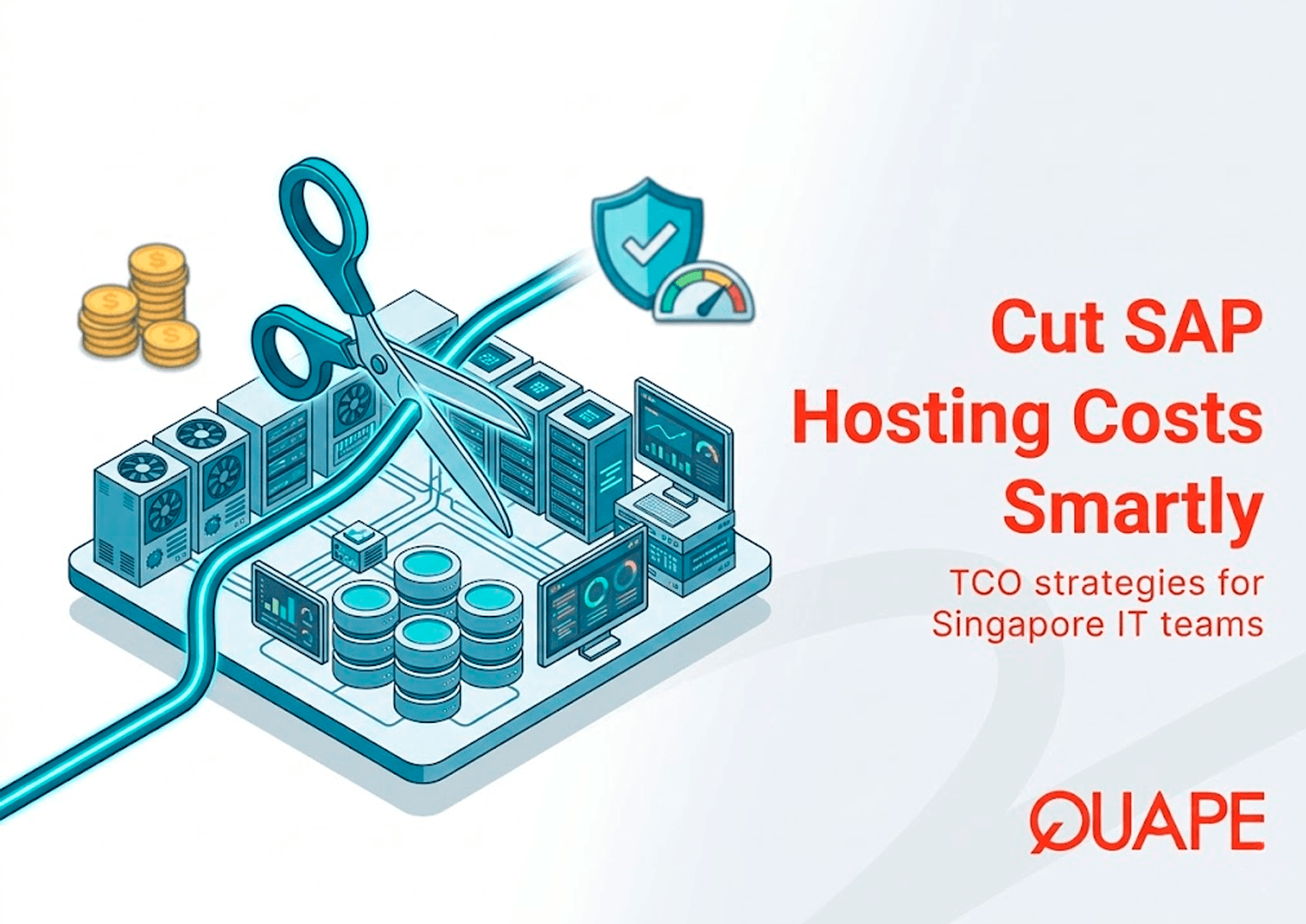
SAP environments carry significant infrastructure weight, and the pressure to reduce IT spending without degrading system performance is one of the most common challenges facing IT leaders in Singapore today. Many organizations make budget decisions based on visible infrastructure pricing alone, which leaves a wide range of indirect costs unaccounted for. Cost optimization in SAP hosting is not simply about choosing a cheaper server or switching cloud providers. It requires a structured understanding of how workload behavior, resource allocation, and operational overhead interact across the full infrastructure lifecycle. Organizations that treat cost reduction as a technical discipline, rather than a procurement exercise, consistently achieve better outcomes.
Introduction to SAP Hosting Cost Optimization
SAP hosting cost optimization refers to the systematic process of reducing the total financial burden of running SAP environments, including SAP HANA, SAP Business One, and SAP S/4HANA, without introducing performance degradation or operational risk. It sits at the intersection of infrastructure architecture, financial planning, and operational governance.
For context on how this topic fits within the broader infrastructure conversation, the SAP hosting infrastructure guide covers the foundational decisions that shape long-term cost structure, from hardware selection to managed service boundaries.
Cost optimization is not a one-time event. It is an ongoing process that responds to changes in workload demand, licensing agreements, vendor pricing, and business growth. The goal is not the lowest possible cost but the best possible cost efficiency relative to performance and reliability requirements.
Poin-Poin Utama
- Total Cost of Ownership (TCO) is the most accurate framework for evaluating SAP infrastructure costs, capturing direct and indirect expenses including downtime, energy, and labor.
- Overprovisioning is a widespread inefficiency: enterprise data centers often operate at utilization rates as low as 20 to 30 percent.
- Virtualization and resource pooling can raise server utilization to 60 to 80 percent, directly reducing hardware requirements.
- Reserved compute planning reduces unpredictable spend, but its effectiveness depends on forecasting accuracy.
- Performance cannot be sacrificed for cost savings in SAP HANA environments. Memory, IOPS, and latency thresholds are non-negotiable for ERP stability.
- Hybrid SAP hosting environments consistently outperform single-environment deployments in cost control and workload flexibility.
- Singapore-based organizations face specific considerations around data sovereignty, latency to regional users, and PDPA compliance that affect infrastructure decisions.
- Managed SAP hosting transfers operational overhead to a provider with established infrastructure, reducing indirect cost exposure.
Key Components of SAP Hosting Cost Optimization
Understanding Total Cost of Ownership (TCO) in SAP Environments
TCO is the most comprehensive framework available for evaluating SAP infrastructure costs because it captures both direct and indirect expenses across the full infrastructure lifecycle. Direct costs include compute, storage, licensing, and networking. Indirect costs, which are frequently underestimated, include downtime losses, maintenance labor, energy consumption, and the administrative overhead of managing compliance and security.
Menurut Gartner, a true TCO model integrates both categories, enabling organizations to identify inefficiencies that would otherwise remain invisible when evaluating infrastructure purely by subscription or hardware pricing. In practice, this means an organization running SAP on a lower-cost public cloud tier may still carry a higher TCO than one running on a well-configured private or managed environment, if the former suffers from frequent performance degradation or unplanned downtime.
For SAP environments specifically, the CAPEX versus OPEX distinction matters significantly. On-premise infrastructure concentrates cost upfront in hardware and licensing, while managed or cloud deployments shift costs toward recurring operational expenditure. Neither model is inherently superior. The optimal structure depends on the organization’s capital flexibility, expected workload growth, and tolerance for variable cost.
Resource Pooling and Infrastructure Efficiency
Resource pooling allows multiple SAP workloads, or other enterprise applications, to share the same underlying physical infrastructure through virtualization or multi-tenant architecture. This reduces idle capacity and lowers the cost per workload without requiring additional hardware.
Menurut OECD, virtualization can raise server utilization rates to 60 to 80 percent. This is a meaningful improvement against the industry baseline: the U.S. Environmental Protection Agency has noted that poor capacity planning frequently results in enterprise data centers operating at utilization rates of only 20 to 30 percent.
For SAP HANA specifically, resource pooling must be implemented carefully. SAP HANA is a memory-intensive, in-memory database, and workload isolation is critical to prevent resource contention. Hybrid SAP hosting environments often offer a practical middle ground, allowing organizations to pool non-critical workloads while dedicating resources to production SAP HANA instances. This structure improves overall utilization without exposing the ERP core to performance risk.
Reserved Compute Planning and Capacity Forecasting
Reserved compute planning is the practice of pre-allocating infrastructure capacity based on anticipated workload demand. In managed or cloud-based SAP environments, reserved instances typically carry lower unit costs than on-demand provisioning, making accurate forecasting a direct cost lever.
The challenge is precision. Overestimating future demand results in paying for unused capacity. Underestimating results in performance bottlenecks at critical business periods, such as month-end closes, inventory runs, or reporting cycles. SAP sizing methodologies help establish baseline compute and memory requirements, but they must be combined with historical usage data and growth projections to be effective.
Organizations preparing for SAP S/4HANA migrations will find that infrastructure readiness planning directly informs reserved compute decisions, particularly in environments where workload behavior is expected to change significantly post-migration.
Performance vs Cost Trade-Off in SAP Hosting
Performance and cost reduction are not automatically in conflict in SAP hosting, but they create genuine tension when optimization is pursued without architectural awareness. SAP HANA’s performance depends on three primary factors: memory throughput, IOPS (input/output operations per second), and network latency. Reducing infrastructure spend in any of these areas can produce measurable degradation in ERP responsiveness.
Latency management is particularly significant for real-time ERP processes, including inventory lookups, financial postings, and approval workflows. Infrastructure placed farther from end users or business operations increases response times in ways that compound across high-frequency transactions.
At the same time, high availability configurations introduce redundant infrastructure that increases cost but reduces downtime risk. Gartner estimates that enterprise IT downtime can exceed USD 5,600 per minute depending on business size and sector. For SAP environments supporting finance, procurement, or supply chain operations, the cost of unplanned downtime frequently exceeds the cost of maintaining redundancy. Framing high availability as a cost decision rather than a performance decision produces more accurate financial planning.
Comparing Cloud, On-Premise, and Hybrid Cost Structures
Public cloud, private cloud, on-premise infrastructure, and hybrid models each produce different cost structures, and none is universally superior for SAP workloads. Public cloud pricing is variable and can offer cost efficiency at scale, but unpredictable consumption patterns introduce budget risk. On-premise infrastructure provides cost stability and control but concentrates capital expenditure and places the operational burden on internal teams.
Hybrid SAP hosting has emerged as a preferred model for many mid-market enterprises because it allows organizations to allocate workloads based on criticality. Production SAP HANA databases remain on dedicated, performance-optimized infrastructure, while development, testing, or archiving workloads are deployed on shared or lower-cost resources. A comparison of SAP hosting versus on-premise infrastructure clarifies the specific cost and operational differences that inform this decision.
IDC research has found that enterprises adopting hybrid cloud strategies consistently report improved cost control and workload flexibility compared to single-environment deployments, a pattern observable across industries with complex ERP requirements.
Practical Application for the Singapore Market
Singapore presents a distinct set of infrastructure considerations that shape SAP hosting cost decisions. Data sovereignty requirements under the Personal Data Protection Act (PDPA) restrict certain data residency options, effectively narrowing the range of viable hosting configurations for organizations handling personal data of Singapore residents. Compliance with PDPA and relevant sector-specific regulations adds an indirect cost layer that must be factored into the TCO model.
Latency to regional users across Southeast Asia also influences infrastructure placement decisions. Singapore data center locations benefit from established connectivity to major APAC markets, which supports ERP responsiveness for organizations with regional operations. However, concentrating infrastructure in Singapore to meet SAP hosting compliance requirements may increase per-unit cost compared to configurations distributed across lower-cost regional data centers.
For Singapore-based IT teams evaluating SAP hosting options, the practical priority is identifying which cost components are fixed by regulatory or performance requirements and which are genuinely flexible. This separation prevents optimization efforts from targeting the wrong cost layers.
How Managed SAP Hosting Supports SAP Hosting Cost Optimization
Managed SAP hosting reduces total cost of ownership primarily by transferring operational overhead to a provider with established infrastructure, SAP-certified expertise, and economies of scale. Instead of maintaining dedicated internal capacity for monitoring, patching, performance tuning, and backup management, the organization converts those activities into a predictable service cost.
This transfer of operational responsibility has a direct impact on indirect cost categories. Staffing costs associated with SAP infrastructure management decrease. Downtime risk reduces when monitoring and incident response are handled by a provider with continuous coverage. Energy and hardware lifecycle costs are absorbed by the hosting provider, eliminating the capital unpredictability that characterizes on-premise ownership.
QUAPE’s Hosting SAP Terkelola includes 24/7 monitoring, daily backups, performance tuning, VPN access, two-factor authentication, and a dedicated Account Manager. The infrastructure uses SAP-certified hardware optimized for memory-intensive HANA workloads, supporting the IOPS and throughput requirements that ERP performance depends on. Evaluating SAP hosting SLA requirements and the scope of infrastructure support services helps organizations determine whether managed hosting aligns with their specific cost and performance targets.
Kesimpulan
Reducing SAP hosting costs without compromising performance requires treating cost optimization as an architectural and financial discipline rather than a procurement shortcut. The organizations that achieve durable cost efficiency in SAP environments do so by applying a TCO framework to expose hidden costs, improving resource utilization through pooling and forecasting, and aligning infrastructure choices with actual workload requirements. For Singapore-based enterprises, regulatory compliance and regional latency add constraints that further define the viable optimization space. Managed SAP hosting addresses many of these challenges by consolidating operational responsibilities under a provider with the expertise and infrastructure to deliver both cost efficiency and performance reliability.
If you are evaluating your current SAP infrastructure costs or planning a transition to managed hosting, contact the QUAPE sales team to discuss a configuration aligned with your performance requirements and budget structure.
Pertanyaan yang Sering Diajukan (FAQ)
What does SAP hosting cost optimization actually mean in practice?
It means systematically reducing the total financial burden of running SAP environments, covering infrastructure, licensing, staffing, downtime, and energy, without introducing performance risk. It goes beyond selecting a cheaper provider and involves architectural decisions about workload placement, resource allocation, and operational governance.
Why is TCO a better measure than infrastructure pricing alone?
Infrastructure pricing captures only the direct cost of compute, storage, and networking. TCO includes indirect costs such as downtime losses, maintenance labor, energy consumption, and compliance overhead. Organizations that evaluate SAP hosting on price alone frequently underestimate total spend.
How does overprovisioning increase SAP hosting costs?
Overprovisioning occurs when infrastructure is allocated beyond actual workload demand, often due to conservative capacity planning under uncertainty. Enterprise data centers running at 20 to 30 percent utilization are paying for capacity that generates no business value. Improving utilization through virtualization or reserved compute planning directly reduces this waste.
Is managed SAP hosting more cost-effective than on-premise infrastructure?
For most mid-market organizations, managed SAP hosting reduces TCO by eliminating capital expenditure on hardware, reducing staffing requirements for infrastructure management, and improving uptime through professional monitoring and support. The actual cost comparison depends on current on-premise utilization rates, staffing costs, and hardware lifecycle stage.
What role does latency play in SAP hosting cost decisions?
Latency affects ERP performance for real-time processes and can compound across high-frequency transactions. Placing infrastructure closer to users or business operations improves responsiveness but may increase regional cost. For Singapore-based organizations with APAC operations, data center location directly influences both performance and cost structure.
How does reserved compute planning reduce SAP hosting costs?
By pre-allocating compute resources based on forecasted workload demand, organizations can access lower per-unit costs compared to on-demand provisioning. The savings depend on forecasting accuracy: underestimating demand causes performance issues, while overestimating results in paying for unused capacity.
What is the cost impact of high availability in SAP hosting?
High availability configurations introduce redundant infrastructure, which increases direct cost. However, the cost of unplanned downtime in SAP environments frequently exceeds the cost of maintaining redundancy. Organizations should evaluate high availability investment against their specific downtime cost exposure, factoring in business-critical processes supported by the ERP system.
Does hybrid SAP hosting genuinely reduce costs compared to single-environment deployments?Hybrid environments allow organizations to allocate workloads based on criticality, dedicating high-performance infrastructure to production SAP HANA while running lower-priority workloads on shared or lower-cost resources. This approach improves overall utilization and cost control without exposing production ERP environments to resource contention.