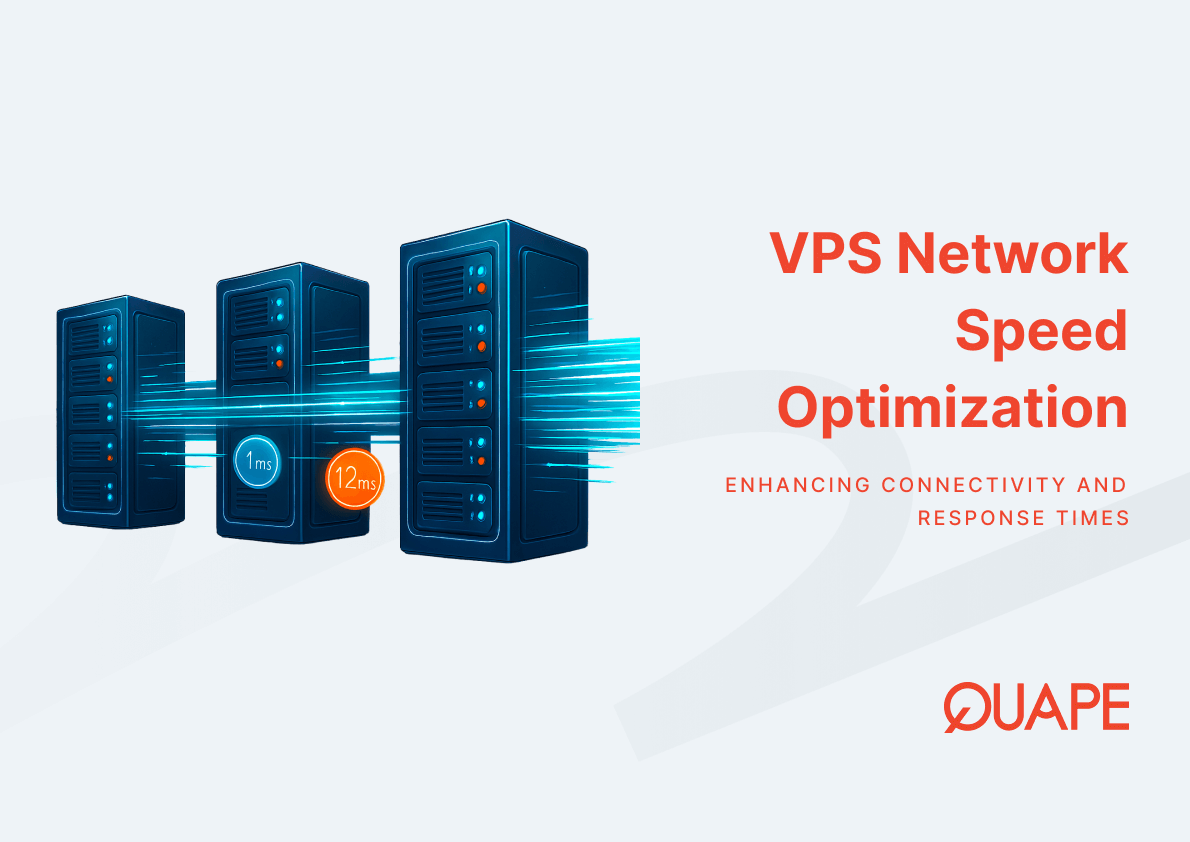
Network performance and latency define the responsiveness of your VPS infrastructure, directly impacting user experience, application availability, and operational efficiency. For IT managers and CTOs deploying services across Southeast Asia, understanding how routing decisions, peering arrangements, and packet scheduling interact determines whether your VPS delivers the low-latency performance your business requires. Regional exchange points, traffic management policies, and buffer optimization each play distinct roles in shaping end-to-end network behavior. Singapore’s position as a regional connectivity hub makes these considerations especially relevant for organizations serving markets across the Asia-Pacific region.
VPS network performance and latency optimization refers to the strategic configuration and infrastructure choices that minimize delay, reduce packet loss, and maintain consistent throughput between your VPS instance and end users. This involves coordinating multiple network layers: how packets traverse internet backbones, where traffic exchanges occur, and how network devices schedule and prioritize data flows under varying load conditions.
Poin-Poin Utama
- Local traffic exchange through regional Internet Exchange Points can reduce latency from 200-600 ms down to 2-10 ms for domestic traffic, according to Internet Society research
- Routing optimization requires balancing BGP policy decisions with actual latency measurements, as shortest AS-path does not guarantee lowest delay
- Peering arrangements at Singapore IX and other regional exchange points enable VPS providers to avoid international transit hops for Asia-Pacific traffic
- Packet scheduling and active queue management mitigate bufferbloat, preventing excessive queuing delay even on high-bandwidth connections
- Dedicated VPS resources combined with strategic network placement provide control over the full performance stack from storage to network edge
- Cross-country analysis shows that a 1% increase in IXPs per 10 million inhabitants correlates with approximately 0.14% improvement in broadband download speed, as documented by UNESCAP
Key Components and Concepts of VPS Network Performance
Routing and Network Path Optimization
Routing protocols determine how packets traverse the internet from your VPS to end users, but these decisions do not always optimize for latency. BGP, the internet’s core routing protocol, typically selects paths based on AS-path length, routing policies, and commercial agreements rather than actual propagation delay or hop count. This creates situations where a packet travels through multiple intermediate networks when a more direct path exists but remains unused due to policy restrictions.
Network hops introduce both propagation delay, the time light or electrical signals take to travel physical distances, and processing delay at each router. Each autonomous system boundary adds latency as routers examine headers, consult routing tables, and forward packets to the next hop. For VPS hosting infrastructure designed for regional performance, minimizing these intermediate hops through strategic network placement becomes essential.
ISP interconnections create natural bottlenecks or efficiency points depending on capacity and peering relationships. When two networks connect directly, either through private peering or at an exchange point, traffic between them bypasses transit providers entirely. This reduces both latency and the number of networks that must be traversed, improving reliability and reducing exposure to congestion in third-party networks.
Peering Arrangements and Regional Exchange Points
Peering enables networks to exchange traffic directly rather than purchasing transit services from upstream providers. At regional exchange points, multiple networks connect to shared switching infrastructure, allowing any participant to establish peering relationships with others. This arrangement particularly benefits domestic and regional traffic flows, keeping packets within geographic proximity to both source and destination.
Singapore IX operates as a neutral interconnection point where content providers, ISPs, cloud platforms, and enterprise networks converge. When a user in Malaysia accesses content hosted on a Singapore-based VPS, peering at Singapore IX allows that traffic to stay regional rather than routing through North American or European transit points. The strategic advantages of Singapore’s network position extend beyond geography to include mature peering infrastructure and carrier diversity.
Cross-border latency between Southeast Asian countries decreases substantially when traffic exchanges locally rather than tromboning through distant continents. Research from Internet Society demonstrates that local IXPs reduce latency for domestic traffic from hundreds of milliseconds to single-digit milliseconds in deployment scenarios across Africa, a pattern that applies equally to Asia-Pacific markets where IXP infrastructure continues expanding.
Remote peering, where networks connect to an exchange point through layer-2 extension services rather than physical presence, offers geographic flexibility but often introduces higher latency than local peering. The additional network segments required to reach the exchange point add both propagation delay and potential congestion points, making direct physical presence at strategic IXPs valuable for latency-sensitive applications.
Packet Scheduling and Traffic Management
Packet scheduling determines the order in which network devices process and forward packets when multiple flows compete for bandwidth. Quality of Service (QoS) policies allow network operators to prioritize latency-sensitive traffic like VoIP or real-time applications over bulk transfers that tolerate delay. Without proper scheduling, large file transfers can monopolize available bandwidth, causing interactive sessions to experience unacceptable latency spikes.
Bandwidth management involves allocating network capacity across competing demands while maintaining fairness and meeting service-level commitments. Traffic shapers and policers control the rate at which packets enter the network, preventing any single flow from consuming excessive resources. These mechanisms work in concert with queue management to balance throughput maximization against latency minimization.
Congestion control operates at multiple layers, from TCP’s built-in algorithms that adjust transmission rates based on packet loss signals to active queue management in network devices. Modern approaches use early congestion notification rather than allowing buffers to fill completely before signaling senders to slow down. This prevents the bufferbloat phenomenon where excessively large buffers maintain high throughput at the cost of dramatically increased latency.
Buffer management significantly impacts latency characteristics under load. Traditional network devices often include large buffers designed to prevent packet loss during traffic bursts, but these same buffers create queuing delay when sustained load fills them. Active queue management algorithms like CoDel, PIE, and FQ-CoDel intelligently drop or mark packets before buffers fill completely, signaling senders to reduce transmission rates while maintaining low latency for well-behaved flows.
Practical Applications for Singapore-Based VPS Deployments
Singapore’s geographic and network position creates specific optimization opportunities for VPS deployments serving Southeast Asian markets. Regional latency measurements show consistent 5-15 ms round-trip times to major cities across ASEAN when traffic exchanges at Singapore IX rather than routing internationally. This becomes operationally significant for database replication, API services, and real-time applications where every millisecond affects user experience.
Local versus international traffic patterns differ substantially in both latency and cost structure. Serving Singapore and Malaysian users from Singapore-based infrastructure allows traffic to remain within regional networks, while serving users in Vietnam or Thailand still benefits from Singapore’s extensive submarine cable connectivity and peering ecosystem. Understanding how data sovereignty requirements intersect with network performance helps organizations make informed infrastructure decisions.
High-performance hosting requirements often mandate not just adequate bandwidth but predictable, low-latency network behavior. E-commerce platforms processing payment transactions, SaaS applications maintaining session state, and content delivery systems serving dynamic content all depend on consistent network performance that dedicated VPS resources can provide more reliably than shared infrastructure.
How VPS Hosting Supports Network Performance & Low Latency
VPS hosting delivers network performance advantages through resource isolation and dedicated allocation. Unlike shared hosting where hundreds of sites compete for the same network interface and bandwidth allocation, each VPS receives guaranteed network throughput independent of neighbor activity. This prevents the “noisy neighbor” problem where one customer’s traffic surge degrades performance for others sharing the same physical infrastructure.
Dedicated resources extend beyond CPU and memory to include network stack components. Each VPS maintains its own network buffers, connection tracking tables, and packet queuing structures. This isolation allows administrators to tune TCP parameters, implement custom firewall rules, and optimize network settings for specific application requirements without affecting other tenants.
NVMe storage performance contributes indirectly to network latency by reducing I/O wait time. When applications can read configuration files, retrieve cached data, or write logs without storage bottlenecks, they respond faster to network requests. The interaction between storage latency and network responsiveness becomes especially visible in database-driven applications where query execution time directly impacts user-facing response times.
High throughput capabilities matter when serving content-rich applications or handling traffic spikes. Modern VPS plans offering 1 Gbps network connectivity provide headroom for burst traffic while maintaining low latency during normal operations. Virtualization technology enables this performance through features like SR-IOV that give VMs near-native network performance by bypassing hypervisor network stack overhead.
Supporting high-traffic websites requires both adequate bandwidth and intelligent traffic management. VPS platforms that implement fair queuing and traffic shaping prevent individual connections from monopolizing resources during traffic spikes, maintaining acceptable latency for all users even during peak load periods.
Best Practices for Maintaining Optimal VPS Network Performance
Monitoring network metrics provides visibility into actual performance versus expected baselines. Track not just bandwidth utilization but latency distributions, packet loss rates, and TCP retransmission percentages. These metrics reveal emerging issues before they impact users, allowing proactive intervention rather than reactive troubleshooting.
Traffic analysis identifies usage patterns, helps capacity planning, and detects anomalies indicating security issues or configuration problems. Understanding which applications consume bandwidth, when traffic peaks occur, and how user behavior varies by time and geography informs infrastructure scaling decisions and optimization priorities.
Security measures intersect with network performance in complex ways. VPS cybersecurity practices like DDoS mitigation and intrusion prevention must balance protection against performance impact. Rate limiting and connection tracking consume system resources, while overly aggressive filtering can introduce latency or block legitimate traffic.
Backup operations affect network performance when replicating data to remote locations. Scheduling large backup transfers during off-peak hours, implementing incremental backups to reduce data volume, and using network QoS to prevent backup traffic from crowding production flows all help maintain consistent performance. Disaster recovery planning should account for network capacity requirements during both normal operations and recovery scenarios.
Regular performance testing validates that infrastructure changes maintain or improve network characteristics. Baseline measurements before upgrades or configuration changes provide comparison points for evaluating impact, while synthetic monitoring simulates user traffic to verify end-to-end performance from different geographic locations.
Kesimpulan
Network performance and latency optimization for VPS infrastructure requires coordinating multiple technical domains: routing decisions that leverage regional exchange points, peering arrangements that keep traffic local, and packet scheduling that balances throughput against latency under varying load conditions. Singapore’s mature interconnection ecosystem, combined with dedicated VPS resources and modern virtualization platforms, enables organizations to deploy infrastructure that serves Southeast Asian markets with consistently low latency and high availability.
Contact our team to discuss how strategic VPS deployment and network optimization can improve your application performance across the Asia-Pacific region.
Pertanyaan yang Sering Diajukan (FAQ)
What causes high latency in VPS environments even with adequate bandwidth?
High latency often results from routing inefficiencies, where traffic traverses unnecessary international hops instead of exchanging at regional peering points. Bufferbloat, excessive queuing in network devices, also increases delay even when bandwidth remains available. Server resource contention from CPU or disk I/O bottlenecks can make applications slow to respond to network requests, manifesting as apparent network latency.
How do Internet Exchange Points improve VPS network performance?
Exchange points enable direct traffic exchange between networks without requiring expensive transit services. This reduces the number of network hops, lowers propagation delay, and keeps regional traffic local rather than routing it internationally. For Singapore-based VPS serving Southeast Asian users, IXP peering can reduce latency from hundreds of milliseconds to under 10 ms for domestic connections.
What network metrics should I monitor for VPS performance?
Monitor round-trip latency to key destinations, packet loss rates, and TCP retransmission percentages alongside bandwidth utilization. Track latency distributions rather than just averages, as 99th percentile latency reveals user experience during peak load. Measure both inbound and outbound throughput, and correlate network metrics with application response times to identify performance bottlenecks.
Does VPS location significantly impact latency for regional users?
Geographic proximity affects latency through propagation delay, the time signals take to travel physical distances. However, network topology and peering relationships often matter more than pure distance. A VPS in Singapore with strong regional peering typically delivers lower latency to Southeast Asian users than infrastructure in closer but poorly-connected locations.
How does packet scheduling affect application performance?
Packet scheduling determines which traffic gets priority when network congestion occurs. Without proper QoS configuration, bulk transfers can monopolize bandwidth and cause interactive applications to experience latency spikes. Modern scheduling algorithms implement fairness mechanisms that prevent any single connection from degrading overall performance while prioritizing latency-sensitive protocols.
What is bufferbloat and why does it matter for VPS hosting?
Bufferbloat occurs when network devices maintain excessively large packet buffers that fill during high traffic, causing queuing delays that increase latency dramatically. Even with high bandwidth, bufferbloat makes interactive applications feel sluggish because packets wait in queues rather than being processed immediately. Active queue management techniques mitigate this by signaling congestion before buffers fill completely.
Can VPS hosting match dedicated server network performance?
Modern VPS platforms using SR-IOV and hardware-assisted virtualization deliver near-native network performance comparable to dedicated servers. The key difference lies in resource guarantees rather than peak capabilities. Dedicated servers provide completely isolated network interfaces, while VPS instances share physical NICs with performance isolation enforced by the hypervisor.
How often should I review and optimize VPS network configuration?
Review network configuration quarterly or when deploying significant application changes, traffic growth, or new geographic markets. Monitor performance continuously to detect degradation early, but avoid making changes without clear baseline measurements and specific performance targets. Network optimization delivers the greatest return when guided by actual usage patterns rather than theoretical assumptions.

- VPS Network Performance & Latency Optimization - Desember 12, 2025
- How to Choose RAM & CPU for Your VPS - Desember 12, 2025
- NVMe VPS Hosting: Why Ultra-Fast Storage Makes a Massive Performance Difference - Desember 11, 2025