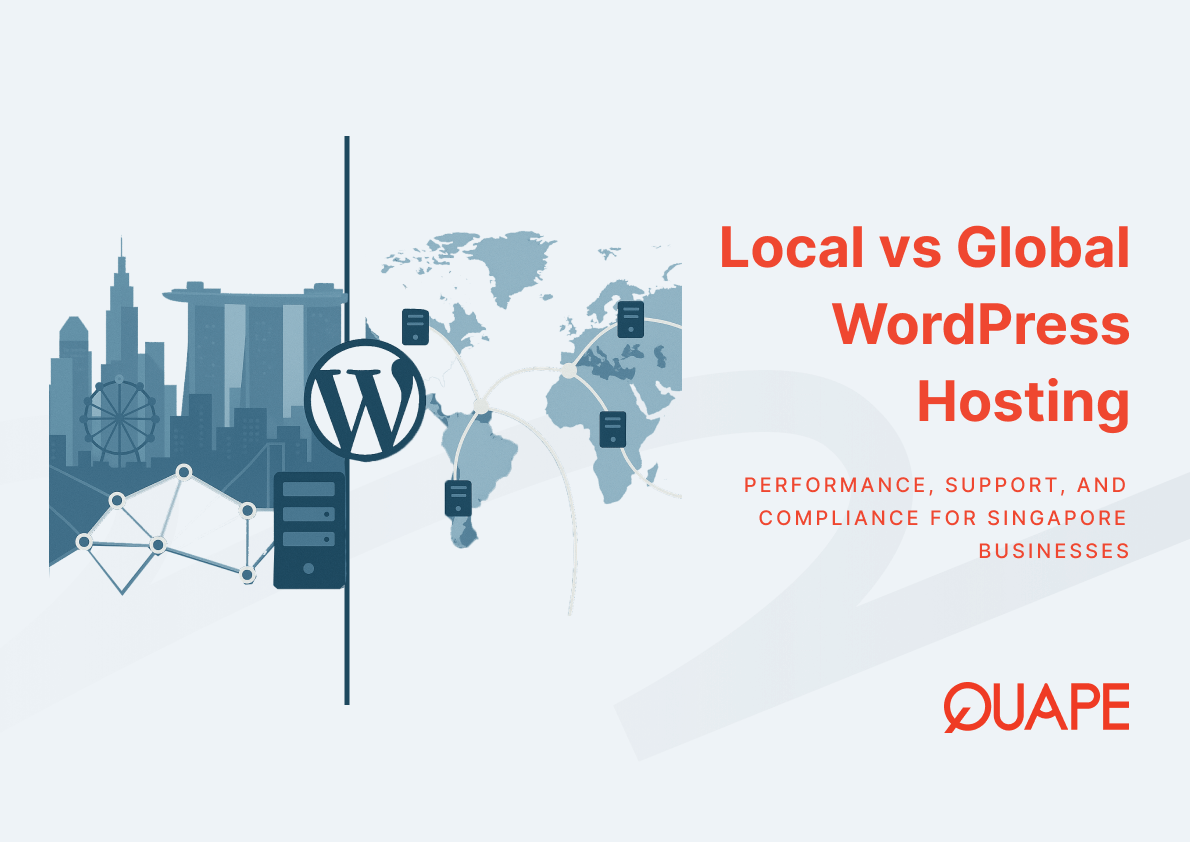
Singapore businesses face a critical decision when selecting WordPress hosting: prioritize local infrastructure for performance and compliance, or leverage global providers for reach and redundancy. This choice directly impacts website speed, operational costs, regulatory alignment, and technical support quality. With Singapore’s data center market projected to grow from USD 4.16 billion in 2024 to USD 5.60 billion by 2030, the infrastructure foundation exists to support both approaches. However, local hosting offers distinct advantages for businesses serving Asia-Pacific audiences, particularly as Singapore maintains 26 submarine cable connections that position it as a regional digital gateway. Understanding how server proximity, support structures, and billing models interact with business requirements helps IT managers and CTOs make informed infrastructure decisions.
WordPress hosting selection requires evaluating how infrastructure location influences application performance and business operations. Local hosting refers to servers physically situated in Singapore data centers, while global hosting distributes infrastructure across multiple international regions. The distinction matters because server proximity to end users directly affects latency, which influences Core Web Vitals scores and user experience. Singapore’s data center capacity reached 1,039 MW in Q4 2024, with colocation facilities accounting for 58.9% of the market, demonstrating substantial local infrastructure availability for businesses seeking performance optimization through geographic proximity.
Những điểm chính
- Local hosting in Singapore reduces latency for regional users due to server proximity and dense submarine cable connectivity, improving page load times and Core Web Vitals performance
- Singapore’s 70+ operational data centers provide robust infrastructure options, though capacity constraints and premium real estate costs create higher operational expenses compared to global alternatives
- Global hosting offers geographic redundancy and disaster recovery advantages, but introduces latency penalties that affect user experience for Singapore-based audiences
- Local billing in SGD eliminates foreign exchange volatility and simplifies financial planning for procurement teams managing recurring hosting expenses
- Time-zone aligned support from Singapore-based providers enables faster issue resolution during business hours, reducing downtime impact on operations
- Singapore’s sustainability standards for data centers, including mandated operating temperatures above 26°C, align local hosting with evolving regulatory requirements
- Data sovereignty considerations favor local hosting when regulatory compliance requires data to remain within Singapore’s jurisdiction
Introduction to Local vs Global WordPress Hosting
The hosting infrastructure decision creates cascading effects across website performance, operational costs, and compliance posture. Local WordPress hosting positions server resources within Singapore’s physical boundaries, leveraging the nation’s position as a connectivity hub with exceptionally reliable power infrastructure that averages only 0.1 hours of annual interruption compared to the global average of 1.6 hours. This reliability stems from Singapore’s mature telecommunications sector and strategic investment in redundant network pathways. Global hosting distributes infrastructure across continents, prioritizing geographic diversity over proximity to any single market. For businesses serving customers primarily in Southeast Asia, understanding how WordPress performance optimization depends on hosting architecture helps align technical decisions with business objectives.
The local versus global distinction extends beyond simple geography. Local hosting enables businesses to align with Singapore’s regulatory framework, including sustainability standards that mandate energy-efficient operations and data protection requirements that increasingly emphasize data residency. Global providers offer economies of scale and multi-region failover capabilities, but these benefits come with trade-offs in control, latency, and regulatory alignment. Singapore IT managers evaluating hosting options must weigh how infrastructure location interacts with their specific traffic patterns, compliance requirements, and budget constraints.
Key Components of Local vs Global Hosting
Localization and Server Proximity
Server location determines the physical path data travels between hosting infrastructure and end users, directly influencing latency and page rendering speed. When a Singapore-based visitor requests a WordPress page hosted on local servers, network packets traverse shorter distances through fewer routing hops, reducing round-trip time and improving Time to First Byte (TTFB). This proximity advantage becomes measurable in Core Web Vitals metrics, particularly Largest Contentful Paint (LCP) and First Input Delay (FID), which Google uses to assess page experience for search ranking purposes. Understanding how server location impacts SEO performance through Core Web Vitals helps businesses quantify the performance differential between local and distant hosting.
Singapore’s network infrastructure density amplifies the localization benefit. With 26 submarine cables landing in the country, local data centers connect to regional destinations through multiple redundant pathways, improving both speed and reliability for Asia-Pacific traffic. A WordPress site hosted in Singapore accessing users in Malaysia, Indonesia, or Thailand benefits from direct regional peering arrangements that bypass congested international transit routes. Conversely, global hosting in Europe or North America forces Asia-Pacific traffic through longer submarine cable paths, introducing 150-250 milliseconds of additional latency that degrades user experience and conversion rates. The choice between hosting in Singapore data centers versus distant alternatives directly affects whether businesses meet the 2.5-second LCP threshold Google recommends for good page experience.
The localization advantage extends to content delivery patterns. WordPress sites serving predominantly Singapore and regional audiences gain more from local hosting than sites with globally distributed traffic. For businesses where 70% or more of visitors originate from Southeast Asia, positioning the origin server in Singapore and using local hosting to improve WordPress performance across Asia delivers better results than relying solely on CDN edge caching. While CDNs cache static assets at edge locations, dynamic WordPress requests still query the origin server, making server proximity critical for database-driven content and authenticated user experiences that bypass cache layers.
Support and Technical Assistance
Technical support quality depends on time zone alignment, language proficiency, and provider familiarity with local regulatory requirements. Managed WordPress hosting from Singapore-based providers enables real-time troubleshooting during Singapore business hours, reducing the resolution time for critical issues that impact revenue or operations. When a WordPress site experiences downtime at 10 AM SGT, local support teams respond immediately rather than waiting for overnight shifts in distant time zones to become available. This responsiveness matters particularly for e-commerce businesses where each hour of downtime translates directly to lost transactions. Businesses benefit from local support structures that understand Singapore business context and can coordinate with regional third-party services like payment gateways or logistics APIs that integrate with WordPress installations.
Global hosting providers often centralize support operations in single time zones, creating response delays for Singapore businesses. A critical database connection issue reported at 9 PM SGT might not receive expert attention until 12-18 hours later when North American or European support shifts begin. While ticketing systems accept requests 24/7, complex troubleshooting requires live engineer intervention that time zone differences delay. Local providers eliminate this gap, offering phone support and real-time chat during Singapore business hours when most technical issues surface. The ability to manage WordPress hosting through familiar interfaces like cPanel also reduces dependency on provider support by empowering in-house teams to handle routine maintenance tasks.
Support quality also relates to infrastructure knowledge. Local providers understand the specific characteristics of Singapore data centers, including which facilities offer superior network connectivity, how local power infrastructure affects redundancy planning, and which upstream providers deliver optimal regional routing. This contextual knowledge enables more effective troubleshooting when diagnosing performance issues or planning capacity expansions. When businesses encounter common WordPress hosting problems like slow database queries or plugin conflicts, local support teams can quickly assess whether the issue stems from application configuration, server resources, or regional network conditions, accelerating resolution and minimizing operational disruption.
Billing and Cost Considerations
Billing structure affects both predictable cost planning and the total expense of hosting operations. Local hosting providers in Singapore typically invoice in SGD, eliminating foreign exchange risk that complicates budget forecasting when paying global providers in USD or EUR. Currency fluctuations create variance in month-to-month hosting costs, making financial planning less predictable for procurement teams managing annual IT budgets. When the SGD weakens against USD, hosting costs increase without corresponding service improvements, eroding budget allocation for other priorities. Local billing in SGD provides cost certainty that simplifies financial modeling and reduces administrative overhead associated with currency conversion and international payment processing fees.
Pricing transparency varies significantly between local and global providers. Singapore-based hosts often structure plans around local market expectations, with published pricing that reflects regional cost baselines and competitive positioning. Global providers sometimes employ dynamic pricing that adjusts based on usage patterns, geographic region, and customer segment, creating complexity when comparing options. Understanding what constitutes fair market pricing for WordPress hosting services requires evaluating not just the monthly or annual fee, but also the included resources, support level, and additional charges for bandwidth overages or backup retention. Local providers competing in Singapore’s transparent market environment tend to offer clearer pricing structures with fewer hidden costs.
The premium for local Singapore hosting reflects real infrastructure costs. Singapore’s land scarcity, electricity rates, and cooling requirements make data center operations more expensive than locations with abundant land and lower energy costs. This cost differential appears in hosting prices, where equivalent specifications on Singapore servers may cost 20-40% more than hosting in lower-cost global markets. However, this premium purchases tangible benefits: regulatory compliance, performance advantages, and support quality that managed hosting provides compared to budget alternatives. Businesses must evaluate whether these benefits justify the cost premium based on their specific performance requirements, compliance obligations, and customer geographic distribution.
Ứng dụng thực tế cho doanh nghiệp Singapore
Singapore SMEs and enterprises implement local or global hosting strategies based on specific operational requirements and customer profiles. A Singapore-based e-commerce business serving primarily Southeast Asian customers gains measurable advantages from local hosting. The reduced latency improves checkout completion rates by decreasing page load delays during the payment process, where every 100 milliseconds of delay statistically correlates with conversion rate reduction. Local hosting also simplifies compliance with Singapore’s data protection regulations when customer information resides on servers within the country’s jurisdiction, reducing cross-border data transfer complexity. Following a structured setup process for WordPress hosting in Singapore ensures businesses configure DNS, SSL certificates, and CDN integration correctly to maximize the localization benefit.
IT managers evaluating hosting options should assess traffic geography, compliance requirements, and performance expectations. Businesses with predominantly Asia-Pacific traffic benefit most from Singapore hosting, while organizations serving global audiences may require multi-region infrastructure regardless of where the origin server resides. The decision framework considers several factors: what percentage of traffic originates from within 2,000 kilometers of Singapore, whether regulatory requirements mandate data residency, how latency-sensitive the WordPress application is, and whether the organization has technical expertise to manage failover and backup procedures. Selecting the right hosting provider to improve WordPress speed requires matching these requirements against provider capabilities rather than defaulting to cost-based decisions.
Performance optimization extends beyond initial hosting selection. Businesses can optimize WordPress hosting infrastructure for speed and uptime through strategic configuration of caching layers, database optimization, and CDN integration that complements the underlying server location. A WordPress site hosted locally in Singapore but poorly configured may still underperform a well-optimized global installation. The optimal approach combines strategic server placement with technical implementation excellence, ensuring the infrastructure foundation supports rather than constrains application performance. Regular monitoring of Core Web Vitals, server response times, and uptime metrics validates whether hosting decisions deliver expected performance outcomes.
How QUAPE WordPress Hosting Supports Local vs Global Hosting Needs
QUAPE operates WordPress hosting infrastructure from Singapore’s TIA-942 certified data centers, positioning servers within the connectivity hub that serves Asia-Pacific traffic patterns. The managed WordPress hosting plans utilize high-IOPS NVMe storage that reduces database query latency, directly improving page generation speed for dynamic WordPress content. Daily automated backups protect against data loss while monthly security updates address WordPress core and plugin vulnerabilities, reducing the administrative burden on internal IT teams. This managed approach suits Singapore businesses that require local hosting benefits without maintaining dedicated infrastructure expertise, as professional developers handle routine maintenance tasks that prevent security compromises.
The three-tier plan structure accommodates businesses at different scales. WP Essential provides single-site hosting with 15 GB NVMe storage for small businesses or development environments, while WP Professional supports up to two websites with 50 GB storage for growing operations. WP Enterprise includes monthly content updates alongside 100 GB storage and three-website capacity, addressing the needs of businesses that require both hosting infrastructure and ongoing content maintenance. All plans include WordPress Toolkit support, enabling plugin management and updates through a centralized interface rather than requiring individual site logins. This tooling integration reduces the operational complexity of maintaining WordPress security across multiple installations.
QUAPE’s infrastructure leverages multiple upstream network providers, a configuration that improves reliability compared to hosts dependent on single connectivity sources. When one upstream provider experiences routing issues or capacity constraints, traffic automatically shifts to alternative pathways, maintaining site availability for users across diverse geographic locations. This multi-homing approach complements Singapore’s dense submarine cable connectivity, ensuring WordPress sites remain accessible even during regional network disruptions. The combination of local infrastructure placement, managed security, and redundant networking addresses the key concerns businesses evaluate when comparing local versus global hosting options. Explore managed WordPress hosting solutions that combine Singapore infrastructure with comprehensive support.
Kết luận
Local hosting in Singapore delivers measurable advantages for businesses serving Asia-Pacific audiences through reduced latency, regulatory alignment, and time-zone synchronized support. While global hosting offers geographic redundancy and potential cost savings, the trade-off in performance and operational complexity favors local infrastructure for organizations where regional traffic dominates. Singapore’s robust data center ecosystem, exceptional network connectivity, and reliable power infrastructure create a foundation that supports high-performance WordPress operations. The decision between local and global hosting ultimately depends on traffic patterns, compliance requirements, and whether the business values proximity over distribution. For Singapore businesses prioritizing speed, control, and regional optimization, local hosting represents the strategic choice that aligns infrastructure with operational reality.
Ready to optimize your WordPress hosting for Singapore and regional performance? Liên hệ với đội ngũ bán hàng của chúng tôi to discuss how managed local hosting can improve your site speed, security, and operational efficiency.
Câu Hỏi Thường Gặp
Does local hosting in Singapore actually improve SEO rankings?
Local hosting improves Core Web Vitals metrics like LCP and TTFB for Singapore and regional users, which Google incorporates into search ranking algorithms as page experience signals. While hosting location alone doesn’t determine rankings, the performance improvements it enables contribute to better user experience scores that influence search visibility.
What are the main cost differences between Singapore and global hosting?
Singapore hosting typically costs 20-40% more than equivalent specifications in lower-cost markets due to premium real estate, electricity rates, and data center operating expenses. However, local hosting eliminates foreign exchange risk and provides performance benefits that may reduce CDN costs by improving origin server efficiency.
Can global hosting provide adequate performance for Singapore audiences?
Global hosting can serve Singapore audiences adequately when combined with CDN edge caching for static content, but dynamic WordPress requests querying distant origin servers introduce 150-250ms additional latency compared to local hosting. For latency-sensitive applications or predominantly regional traffic, this performance gap negatively impacts user experience.
How does data sovereignty affect the local versus global hosting decision?
Data sovereignty regulations increasingly require certain data types to remain within specific jurisdictions. Local Singapore hosting simplifies compliance when regulations mandate data residency, while global hosting may require complex data processing agreements and geographic restrictions on where customer information can be stored or processed.
What support advantages do local hosting providers offer?
Local providers operate during Singapore business hours, enabling real-time troubleshooting when issues occur during peak business periods. They also understand regional network characteristics, regulatory requirements, and third-party service integrations common in Singapore’s market, which accelerates issue resolution compared to global support teams unfamiliar with local context.
Is local hosting necessary for small Singapore businesses?
Small businesses with primarily local customers benefit from local hosting’s performance advantages, but the decision depends on growth plans and budget constraints. Businesses planning regional expansion should consider local hosting’s ability to serve Asia-Pacific audiences efficiently, while those targeting global markets may require distributed infrastructure regardless of origin server location.
How does Singapore’s data center capacity constraint affect hosting availability?
Singapore’s data center capacity reached 1,039 MW in Q4 2024 with only 50 MW under construction and 2.2% vacancy, indicating tight supply. This scarcity may limit immediate capacity availability and contribute to premium pricing, though businesses working with established providers like QUAPE typically secure resources through existing relationships and capacity planning.
What role does sustainability play in choosing between local and global hosting?
Singapore’s government mandates sustainability standards for data centers, including operating temperature requirements that improve energy efficiency. Local hosting aligns with these evolving regulations, while global hosting may operate under different environmental standards. Businesses with sustainability commitments should evaluate how hosting location affects their carbon footprint and regulatory compliance.

- Squarespace Alternative: Bespoke UI/UX Design that Converts High-Ticket Clients - Tháng 6 17, 2026
- Wix Alternative for Enterprises: Why You Need Custom Corporate Web Design - Tháng 6 16, 2026
- Dropbox Business Alternative: Avoid High User Licensing Fees with Private Nextcloud - Tháng 6 15, 2026