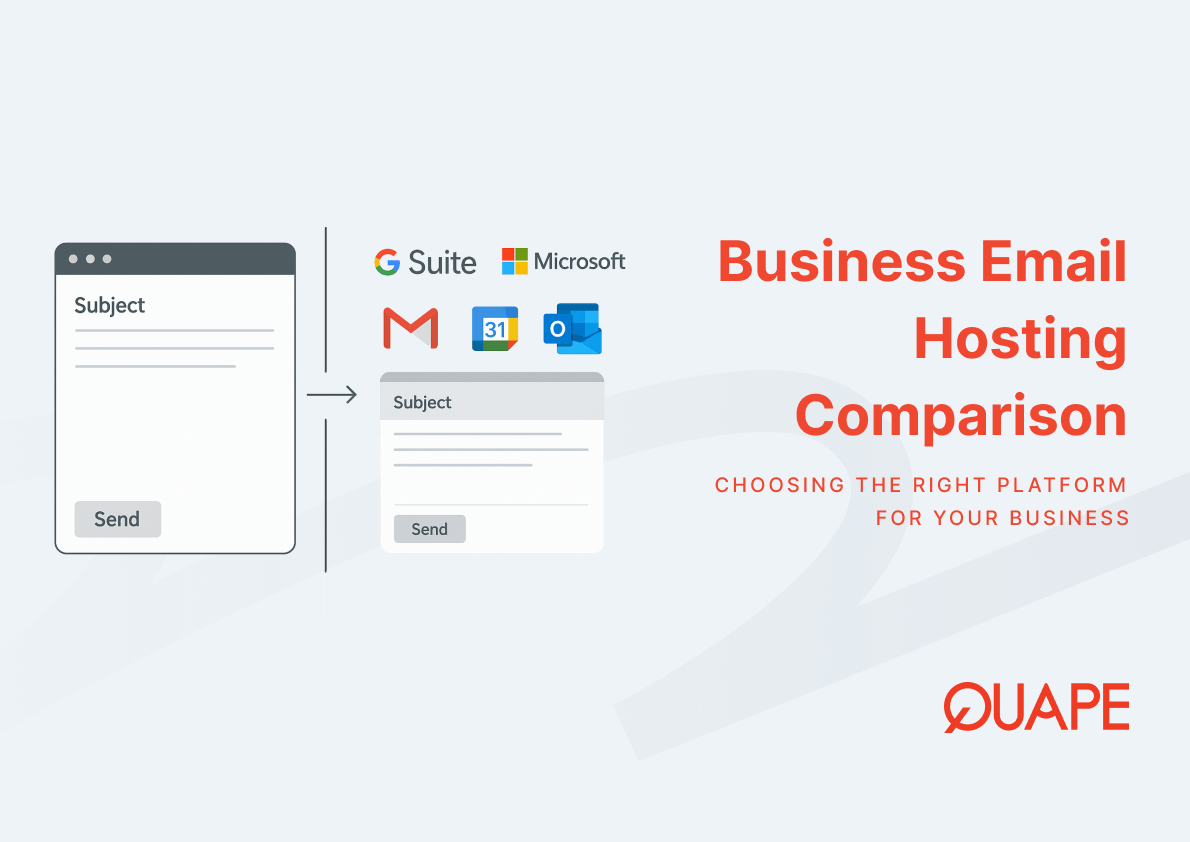
Business email hosting decisions influence operational agility, cost predictability, and compliance alignment for organizations across Singapore and the broader Asia-Pacific region. The choice between self-managed email infrastructure hosted in regional data centers and globally distributed SaaS platforms like Google Workspace or Microsoft 365 determines how email systems integrate with existing IT workflows, where data resides under regulatory frameworks, and how costs scale as teams grow. Email hosting remains a central workload in enterprise cloud adoption strategies, with Eurostat reporting that 82.7% of EU enterprises using cloud services in 2023 deployed those services for email systems. This article examines architectural, operational, and financial distinctions between business email hosting on data center infrastructure and subscription-based SaaS email platforms to support informed decision-making for IT managers, CTOs, and procurement leads.
Business email hosting refers to email infrastructure deployed on dedicated or shared servers within managed data centers, where organizations retain administrative control over email configurations, storage policies, and access protocols. This contrasts with cloud-based SaaS platforms that abstract infrastructure management to third-party vendors operating multi-tenant environments across global hyperscale networks.
Những điểm chính
- Cloud email platforms shift operational responsibility for hardware, updates, and redundancy to external providers, while data center hosted email enables direct control over infrastructure and compliance configurations.
- SaaS email services typically employ per-user subscription pricing that scales linearly with headcount, whereas business email hosting often uses fixed resource allocations with predictable costs regardless of user count.
- Data residency and sovereignty considerations become critical when regulatory frameworks require email data to remain within specific geographic boundaries or under local administrative control.
- Security models differ structurally: SaaS platforms implement shared responsibility frameworks where vendors secure infrastructure while customers manage identity and access, versus data center hosted email where infrastructure-level security integrates with network and facility controls.
- Local data center deployment reduces latency for regional email routing and supports multi-homed bandwidth architectures that enhance reliability for Singapore-based operations.
- Operational fit depends on organizational priorities: SaaS platforms optimize for minimal IT overhead and rapid deployment, while business email hosting suits cost-sensitive organizations with custom policy requirements or compliance mandates.
- Email hosting market growth from USD 27.04 billion in 2024 to a projected USD 108.73 billion by 2032 reflects expanding infrastructure diversity and enterprise demand for flexible deployment models beyond dominant SaaS vendors, according to Data Bridge Market Research.
Core Architectural Differences Between Email Hosting Models
Email infrastructure architecture determines how messages route through networks, where data persists during storage and transmission, and which administrative controls organizations can apply to email systems. These structural distinctions influence performance characteristics, compliance alignment, and operational flexibility across different deployment models.
Cloud Email Platforms (Google Workspace & Microsoft 365)
Google Workspace and Microsoft 365 operate on public cloud infrastructure distributed across global hyperscale data centers. These platforms use multi-tenant architectures where multiple organizations share underlying compute, storage, and network resources while maintaining logical separation at the application layer. The vendor manages the entire email stack, including mail transfer agents, spam filtering systems, storage backend, and redundancy protocols. Organizations access email services through subscription-based licensing that bundles collaboration tools, productivity applications, and administrative dashboards within unified interfaces.
Public cloud email platforms prioritize horizontal scalability, enabling organizations to provision new user accounts and increase storage capacity through self-service portals without infrastructure planning cycles. Vendor-managed email stacks receive continuous updates for security patches, feature enhancements, and protocol compliance without requiring customer intervention. This operational model reduces internal IT overhead for organizations that lack dedicated email administration resources or prefer to allocate technical capacity toward business-specific applications rather than commodity infrastructure management.
Business Email Hosting on Data Center Infrastructure
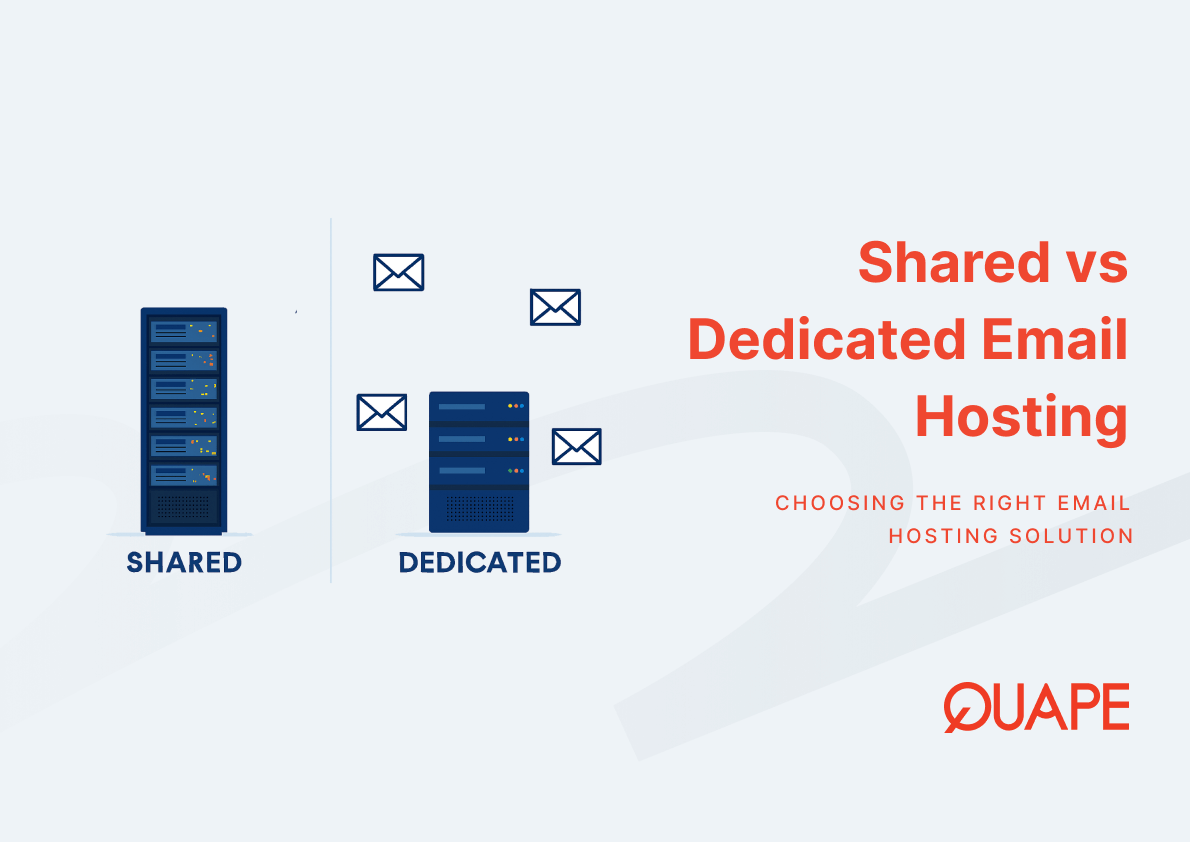
Business email hosting services deployed in regional data centers use dedicated or shared server infrastructure where organizations retain direct administrative access to email configurations. Tier 3 data centers in Singapore provide localized email servers with controlled environmental conditions, redundant power systems, and multi-homed network connectivity that supports both POP3 and IMAP protocols alongside SMTP delivery control. This architecture enables IT teams to customize email retention policies, implement domain-specific authentication mechanisms, and integrate email services with on-premises directory services or custom applications.
Data center hosted email infrastructure separates email workloads from other cloud services, allowing organizations to maintain hybrid IT environments where email remains within managed facilities while other applications migrate to public cloud platforms. This deployment model suits organizations with existing data center investments, regulatory requirements for local data storage, or operational preferences for direct infrastructure control. Email servers deployed in Singapore Tier 3 facilities benefit from regional network peering arrangements that reduce latency for Asia-Pacific email routing and support compliance frameworks requiring email data to remain within specific geographic jurisdictions.
Control, Compliance, and Data Residency Considerations
Data sovereignty requirements influence email hosting decisions for organizations operating under regulatory frameworks that specify where email data must reside and which administrative controls must govern access to that data. Singapore’s Personal Data Protection Act (PDPA) establishes obligations for how organizations collect, use, and disclose personal data, including email communications that may contain customer information, employee records, or business transactions. Email hosting on local data center infrastructure enables organizations to demonstrate compliance with data residency requirements by maintaining email storage within Singapore’s regulatory jurisdiction.
Administrative control over email infrastructure determines how organizations implement custom security policies, audit access logs, and respond to data subject access requests under privacy regulations. Business email hosting models that provide root or administrative access to mail server configurations enable IT teams to enforce encryption standards, configure retention policies aligned with legal hold requirements, and integrate email systems with security information and event management (SIEM) platforms for centralized monitoring. SaaS email platforms abstract these controls to vendor-managed interfaces that may limit granular customization but reduce the technical expertise required to maintain secure email operations.
Organizations evaluating email hosting models should assess whether regulatory obligations or internal governance policies require demonstrable control over email data location, encryption key management, or audit trail preservation that extends beyond standard SaaS platform capabilities.
Cost Structure and Long-Term Budget Predictability
SaaS email platforms typically employ per-user subscription pricing where monthly or annual costs scale linearly with employee headcount. This pricing model simplifies budgeting for small teams but can create unpredictable expenses as organizations grow or fluctuate in size. Additional costs may accrue through storage overages, premium features, or compliance add-ons that vendors bundle separately from base email subscriptions.
Business email hosting uses fixed resource allocation pricing where organizations purchase specific storage capacity, bandwidth limits, and email account quotas regardless of actual user count. A shared hosting plan with 30 GB storage and unlimited email accounts costs the same whether serving five users or fifteen users, enabling organizations to absorb team growth without triggering incremental per-seat charges. This cost structure benefits organizations with predictable email workloads and established team sizes that prioritize budget stability over variable consumption-based billing.
Long-term total cost of ownership comparisons should account for administrative labor, security tool integration, and migration costs alongside subscription or hosting fees. SaaS platforms reduce internal IT labor for routine maintenance but may introduce vendor lock-in costs if organizations later migrate email systems to alternative infrastructure. Business email hosting requires ongoing server administration but enables organizations to preserve infrastructure investments across vendor transitions or service provider changes.
Security Model Comparison
Email security encompasses multiple protection layers including spam filtering, brute-force attack prevention, transport encryption, and data-at-rest protection. Different hosting models distribute security responsibilities between vendors and customers in ways that influence both risk exposure and operational complexity.
Security in SaaS Email Platforms
SaaS email platforms implement shared responsibility models where vendors secure underlying infrastructure, network perimeter, and platform-level services while customers manage identity access controls, endpoint security, and user authentication policies. Google Workspace and Microsoft 365 include integrated spam filtering, malware scanning, and phishing detection systems that process inbound email through machine learning classifiers before delivery to user mailboxes. These platforms enforce TLS encryption for email in transit and provide encryption-at-rest capabilities for stored messages.
Platform-level security controls benefit from vendor investment in threat intelligence, security research teams, and continuous vulnerability management across global infrastructure. However, customers rely on vendor security practices and may have limited visibility into incident response procedures, data breach notification timelines, or third-party access to email systems under government data requests.
Security in Data Center Hosted Business Email
Business email hosting on data center infrastructure integrates email security with facility-level protections including biometric access controls, video surveillance, and network firewall policies that restrict email server exposure to internet traffic. Infrastructure-level security enables organizations to deploy web application firewalls (WAF) that inspect email protocols for malicious payloads, implement custom spam filtering rulesets tuned to organization-specific threat patterns, and configure brute-force prevention systems that automatically block repeated authentication failures.
Controlled access environments in Tier 3 data centers reduce physical security risks by limiting server room entry to authorized personnel and maintaining audit logs for facility access events. Organizations using business hosting plans with integrated email services can centralize security monitoring across web and email infrastructure through unified management interfaces that correlate attack patterns across multiple service types.
Email attack surface management differs between hosting models: SaaS platforms present globally accessible endpoints that attackers can probe from any internet location, while data center hosted email can implement geographic access restrictions, IP whitelisting, or VPN-only access policies that reduce exposure to automated scanning tools.
Performance, Latency, and Email Reliability in Singapore
Email delivery performance depends on network path length between mail servers, routing efficiency across internet exchange points, and redundancy protocols that maintain service availability during network disruptions. Email servers deployed in Singapore Tier 3 data centers reduce latency for regional email routing by minimizing physical distance and network hop counts between email infrastructure and recipient mail servers across Southeast Asia and the broader Asia-Pacific region.
Multi-homed bandwidth architectures connect data center facilities to multiple upstream internet service providers, enabling email traffic to route through alternative network paths when primary connections experience congestion or outages. This redundancy improves email reliability by preventing single points of failure in network connectivity and supporting automatic failover to backup routes without service interruption.
Local data center deployment also benefits from regional peering arrangements where Singapore internet exchange points enable direct interconnection between email infrastructure and major telecommunications providers serving Asian markets. These peering relationships reduce dependence on intercontinental links that can introduce latency variability and increase exposure to submarine cable failures that periodically disrupt global internet traffic.
Operational Fit for SMEs, IT Managers, and Growing Teams
Small and medium enterprises often balance competing priorities between minimizing IT management overhead, controlling costs, and maintaining flexibility to customize infrastructure as business requirements evolve. SaaS email platforms optimize for rapid deployment and minimal technical complexity, enabling organizations without dedicated IT staff to establish professional email services through self-service provisioning. However, this convenience introduces vendor lock-in risks where migration to alternative platforms requires complex data export processes and potential business disruption during transition periods.
IT managers evaluating email hosting decisions should assess internal technical capacity against operational requirements. Organizations with existing IT teams capable of server administration may prefer business email hosting models that provide granular control over email configurations, enable integration with custom applications, and support specialized compliance requirements that exceed standard SaaS platform capabilities. Growing teams benefit from hosting models that accommodate expansion without triggering per-user cost increases or requiring infrastructure upgrades when email storage needs increase gradually over time.
Custom email policies including domain-based message routing, automated archiving rules, or industry-specific retention schedules may require administrative access beyond what SaaS platforms expose through web-based management consoles. Business email hosting enables IT managers to implement these customizations while maintaining compatibility with existing authentication systems, backup infrastructure, and security monitoring tools already deployed within organizational IT environments.
When Business Email Hosting Is a Better Fit Than G-Suite or Microsoft 365
Business email hosting suits organizations with predictable email workloads where team sizes remain stable and storage requirements grow incrementally rather than experiencing rapid spikes. Cost-sensitive organizations that operate lean IT budgets benefit from fixed resource pricing that eliminates variable per-user subscription costs and enables accurate long-term budget forecasting. Companies with five to twenty employees using email primarily for business correspondence rather than large file attachments can optimize costs by selecting shared hosting plans with generous storage allocations and unlimited email accounts.
Local compliance needs drive business email hosting adoption when regulatory frameworks mandate email data storage within specific geographic boundaries or when organizations must demonstrate direct administrative control over email infrastructure during compliance audits. Singapore-based organizations serving customers across Southeast Asia may prefer email infrastructure deployed in local Tier 3 data centers to satisfy PDPA requirements and reduce legal complexity around cross-border data transfer obligations.
Custom infrastructure preferences including integration with on-premises directory services, compatibility with legacy email clients, or support for specialized email protocols may favor business email hosting over SaaS platforms that standardize configurations to serve broad market segments. Organizations migrating from self-managed email servers can preserve existing workflows and user experiences by transitioning to managed business email hosting rather than adopting fundamentally different collaboration paradigms required by cloud productivity suites.
How QUAPE Business Hosting Supports Business Email Hosting
QUAPE business hosting plans integrate web and email services on shared infrastructure deployed in Singapore Tier 3 data centers, providing organizations with unified hosting environments that combine website performance, email reliability, and managed security controls. Business One, Business Two, and Business Three plans allocate 15 GB to 75 GB of SSD storage with unlimited email accounts and databases, enabling organizations to scale email usage within fixed resource limits as teams grow from one to five users up to ten or more users without incurring additional subscription costs.
Email hosting infrastructure benefits from data center facilities certified to TIA 942 standards, ensuring 99.9% uptime through redundant power systems, climate control, and multi-homed network connectivity. WAF protection, spam filtering, and brute-force prevention systems secure email services against common attack vectors while SSL/TLS encryption protects email transmission between mail servers and client applications. Organizations using QUAPE business hosting maintain POP3 and IMAP protocol support for compatibility with diverse email clients and mobile devices across distributed teams.
Managed hosting services reduce operational complexity for organizations that prefer to focus internal resources on core business activities rather than email infrastructure administration. QUAPE handles routine security updates, server maintenance, and monitoring while customers retain administrative control through DirectAdmin panels that enable email account creation, domain configuration, and storage management without requiring command-line expertise.
Kết luận
Email hosting decisions should align with organizational priorities around cost predictability, compliance requirements, and operational control over communication infrastructure. Business email hosting on data center infrastructure serves organizations that value fixed resource pricing, local data residency, and administrative flexibility over the automated scalability and integrated collaboration tools that define SaaS email platforms. Singapore-based businesses evaluating email infrastructure options should assess how architectural differences between hosting models support specific compliance obligations, security requirements, and long-term budget planning.
Organizations seeking email hosting solutions that combine local infrastructure deployment with managed security and predictable costs can explore QUAPE business hosting plans designed for teams across small to medium enterprise segments. Liên hệ với đội ngũ bán hàng của chúng tôi to discuss how business email hosting aligns with your operational requirements and compliance framework.
Câu Hỏi Thường Gặp
What is the main difference between business email hosting and G-Suite or Microsoft 365?
Business email hosting deploys email infrastructure on data center servers where organizations control configurations and pay fixed resource fees, while G-Suite and Microsoft 365 operate as SaaS platforms with per-user subscription pricing and vendor-managed infrastructure. The primary distinction lies in where operational responsibility resides and how costs scale with organizational growth.
How does data residency affect email hosting decisions in Singapore?
Data residency requirements under Singapore’s PDPA may require organizations to store email data within local jurisdictions and maintain administrative control over access policies. Business email hosting in Singapore Tier 3 data centers enables demonstrable compliance with these requirements, whereas SaaS platforms may distribute data across global regions unless customers purchase specific compliance add-ons.
Which email hosting model offers better cost predictability for growing teams?
Business email hosting with fixed resource allocations provides stable costs as teams grow within plan limits, while SaaS platforms charge per-user fees that increase linearly with headcount. Organizations experiencing gradual team expansion may achieve better budget predictability through business email hosting that absorbs user growth without triggering incremental charges.
Can business email hosting integrate with existing IT security tools?
Business email hosting deployed on data center infrastructure supports integration with organizational SIEM platforms, network firewalls, and custom security monitoring tools through direct administrative access to email server configurations. This integration capability exceeds what SaaS platforms typically expose through their management interfaces.
What performance advantages does local email hosting provide for Singapore businesses?
Email servers in Singapore Tier 3 data centers reduce latency for regional message routing across Southeast Asia and benefit from local peering arrangements that improve reliability. Multi-homed bandwidth architectures enable redundant network paths that maintain email availability during connectivity disruptions.
How do security responsibilities differ between business email hosting and SaaS platforms?
SaaS email platforms use shared responsibility models where vendors secure infrastructure while customers manage user access, whereas business email hosting enables organizations to control both infrastructure-level security and application-layer protections. This difference influences audit requirements and compliance demonstration processes.
When should organizations choose business email hosting over cloud email platforms?
Organizations with stable team sizes, local compliance requirements, custom policy needs, or cost optimization priorities often find business email hosting better aligned with operational goals. Companies seeking minimal IT overhead and integrated collaboration tools may prefer SaaS platforms despite higher per-user costs.
Does business email hosting support mobile device access and modern email protocols?
Business email hosting maintains compatibility with POP3, IMAP, and SMTP protocols that enable access from mobile devices, desktop clients, and webmail interfaces. Organizations can configure email services to support the same device ecosystem that SaaS platforms accommodate while retaining administrative control over security policies and authentication mechanisms.

- Business Email Hosting vs G-Suite / Microsoft 365 - Tháng 12 29, 2025
- Shared Hosting vs Dedicated Hosting for Email - Tháng 12 29, 2025
- SMTP vs POP3 vs IMAP: Which Protocol Fits Your Business Workflow - Tháng 12 28, 2025