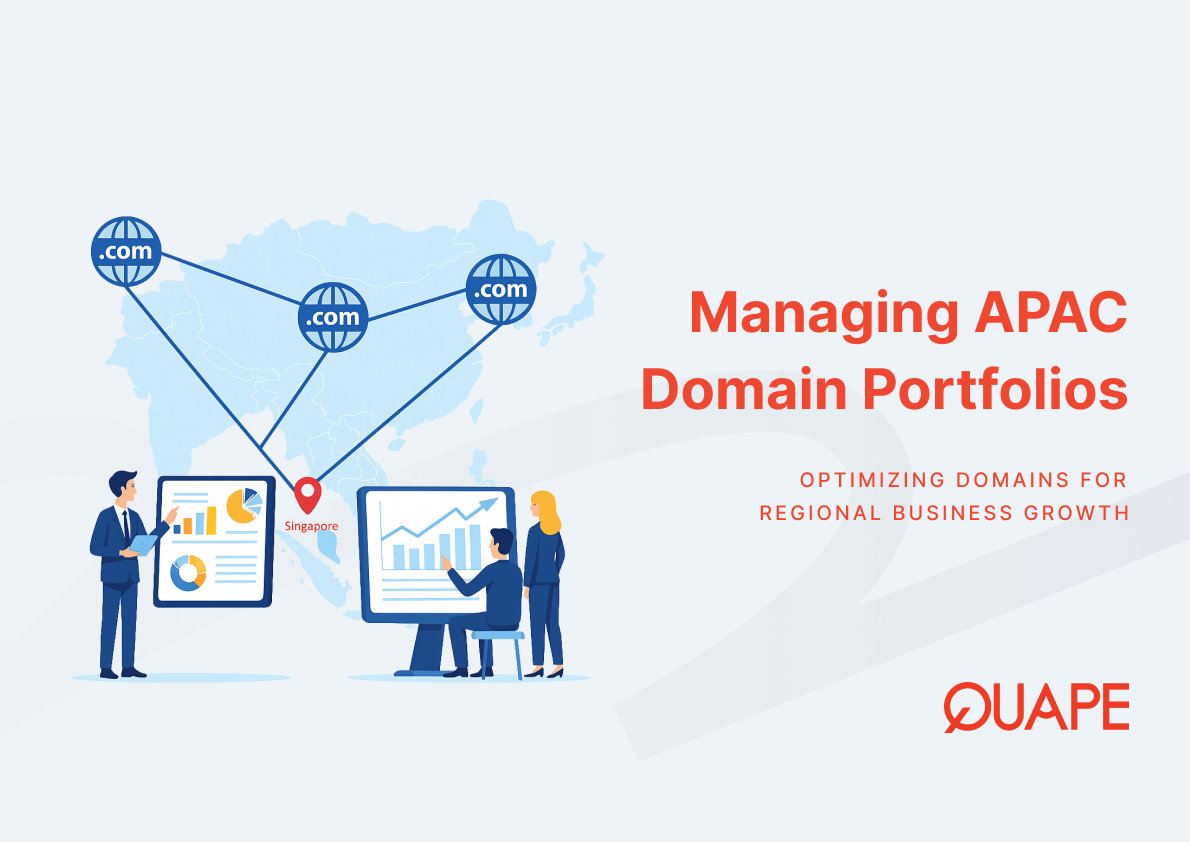
Singapore companies expanding across Asia-Pacific face a complex challenge: managing domain portfolios that span multiple countries, each with distinct registration policies, technical requirements, and trust signals. As regional digital commerce intensifies, organizations must balance global brand consistency with local market relevance. This involves strategic decisions about which top-level domains to acquire, how to structure ownership across subsidiaries, and how to protect brand identity against domain hijacking and typosquatting. For IT managers and CTOs overseeing APAC operations, domain portfolio management directly influences customer trust, search visibility, and operational risk.
An APAC domain portfolio refers to the collection of domain names a business registers and maintains across Asia-Pacific markets to support localized digital presence. This portfolio typically includes a mix of global top-level domains (gTLDs) like .com alongside country-code top-level domains (ccTLDs) such as .sg, .id, .my, and .asia. Each domain serves as a digital address that connects customers to region-specific content, services, or storefronts. The strategic composition of this portfolio affects how effectively a brand can establish trust, comply with local regulations, and compete in diverse markets where consumers exhibit strong preferences for localized web properties.
Những điểm chính
- Country-code TLDs accounted for approximately 48% of domain registrations in the Asia-Pacific region, reflecting strong regional preference for localized digital identity over generic global domains.
- Singapore’s .sg domain requires a local presence, meaning registrants must have a Singapore postal address or verified local contact, which increases trust signals for Singapore-centric brands.
- Centralized portfolio control with regional execution enables parent companies to maintain brand governance while allowing subsidiaries flexibility in tactical implementation.
- Balancing .com domains with local ccTLDs optimizes both global visibility and market-specific search relevance, addressing the trade-off between broad reach and localized trust.
- Domain sprawl and fragmented renewal cycles create expiry risk, making lifecycle automation and role-based access control essential for multi-market operations.
- Registrar consolidation reduces vendor risk and improves renewal transparency, particularly when managing domains across jurisdictions with varying policy enforcement.
- Domain architecture directly supports brand localization strategy by signaling compliance, cultural alignment, and commitment to specific geographic markets.
- Infrastructure alignment between domain portfolios and regional hosting reduces latency and improves user experience for distributed customer bases.
Core Challenges of Managing Domains Across the APAC Region
Cross-border registration complexity arises from the fact that each APAC market operates its own domain registry with distinct rules. Some registries require local business entities, others mandate specific documentation, and many enforce residency or incorporation requirements that foreign companies must navigate through partnerships or local subsidiaries. This regulatory fragmentation forces organizations to maintain relationships with multiple registrars, understand diverse compliance frameworks, and adapt registration workflows to each jurisdiction’s administrative processes.
Country-Specific Domain Policies and Registry Rules
Local presence requirements vary significantly across APAC ccTLDs. Singapore’s .sg domain, administered by the Singapore Network Information Centre, enforces rules that require registrants to maintain a Singapore postal address, while other markets like Japan’s .jp impose similar constraints. These governance models exist to ensure that ccTLDs represent genuine local business activity rather than speculative domain hoarding. Registry validation processes typically involve document submission, entity verification, and ongoing compliance checks that registrants must satisfy before and after domain acquisition. For multinational companies, this means establishing legal entities or appointing local administrative contacts in each target market.
Fragmented Domain Ownership and Renewal Risk
Domain sprawl occurs when different business units, regional offices, or subsidiaries register domains independently without centralized oversight. This decentralized control creates visibility gaps where the parent organization loses track of which domains exist, when they expire, and who manages them. Expiry risk management becomes critical because domains that lapse can be acquired by competitors or malicious actors, leading to brand impersonation or traffic hijacking. Centralized governance addresses this by consolidating domain ownership under a single entity while delegating operational control to regional teams through role-based access systems.
Security, Compliance, and Brand Abuse Risks
Domain hijacking represents a persistent threat where attackers gain unauthorized access to domain registrar accounts and transfer ownership or modify DNS records. Typosquatting exploits common misspellings of brand names to capture misdirected traffic, while brand impersonation involves registering domains that resemble legitimate corporate properties to deceive customers. These risks intensify across APAC portfolios because attackers can target less-monitored regional domains or exploit jurisdictions with weaker dispute resolution mechanisms. Security controls must therefore span authentication protocols, registrar lock features, and continuous monitoring for suspicious registration patterns.
Regional Multi-Domain Management Models Used by Singapore Companies
Regional multi-domain management balances the need for corporate brand consistency with the operational reality that local markets require customized digital properties. Singapore companies with APAC operations typically adopt models where centralized IT governance establishes policies, security standards, and architectural frameworks, while distributed brand operations execute tactical decisions about content, marketing, and customer engagement. This separation allows parent organizations to protect core assets while enabling regional teams to respond quickly to market conditions.
Centralized Portfolio Control with Regional Execution
Parent-subsidiary domain structures often place legal ownership of all domains with the Singapore headquarters while granting administrative privileges to country managers. This arrangement ensures that renewal payments, security policies, and dispute resolution remain under central oversight, reducing the risk of domain loss due to subsidiary mismanagement. Regional DNS delegation allows local teams to control DNS records for their market-specific domains, enabling them to point domains to local hosting infrastructure, configure email systems, and implement content delivery optimizations without requiring approval for every technical change.
Balancing Global TLDs and Local ccTLDs
The .com vs ccTLD strategy presents a fundamental trade-off. Global TLDs like .com maximize broad visibility and are universally recognized, making them suitable for international marketing campaigns and cross-border e-commerce. However, local ccTLDs such as .sg, .com.sg, or .asia generate trust localization signals that improve conversion rates in specific markets. Research indicates that consumers in APAC often perceive ccTLDs as more credible for transactions involving local currency, customer service, or regulatory compliance. Effective portfolio strategies combine both approaches, using .com for corporate communications while deploying ccTLDs for market-specific storefronts and support portals.
Brand Localization Strategy Through Domain Architecture
Brand localization strategy extends beyond translation to encompass market-specific digital identity that reflects cultural preferences, regulatory expectations, and consumer behavior patterns. Domain architecture serves as the foundation for this strategy by signaling to customers, search engines, and business partners that an organization maintains a genuine presence in their market rather than simply serving them from a foreign headquarters.
Using ccTLDs to Signal Local Trust and Compliance
The .sg and .com.sg domains directly improve local search relevance because search engines treat ccTLDs as strong geographic signals when ranking results for Singapore-based queries. This technical advantage combines with psychological trust factors. Customers shopping for financial services, healthcare, or government-related products exhibit strong preferences for domains that demonstrate local establishment. The regulatory requirement for a Singapore address when registering these domains reinforces their credibility, as customers recognize that businesses cannot acquire them without legitimate local presence.
Language, Market Segmentation, and Domain Naming Conventions
Geo-targeted branding adapts domain names to reflect how customers in specific markets search for products and services. This might involve registering domains that incorporate local language terms, regional business identifiers, or market-specific product categories. Linguistic adaptation considers not only translation but also how domain names appear in local scripts, how easily they can be typed on regional keyboard layouts, and whether they avoid unintended meanings in local languages. Singapore companies expanding into markets like Indonesia, Vietnam, or Thailand must evaluate whether to use English-based domains, transliterated names, or entirely localized domain strings based on target audience digital literacy and search behavior.
Operational Best Practices for Cross-Border Domain Registration
Cross-border registration workflows require standardized processes that accommodate jurisdictional differences while maintaining efficiency. Organizations establish documentation repositories for required business certificates, residency proofs, and administrative contact information. They create registration playbooks that specify which registrar to use in each market, what approval chain to follow, and how to record domain metadata in centralized asset management systems. Registrar consolidation reduces complexity by partnering with providers that can handle multiple ccTLDs and gTLDs through a single interface.
Registrar Selection and Vendor Risk Management
Registrar reliability matters because domain transfers between registrars involve lock periods, verification steps, and potential service disruption. Organizations evaluate registrars based on their accreditation status with relevant registries, their track record for renewal transparency, and their responsiveness during security incidents. Vendor risk management also considers financial stability, since registrar bankruptcy or acquisition can force domain migrations at inopportune times. For APAC portfolios, registrars with regional presence and multilingual support streamline cross-border operations.
Automation, Renewal Cycles, and Access Control
Domain lifecycle management automates renewal cycles to prevent accidental expiration, which poses particular risk for portfolios spanning dozens or hundreds of domains across multiple registries. Automation systems track expiration dates, trigger renewal payments, and alert administrators when domains approach their renewal windows. Role-based access ensures that regional managers can update DNS records or technical contacts for their domains without gaining the ability to transfer ownership or modify payment methods. This separation of privileges reduces insider risk while maintaining operational flexibility.
How Domain Registration Supports Scalable APAC Domain Portfolios
Đăng ký tên miền establishes the foundational relationship between an organization and its digital properties. Portfolio scalability depends on registration processes that accommodate rapid market entry without creating governance gaps. This requires systems that can onboard new domains quickly while ensuring they conform to security standards, naming conventions, and ownership structures. DNS management integrates with registration to ensure that newly acquired domains can be configured immediately for production use, testing environments, or protective defensive registrations.
Scalable registration also addresses the reality that APAC expansion often involves opportunistic market entry where business priorities shift rapidly. Organizations need the ability to register domains in new markets within days of identifying opportunities, which requires pre-established relationships with registrars covering multiple jurisdictions. The registration process should capture metadata about each domain’s business purpose, responsible team, and renewal budget to prevent the accumulation of orphaned domains that consume resources without delivering value.
Strategic Alignment Between Domain Portfolios and Hosting Infrastructure
Domain-to-infrastructure alignment ensures that domains point to hosting systems that optimize latency and comply with data sovereignty requirements. Regional hosting strategy places web servers, databases, and content delivery nodes in geographic proximity to target customers, reducing page load times and improving user experience. This alignment matters particularly for e-commerce and SaaS applications where milliseconds of latency influence conversion rates and customer satisfaction.
Singapore companies expanding across APAC often establish their primary infrastructure in Singapore due to its robust connectivity, political stability, and skilled technical workforce. They then deploy edge nodes or secondary hosting in markets like Indonesia, Vietnam, and Malaysia to serve local traffic while maintaining core systems in Singapore. Domain architecture supports this by using DNS geolocation to route users to the nearest hosting point while maintaining centralized control over domain ownership and security policies.
Conclusion & Next Steps for Singapore-Based APAC Expansion
Managing domain portfolios across APAC requires strategic thinking about how digital identity supports business objectives in diverse regulatory and cultural environments. Organizations that treat domains as infrastructure assets rather than isolated registrations build competitive advantages through improved trust signals, reduced operational risk, and faster market entry capabilities. Success depends on establishing governance frameworks that balance central control with regional flexibility while investing in automation systems that prevent the expiry and security incidents that plague fragmented portfolios.
For businesses ready to strengthen their APAC domain strategy, liên hệ với đội ngũ bán hàng của chúng tôi to discuss how our domain registration services support multi-market expansion with transparent pricing and regional expertise.
Câu Hỏi Thường Gặp
What makes managing APAC domain portfolios different from single-market operations?
APAC portfolios must accommodate country-specific registration policies, varying local presence requirements, and diverse consumer preferences for ccTLDs versus global domains. Each market operates its own registry with distinct documentation requirements, validation processes, and dispute resolution mechanisms that complicate centralized management.
How do local presence requirements affect Singapore companies registering domains in other APAC markets?
Local presence requirements often force Singapore companies to establish legal entities, appoint local administrative contacts, or partner with in-country registrars to acquire ccTLDs. This increases operational complexity and legal overhead but enables access to trust signals that improve local market performance.
Should a business prioritize .com domains or local ccTLDs when expanding across APAC?
The optimal strategy combines both. Use .com for global brand consistency and international marketing, while deploying local ccTLDs for market-specific e-commerce, customer support, and content that requires strong local trust signals. Research shows ccTLDs improve search relevance and conversion rates in their home markets.
What are the biggest security risks when managing domains across multiple APAC countries?
Domain hijacking poses the greatest threat, particularly for less-monitored regional domains where attackers exploit weak registrar account security. Typosquatting and brand impersonation also intensify across diverse markets where monitoring suspicious registrations becomes more resource-intensive.
How does domain architecture support brand localization beyond just translation?
Domain architecture signals genuine local presence through ccTLDs that require in-country registration, demonstrates compliance with regional data policies, and enables geo-targeted content delivery that adapts to cultural preferences. This creates differentiated digital experiences that resonate with local customers more effectively than translated content served from foreign domains.
What role does registrar consolidation play in reducing operational complexity?
Consolidating domains with registrars that can manage multiple ccTLDs and gTLDs through unified interfaces reduces the number of vendor relationships, payment systems, and administrative portals teams must navigate. This improves renewal transparency, simplifies security policy enforcement, and reduces the risk of domains falling through management gaps.
How frequently should businesses audit their APAC domain portfolios?
Quarterly audits help identify orphaned domains, verify ownership records, check renewal status, and assess whether existing domains still align with business priorities. This frequency balances the need for oversight with the operational burden of conducting comprehensive portfolio reviews.
What automation capabilities are most important for managing multi-country domain portfolios?
Renewal automation prevents accidental expiration, role-based access control maintains security while enabling regional operations, and centralized monitoring systems track registration changes, DNS modifications, and suspicious activity across all domains regardless of registrar or jurisdiction.

- Business Email Hosting vs G-Suite / Microsoft 365 - Tháng 12 29, 2025
- Shared Hosting vs Dedicated Hosting for Email - Tháng 12 29, 2025
- SMTP vs POP3 vs IMAP: Which Protocol Fits Your Business Workflow - Tháng 12 28, 2025