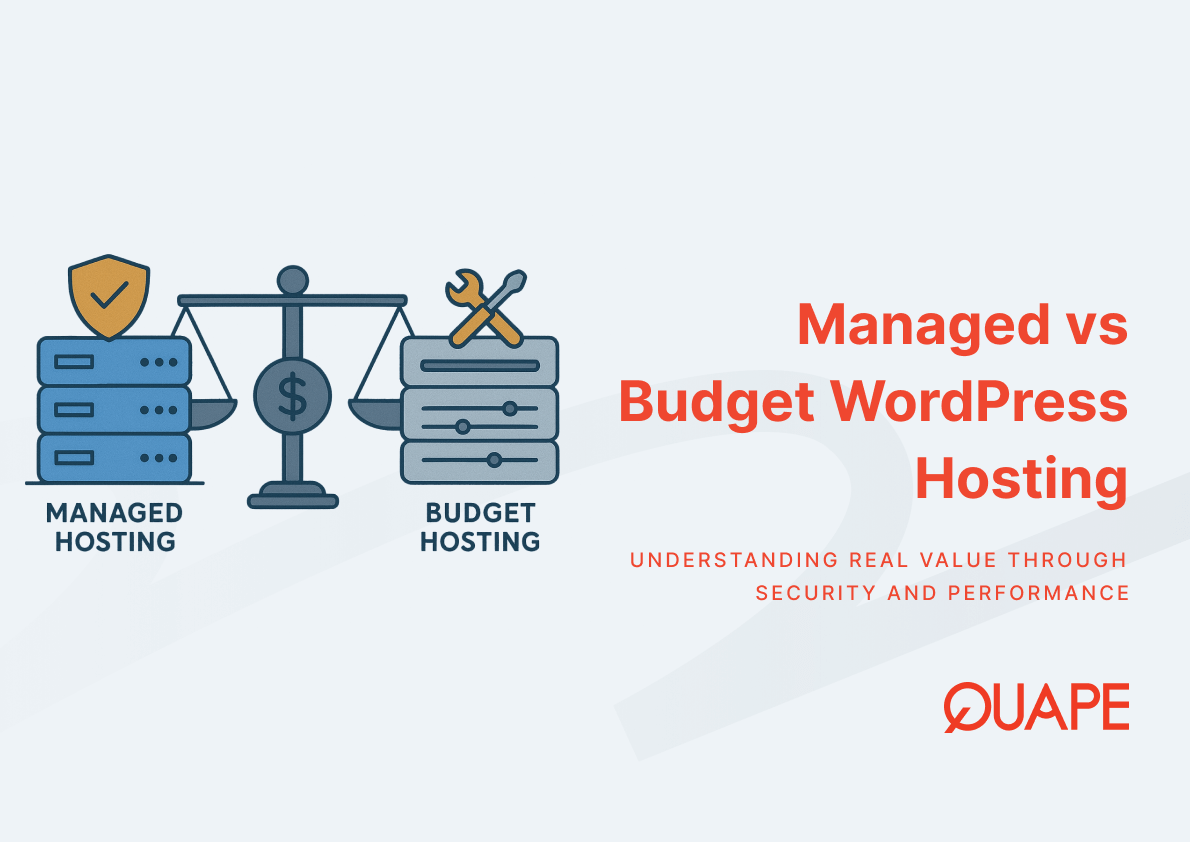
For organisations running WordPress sites, hosting decisions extend beyond monthly costs to affect security posture, operational workload, and business continuity. With WordPress powering roughly 43% of all websites globally, the infrastructure choices supporting these installations represent a systemic concern for a substantial portion of the web. Managed and budget hosting models differ fundamentally in how they distribute responsibility for security patching, performance tuning, and incident response, and those differences translate directly into risk profiles, staff time commitments, and long-term total cost of ownership. Understanding the real value proposition requires examining how hosting infrastructure, service level agreements, and operational support interact with your organisation’s technical capacity and business priorities.
Managed WordPress hosting transfers operational responsibilities (security updates, performance optimisation, backup orchestration, and troubleshooting) to the hosting provider, while budget (unmanaged) hosting provides infrastructure access at lower recurring fees but requires in-house teams to handle patching, monitoring, and remediation. The distinction centres on risk allocation and resource efficiency rather than simple price comparison.
Những điểm chính
- Security exposure scales with the WordPress ecosystem: Over 8,000 WordPress-related vulnerabilities were disclosed in 2024 alone, many affecting widely-deployed plugins; managed services that include patch management reduce exploitable surface area and lower incident response costs.
- Total Cost of Ownership (TCO) captures hidden expenses: Lower hosting fees can be offset by higher staff time, security incidents, and downtime costs; enterprise decision frameworks evaluate hosting over 3 to 5 year windows to account for operational burden.
- Infrastructure choices directly affect performance metrics: NVMe storage delivers materially higher IOPS and lower latency than legacy SATA drives, improving database responsiveness and Time To First Byte (TTFB) for WordPress installations.
- Performance improvements drive measurable business outcomes: Case studies consistently demonstrate conversion uplift and engagement gains from reduced page load times, creating a quantifiable ROI channel for faster hosting infrastructure.
- Server proximity reduces latency for regional audiences: Hosting close to primary user bases lowers round-trip times and improves Core Web Vitals, particularly relevant for Singapore-focused businesses targeting local customers.
- Managed hosting functions as a risk-transfer mechanism: By consolidating security, performance, and uptime responsibilities with specialist providers, organisations gain predictable operational risk profiles and reduce internal workload.
- Budget hosting shifts operational burden in-house: Organisations with limited technical resources or competing priorities often underestimate the labour and incident costs associated with self-managed WordPress infrastructure.
Introduction to Managed vs Budget WordPress Hosting
The choice between managed and budget WordPress hosting fundamentally shapes how security vulnerabilities, performance degradation, and operational incidents affect your organisation. Budget hosting models provide infrastructure access (server resources, storage, and network connectivity) but leave WordPress-specific maintenance, security patching, and performance tuning to the site owner. Managed hosting embeds these responsibilities into the service contract, delivering not just infrastructure but ongoing operational oversight by WordPress specialists.
For Singapore SMEs evaluating managed WordPress hosting options, the distinction matters because it determines where risk accumulates and how quickly your team can respond to emerging threats or performance issues. Budget hosting optimises for initial cost efficiency, making it suitable for organisations with in-house technical capacity and established processes for patch management, backup verification, and incident response. Managed hosting optimises for operational efficiency and risk reduction, appealing to organisations where technical staff time is constrained, business continuity depends on uptime guarantees, or the cost of security incidents outweighs the premium for delegated management.
The service level difference reflects a trade-off between control and convenience. Budget hosting grants full administrative access and configuration flexibility, requiring technical proficiency to maintain security and performance standards. Managed hosting restricts certain server-level modifications to preserve stability and security, but provides specialised support teams that understand WordPress’s architecture, plugin ecosystem, and common failure modes. For procurement leads and IT managers, the value comparison depends on whether your organisation’s competitive advantage lies in managing hosting infrastructure or in focusing technical resources on product development, customer experience, and revenue-generating activities.
Key Components of Managed vs Budget WordPress Hosting
Performance and Speed Factors (Server Optimization, NVMe, IOPS)
Server infrastructure choices directly influence how WordPress responds under load and how quickly pages render for end users. WordPress relies heavily on database queries and PHP processing for dynamic content generation, making storage I/O performance and server resource allocation critical determinants of Time To First Byte and overall page load speed. NVMe storage delivers orders-of-magnitude higher IOPS and substantially lower latency compared to legacy SATA/AHCI stacks, improving random read/write operations that database-driven CMS platforms depend on during query execution and cache retrieval.
Managed hosting providers typically provision NVMe drives, optimised PHP/MySQL configurations, and object caching layers as standard infrastructure components, ensuring that server resources align with WordPress’s technical requirements. Budget hosting often relies on shared resources and older storage technologies, where performance variability increases with server load and neighbour activity. When multiple sites contend for limited IOPS on shared infrastructure, database query times lengthen and TTFB degrades, particularly during traffic spikes or when resource-intensive plugins execute.
The business impact of these infrastructure differences manifests in Core Web Vitals scores and user experience metrics that correlate with conversion rates and engagement. Multiple case studies document measurable conversion and engagement uplift from speed optimisation, demonstrating that performance improvements translate into quantifiable business ROI. For organisations where site speed affects revenue or customer acquisition costs, the performance floor established by server optimisation and storage architecture becomes a strategic factor rather than a technical detail.
Network proximity to end users introduces another performance variable. Server location and network path materially affect latency and TTFB, as documented in web performance research measuring server response time across geographically distributed audiences. For businesses targeting Singapore customers or regional markets, hosting infrastructure positioned close to the user base reduces round-trip times and improves perceived responsiveness, a clear operational advantage when competing for attention in latency-sensitive contexts like mobile commerce or content consumption.
Security, Monitoring, and Risk Management
WordPress’s large ecosystem and dominant market position create a persistent security challenge: as the platform evolves, thousands of themes and plugins introduce potential vulnerabilities that require continuous monitoring and timely remediation. Security reports document large year-over-year increases in disclosed high-risk issues affecting core, themes, and plugins, with independent reporting noting approximately 8,000 new WordPress-related vulnerabilities in 2024 alone. Many of these affect widely-used plugins, creating operational risk for installations that lack proactive patch management.
Managed hosting services that include vulnerability scanning, automated patching, and security monitoring reduce the exploitable surface area by ensuring that known CVEs are addressed systematically. When a critical vulnerability emerges in a popular plugin, managed providers can deploy patches across their infrastructure within hours, limiting exposure windows. Budget hosting requires site owners to track security advisories, test updates in staging environments, and deploy patches manually, a process that introduces delays and depends on internal vigilance.
The risk-transfer dynamic matters because security incidents carry costs beyond direct remediation: revenue loss during downtime, customer trust erosion, regulatory notification requirements, and forensic investigation expenses. For organisations without dedicated security operations teams, the cumulative cost of monitoring, patching, and responding to incidents often exceeds the price differential between budget and managed hosting over multi-year evaluation windows. Security checklist implementation becomes a recurring operational burden rather than a one-time configuration task.
Monitoring and uptime protection extend the security value proposition. Managed hosting typically includes real-time alerting for performance anomalies, failed backups, or suspicious activity patterns, enabling rapid incident response before issues escalate. Budget hosting provides infrastructure availability guarantees but leaves application-layer monitoring and threat detection to the site owner. The operational question centres on whether your organisation has the capacity to maintain 24/7 monitoring, investigate alerts, and coordinate responses, or whether delegating that responsibility to specialist providers reduces total cost and improves threat mitigation outcomes.
Support Quality and Technical Expertise
Support quality differentiates managed and budget hosting most clearly when issues arise outside routine operations. Managed hosting providers employ WordPress specialists who understand the platform’s architecture, plugin interactions, and common failure modes, enabling rapid diagnosis and resolution when performance degrades or functionality breaks. Budget hosting typically offers infrastructure-level support (network connectivity, server availability, basic control panel assistance) but stops short of troubleshooting WordPress-specific issues like theme conflicts, database optimisation, or plugin compatibility.
The technical expertise gap affects mean time to resolution during critical incidents. When a site experiences unexplained slowdowns or service interruptions, WordPress-focused support teams can analyse database query patterns, identify resource-intensive plugins, and implement caching strategies without requiring site owners to possess deep technical knowledge. Budget hosting support may confirm that the server is operational and network-accessible but defer application-layer troubleshooting to the customer or third-party developers, extending downtime and increasing diagnostic costs.
For organisations where WordPress represents a business-critical platform (customer portals, e-commerce storefronts, content delivery systems), the value of expert troubleshooting compounds over time. Recurring issues that consume developer hours under budget hosting can be resolved quickly by managed support teams familiar with WordPress’s technical dependencies. The service level reliability embedded in managed hosting contracts translates into predictable incident response times and reduced internal workload, freeing technical staff to focus on feature development and strategic initiatives rather than operational firefighting.
Developer assistance models also differ structurally. Managed hosting providers often support staging environments, automated deployment workflows, and Git integration, enabling development teams to test changes safely before production deployment. Budget hosting provides infrastructure access but requires customers to configure development workflows independently. For teams that lack DevOps experience or prefer to avoid managing deployment pipelines, managed hosting delivers operational scaffolding that reduces friction and improves release velocity.
ROI and Long-Term Operational Value
Total Cost of Ownership (TCO) serves as the standard framework enterprises use to evaluate the full lifecycle cost of IT services, capturing acquisition costs, recurring fees, operational expenses, and opportunity costs from downtime or delayed projects. Applying TCO to WordPress hosting decisions reveals that lower upfront hosting fees can be offset by higher ongoing management, security, and incident response costs when budget hosting transfers operational responsibilities in-house.
Decision-makers evaluating hosting over 3 to 5 year windows (the typical TCO analysis horizon recommended by enterprise procurement guidance) must account for staff time spent on patch management, security monitoring, performance tuning, and troubleshooting. If an internal developer spends four hours monthly managing WordPress updates and investigating performance issues, that recurring labour cost accumulates substantially over multi-year periods. Managed hosting raises recurring fees but eliminates or significantly reduces that internal workload, potentially lowering total cost when staff time carries high opportunity cost or when technical resources face competing priorities.
The risk vs value calculation also incorporates downtime costs and security incident expenses. For revenue-generating sites, even brief outages translate directly into lost transactions and customer frustration. For customer-facing platforms, security breaches damage brand reputation and trigger regulatory notification obligations. Managed hosting providers that offer uptime SLAs, proactive monitoring, and rapid incident response reduce the likelihood and severity of these high-cost events. Budget hosting places the burden of availability and security on site owners, increasing exposure to incidents that budget-conscious decisions often underestimate.
Resource efficiency considerations extend beyond cost comparison to strategic alignment. Organisations with limited technical capacity or where developer time constrains product velocity gain more value from delegating operational overhead to managed providers. The lifecycle cost calculation must weigh not just direct hosting fees versus internal labour but also the strategic opportunity cost of technical staff managing infrastructure instead of building features, optimising conversions, or improving customer experience. For SMEs and startups where technical talent is scarce and business priorities shift rapidly, managed hosting delivers operational predictability that supports faster execution.
Ứng dụng thực tế cho doanh nghiệp tại Singapore
Singapore-based businesses evaluating WordPress hosting decisions benefit from understanding how regional infrastructure, regulatory context, and local support availability interact with managed versus budget hosting models. Server proximity to Singapore reduces latency for local audiences, improving TTFB and user experience for customers accessing sites from the region. Hosting infrastructure positioned in Singapore data centers or with regional edge presence delivers measurable performance advantages compared to distant server locations, particularly for latency-sensitive applications like real-time content delivery or transactional systems.
Regulatory compliance considerations also factor into procurement decisions. Organisations subject to data localisation requirements or industry-specific regulations (financial services, healthcare, government contractors) must ensure that hosting infrastructure meets jurisdictional and security standards. Managed hosting providers with Cơ sở hạ tầng trung tâm dữ liệu Singapore can offer compliance guidance, audit support, and contractual assurances around data residency, operational capabilities that budget hosting rarely includes. For procurement leads navigating regulatory obligations, the compliance scaffolding embedded in managed services reduces implementation risk and simplifies vendor management.
Local support availability affects incident response effectiveness during business-critical outages. Managed hosting providers with Singapore-based support teams operate in compatible time zones and understand regional business practices, enabling faster communication and resolution during urgent incidents. Budget hosting often routes support requests through global queues or offshore teams, introducing communication delays and timezone mismatches that extend downtime. For organisations where site availability directly affects revenue or customer trust, local support responsiveness becomes a material operational advantage.
The procurement decision framework for Singapore SMEs must balance initial cost sensitivity with operational maturity. Early-stage businesses with technical founders may extract value from budget hosting’s flexibility and lower fees, investing staff time in infrastructure management while conserving capital. Growth-stage organisations scaling customer bases or expanding product offerings typically benefit from transitioning to managed hosting, as operational complexity increases and the opportunity cost of technical staff managing infrastructure rises. Mature enterprises with established technical teams may selectively deploy managed hosting for business-critical properties while maintaining budget hosting for internal tools or experimental projects, aligning hosting models with strategic importance and risk tolerance.
How WordPress Hosting by Quape Supports Real Value in Managed Hosting
QUAPE’s managed WordPress hosting plans embed security updates, automated daily backups, and NVMe storage into standard service offerings, addressing the operational and performance factors that differentiate managed from budget hosting models. Monthly security updates ensure that WordPress core, themes, and plugins receive patches systematically, reducing exposure to the thousands of vulnerabilities disclosed annually. Automated backup orchestration with one-click restore capability provides recovery options when incidents occur, minimising downtime and data loss risks that budget hosting leaves to site owners to implement independently.
The WordPress Toolkit integrated into QUAPE’s control panel enables plugin updates without requiring direct WordPress admin access, streamlining maintenance workflows for technical teams and reducing the operational burden of keeping installations current. For organisations managing multiple WordPress sites, centralised toolkit access simplifies security hygiene and reduces the likelihood that busy teams defer updates due to login friction. Higher-tier plans include monthly content updates, extending managed services beyond infrastructure and security to include editorial assistance, a service layer that budget hosting never addresses.
Server infrastructure optimised specifically for WordPress ensures that NVMe storage, high IOPS configurations, and multiple upstream network providers deliver the performance characteristics that affect Core Web Vitals and user experience. QUAPE’s Singapore data center locations position infrastructure close to regional audiences, reducing latency for local customers and supporting compliance requirements for organisations subject to data residency obligations. Free migration services within 1 to 3 business days (with expedited options available) lower switching costs for organisations evaluating transitions from budget to managed hosting, addressing a common procurement barrier.
The support model emphasises WordPress expertise over generic infrastructure assistance. Professional developers assess plugin configurations during migrations, identify paid plugins requiring licenses, and perform security checklist reviews before sites go live on QUAPE infrastructure. This pre-deployment scrutiny reduces post-migration issues and ensures that sites inherit security best practices from the outset. For organisations outgrowing standard managed hosting, upgrade paths to Các gói lưu trữ VPS provide additional CPU, RAM, and storage without requiring architectural redesign or platform migration.
The value proposition centres on operational predictability and risk reduction. By consolidating security patching, performance tuning, backup management, and expert support under a single service contract, QUAPE enables organisations to treat WordPress infrastructure as a managed operational layer rather than an ongoing technical project. For procurement leads evaluating TCO over multi-year horizons, this operational model converts variable internal costs (staff time, incident response, security remediation) into predictable recurring fees while improving security posture and site reliability.
Kết luận
Choosing between managed and budget WordPress hosting requires evaluating how operational responsibilities, risk allocation, and total cost of ownership align with your organisation’s technical capacity and business priorities. While budget hosting optimises for initial cost efficiency, managed hosting delivers operational predictability, security assurance, and performance guarantees that often prove more valuable when measured over multi-year horizons and when accounting for staff time, incident costs, and business continuity requirements. For Singapore businesses where technical resources are constrained or where site performance directly affects revenue, managed hosting functions as a strategic enabler rather than a discretionary expense.
If your organisation is ready to evaluate how managed WordPress hosting can reduce operational burden and improve security posture, liên hệ với đội ngũ bán hàng của chúng tôi to discuss hosting plans aligned with your technical requirements and business objectives.
Câu Hỏi Thường Gặp
What specific operational tasks does managed WordPress hosting handle that budget hosting does not?
Managed hosting providers typically perform WordPress core updates, plugin patching, theme security updates, automated backup verification, database optimisation, and security monitoring. Budget hosting delivers infrastructure access but leaves these application-layer tasks to site owners, requiring internal technical capacity or third-party contractors to maintain security and performance standards.
How do I calculate whether the higher cost of managed hosting is justified for my organisation?
Apply Total Cost of Ownership analysis over a 3 to 5 year evaluation window, accounting for recurring hosting fees, internal staff time spent on maintenance and troubleshooting, potential downtime costs, and security incident expenses. If staff time carries high opportunity cost or if business continuity depends on rapid incident response, managed hosting often delivers lower TCO despite higher monthly fees.
Can managed hosting improve SEO performance compared to budget hosting?
Managed hosting improves infrastructure factors that affect Core Web Vitals (server response time, TTFB, and page load speed), which Google incorporates into ranking algorithms. Faster infrastructure, NVMe storage, and optimised server configurations reduce technical barriers to good performance, though on-page SEO, content quality, and backlink profiles remain dominant ranking factors.
What happens if my site outgrows managed WordPress hosting capacity?
Reputable managed hosting providers offer upgrade paths to VPS or dedicated server infrastructure with higher CPU, RAM, and storage allocations. Migration to higher-tier infrastructure typically preserves existing configurations and support relationships, avoiding the disruption of switching providers while accommodating growth in traffic or resource requirements.
How does server location in Singapore affect performance for regional audiences?
Server proximity reduces network latency and TTFB for users accessing sites from Singapore and surrounding regions. For businesses targeting local customers, Singapore data center hosting delivers measurably faster response times compared to hosting in distant locations, improving user experience and supporting better Core Web Vitals scores.
Is managed hosting suitable for organisations with internal development teams?
Managed hosting benefits development teams by reducing operational overhead, allowing developers to focus on feature development rather than infrastructure maintenance. Managed providers that support staging environments, Git integration, and deployment automation enhance development workflows while maintaining security and performance standards that internal teams would otherwise need to implement independently.
What security guarantees should I expect from managed WordPress hosting providers?
Look for providers that commit to timely security patching, vulnerability scanning, malware monitoring, and incident response protocols documented in service level agreements. Managed providers should disclose patch deployment timelines, backup retention policies, and support response times, enabling you to assess whether security commitments align with your risk tolerance.
How quickly can I migrate from budget to managed hosting if security or performance issues arise?
Migration timelines vary by provider but typically range from 1 to 3 business days for standard transitions, with expedited options available for urgent moves. Evaluate providers that offer free migration services and pre-migration security assessments to minimise switching friction and ensure that sites inherit best practices during the transition.

- Business Email Hosting vs G-Suite / Microsoft 365 - Tháng 12 29, 2025
- Shared Hosting vs Dedicated Hosting for Email - Tháng 12 29, 2025
- SMTP vs POP3 vs IMAP: Which Protocol Fits Your Business Workflow - Tháng 12 28, 2025