Virtual private server infrastructure continues to evolve alongside enterprise IT strategies, yet the choice between fully managed and self-managed deployment models remains one of the most consequential decisions organizations face. The managed IT infrastructure services market is projected to reach USD 210.08 billion by 2030, reflecting a fundamental shift in how businesses approach server operations, security, and resource allocation. For IT managers and CTOs in Singapore’s competitive digital landscape, understanding the operational, financial, and strategic implications of each model directly impacts application performance, security posture, and long-term scalability. This analysis examines how managed service roles, sysadmin responsibilities, and monitoring frameworks interact with VPS infrastructure to support different organizational needs and technical capabilities.
What Fully Managed vs Self-Managed VPS Means
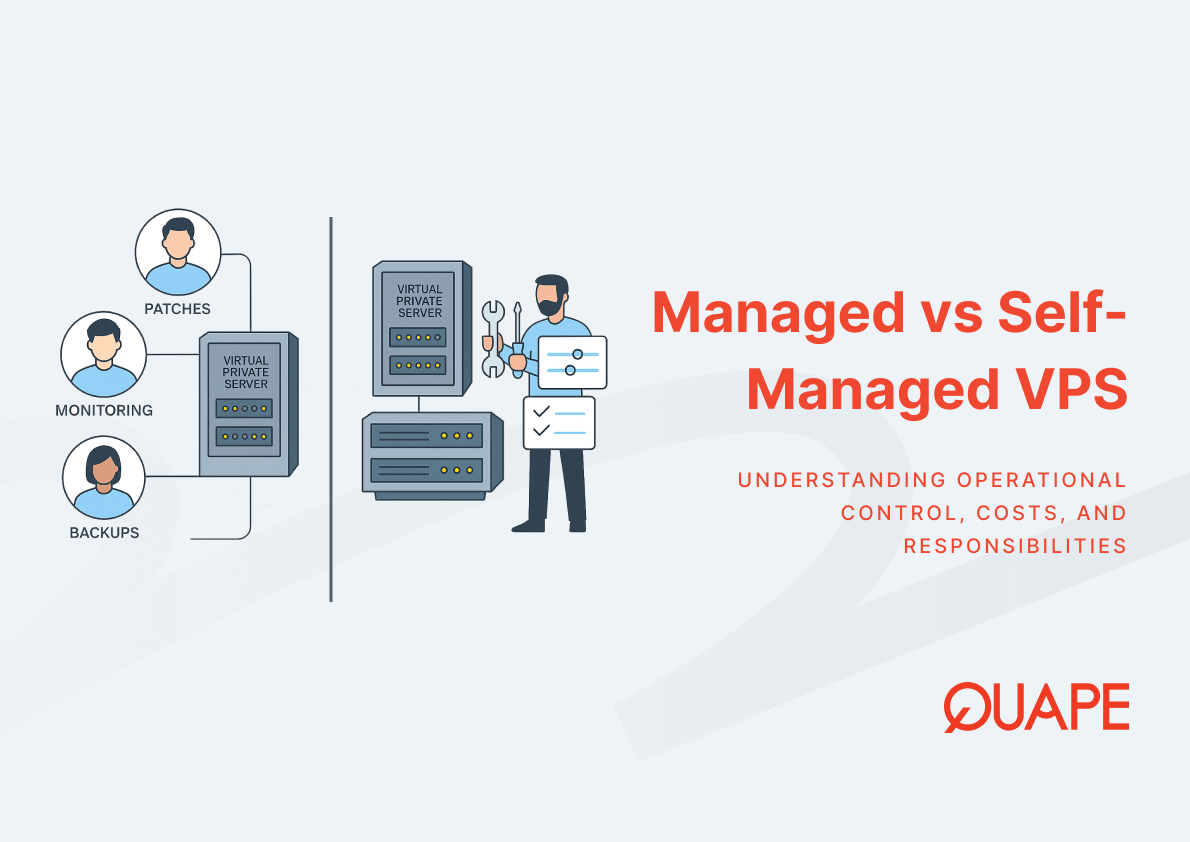
The distinction between fully managed and self-managed VPS centers on who controls server operations and bears responsibility for ongoing maintenance. A fully managed VPS delegates patching, security updates, backup execution, monitoring, and incident response to the hosting provider’s technical team. A self-managed VPS grants root access and complete administrative control to the customer’s internal team or contracted specialists, who then assume all operational responsibilities. Both models utilize the same underlying VPS托管 infrastructure with dedicated resources, but the management layer fundamentally changes cost structure, risk distribution, and required expertise.
要点总结
- Fully managed VPS offloads patching, monitoring, backup, and security tasks to the provider, reducing internal operational burden but increasing recurring costs
- Self-managed VPS provides root access and configuration flexibility, demanding sysadmin expertise while exposing organizations to maintenance risks and variable costs
- The managed servers market grew from USD 20.5 billion in 2023 and is projected to reach approximately USD 81.2 billion by 2033, indicating strong enterprise preference for outsourced infrastructure operations
- Over 50% of enterprises now use managed service providers for cloud environments, with 73% expecting to increase their reliance on managed services
- Cost predictability differs significantly: managed services operate on fixed monthly fees while self-managed setups accumulate variable expenses through licenses, outage recovery, and security incidents
- Singapore organizations must evaluate managed versus self-managed models against compliance requirements, talent availability, and business continuity objectives
- Hybrid approaches exist where providers manage infrastructure layers while customers retain application-level control
Introduction to Fully Managed vs Self-Managed VPS
Organizations selecting VPS infrastructure face a binary decision that cascades through their entire IT operations: whether to retain direct control over server administration or delegate operational responsibility to a managed service provider. This choice intersects with talent acquisition challenges, security risk tolerance, and capital allocation strategies. Survey data from S&P Global shows that 73% of enterprises using managed service providers expect their reliance to increase, driven by cloud complexity and the scarcity of qualified system administrators. The global managed service provider market reached USD 365.3 billion in 2023 and is forecast to hit USD 511.0 billion by 2029, demonstrating how operational outsourcing has become a mainstream enterprise IT strategy rather than an edge-case solution.
The managed versus self-managed question becomes particularly acute for small and medium enterprises that lack dedicated infrastructure teams. A fully managed VPS removes the need for organizations to hire, train, and retain sysadmin specialists who can handle Linux kernel updates, security patch cycles, and performance tuning. Conversely, self-managed infrastructure appeals to development teams that require granular control over application stacks, custom kernel modules, or specialized networking configurations that standardized managed services cannot accommodate. The IT services outsourcing market, estimated at USD 744.6 billion in 2024 and projected to reach USD 1,219.3 billion by 2030, reflects how businesses increasingly view infrastructure management as a specialized function best handled by dedicated providers rather than generalist internal teams.
Cost structures between these models differ in both visibility and predictability. Managed VPS services operate on fixed monthly fees that bundle server resources with operational support, creating predictable operational expenses without surprise capital outlays. Self-managed setups may appear less expensive on a per-instance basis, but accumulate hidden costs through staff time, security incident remediation, and downtime recovery. IT outsourcing statistics indicate that 81% of companies now outsource cybersecurity functions, recognizing that specialized providers can maintain threat intelligence, patch management, and compliance frameworks more effectively than distributed internal teams. The economic calculation extends beyond line-item comparison to total cost of ownership across the full infrastructure lifecycle.
Key Components & Concepts of Fully Managed vs Self-Managed VPS
Managed Service Roles
Managed VPS providers assume responsibility for the entire operational layer that sits between hardware infrastructure and customer applications. This includes operating system patching, security update deployment, kernel upgrades, backup execution, monitoring configuration, and incident response. The managed service provider monitors server health metrics continuously, responds to resource constraints before they impact application performance, and maintains security configurations aligned with current threat landscapes. Organizations utilizing VPS backup and disaster recovery planning benefit from provider-maintained retention policies and automated snapshot schedules without needing to architect these systems internally.
The scope of managed services typically encompasses firewall configuration, intrusion detection system maintenance, malware scanning, and security hardening based on CIS benchmarks or similar frameworks. Providers establish monitoring frameworks that track CPU utilization, memory consumption, disk I/O patterns, and network throughput, generating alerts when metrics exceed defined thresholds. This monitoring layer integrates with ticketing systems that route incidents to on-call engineers who can diagnose and resolve issues without requiring customer intervention. For organizations implementing cybersecurity best practices for VPS environments, managed providers offer consistent security posture maintenance that individual customers struggle to replicate across distributed server fleets.
Cost structures in managed services reflect the bundled nature of operational support. Monthly fees incorporate not just compute resources but also the expertise required to maintain those resources securely and reliably. The managed data center services market, valued at USD 53.88 billion in 2024 and forecast to reach USD 174.25 billion by 2033, demonstrates enterprise willingness to pay premium rates for operational certainty. This economic model shifts infrastructure costs from variable capital expenditures requiring internal hiring decisions to predictable operational expenses that scale with business growth. Organizations avoid the hidden costs associated with staff turnover, training requirements, and knowledge loss that characterize in-house sysadmin teams.
Sysadmin Responsibilities in Self-Managed VPS
Self-managed VPS infrastructure places complete operational control and responsibility in the hands of internal technical teams or contracted specialists. System administrators must handle initial server provisioning, operating system installation, security hardening, package management, kernel updates, and ongoing performance optimization. Root access enables administrators to modify any aspect of the server configuration, from network stack tuning to custom firewall rules, but this flexibility demands comprehensive Linux administration expertise and continuous time investment. Organizations must evaluate whether their technical staff has the depth of knowledge required for tasks ranging from choosing appropriate RAM and CPU configurations to diagnosing obscure network performance issues.
Security maintenance in self-managed environments requires administrators to monitor vulnerability disclosures, evaluate patch criticality, test updates in staging environments, and deploy fixes across production systems within appropriate maintenance windows. This process consumes significant time and demands judgment about risk trade-offs when patches introduce compatibility issues with application dependencies. The complexity multiplies across heterogeneous server fleets running different Linux distributions, application stacks, and middleware versions. Organizations lacking formal patch management processes face elevated security risks, particularly for zero-day vulnerabilities that require rapid response outside normal business hours.
Performance optimization tasks fall entirely on self-managed teams, who must diagnose bottlenecks, tune kernel parameters, optimize database configurations, and implement caching strategies. VPS network performance and latency optimization requires understanding TCP stack behavior, congestion control algorithms, and how network topology affects application responsiveness. System administrators must also establish backup procedures, verify restoration processes, and maintain disaster recovery documentation. The cumulative time investment for these ongoing responsibilities often exceeds initial estimates, particularly when unexpected incidents require after-hours troubleshooting. Organizations pursuing self-managed infrastructure must honestly assess whether existing staff has capacity and expertise for these sustained operational demands or whether hiring additional specialized talent is economically justified.
Monitoring & Automation Frameworks
Monitoring frameworks form the observability layer that enables proactive infrastructure management regardless of whether operations are self-managed or outsourced. These systems collect metrics on CPU utilization, memory pressure, disk I/O wait times, network throughput, and application-specific performance indicators, then evaluate collected data against threshold rules that trigger alerts when anomalies appear. Managed service providers operate sophisticated monitoring platforms that aggregate telemetry across thousands of customer instances, using pattern recognition to identify emerging issues before they escalate into outages. Self-managed teams must implement equivalent monitoring capabilities using tools like Prometheus, Grafana, Zabbix, or commercial alternatives that require configuration expertise and ongoing maintenance.
Automation scripts reduce manual intervention for repetitive tasks such as log rotation, temporary file cleanup, security scanning, and backup verification. Configuration management systems like Ansible, Puppet, or Chef enable infrastructure-as-code approaches where server configurations are version-controlled and reproducible across multiple instances. Organizations operating at scale benefit from automation that ensures consistent security postures, standardized software versions, and predictable deployment processes. VPS hosting that supports high-traffic websites typically incorporates auto-scaling mechanisms that provision additional resources when demand spikes, then de-provision them during quiet periods to optimize costs.
The effectiveness of monitoring and automation correlates directly with technical maturity and available expertise. Managed providers amortize the cost of developing sophisticated automation frameworks across their entire customer base, delivering enterprise-grade capabilities to organizations that could never justify building equivalent systems internally. Self-managed teams must either invest significant time constructing automation infrastructure or accept the operational burden of manual processes that scale poorly and introduce human error risk. The integration between monitoring alerts and incident response workflows determines how quickly issues get resolved, making monitoring architecture a critical factor in overall infrastructure reliability. Storage performance monitoring becomes particularly important for applications with high I/O demands, where NVMe VPS hosting provides measurable performance advantages that must be validated through consistent telemetry collection.
新加坡企业的实际应用
Singapore’s position as a regional digital hub creates specific considerations for organizations evaluating managed versus self-managed VPS infrastructure. Local data sovereignty regulations may require that certain data types remain within Singapore’s borders, influencing whether organizations can utilize offshore managed service providers or must select Singapore-based alternatives. The tight labor market for skilled IT professionals in Singapore makes talent acquisition particularly challenging, with qualified system administrators commanding premium salaries that shift economic calculations toward managed services. Organizations must evaluate whether Singapore’s strategic advantages for VPS hosting justify managed service premiums or whether self-managed infrastructure with offshore support teams offers better economics.
Compliance requirements intersect with management model selection. Financial services, healthcare, and government-adjacent organizations operating under MAS, PDPA, or sector-specific regulations must ensure that managed service providers can demonstrate appropriate security controls, audit capabilities, and incident response procedures. Understanding Singapore data sovereignty and compliance requirements becomes critical when evaluating managed service agreements, as providers must contractually commit to maintaining data residency, supporting audit requests, and notifying customers of security incidents within mandated timeframes. Self-managed infrastructure gives organizations direct control over compliance evidence collection but requires internal expertise to interpret regulatory requirements and implement appropriate technical controls.
Business continuity planning differs between managed and self-managed models. Managed providers typically operate follow-the-sun support teams that can respond to incidents regardless of when they occur, providing assurance that critical systems receive attention during Singapore’s night hours when internal staff may be unavailable. Self-managed teams must establish on-call rotations, maintain comprehensive runbook documentation, and ensure sufficient knowledge distribution so that no single employee becomes a critical dependency. For SMEs lacking deep technical benches, managed services de-risk operations by ensuring that provider staff continuity maintains service levels even as individual team members change roles. The managed servers market growth to a projected USD 81.2 billion by 2033 reflects how organizations increasingly value operational certainty over the theoretical cost savings of self-management.
How VPS Hosting Supports Managed and Self-Managed VPS
VPS hosting infrastructure provides the foundation layer that both managed and self-managed models build upon. Dedicated CPU cores, memory allocation, and NVMe storage deliver consistent performance regardless of which team handles operational management. The virtualization layer isolates customer workloads, ensuring that resource consumption by neighboring instances cannot impact application performance or introduce security risks. Organizations selecting VPS托管 gain dedicated resources without the capital expense and maintenance burden of physical dedicated servers, creating a middle ground between shared hosting’s resource contention and dedicated hardware’s operational complexity.
Performance characteristics remain consistent across management models, as the underlying infrastructure determines I/O throughput, network latency, and computational capacity. The primary difference lies in who optimizes configurations to extract maximum value from allocated resources. Managed providers tune kernel parameters, optimize web server configurations, and implement caching strategies as part of their standard service delivery. Self-managed teams must develop equivalent expertise or accept suboptimal performance from default configurations. The three-fold performance advantage demonstrated in comparative benchmarks reflects how proper tuning significantly impacts application responsiveness, regardless of whether that optimization comes from provider engineers or customer sysadmins.
Security capabilities inherent to VPS infrastructure include network isolation, dedicated IP addresses, and the ability to implement custom firewall rules that restrict traffic to only required ports and protocols. Managed service providers leverage these capabilities by maintaining standardized security configurations aligned with industry frameworks, while self-managed teams must architect equivalent protections based on their specific threat models and compliance requirements. Both approaches can achieve strong security postures, but the managed model removes the burden of continuously tracking emerging vulnerabilities, evaluating their applicability, and deploying mitigations before exploitation occurs. The architectural foundation of VPS hosting supports security through isolation; operational practices determine whether that foundation translates into effective protection.
Choosing Between Fully Managed and Self-Managed VPS
Organizations must evaluate their technical capabilities, risk tolerance, and strategic priorities when selecting between managed and self-managed VPS infrastructure. The decision framework begins with honest assessment of internal expertise: does the organization employ system administrators with demonstrated Linux administration skills, security hardening experience, and performance tuning capabilities? If not, can the organization attract and retain such talent in a competitive labor market, and does the business scale justify the salary expense? The global managed services market growth from USD 275.5 billion in 2023 to a projected USD 372.6 billion by 2028 indicates that most organizations answer these questions by acknowledging that infrastructure operations represent specialized expertise better sourced externally than developed internally.
Cost-benefit analysis extends beyond simple price comparison to examine total ownership expenses across multi-year horizons. VPS hosting pricing models differ in how they bundle resources, support, and operational services. Managed VPS appears more expensive on a per-instance basis but eliminates costs associated with hiring sysadmins, maintaining monitoring infrastructure, and recovering from incidents caused by misconfigurations or delayed patching. Self-managed infrastructure offers lower baseline costs but accumulates variable expenses through staff time, security incident remediation, and downtime recovery. Organizations must predict VPS scaling costs over time by modeling both direct hosting expenses and indirect costs related to operational overhead and risk exposure.
Risk tolerance shapes management model selection. Organizations with low tolerance for downtime, security incidents, or compliance violations typically favor managed services that contractually commit to service level agreements backed by financial penalties. Self-managed infrastructure places full responsibility on internal teams, who must architect redundancy, maintain security postures, and respond to incidents without external escalation options. The 131% growth in IT outsourcing between 2021 and 2025 demonstrates how organizations increasingly view infrastructure operations as risk domains best transferred to specialized providers rather than managed in-house. Strategic context matters: a technology company building its core product on custom infrastructure justifies self-management investment, while a marketing agency running standard web applications gains limited strategic value from maintaining its own server operations. The optimal choice aligns infrastructure management approach with organizational core competencies and competitive differentiators.
结论
The managed versus self-managed VPS decision represents a strategic choice about where organizations invest scarce technical talent and how they manage operational risk. Fully managed services deliver predictable costs, reduced operational burden, and professional security maintenance at premium pricing, while self-managed infrastructure offers configuration flexibility and potentially lower baseline costs in exchange for demanding ongoing expertise investment. As the managed IT infrastructure services market approaches USD 210 billion by 2030, the trajectory clearly indicates enterprise preference for operational outsourcing. Singapore organizations must evaluate this decision against local talent constraints, compliance requirements, and strategic priorities that determine whether infrastructure management represents a core competency worth developing internally or a specialized function better sourced from dedicated providers.
联系我们的销售团队 to discuss whether managed or self-managed VPS infrastructure best aligns with your operational requirements and technical capabilities.
常见问题 (FAQ)
What are the main differences between fully managed and self-managed VPS?
Fully managed VPS delegates all server operations including patching, monitoring, backups, and security to the hosting provider, while self-managed VPS gives you root access and full control but requires you to handle all maintenance tasks yourself. The managed model costs more but removes operational burden, whereas self-management offers flexibility at the expense of requiring sysadmin expertise.
How much does managed VPS typically cost compared to self-managed?
Managed VPS services typically cost 30-50% more than equivalent self-managed instances due to bundled operational support, monitoring infrastructure, and security maintenance. However, this comparison excludes the cost of hiring sysadmin staff, time spent on maintenance tasks, and potential expenses from security incidents or downtime in self-managed environments.
Can I switch from self-managed to managed VPS later?
Yes, most providers support migration from self-managed to managed services, though the process requires coordination to transfer operational responsibilities and may involve reconfiguration to align with the provider’s management standards. The transition typically includes auditing existing configurations, standardizing security settings, and establishing monitoring baselines before the provider assumes full operational control.
What level of access do I have with fully managed VPS?
Fully managed VPS typically provides limited access sufficient for application deployment and configuration but restricts root-level system administration to prevent conflicts with provider management processes. You can deploy applications, modify application configurations, and access logs, but kernel updates, security patching, and infrastructure-level changes remain provider responsibilities.
Do managed VPS providers support custom software installations?
Most managed VPS providers support common application stacks and can install custom software upon request, but highly specialized or uncommon software may fall outside their standard support scope. Organizations with unique infrastructure requirements should verify that providers can accommodate specific software dependencies before committing to managed services.
How quickly can managed VPS providers respond to security incidents?
Managed VPS providers typically offer 24/7 monitoring with incident response times ranging from 15 minutes to several hours depending on severity level and service tier. Critical security incidents receive immediate attention, while lower-priority issues may be addressed during next business day, with specific response commitments detailed in service level agreements.
Is self-managed VPS suitable for small businesses without dedicated IT staff?
Self-managed VPS is generally not recommended for small businesses lacking dedicated IT expertise, as the operational burden of security maintenance, patching, monitoring, and incident response requires specialized knowledge that generalist staff cannot reliably provide. Small businesses without sysadmin resources typically achieve better outcomes with managed services that bundle infrastructure with professional operational support.
What happens if my managed VPS provider experiences an outage?
Managed VPS providers typically operate redundant infrastructure with service level agreements that commit to minimum uptime percentages, often 99.9% or higher. If provider infrastructure fails, their operations teams work to restore service while keeping customers informed of progress, and SLA breaches may result in service credits as contractual remediation.

- VPS Network Performance & Latency Optimization - 12 月 12, 2025
- How to Choose RAM & CPU for Your VPS - 12 月 12, 2025
- NVMe VPS Hosting: Why Ultra-Fast Storage Makes a Massive Performance Difference - 12 月 11, 2025