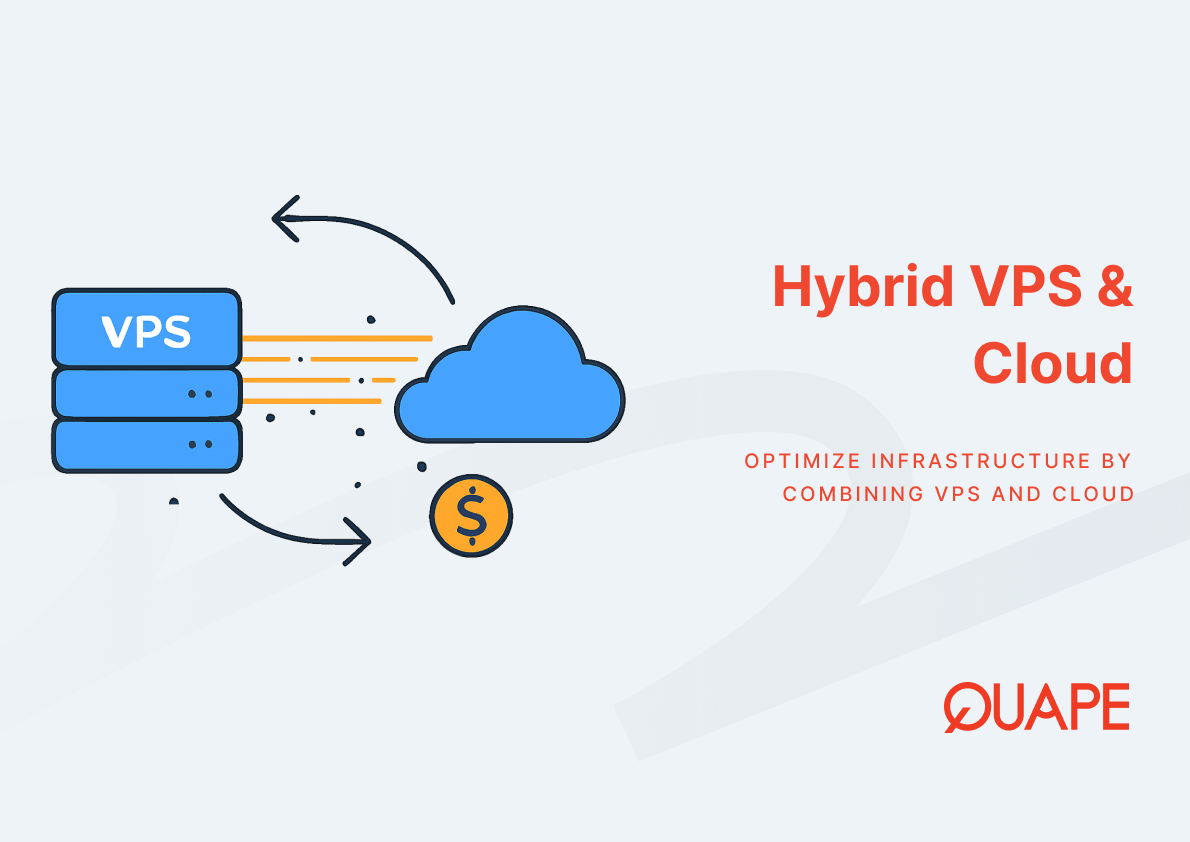
Organizations worldwide are moving away from cloud-only strategies toward infrastructure models that balance control, cost predictability, and elastic scaling capacity. Hybrid approaches combine VPS hosting stability with public cloud elasticity to address workload diversity that single-platform deployments cannot efficiently serve. This shift reflects operational realities: predictable workloads benefit from dedicated resources, while variable demand requires burst capacity. According to Gartner, up to 90% of organizations are expected to adopt a hybrid cloud model as part of their infrastructure strategy by 2027, signaling that infrastructure distribution across VPS and cloud environments has become standard practice rather than experimental architecture.
Hybrid VPS and cloud workloads represent an infrastructure strategy where organizations deploy applications and services across both virtual private servers and public cloud platforms, segmenting workloads based on performance requirements, cost tolerance, and operational control needs. This approach enables teams to place stable, resource-consistent workloads on VPS infrastructure while leveraging cloud elasticity for unpredictable traffic patterns or temporary compute demands.
要点总结
- Hybrid infrastructure combines VPS stability with cloud elasticity to address diverse workload requirements that single-platform strategies cannot efficiently satisfy
- Workload segmentation determines placement: stateful applications and databases align with VPS predictability, while stateless services benefit from cloud auto-scaling
- Orchestration layers unify management across disparate environments, enabling workload coordination, failover routing, and performance governance
- Cost predictability improves when fixed VPS pricing anchors baseline capacity while cloud resources absorb variable demand spikes
- Regional infrastructure placement affects latency, data residency compliance, and user experience, particularly for Singapore-based organizations serving Southeast Asian markets
- Security and control requirements often dictate hybrid adoption, as VPS environments provide root access and isolated resources for sensitive workloads
- Failover strategies use VPS infrastructure as primary or secondary targets, improving availability without full cloud dependency
Introduction to Hybrid VPS + Cloud Workloads
Infrastructure strategy has evolved beyond binary choices between on-premises control and cloud flexibility. Hybrid models recognize that workload characteristics vary significantly within a single organization, making uniform platform deployment inefficient. VPS hosting delivers dedicated CPU, memory, and storage resources with predictable performance baselines, supporting applications where latency consistency and cost certainty matter more than infinite scalability. Public cloud platforms provide on-demand resource provisioning and horizontal scaling, addressing traffic surges and experimental workloads without upfront capacity planning.
A 2025 survey indicated that 88% of cloud buyers are deploying or operating hybrid-cloud capabilities, reflecting widespread recognition that distributed infrastructure better aligns with operational reality than single-platform dependence. Organizations combine these environments to optimize workload placement, balancing control, compliance, and elasticity across application tiers. This distribution also mitigates vendor lock-in risks while enabling teams to select infrastructure based on specific workload profiles rather than forcing all services onto a single platform type.
Hybrid strategies require deliberate workload segmentation and clear responsibility boundaries. Understanding how VPS hosting provides performance, control, and scalability establishes the foundation for identifying which applications benefit from dedicated resources versus cloud burst capacity. Infrastructure teams must evaluate performance requirements, cost tolerance, security postures, and regulatory constraints before distributing workloads across VPS and cloud layers.
Core Concepts Behind Hybrid VPS and Cloud Architectures
Cloud computing models abstract physical hardware into virtualized resource pools, enabling programmatic provisioning and dynamic scaling. Virtual private servers represent a specific abstraction layer where dedicated CPU cores, RAM allocations, and storage volumes serve individual tenants without resource contention from neighboring workloads. This isolation contrasts with shared hosting environments and provides predictable performance characteristics that application teams depend on for capacity planning.
Infrastructure abstraction in cloud platforms prioritizes elasticity and consumption-based billing. Resources scale horizontally by adding compute instances in response to demand signals, distributing load across multiple nodes. This model optimizes for variable workloads where traffic patterns fluctuate unpredictably, making fixed-capacity planning inefficient. However, elasticity introduces cost volatility and requires sophisticated orchestration to maintain application state across dynamically provisioned instances.
Workload placement decisions determine which infrastructure layer hosts specific application components. Database servers with consistent query loads and strict latency requirements align naturally with VPS stability, while web application frontends handling variable user traffic benefit from cloud auto-scaling. This segmentation reflects functional boundaries within application architectures rather than arbitrary infrastructure preferences.
VPS as a Stability-Oriented Compute Layer
VPS hosting provides dedicated CPU cores, memory allocations, and storage volumes that remain consistent across time, eliminating resource contention and performance variability. Predictable performance enables accurate capacity planning and baseline establishment, allowing teams to forecast application behavior under known load conditions. This stability matters for databases, caching layers, and stateful services where latency spikes or resource throttling disrupts user experience.
Virtual machines within VPS environments operate with hypervisor-level isolation, ensuring that neighboring tenants cannot impact resource availability. Unlike shared hosting where CPU and memory compete across multiple sites, understanding the differences between VPS and shared hosting clarifies why dedicated resources support production workloads more reliably. Applications requiring consistent disk I/O throughput, such as transactional databases or log aggregation systems, depend on this isolation to maintain performance SLAs.
Dedicated resources also simplify cost modeling. Fixed monthly pricing removes consumption uncertainty, enabling budget forecasting without variable cloud billing. For workloads with steady resource utilization, VPS hosting often delivers better price-to-performance ratios than cloud instances running at constant capacity. This economic advantage becomes significant when baseline infrastructure remains active 24/7 rather than scaling down during low-traffic periods.
Cloud Elasticity for Variable and Burst Workloads
Cloud elasticity enables infrastructure to expand or contract based on real-time demand signals, provisioning additional compute instances when traffic exceeds capacity thresholds. Auto-scaling policies define rules for horizontal expansion, adding nodes to application tiers as request queues grow or CPU utilization rises. This capability addresses unpredictable traffic patterns, such as viral content surges or seasonal purchasing spikes, without maintaining idle capacity during low-demand periods.
On-demand resource provisioning removes lead time from capacity expansion. Teams can deploy additional compute, storage, or network resources within minutes rather than waiting for hardware procurement and installation. This agility supports experimentation and rapid iteration, allowing developers to test infrastructure configurations or scale proof-of-concept deployments without capital investment. However, elasticity requires applications to support stateless operation or implement distributed state management, adding architectural complexity.
Horizontal scaling distributes load across multiple identical instances rather than vertically increasing resources within a single server. Load balancers route requests across instance pools, maintaining availability even when individual nodes fail or restart. This model suits web frontends, API gateways, and processing pipelines where request independence allows parallel execution. Applications with shared state or session affinity require additional coordination mechanisms, such as external caching layers or database clustering.
Workload Segmentation and Responsibility Boundaries
Stateful workloads maintain session data, user context, or transaction history that must persist across requests. Databases, file storage systems, and authentication services exemplify stateful components where data consistency and durability override elasticity priorities. These workloads align with VPS infrastructure because dedicated resources provide predictable I/O performance and simplified backup strategies. Migrating stateful services between instances introduces complexity around data synchronization and consistency guarantees.
Stateless workloads process requests independently without retaining context between invocations. Web servers rendering dynamic content from external data sources, API endpoints querying databases, and microservices performing discrete transformations operate statelessly when session information resides in external stores. These components benefit from cloud auto-scaling because adding or removing instances does not affect application state. Load balancers distribute traffic across instance pools without session affinity requirements.
Application tiers naturally segment based on state management patterns. Presentation layers handling HTTP requests and rendering responses often operate statelessly, making them ideal cloud workloads. Data layers managing persistent storage, transaction logs, and user records require stability and consistent performance, aligning with VPS deployment. Middleware components such as message queues, caching layers, and search indexes fall between these extremes, requiring evaluation based on specific performance and consistency requirements.
Orchestration and Control Layers in Hybrid Environments
Orchestration layers unify management across VPS and cloud infrastructure, providing centralized workload coordination, deployment automation, and operational visibility. These control planes abstract underlying infrastructure differences, enabling teams to define application requirements without manually configuring individual servers or cloud resources. Orchestration platforms handle service discovery, health monitoring, and automated recovery, reducing operational overhead in distributed environments.
Infrastructure management in hybrid contexts requires tools that span multiple platforms while maintaining consistent deployment patterns. Configuration management systems define desired infrastructure states declaratively, automatically reconciling differences between current and target configurations. This approach ensures that VPS environments and cloud deployments maintain consistent security policies, software versions, and network configurations without manual intervention across platforms.
Workload coordination determines how application components communicate across infrastructure boundaries. Service meshes provide network-level abstraction, routing traffic between VPS-hosted databases and cloud-deployed frontends while handling encryption, authentication, and load balancing. These coordination layers enable hybrid deployments to function as unified systems rather than disconnected infrastructure silos.
Role of Virtualization and Hypervisors
Virtualization technology abstracts physical hardware into logical resource pools, enabling multiple virtual machines to operate independently on shared infrastructure. Hypervisors manage resource allocation, CPU scheduling, and memory isolation between VMs, ensuring that tenant workloads do not interfere with each other. This layer provides the foundation for VPS hosting, creating dedicated compute environments within multi-tenant physical servers.
Resource isolation at the hypervisor level prevents noisy neighbor problems where one VM’s intensive operations degrade performance for others. Modern hypervisors implement CPU pinning, memory reservation, and I/O scheduling policies that guarantee minimum resource availability regardless of neighboring activity. Understanding how virtualization technology powers modern VPS hosting clarifies why hypervisor choice affects application performance and security posture.
Hypervisors also enable rapid VM provisioning, snapshotting, and migration. Teams can clone VM templates to deploy standardized environments, capture running system states for backup purposes, and relocate VMs between physical hosts during maintenance. These capabilities support disaster recovery strategies and infrastructure flexibility without requiring application-level changes.
Container and VM Coordination Across VPS and Cloud
Containers package applications with their dependencies into portable units that run consistently across different infrastructure environments. Container orchestration platforms schedule these units across VM clusters, whether hosted on VPS infrastructure or cloud compute services. This abstraction layer enables teams to define application topologies once and deploy them across hybrid infrastructure without environment-specific configurations.
Virtual machines provide isolation boundaries within which container clusters operate. VPS-hosted VMs can run container orchestration control planes, managing workload distribution across both local containers and cloud-based container instances. This coordination enables gradual workload migration between infrastructure layers based on performance metrics or cost optimization goals.
Orchestration platforms maintain desired application states by continuously monitoring container health and automatically replacing failed instances. This self-healing capability works across VPS and cloud environments, providing consistent availability guarantees regardless of underlying infrastructure. Network overlays enable containers on VPS infrastructure to communicate seamlessly with containers in cloud regions, abstracting physical network topology from application logic.
Observability and Performance Governance
Monitoring systems collect metrics, logs, and traces from both VPS and cloud infrastructure, providing unified visibility into application behavior. Performance baselines established from historical data enable teams to detect anomalies, capacity constraints, and degradation patterns before they impact users. Centralized observability becomes critical in hybrid environments where troubleshooting requires correlation across multiple infrastructure platforms.
Latency visibility reveals how network paths and resource placement affect user experience. Distributed tracing tracks requests as they traverse VPS-hosted databases, cloud-based caching layers, and content delivery networks, identifying bottlenecks and optimization opportunities. Recognizing patterns in VPS network performance and latency optimization helps teams make informed workload placement decisions.
Performance governance establishes policies for resource utilization, cost thresholds, and availability targets across hybrid infrastructure. Automated responses to policy violations trigger scaling actions, traffic rerouting, or alerting workflows that maintain operational standards. These governance mechanisms ensure that hybrid complexity does not compromise application reliability or budget predictability.
Failover, Redundancy, and Traffic Routing Strategies
Failover routing automatically redirects traffic from failed or degraded infrastructure to healthy backup systems, maintaining application availability during outages. Hybrid environments enhance failover capabilities by providing geographically distributed infrastructure options that survive regional cloud failures or VPS provider incidents. Traffic management systems continuously assess endpoint health and route requests to responsive infrastructure regardless of platform.
High availability architectures distribute application components across multiple failure domains, ensuring that single infrastructure failures do not cause total service disruption. VPS and cloud redundancy together create diverse failure domains that span different providers, network paths, and data center facilities. This diversity reduces correlated failure risks where a single provider outage affects all application infrastructure simultaneously.
Redundancy strategies balance cost against availability requirements. Mission-critical workloads justify active-active configurations where VPS and cloud infrastructure serve traffic simultaneously, providing instant failover without service interruption. Less critical applications may use active-passive setups where VPS infrastructure serves normal traffic and cloud resources activate only during primary failures, reducing idle capacity costs.
Using VPS as a Primary or Secondary Failover Target
Disaster recovery plans designate VPS infrastructure as either primary production environments with cloud failover or secondary backup targets that activate during VPS failures. Primary VPS deployment suits workloads requiring predictable performance and cost stability, with cloud resources provisioned automatically when traffic exceeds VPS capacity or primary systems fail. This configuration optimizes for steady-state operation while maintaining emergency scaling capacity.
Standby infrastructure represents pre-configured VPS or cloud resources that remain inactive until disaster recovery procedures activate them. Standby VPS instances can synchronize data from primary cloud deployments, providing recovery targets when cloud regions experience extended outages. Implementing effective VPS backup and disaster recovery planning ensures that standby infrastructure maintains current data and configuration states.
Recovery objectives define acceptable downtime and data loss tolerances that disaster recovery strategies must satisfy. VPS infrastructure often provides faster recovery time objectives than cloud deployments for workloads with synchronized backups because VM restoration from snapshots typically completes within minutes. Cloud infrastructure offers broader geographic distribution for recovery point objectives, enabling data replication across continents to survive regional disasters.
DNS and Load-Based Traffic Distribution
DNS routing directs client requests to appropriate infrastructure based on health checks, geographic proximity, or load distribution policies. Weighted DNS records allocate traffic percentages across VPS and cloud endpoints, enabling gradual migration or A/B testing scenarios. Geographic routing sends users to regionally proximate infrastructure, reducing latency while maintaining failover capability to distant locations during local failures.
Traffic steering policies evaluate multiple criteria simultaneously, selecting optimal endpoints based on current performance metrics rather than static configuration. Latency-based routing directs requests to the fastest-responding infrastructure, automatically adapting to network conditions or resource saturation. Failover policies define fallback sequences that try VPS infrastructure first and cascade to cloud resources when primary endpoints become unhealthy.
Regional failover protects against data center or network provider outages by maintaining infrastructure presence in multiple geographic locations. Singapore-based VPS infrastructure can failover to cloud regions in adjacent countries, maintaining service availability for Southeast Asian users during local incidents. This geographic diversity requires careful data synchronization to ensure that failover targets contain current application state and user data.
Cost Control and Predictability in Hybrid VPS + Cloud Models
Infrastructure cost modeling in hybrid environments combines fixed VPS pricing with variable cloud consumption to forecast monthly expenditures. VPS hosting provides cost stability through predictable monthly fees that remain constant regardless of traffic fluctuations. Cloud resources introduce consumption-based billing where costs scale with actual usage, creating budget uncertainty that requires monitoring and governance controls.
OPEX optimization balances cost predictability against elasticity benefits by sizing VPS infrastructure to handle baseline capacity while using cloud resources for overflow traffic. This approach minimizes idle cloud capacity costs during low-demand periods while avoiding over-provisioned VPS infrastructure that sits unused. Financial modeling must account for cloud egress fees, storage costs, and premium support charges that often exceed basic compute pricing.
Pricing predictability affects budget planning and financial forecasting accuracy. Organizations with stable workload patterns prefer VPS economics because fixed monthly costs simplify budget approval and variance analysis. Variable cloud spending complicates financial planning but provides cost avoidance during low-utilization periods, making it economically attractive for seasonal or experimental workloads.
VPS Cost Stability vs Cloud Usage Volatility
Fixed pricing models charge consistent monthly fees regardless of actual resource utilization, simplifying cost forecasting and eliminating unexpected bill spikes. VPS hosting typically uses fixed pricing because dedicated resource allocations do not vary with workload intensity. This predictability enables accurate annual budget planning and removes consumption monitoring overhead required for variable cloud billing.
Consumption-based billing charges for actual resource usage measured by compute hours, storage volume, network transfer, and API requests. Cloud platforms implement consumption pricing to align costs with value received, ensuring organizations pay only for utilized capacity. However, this model introduces volatility where traffic surges or inefficient application code can unexpectedly increase monthly expenditures beyond budgeted amounts. Understanding VPS hosting pricing models helps teams evaluate fixed versus variable cost structures.
Cost volatility mitigation strategies include reserved capacity purchases, spending limits, and automated scaling policies that constrain cloud resource consumption. Reserved instances provide cloud resources at discounted rates in exchange for long-term commitment, effectively converting variable pricing into fixed costs. Spending alerts notify teams when consumption approaches budget thresholds, enabling intervention before significant overruns occur.
Forecasting Hybrid Scaling Over Time
Capacity planning projects future infrastructure requirements based on historical growth trends, seasonal patterns, and business expansion plans. Hybrid environments require separate forecasts for VPS baseline capacity and cloud burst requirements because these infrastructure layers serve different workload characteristics. Baseline capacity grows gradually with sustained user base expansion, while burst capacity fluctuates with short-term traffic variability.
Growth forecasting incorporates user acquisition projections, feature release schedules, and market expansion timelines to anticipate infrastructure needs months or years ahead. VPS capacity planning focuses on steady-state requirements, upgrading server tiers or adding instances as baseline traffic increases. Cloud capacity forecasting emphasizes peak handling capability, ensuring sufficient elasticity to absorb temporary demand spikes without performance degradation. Tools for predicting VPS scaling costs help teams model infrastructure expenses as workloads grow.
Long-term hybrid strategies evolve as organizations mature and workload patterns stabilize. Early-stage companies often rely heavily on cloud elasticity because user growth and feature iteration create unpredictable capacity needs. As applications mature and traffic patterns become predictable, VPS infrastructure increasingly anchors baseline capacity while cloud resources handle decreasing proportions of total workload, optimizing cost efficiency.
Practical Application for Singapore-Based Organizations
Singapore data centers serve as regional infrastructure hubs for organizations operating across Southeast Asia, providing connectivity to major Asian markets within low-latency network paths. Regional latency affects user experience for interactive applications where round-trip delay impacts responsiveness. Placing VPS infrastructure in Singapore positions compute resources close to Malaysian, Indonesian, and Thai user populations, minimizing network delay compared to distant cloud regions.
Data residency requirements in various Southeast Asian markets mandate that certain data types remain within national borders or approved geographic zones. Singapore’s regulatory framework and treaty relationships often satisfy these requirements while providing advanced infrastructure and network connectivity. Organizations subject to data localization rules can use Singapore VPS hosting for regional data storage while leveraging cloud services in other regions for non-regulated workload components.
Regulatory alignment between Singapore’s data protection framework and international standards simplifies compliance for organizations operating across multiple jurisdictions. Personal data protection rules, financial services regulations, and healthcare privacy requirements often accept Singapore infrastructure as meeting control and sovereignty obligations. This regulatory acceptance reduces compliance complexity compared to cloud regions in jurisdictions with conflicting or uncertain legal frameworks.
Latency-Sensitive Workloads in Southeast Asia
Regional proximity directly correlates with network latency because signal propagation speed through fiber optic cables creates unavoidable delay proportional to physical distance. Singapore VPS infrastructure typically provides 5-20 millisecond latency to major Southeast Asian cities, while distant cloud regions may exhibit 100-300 millisecond delays. Interactive applications such as real-time collaboration tools, gaming servers, and financial trading platforms require low latency to maintain usable responsiveness.
Network latency accumulates across application tiers when user requests traverse multiple services. Database queries, API calls, and microservice interactions each add round-trip delay that compounds into total request latency. Placing latency-sensitive components on regionally proximate VPS infrastructure reduces aggregate delay by minimizing distance between interdependent services.
User experience degrades noticeably when latency exceeds perception thresholds specific to application types. Video conferencing tolerates 150-millisecond delays before conversation flow disrupts, while e-commerce checkout processes lose conversion when page load times exceed three seconds. Understanding these thresholds guides infrastructure placement decisions, determining which workloads require regional VPS deployment versus accepting higher-latency cloud regions.
Data Sovereignty and Compliance Considerations
Data sovereignty regulations require that specific data categories remain under national jurisdiction, prohibiting storage or processing in foreign territories. Financial records, healthcare information, and government data often fall under sovereignty restrictions that limit infrastructure options. Singapore VPS hosting satisfies sovereignty requirements for many Southeast Asian operations while providing infrastructure quality and connectivity superior to some national alternatives.
Regulatory compliance frameworks define technical controls, audit procedures, and incident reporting obligations that infrastructure must support. ISO certifications, SOC 2 attestations, and industry-specific compliance standards often specify physical security, access controls, and data protection measures. VPS infrastructure can implement these controls more transparently than multi-tenant cloud services where shared responsibility models complicate compliance validation. Resources about Singapore data sovereignty and compliance detail specific regulatory requirements.
Governance requirements extend beyond technical controls to include data residency verification, access logging, and breach notification procedures. Organizations must demonstrate that personal data remains within approved jurisdictions and that unauthorized access triggers appropriate response protocols. VPS infrastructure simplifies governance because dedicated resources provide clear custody chains and audit trails without shared-tenant complications.
Why Singapore Is Commonly Chosen as the VPS Anchor
Connectivity hub characteristics make Singapore infrastructure attractive for regional deployments serving multiple Southeast Asian markets from a single location. Submarine cable landing stations, internet exchange points, and carrier-neutral data centers concentrate in Singapore, providing diverse network paths and low-latency connectivity across the region. This connectivity density reduces network hop counts and improves redundancy compared to less interconnected locations.
Infrastructure reliability in Singapore data centers typically exceeds regional alternatives because mature facilities implement redundant power, cooling, and network systems that minimize downtime risks. Carrier diversity, generator backup capacity, and seismic design standards reflect Singapore’s position as a Tier 3+ data center market with stringent operational standards. Discovering why Singapore functions as a strategic VPS hosting hub reveals infrastructure advantages beyond geographic centrality.
Political stability and business-friendly regulatory environments reduce operational risks compared to markets with uncertain legal frameworks or infrastructure nationalization concerns. Singapore’s transparent legal system, intellectual property protections, and investment guarantees provide confidence for long-term infrastructure commitments. These factors matter when selecting VPS infrastructure locations that will anchor hybrid deployments for years.
How VPS Hosting Supports Hybrid VPS + Cloud Workloads
VPS hosting provides the infrastructure foundation for hybrid architectures by delivering dedicated resources, operational control, and performance predictability that anchor baseline capacity. Hybrid architecture enablement depends on VPS infrastructure offering sufficient customization, security controls, and integration capabilities to coordinate with cloud platforms seamlessly. Infrastructure foundation quality determines whether hybrid deployments achieve their cost, performance, and reliability objectives or introduce unnecessary complexity.
Organizations building hybrid infrastructure require VPS platforms that support modern orchestration tools, network configurations, and monitoring integrations. Legacy VPS offerings with limited API access or restrictive network policies constrain hybrid coordination capabilities. Modern VPS hosting must provide programmatic management interfaces, flexible networking options, and compatibility with standard orchestration platforms to function effectively within hybrid deployments.
Dedicated Resources as a Predictable Core Layer
CPU allocation in VPS environments assigns specific processor cores to individual virtual machines, ensuring consistent compute capacity without time-slicing or CPU stealing from neighboring tenants. Dedicated cores provide predictable instruction execution rates that enable accurate performance modeling and capacity planning. Applications with CPU-intensive operations such as encryption, compression, or data processing depend on this allocation consistency to maintain throughput SLAs.
RAM isolation prevents memory pressure from neighboring VMs from affecting application performance. Dedicated memory allocations ensure that caching strategies, in-memory data structures, and application buffers function as designed without unexpected evictions or swap usage. Database systems and real-time analytics platforms require memory isolation to maintain query response times and avoid thrashing.
Storage performance consistency matters for workloads with intensive I/O patterns. NVMe storage interfaces provide low-latency access to solid-state drives that deliver consistent IOPS regardless of neighboring activity. Transaction processing systems, logging infrastructure, and content management platforms depend on reliable storage performance to avoid write delays or read bottlenecks.
Security and Control for Persistent Workloads
Root access enables administrators to configure operating systems, install software packages, and modify kernel parameters according to specific application requirements. This system control allows security hardening procedures that lock down unnecessary services, implement custom firewall rules, and configure intrusion detection systems. Recognizing the importance of root access for developers clarifies why VPS infrastructure supports customization that shared or managed platforms restrict.
Security hardening procedures implement defense-in-depth strategies that minimize attack surfaces and enforce security policies at multiple system layers. VPS infrastructure enables kernel security modules, mandatory access controls, and security monitoring agents that require root privileges. Organizations with stringent security requirements deploy baseline hardening configurations across VPS infrastructure that satisfy compliance frameworks and internal standards. Best practices for VPS cybersecurity guide secure configuration approaches.
Control granularity extends to network configuration, storage encryption, and backup scheduling that persistent workloads require. Database servers need precise control over network port exposure, filesystem permissions, and backup retention policies. VPS infrastructure provides this control without requiring coordination with platform providers or accepting shared-responsibility model constraints.
Storage and Performance Consistency
NVMe storage technology delivers significantly lower latency than traditional SATA interfaces by eliminating legacy protocol overhead and enabling direct PCIe attachment. Submillisecond read latencies enable database query patterns that would timeout on slower storage, while parallel write channels sustain high-throughput logging and data ingestion. Learning about NVMe VPS hosting performance benefits quantifies storage performance improvements.
IOPS stability ensures that storage operations maintain consistent throughput across time rather than exhibiting performance variability during peak periods. Applications experiencing IOPS throttling suffer degraded responsiveness, failed transactions, or cascading delays across dependent services. VPS infrastructure with dedicated storage resources eliminates throttling risks that multi-tenant storage systems introduce when aggregate demand exceeds provisioned capacity.
Performance consistency across storage, network, and compute resources enables reliable capacity planning and performance prediction. Applications exhibiting stable performance under known load conditions can accurately forecast resource requirements as workload scales. This predictability supports informed infrastructure scaling decisions within hybrid environments, determining when baseline VPS capacity requires expansion versus activating cloud burst resources.
结论
Hybrid VPS and cloud infrastructure strategies reflect practical responses to diverse workload requirements that single-platform deployments cannot efficiently address. Organizations distribute applications across VPS stability and cloud elasticity based on performance needs, cost tolerance, and control requirements rather than forcing all workloads onto uniform infrastructure. This segmentation optimizes operational expenses, improves availability through diversified failure domains, and maintains compliance with data sovereignty regulations. As hybrid adoption becomes standard practice across industries, success depends on deliberate workload analysis, robust orchestration capabilities, and clear understanding of how infrastructure characteristics align with application demands. Teams building distributed systems across Singapore and broader Southeast Asian markets particularly benefit from VPS infrastructure anchored regionally while leveraging global cloud resources for geographic expansion and burst capacity.
If your organization is evaluating hybrid infrastructure strategies or needs guidance on workload distribution across VPS and cloud platforms, 联系我们的销售团队 to discuss architecture recommendations tailored to your operational requirements. Additionally, explore our comprehensive VPS hosting solutions designed to anchor hybrid deployments with predictable performance and regional connectivity.
常见问题 (FAQ)
When should workloads remain on VPS instead of moving to cloud? Workloads with predictable resource requirements, consistent traffic patterns, and strict latency tolerances typically perform better and cost less on VPS infrastructure. Database servers, caching layers, and real-time processing systems benefit from dedicated resources that eliminate performance variability. Applications requiring specific kernel configurations, custom security controls, or data sovereignty compliance also align naturally with VPS deployment.
How does orchestration work across VPS and cloud infrastructure? Modern orchestration platforms abstract underlying infrastructure differences, managing workloads across VPS and cloud environments through unified APIs and control planes. Container orchestration systems schedule application components based on resource requirements and placement policies regardless of whether target infrastructure runs on VPS or cloud. Service meshes handle inter-service communication, load balancing, and failover across infrastructure boundaries transparently to applications.
What network configurations support hybrid VPS and cloud coordination? VPN tunnels or dedicated network interconnects establish secure communication channels between VPS and cloud infrastructure, enabling private network addressing across platforms. Software-defined networking overlays create logical networks that span physical infrastructure boundaries, allowing workloads to communicate as if residing within a single data center. DNS-based service discovery and load balancing distribute traffic across hybrid infrastructure based on health checks and routing policies.
Can hybrid infrastructure improve disaster recovery capabilities? Distributing infrastructure across VPS and cloud platforms creates diverse failure domains that survive provider-specific outages or regional disasters. Automated failover configurations redirect traffic from failed infrastructure to healthy backup systems within seconds, maintaining availability during incidents. Geographic distribution across Singapore VPS infrastructure and cloud regions in other countries provides redundancy that single-provider deployments cannot achieve.
How do organizations forecast costs in hybrid VPS plus cloud models? Baseline capacity sizing determines fixed VPS costs based on steady-state workload requirements, while historical traffic patterns inform cloud burst capacity budgets. Cost modeling tools project monthly expenses by combining predictable VPS fees with estimated cloud consumption during peak periods. Organizations typically allocate 60-80% of infrastructure budget to VPS baseline capacity and reserve remaining funds for variable cloud expenses.
What security considerations arise when coordinating VPS and cloud workloads? Network traffic between VPS and cloud infrastructure requires encryption to protect data in transit across provider boundaries. Access control policies must enforce consistent authentication requirements across both platforms, preventing security gaps at infrastructure boundaries. Compliance frameworks often require audit logging and monitoring that spans hybrid environments to detect unauthorized access or policy violations regardless of where workloads execute.
Why do Singapore-based organizations frequently anchor hybrid infrastructure with local VPS? Regional latency requirements for Southeast Asian users make Singapore VPS infrastructure optimal for latency-sensitive workloads while cloud resources in distant regions handle non-critical services. Data sovereignty regulations in multiple Southeast Asian countries accept Singapore infrastructure for regulated data storage, simplifying multi-market compliance. Singapore’s connectivity density and infrastructure reliability provide stable anchors for hybrid architectures serving regional markets.
How does workload migration between VPS and cloud platforms occur? Containerized applications migrate by redeploying container images to target infrastructure with updated orchestration configurations. Virtual machine workloads transfer through snapshot exports, network file copies, or incremental synchronization tools that replicate running systems. Database migrations use replication streams or backup restoration procedures that maintain data consistency during cutover periods, minimizing downtime and data loss risks.

- Business Email Hosting vs G-Suite / Microsoft 365 - 12 月 29, 2025
- Shared Hosting vs Dedicated Hosting for Email - 12 月 29, 2025
- SMTP vs POP3 vs IMAP: Which Protocol Fits Your Business Workflow - 12 月 28, 2025