Corporate websites are no longer evaluated solely on visual design or conversion performance. Regulatory bodies, courts, and procurement teams increasingly assess digital platforms against measurable accessibility standards, and organisations that fail to meet these benchmarks face legal exposure, reputational risk, and a shrinking addressable audience. For IT managers, CTOs, and developers operating in Singapore’s enterprise landscape, web accessibility has shifted from a best-practice recommendation to a compliance requirement with real operational consequences. The technical foundation of this compliance sits within globally recognised frameworks, and understanding how those frameworks translate into architecture decisions is what separates a compliant website from one that merely looks the part.
Introduction to Corporate Web Accessibility Compliance
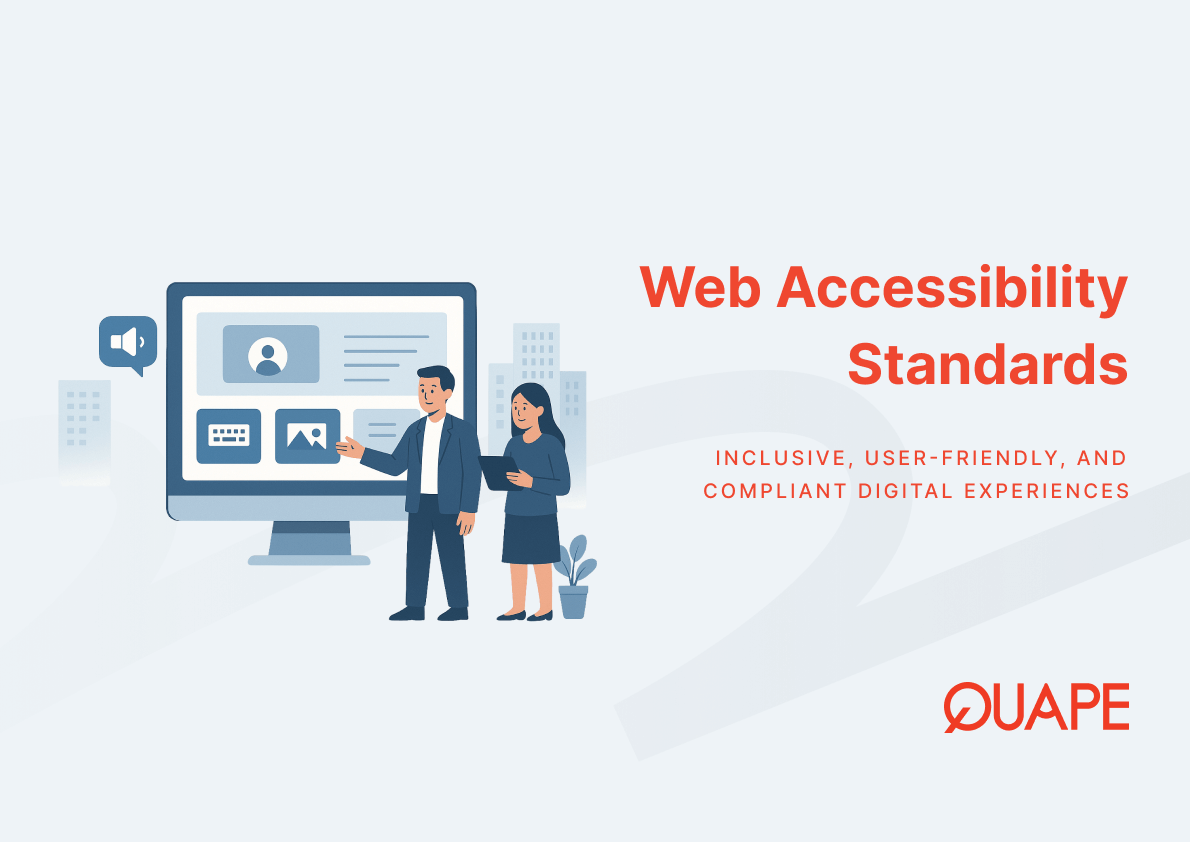
Corporate web accessibility compliance refers to the practice of designing and maintaining enterprise websites so that all users, including those with visual, auditory, motor, or cognitive disabilities, can perceive, navigate, and interact with digital content without barriers. This is not a single checkbox or plugin fix. It is an ongoing architectural commitment that spans code structure, interface design, content strategy, and third-party integration governance.
The scale of the requirement becomes clear when viewed against the user population it serves. According to the World Health Organization, approximately 1.3 billion people worldwide live with significant disabilities, representing roughly 16% of the global population. For any enterprise operating digital services at scale, that figure is not a niche edge case. It is a substantial segment of users, customers, partners, and employees whose access depends on decisions made at the design and development stage.
Accessibility compliance intersects directly with how corporate website design is approached from the ground up, because retrofitting accessibility into an already-built platform is significantly more costly and less effective than building it in from the start.
Poin-Poin Utama
- WCAG 2.2, published as a W3C Recommendation in October 2023, is the current technical standard for web accessibility and adds nine new success criteria targeting visual, physical, and cognitive access.
- The four POUR principles (Perceivable, Operable, Understandable, Robust) define the behavioural framework against which all accessible content is evaluated.
- ADA compliance increasingly applies to digital platforms, with thousands of website accessibility lawsuits filed annually in the United States.
- Semantic HTML and ARIA roles form the structural and programmatic layer that makes interfaces readable by assistive technologies.
- UX inclusivity encompasses keyboard navigation, colour contrast, focus indicators, and predictable interaction patterns.
- Third-party integrations, including advertising networks and external widgets, can introduce accessibility violations even on otherwise compliant websites.
- Singapore enterprises should align accessibility practices with both global WCAG standards and local digital inclusivity expectations.
- Automated testing tools are useful but insufficient. Human evaluation remains necessary for full compliance assurance.
Key Components of Corporate Web Accessibility Compliance
WCAG 2.2 Principles and Their Role in Enterprise Websites
Itu Web Content Accessibility Guidelines (WCAG), developed by the World Wide Web Consortium, provide the globally accepted technical framework for accessible digital content. WCAG 2.2, published on 5 October 2023 as an official W3C Recommendation, extends previous versions with nine new success criteria specifically designed to improve access for users with visual, physical, and cognitive disabilities.
The guidelines are structured around four principles known collectively as POUR. Perceivable content ensures that information and interface components are presentable to users in ways they can detect, regardless of sensory ability. Operable interfaces require that all functionality be accessible via keyboard and that users have sufficient time and control to interact with content. Understandable design demands that both information and interface behaviour be consistent and predictable. Robust web standards ensure that content is interpreted reliably by current and future assistive technologies.
For enterprise websites, each POUR principle maps directly to development and design decisions. A perceivable website provides text alternatives for images and captions for video. An operable interface supports keyboard-only navigation without trapping focus. An understandable interface avoids unexpected context changes and provides clear error identification in forms. A robust platform uses valid, well-structured markup that screen readers and other tools can parse accurately.
ADA Compliance and Global Accessibility Expectations
The Americans with Disabilities Act originally applied to physical spaces, but courts in the United States have increasingly interpreted inaccessible websites as a form of discrimination, particularly where digital platforms provide essential services. According to data from EcomBack’s 2025 Annual Report, 3,948 ADA website accessibility lawsuits were recorded in the United States in 2025, representing a 23.8% increase from the previous year.
While the ADA applies specifically within the United States, its enforcement trajectory signals a broader global direction. Enterprises operating across multiple jurisdictions, including Singapore-headquartered companies with US-facing digital platforms, face real legal exposure if their websites exclude users with disabilities. The accessible public services framework is expanding beyond government portals to include corporate e-commerce platforms, SaaS products, investor relations pages, and employment portals.
The scope of ADA applicability to purely digital businesses continues to be tested in courts, and there is no universal global enforcement standard. However, aligning with WCAG 2.2 provides a defensible technical baseline that satisfies the requirements of multiple regional frameworks simultaneously.
Semantic HTML as the Structural Foundation of Accessibility
Semantic HTML is the layer of markup that assigns meaning to content structure. It communicates to browsers and assistive technologies what each element represents, not just how it looks. A heading marked with an <h2> tag signals hierarchy. A navigation block wrapped in a <nav> element signals landmark structure. A form field associated with a <label> element signals its purpose to screen readers.
When heading hierarchy is inconsistent or structural elements are replaced with generic <div> Dan <span> tags styled to look like headings or buttons, the visual presentation may appear correct, but the underlying meaning is lost. Screen readers cannot interpret page hierarchy from visual styling alone. They rely on the semantic structure of the HTML to construct an accessible outline of the page.
HTML5 introduced a richer set of structural elements including <main>, <article>, <section>, <aside>, Dan <footer>. Proper use of these landmarks enables users of assistive technologies to jump directly to relevant regions of a page, which reduces cognitive load and navigation time significantly on content-heavy corporate websites.
ARIA Roles and Assistive Technology Compatibility
Accessible Rich Internet Applications (ARIA) roles and attributes extend the accessibility of dynamic and interactive web components beyond what native HTML alone can communicate. Where HTML5 semantics cover standard document structure, ARIA covers the behavioural layer of custom UI components such as dropdown menus, modal dialogs, tab panels, and accordion controls.
ARIA roles tell assistive technologies what type of component they are encountering. ARIA states and properties communicate the current condition of that component, whether a menu is expanded or collapsed, whether a checkbox is checked, whether a dialog is open. Without these attributes, a screen reader user interacting with a custom JavaScript-built modal may encounter a region of the page that provides no information about what it is or how to interact with it.
The critical principle is that ARIA supplements HTML rather than replacing it. Developers who apply ARIA roles to elements that already have native semantic meaning, or who use incorrect role values, can make a component less accessible than if no ARIA had been applied at all. Correct implementation depends on understanding how specific roles interact with specific assistive technologies, which is one reason human evaluation cannot be replaced by automated testing.
UX Inclusivity and Accessible User Experience Design
UX inclusivity extends accessibility from code compliance into the experience layer. A website can pass automated WCAG checks and still create significant usability barriers through poor design decisions. Visual contrast between text and background must meet minimum ratios to remain legible for users with low vision. Clickable targets must be large enough to be activated reliably by users with motor impairments. Focus indicators must be visible so that keyboard-only users know where they are on the page at all times.
For enterprise websites where users complete high-stakes tasks including submitting procurement enquiries, accessing account dashboards, or navigating multi-step onboarding flows, accessible UX design for corporate websites determines whether those tasks are completable. Predictable navigation patterns reduce cognitive load. Consistent interaction behaviour reduces errors. Clear error messages and recovery pathways reduce frustration for all users, not only those with disabilities.
The business case for inclusive UX extends beyond compliance. Accessible design patterns tend to improve overall usability metrics, reduce support requests, and increase task completion rates across the entire user base.
Practical Application for Corporate Websites in Singapore
Singapore’s digital economy agenda includes accessibility as a component of inclusive digital services. Government agencies and statutory boards have adopted accessibility standards aligned with WCAG, and enterprise platforms operating in regulated industries, including financial services, healthcare, and public sector procurement, face increasing expectations around digital inclusivity.
For Singapore-based enterprises, compliance means addressing the multilingual and multicultural dimensions of the user base alongside the technical requirements of WCAG. A corporate platform serving users in English, Mandarin, Malay, and Tamil must apply accessibility principles consistently across all language variants, not only the primary English version.
Accessibility Considerations for Multilingual Corporate Platforms
Language accessibility on multilingual corporate websites encompasses more than translation. It includes declaring the language of each page and content region in the HTML so that screen readers can switch to the appropriate language profile and pronounce content correctly. It includes ensuring that right-to-left or character-based scripts do not break keyboard navigation or focus management. It includes applying consistent heading hierarchy and landmark structure across all language versions so that assistive technology users experience equivalent navigation regardless of which language they select.
Internationalisation at the code level supports accessibility at the experience level. When language direction, character encoding, and content structure are handled correctly in the underlying markup, the assistive technology layer can interpret the content reliably.
Aligning Accessibility with PDPA-Compliant Digital Practices
PDPA-compliant websites must communicate data practices clearly and present consent interfaces that users can understand and operate. For accessibility, this means that cookie consent banners, privacy notices, and consent forms must themselves meet WCAG standards. A consent interface that cannot be operated by keyboard, lacks proper focus management, or presents text at insufficient contrast fails on both accessibility and transparency grounds.
Accessible privacy notices use plain language, logical reading order, and clear interactive controls. Consent mechanisms should expose their state to assistive technologies through appropriate ARIA roles so that screen reader users can identify what they are consenting to and confirm or withdraw that consent without ambiguity.
How Corporate Web Design Supports Corporate Web Accessibility Compliance
Designing Accessible Corporate Interfaces from the Ground Up
Accessibility integrated during the design phase costs significantly less than accessibility retrofitted after launch. When colour palettes are selected with contrast ratios in mind, when interactive components are designed with keyboard focus states, and when layout structures are planned around semantic HTML rather than visual positioning, the development phase inherits a compliant foundation rather than having to engineer one retroactively.
Responsive accessibility is a related principle. An accessible design must remain accessible across screen sizes and input modalities. A navigation pattern that works correctly on desktop with a mouse must also work on mobile with touch, and on desktop with a keyboard only. Usability standards applied consistently across breakpoints and input methods are what differentiate an accessibility-aware design system from one that treats accessibility as an afterthought.
Content Structures that Improve Accessibility and Discoverability
Accessible information hierarchy benefits two audiences simultaneously: users relying on assistive technologies and search engine crawlers. Structured content built around semantic headings, descriptive link text, properly labelled images, and logical reading order improves both screen reader navigation and SEO indexing.
A corporate website content strategy that integrates accessibility from the content planning stage produces pages where headings reflect genuine document hierarchy, not visual styling preferences. Descriptive anchor text replaces generic phrases. Image alt text communicates meaning rather than repeating adjacent captions. These structural decisions compound into measurable improvements in both accessibility compliance and organic search performance.
CMS Platforms and Accessibility Management
Content management systems introduce both opportunity and risk for accessibility. A well-configured CMS enforces accessible content patterns by default, requiring authors to provide alt text for images, restricting heading usage to maintain hierarchy, and validating content against basic accessibility rules before publication.
WordPress, the CMS platform used in Quape’s corporate web design service, supports a range of accessibility-focused plugins and governance tools that help content teams maintain compliance after launch. However, plugin selection matters. Accessibility overlays, which are scripts that attempt to patch accessibility issues dynamically, do not resolve structural problems in the underlying HTML and are not a substitute for compliant development. A CMS governance framework should include training for content contributors, editorial guidelines for accessible writing, and periodic audits that combine automated scanning with manual review.
Kesimpulan
Corporate web accessibility is an architectural, legal, and strategic commitment that touches every layer of a digital platform, from markup structure and component behaviour to content governance and third-party integration management. Organisations that treat accessibility as a compliance checkbox will continue to accumulate technical debt and legal exposure. Those that embed it into design systems, development standards, and content workflows create platforms that serve a broader audience, perform more reliably across assistive technologies, and satisfy the growing scrutiny of regulators and procurement evaluators in Singapore and beyond.
If your organisation is building or redesigning a corporate website and needs a development partner with structured expertise in accessible web design, contact the Quape team to discuss how accessibility compliance can be built into your project from the foundation up.
Pertanyaan yang Sering Diajukan (FAQ)
What is WCAG 2.2 and why does it matter for corporate websites?
WCAG 2.2 is the current version of the Web Content Accessibility Guidelines, published by the World Wide Web Consortium in October 2023. It establishes the technical criteria that corporate websites must meet to be considered accessible, and it forms the basis for accessibility compliance assessments across most regulatory frameworks.
Does web accessibility apply to Singapore-based companies?
Yes. While Singapore does not have legislation identical to the US ADA, government agencies and regulated industries in Singapore align with WCAG standards, and enterprise platforms operating internationally face compliance expectations from multiple jurisdictions. Accessibility is increasingly a procurement and partnership requirement in Singapore’s business environment.
Can automated tools alone ensure WCAG compliance?
No. Automated accessibility testing tools can identify a proportion of WCAG violations but cannot evaluate all success criteria. Issues related to logical reading order, meaningful link context, and the quality of alternative text descriptions require human evaluation to assess accurately.
What is the difference between semantic HTML and ARIA roles?
Semantic HTML uses native elements to assign structural meaning to content, such as headings, navigation landmarks, and form fields. ARIA roles extend this to dynamic and custom UI components, communicating their type and state to assistive technologies. Both layers work together to create a fully accessible interface.
How do third-party integrations affect accessibility compliance?
External scripts including advertising networks, live chat widgets, and social media embeds can introduce accessibility violations that are outside the direct control of the website’s development team. Governance of third-party integrations, including accessibility review before deployment, is a necessary component of a compliant corporate platform.
What is an accessibility overlay and why is it insufficient?
An accessibility overlay is a script applied to a website that attempts to detect and correct accessibility issues dynamically in the browser. Overlays do not fix structural problems in the underlying HTML or JavaScript and cannot address all WCAG criteria. They are not accepted as a substitute for accessible development by most compliance frameworks or legal standards.
How does accessible web design affect SEO?
Accessible design practices, including semantic heading hierarchy, descriptive link text, and properly structured content, align closely with SEO best practices. Search engine crawlers benefit from the same structural clarity that assistive technologies rely on, which means investing in accessibility typically produces parallel improvements in organic search performance.
What should Singapore enterprises prioritise when starting an accessibility audit?
Begin with a structural review of semantic HTML and keyboard navigability, as these affect the broadest range of users and assistive technologies. Follow with a contrast and visual design audit, then review interactive components for ARIA implementation. Combine automated scanning with manual testing, and include users with disabilities in the evaluation process where possible.