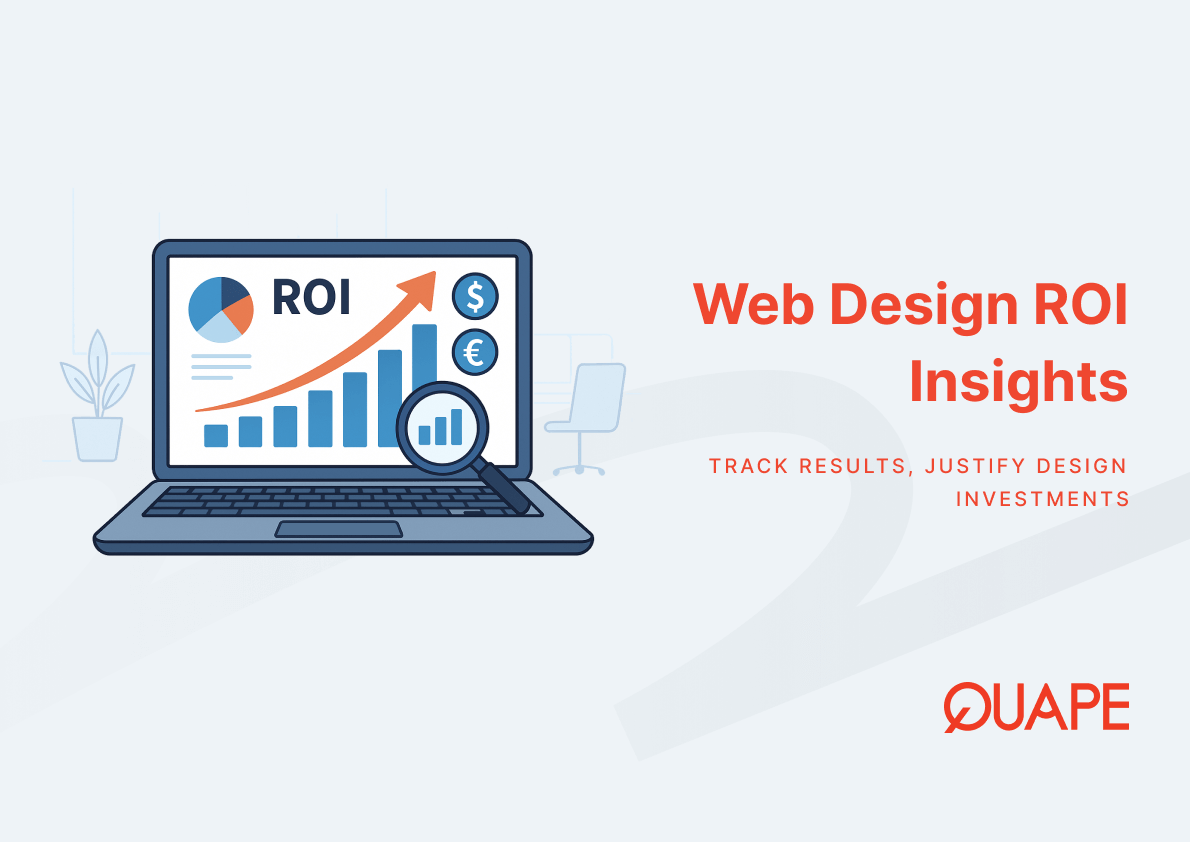
Corporate web design is not a cosmetic investment. For IT managers, CTOs, and procurement leads in Singapore, a website represents a revenue-generating asset whose performance can be tracked, benchmarked, and optimized across its entire lifecycle. Yet many organizations still evaluate design projects on visual output alone, overlooking the financial metrics that determine whether the investment delivered actual business value. This article establishes a structured framework for measuring the return on investment of corporate web design, connecting design decisions to quantifiable outcomes across conversion, performance, trust, and operational cost.
Introduction to Corporate Web Design ROI
Return on investment, as defined by the OECD, is a standardized financial metric that compares net profit against total cost to evaluate investment efficiency. Applied to corporate web design, ROI measurement requires mapping design decisions to business KPIs: conversion rates, customer acquisition costs, session quality, and long-term maintenance expenditure. A website that looks polished but fails to convert visitors, load reliably, or scale with business growth represents a negative ROI event regardless of its visual quality.
The lifecycle value of a corporate website extends well beyond launch. Organizations that treat the website as a dynamic performance asset, rather than a one-time project, consistently extract greater return from their design investment. Understanding how design strategy, infrastructure quality, and user experience interact with business outcomes is the foundation of any credible ROI measurement model. For a broader perspective on what defines a high-performing corporate website, the brand-led corporate website design framework provides the strategic context for the metrics discussed here.
Poin-Poin Utama
- ROI from corporate web design is measurable through conversion rates, customer acquisition cost, session quality, and total cost of ownership.
- A 1-second delay in page load time can reduce conversions by up to 7%, making performance optimization a direct financial lever.
- 75% of users judge a company’s credibility based on website design, which links visual and structural quality to trust-driven conversion.
- Design investment models must account for both capital expenditure and ongoing operational costs to reflect true ROI.
- Technical performance metrics including Core Web Vitals directly affect search visibility and organic traffic volume.
- Singapore’s PDPA compliance requirements introduce both cost and trust considerations that influence long-term ROI outcomes.
- CMS scalability and content governance affect workflow efficiency and reduce long-term redesign costs.
- Analytics integration enables clearer attribution modeling, reducing uncertainty in ROI measurement.
Key Components of Corporate Web Design ROI
Conversion Rate Metrics and Revenue Attribution
Conversion rate sits at the center of any corporate web design ROI model. It measures how efficiently a website transforms visitors into leads, inquiries, or sales, and it responds directly to design variables: layout clarity, call-to-action placement, form structure, and page hierarchy. When a design project improves conversion rate, the financial impact compounds across every traffic source the organization maintains.
Revenue attribution modeling connects conversion events to specific design elements, traffic channels, and user pathways. This requires setting up event tracking, goal completions, and funnel visualization before any design changes are made so that pre- and post-launch data can be compared with confidence. Customer acquisition cost, which divides total marketing spend by the number of new customers acquired, decreases when the website converts a higher proportion of existing traffic. Organizations that integrate corporate website content strategy into their design workflow tend to create stronger alignment between messaging and conversion architecture, which improves attribution clarity and reduces wasted spend.
Without a defined attribution model, organizations cannot isolate the contribution of design from other variables such as traffic quality, pricing changes, or seasonal demand. This distinction matters for procurement leads and CTOs who need to justify design budgets with measurable evidence rather than assumptions.
Performance Analytics and User Behavior Tracking
Web analytics platforms generate the behavioral data that makes ROI measurement possible. Metrics including bounce rate, session duration, pages per session, and scroll depth describe how users interact with a website’s structure and content. These metrics do not operate in isolation: a high bounce rate on a landing page may indicate a mismatch between ad messaging and page content, a slow load time, or a failure in visual hierarchy that prevents users from understanding what action to take next.
User journey mapping extends this analysis by tracing the paths visitors take through a website before converting or exiting. It identifies where users drop off, which pages create friction, and which sequences lead to higher engagement. Event tracking, which records specific interactions such as button clicks, video plays, and form field completions, adds granularity to this picture. Organizations that invest in UX design for corporate websites build user journey logic into the design architecture itself, reducing friction at decision points and improving measurable outcomes across all tracked segments.
Session quality metrics such as time-on-page and repeat visit rate also reflect the degree to which a website delivers value to its intended audience. For B2B organizations in Singapore, where sales cycles are longer and decision-making involves multiple stakeholders, these engagement signals contribute to lead nurturing outcomes that eventually translate into revenue.
Design Investment Models and Cost Structures
Evaluating corporate web design ROI requires a clear accounting of both upfront and ongoing costs. Capital expenditure covers initial design, development, and deployment. Operational expenditure includes hosting, maintenance, security updates, plugin licensing, and periodic content or feature updates. Combining these into a total cost of ownership model gives a more accurate picture of what a website actually costs over a two- to five-year period.
A common error in ROI analysis is comparing the upfront cost of a custom build against a cheaper template solution without accounting for long-term maintenance burden, performance limitations, or redesign frequency. Custom architecture typically reduces the rate of technical debt accumulation, which lowers remediation costs over time. Scalability investments made during the design phase, such as modular component libraries or headless CMS configurations, reduce the cost of future changes because new features can be added without rebuilding the entire front end.
Organizations evaluating these trade-offs benefit from understanding the specific challenges in corporate web design that drive unplanned cost. Infrastructure decisions, security architecture, and content management scalability all affect the TCO calculation and therefore the final ROI figure.
Technical Performance and Its Impact on ROI
Page load speed is one of the most directly quantifiable design-related variables in ROI analysis. Research from Aberdeen Group found that a 1-second delay in load time can reduce conversions by up to 7%. For a corporate website generating a meaningful volume of leads, that degradation in performance represents a calculable revenue loss that compounds over time.
Core Web Vitals, the performance metrics defined by Google Search Central, measure loading performance, interactivity, and visual stability. These metrics influence search engine ranking, which affects organic traffic volume and therefore the total audience exposed to the website’s conversion architecture. A technically underperforming website loses visibility in search, compounds the cost of paid acquisition, and reduces the return on every other investment in the marketing stack.
Hosting infrastructure quality determines uptime reliability, which is a precondition for any performance metric being meaningful. A website that experiences frequent downtime or inconsistent response times loses trust signals and conversion opportunities simultaneously. Organizations that address corporate website speed optimization as a structural priority, rather than a post-launch correction, protect their conversion rate baseline and preserve the ROI assumptions built into the original business case.
Trust, Security, and Compliance as ROI Drivers
Trust operates as an indirect but measurable ROI driver in corporate web design. Research from Stanford University found that 75% of users assess a company’s credibility based on its website design. In a B2B context, where decision-makers evaluate vendors before initiating contact, this credibility assessment happens before any human interaction occurs. Design elements that signal professionalism, stability, and attention to detail directly influence whether a prospective client advances through the inquiry process.
Security infrastructure reinforces trust signals at a technical level. SSL certificates, secure form handling, and transparent data practices reduce the risk of user abandonment at sensitive interaction points such as contact forms or account registrations. For Singapore-based organizations, the Personal Data Protection Act (PDPA), enforced by the Personal Data Protection Commission, establishes mandatory requirements for how user data collected through websites must be managed, stored, and disclosed. Non-compliance creates both financial penalties and reputational exposure, both of which carry negative ROI implications that extend beyond any single design project.
Organizations that integrate compliance architecture into the design process, rather than retrofitting it after launch, reduce remediation costs and build user confidence as a structural outcome. Resources on corporate website security, trust-building design elements, Dan PDPA-compliant website development provide practical frameworks for embedding these considerations into the design workflow from the start.
CMS and Scalability in Long-Term ROI
Content management systems affect ROI through their influence on workflow efficiency and long-term operational flexibility. A CMS that is well-matched to an organization’s content governance model reduces the time required to publish, update, and maintain web content, lowering the per-unit cost of content operations. A poorly configured CMS creates bottlenecks, increases dependency on developer intervention for routine tasks, and slows the organization’s ability to respond to market changes.
Scalability in CMS architecture refers to the system’s capacity to accommodate growth in content volume, user roles, language variants, and functional integrations without requiring structural rebuilds. Organizations that anticipate growth and select a CMS platform suited to corporate website requirements from the outset extend the useful life of their web investment and defer the cost of full redesigns. WordPress, when configured with a disciplined plugin strategy and performance-optimized hosting environment, provides a scalable foundation that supports SEO integration, role-based content access, and functional expansion through vetted extensions.
Content governance frameworks, which define ownership, approval workflows, and update schedules, determine how consistently a website reflects accurate business information. Outdated content reduces trust and search relevance, both of which degrade ROI outcomes over time.
Practical Application for Singapore Market
Singapore’s digital economy contributes over 17% of GDP, as reported by the Singapore Department of Statistics, reflecting the degree to which enterprise performance depends on digital infrastructure. For B2B organizations operating in this environment, a corporate website functions as a primary channel for enterprise procurement evaluation. Decision-makers in regulated industries, financial services, logistics, and professional services use website quality as a proxy for organizational capability and reliability.
The multilingual composition of Singapore’s business audience introduces localization as an ROI variable. A website that serves only English-language users may fail to engage segments of a procurement team that communicates primarily in Mandarin, Malay, or Tamil. Organizations building for Singapore’s full commercial audience benefit from understanding the technical and structural requirements of multilingual corporate websites, which affect both user experience quality and search visibility across language-specific queries.
PDPA compliance is not optional for organizations collecting user data through their websites, and the compliance cost is a legitimate line item in any honest TCO analysis. However, compliance-first design also signals institutional maturity, which influences enterprise procurement decisions. Buyers who assess vendors partly on information security posture respond positively to visible compliance signals, making regulatory investment an indirect conversion driver. Staying aligned with Singapore web design trends helps organizations balance compliance requirements with the user experience expectations that local enterprise audiences hold.
How Corporate Web Design Supports Measurable ROI Outcomes
The technical and strategic capabilities embedded in a corporate web design engagement directly determine which ROI inputs are available to measure and optimize. A custom-built website with a well-configured WordPress CMS, Yoast SEO integration, and performance-optimized hosting infrastructure creates the preconditions for meaningful analytics: stable tracking, fast load times, accessible content, and structured data that search engines can index accurately.
Functional systems including AI-driven chatbots, booking integrations, and membership management extend the website’s role from a passive information channel to an active conversion and service delivery platform. Each of these systems introduces trackable interaction points that contribute to attribution modeling and strengthen the overall ROI calculation. Chatbot interaction rates, booking completion rates, and membership conversion metrics all provide discrete data signals that connect design investment to business outcomes.
Enterprise website architecture built on scalable frameworks accommodates growth without requiring full rebuilds, preserving the value of the original investment over a longer useful life. For organizations evaluating or commissioning a design engagement, the corporate web design services at Quape reflect an approach built around performance, compliance, and long-term operational value rather than visual output alone.
Kesimpulan
Measuring the ROI of corporate web design requires treating the website as a performance system rather than a creative deliverable. Conversion rate, total cost of ownership, technical performance, trust signal quality, and compliance architecture all contribute to the financial case for design investment. For Singapore-based organizations operating in a competitive digital economy with PDPA obligations and multilingual audience requirements, this evaluation must be both rigorous and contextually specific. Organizations that build measurement frameworks into their design process from the start are better positioned to validate investment decisions, optimize iteratively, and demonstrate tangible business value to executive and procurement stakeholders.
If your organization is evaluating a corporate web design project and needs to align design decisions with measurable business outcomes, contact the Quape team to discuss a solution built around your performance requirements.
Pertanyaan yang Sering Diajukan (FAQ)
How is ROI calculated for a corporate web design project?
ROI is calculated by comparing the net financial benefit generated by the website against the total cost of design, development, hosting, and maintenance over a defined period. The benefit side typically includes revenue from converted leads, reduction in customer acquisition cost, and operational savings from improved content management efficiency. A complete ROI model accounts for both direct revenue attribution and indirect value such as improved search visibility or reduced support burden.
Which metrics most directly reflect web design ROI?
Conversion rate, customer acquisition cost, bounce rate, and session duration are the primary behavioral metrics that reflect design quality in financial terms. Technical metrics including Core Web Vitals and uptime reliability also contribute because they affect search visibility and the volume of traffic available to convert. Combining behavioral and technical data gives the most accurate picture of design-driven performance.
How does page load speed affect ROI?
Slow page load times reduce conversions, increase bounce rates, and suppress search engine rankings, all of which decrease the revenue a website generates relative to its cost. Research indicates that even a one-second delay in load time can reduce conversions by up to 7%, which compounds significantly for websites with high traffic volume. Speed optimization is therefore one of the highest-return technical improvements available to corporate web teams.
What role does PDPA compliance play in web design ROI for Singapore businesses?
PDPA compliance is a mandatory operational requirement for organizations that collect user data through their websites in Singapore. Non-compliance exposes organizations to financial penalties and reputational risk, both of which negatively affect ROI. Beyond risk mitigation, visible compliance architecture improves user trust, which supports conversion rates and long-term brand credibility in enterprise procurement contexts.
Why does CMS selection affect long-term ROI?
A CMS that aligns with an organization’s content governance model reduces the operational cost of maintaining and updating web content over time. Poor CMS fit increases dependency on developer resources for routine tasks, raises per-update cost, and slows the organization’s ability to respond to business changes. Selecting a scalable, well-supported platform at the design stage extends the useful life of the investment and defers costly rebuilds.
How can organizations isolate the ROI contribution of design from other variables?
Isolating design’s contribution requires establishing a measurement baseline before any design changes are made and using controlled attribution modeling to track changes in conversion and engagement metrics post-launch. Analytics event tracking, A/B testing, and funnel analysis help separate design-driven outcomes from changes in traffic quality, pricing, or external market conditions. While perfect isolation is rarely achievable, structured measurement significantly reduces uncertainty in ROI attribution.
What is the difference between CAPEX and OPEX in web design investment?
CAPEX refers to the upfront capital cost of designing and building the website, including development, design, and deployment. OPEX covers ongoing operational costs such as hosting, security maintenance, plugin licensing, and content updates. Both must be included in a total cost of ownership model to produce an accurate ROI figure, as OPEX costs often exceed the initial CAPEX investment over a multi-year website lifecycle.
How does trust signal quality influence conversion rates?
Trust signals including visual design quality, SSL security indicators, professional content, and compliance disclosures reduce the perceived risk of engaging with a vendor online. In B2B contexts, where procurement decisions involve organizational accountability, trust signals filter early in the evaluation process and determine whether a prospective client proceeds to inquiry. Improving trust signal quality through design directly increases the proportion of visitors who convert to leads, which raises the revenue-per-visitor metric central to ROI calculation.