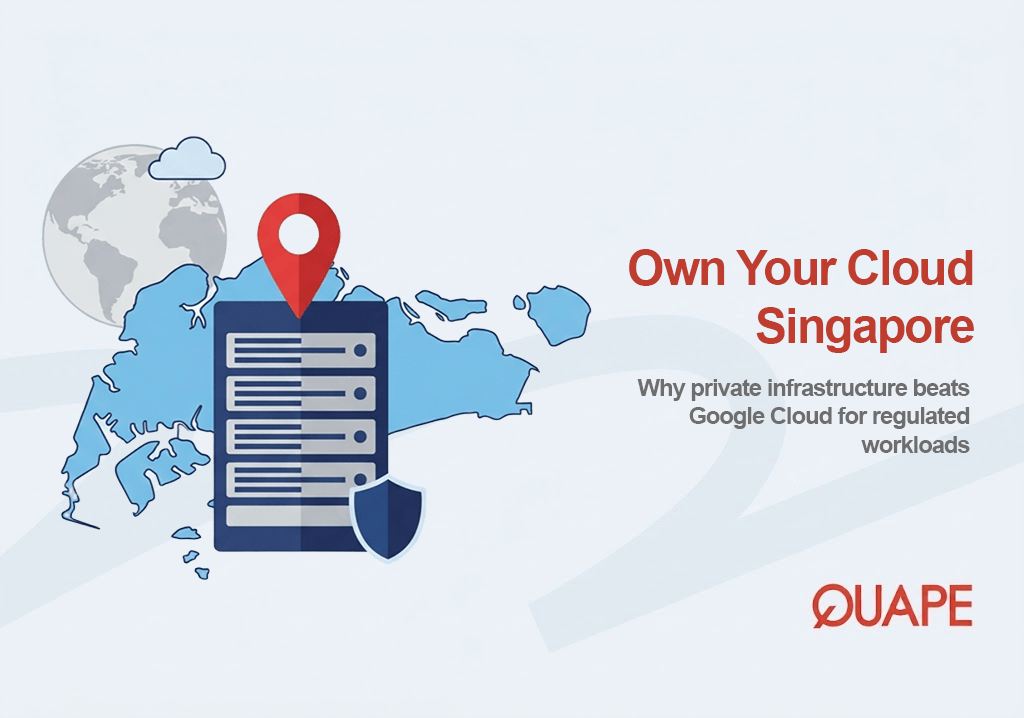
Singapore enterprises operating in regulated sectors are increasingly questioning whether a global public cloud is the right foundation for workloads that carry compliance obligations under the Personal Data Protection Act. Google Cloud offers genuine engineering depth, but its billing model, support structure, and data jurisdiction mechanics create real friction for finance, healthcare, and government-adjacent organisations that need clarity and control. For IT leaders who have spent months managing unpredictable cloud invoices or navigating PDPA audit questions, there is a structurally different option available locally. This article explains where Google Cloud serves enterprises well, where its model creates friction for Singapore-based teams, and why a private virtualization stack hosted in a Singapore Tier 3 data centre may be the more defensible long-term decision for organisations that prioritise compliance, cost predictability, and engineering-level support.
Why Singapore enterprises are re-evaluating Google Cloud dependence
Singapore’s position as a regional data hub comes with regulatory expectations that shape infrastructure decisions in ways that most global cloud providers were not originally designed to accommodate. The Personal Data Protection Act requires organisations to maintain protective standards over any personal data under their control, including data transferred across borders. For organisations in finance, healthcare, and public sector work, the Monetary Authority of Singapore’s Technology Risk Management Guidelines add a further layer of expectation, requiring that outsourcing arrangements including cloud services maintain auditability, control, and clearly defined accountability. These requirements do not prevent cloud adoption, but they do shift the evaluation criteria in a direction where data jurisdiction, support responsiveness, and infrastructure transparency carry more weight than raw feature count.
Cloud cost management has become a parallel pressure. Research from Flexera’s State of the Cloud Report consistently finds that more than 60% of enterprises cite cost management as their top cloud challenge, and Gartner has estimated that up to 30% of cloud spend is wasted through overprovisioning and idle resources. For SMEs and mid-market teams without dedicated FinOps capability, this is not an abstract concern. It shows up as invoice variability, unexpected egress charges, and budget conversations that are difficult to have with confidence.
What Google Cloud does well for modern infrastructure
Before making a case for an alternative, it is worth being direct about what Google Cloud genuinely delivers. Organisations building globally distributed applications, running Kubernetes-native workloads, or operating across multiple markets benefit from an infrastructure that few providers can match in depth. Google Cloud’s global network of data centres enables low-latency access across regions, and its managed services ecosystem reduces operational overhead for teams that want to move fast without managing underlying infrastructure.
Global scale and multi-region architecture
Google Cloud supports high availability architectures built on geographically distributed systems. For organisations that need replicated infrastructure across Asia-Pacific regions, or that rely on services like BigQuery, Cloud Spanner, or Vertex AI, the depth of the managed services catalogue is a genuine advantage. If workloads are designed to take advantage of cloud-native tooling and global distribution is genuinely required, Google Cloud is a reasonable choice and this article is not trying to argue otherwise.
Deep integration with cloud-native ecosystems
Google Cloud’s integration with Kubernetes, DevOps pipelines, and microservices architectures makes it a strong foundation for product engineering teams. GKE (Google Kubernetes Engine) in particular reduces the operational complexity of container orchestration. For organisations whose engineering culture is already built around cloud-native patterns, re-platforming away from Google Cloud carries its own switching costs and risks. That is an honest constraint worth acknowledging before evaluating alternatives.
Key takeaways
- Google Cloud is well suited for globally distributed, cloud-native workloads where managed services and Kubernetes integration are core requirements.
- For Singapore-regulated workloads, PDPA and MAS requirements shift the evaluation toward data jurisdiction, auditability, and support accountability, areas where public cloud architecture creates compliance overhead.
- Usage-based billing and egress fees make cloud cost forecasting difficult for organisations without dedicated FinOps capability.
- Data residency (selecting a Singapore region) is not the same as data sovereignty. Legal accountability for personal data remains with the organisation, regardless of where it chooses to host.
- Quape’s Virtualization Management Stack is deployed on dedicated hardware in a Singapore Tier 3 data centre, meaning data remains within Singapore’s jurisdiction without requiring region configuration or compliance workarounds.
- VMS pricing is structured as annual per-host licensing, with no per-core or per-VM fees, making cost forecasting straightforward for teams managing predictable workloads.
- Quape is an official Vates.tech partner with 24/7 DevOps engineering support, offering a direct support model rather than tiered documentation-based troubleshooting.
Where Google Cloud creates friction for Singapore-based organisations
Cost volatility from usage-based billing and egress fees
Google Cloud’s billing model scales with usage, which works well when workloads are predictable and when engineering teams have the tooling to monitor consumption in real time. In practice, compute, storage, and data egress do not scale linearly with business activity. A traffic surge, a misconfigured job, or an unoptimised data transfer can produce an invoice that bears little resemblance to last month’s. Egress fees in particular are a persistent source of billing unpredictability, especially for organisations moving data between Google Cloud and on-premises systems. For SMEs without a dedicated FinOps function, this dynamic makes budget forecasting genuinely difficult.
Data residency vs data sovereignty in Singapore context
Selecting the Singapore region on Google Cloud ensures data is stored in Singapore-located infrastructure. What it does not guarantee is that legal jurisdiction, operational control, and audit accountability all sit within Singapore. Under PDPA, the organisation collecting and controlling personal data remains accountable for how that data is handled, even when infrastructure is outsourced to a cloud provider. This distinction between residency and sovereignty creates compliance overhead during audits, particularly when organisations need to demonstrate traceability and deterministic control over sensitive data. For finance and healthcare workloads subject to MAS oversight, that overhead is not theoretical.
Limited direct engineering support for critical workloads
Google Cloud’s support model operates through tiered service packages. Access to engineering-level troubleshooting typically requires premium support subscriptions, and even then, the engagement model is documentation-driven and ticket-based. For Singapore SMEs running production workloads without large internal IT teams, this creates a support gap at precisely the moment it matters most. When infrastructure issues occur at 2am, the difference between a support portal and a DevOps engineer who knows your environment is meaningful.
Infographic placement: after this section, before the next H2. See infographic prompt in the supplementary outputs below.
The shift toward private virtualization in regulated industries
A quiet counter-trend to cloud-first infrastructure strategy is emerging in Singapore’s regulated sectors. Finance, healthcare, and government-adjacent organisations are not abandoning cloud adoption entirely, but a growing number are drawing clearer boundaries around which workloads belong in public cloud environments and which require the jurisdictional clarity and operational control that only privately hosted infrastructure can deliver. The global virtualization market continues to grow, driven in part by this demand for cost efficiency and infrastructure control in hybrid and private cloud deployments.
Why finance, healthcare, and government-adjacent sectors are moving away from full public cloud dependency
For financial institutions operating under MAS oversight, cloud outsourcing arrangements must satisfy auditability requirements that are difficult to meet when the underlying infrastructure is managed by a third party. Healthcare organisations handling patient data carry similar obligations under PDPA and sector-specific guidelines. The challenge is not that public cloud is inherently non-compliant. It is that demonstrating compliance, in the form of audit trails, access controls, and data lineage, requires substantially more governance effort when infrastructure is abstracted behind a managed service layer. Private virtualization, hosted locally, reduces that audit surface considerably.
Introducing a Singapore-hosted alternative: Virtualization Management Stack (VMS)
Quape's Virtualization Management Stack is built on XCP-ng, an open-source enterprise virtualization platform developed by the Xen Project and maintained commercially by Vates.tech. VMS is deployed on Quape’s dedicated hardware, housed in a Tier 3 data centre in Singapore, which provides 99.982% availability with redundant capacity components across multiple distribution paths. The architecture is deliberately different from public cloud: resources are not shared, infrastructure is not abstracted behind a multi-tenant layer, and data does not leave Singapore.
Built on open-source XCP-ng without vendor lock-in
XCP-ng is a high-performance hypervisor trusted by enterprise organisations and major cloud providers, built on the battle-tested Xen architecture that has underpinned large-scale virtualization deployments for over two decades. Because XCP-ng is open-source and built on open standards, workloads running on it are not coupled to proprietary APIs or licensing structures. This matters strategically. Vendor lock-in is a recognised business risk, particularly as cloud providers deepen proprietary integrations that increase switching costs over time. Open infrastructure removes that constraint.
Hosted in Singapore Tier 3 data centres for full data control
Tier 3 data centres are designed to provide 99.982% availability with redundant capacity components and multiple distribution paths, as defined by the Uptime Institute. Hosting within Singapore means data jurisdiction is unambiguous. There is no region configuration to manage, no cross-border transfer consideration under PDPA, and no ambiguity about which legal framework applies to data at rest. For organisations preparing for MAS or PDPA audits, this simplicity is operationally valuable. Latency for Singapore-based users is also reduced, which matters for applications where response time is a product requirement.
Predictable cost model without per-core or per-VM licensing
VMS pricing is structured as annual per-host licensing, starting from SGD 2,000 per year for small infrastructure with standard needs, scaling through Pro and Enterprise tiers for larger deployments. There are no per-core fees, no per-VM charges, and no egress costs. For organisations managing predictable workloads, this structure makes budget planning straightforward. The total cost of ownership conversation changes fundamentally when infrastructure cost does not vary with usage.
Backed by local DevOps support and operational expertise
Quape has been a Vates.tech partner since the early XenServer days, supporting XCP-ng from its Kickstarter inception to production-ready enterprise deployments. This history translates into operational depth that a general-purpose cloud support desk cannot replicate. The 24/7 DevOps engineering support model means that when issues arise, they are handled by engineers familiar with the specific environment, not routed through documentation tiers.
Google Cloud vs VMS: what actually matters in real infrastructure decisions
| Consideration | Google Cloud | Quape VMS (XCP-ng) |
| Cost model | Usage-based, variable, egress fees apply | Annual per-host licensing, no per-VM fees |
| Data jurisdiction | Regional hosting within Google infrastructure | Physically hosted in Singapore, full jurisdiction clarity |
| PDPA compliance posture | Requires governance effort and configuration | Simplified by local hosting and dedicated hardware |
| Support model | Tiered, documentation-driven, ticket-based | 24/7 DevOps engineering support, environment-specific |
| Vendor lock-in risk | High, proprietary APIs and managed services | Low, open-source XCP-ng on open standards |
| Infrastructure control | Abstracted, managed layer | Dedicated hardware, full visibility |
| Best for | Global-scale, cloud-native, multi-region workloads | Regulated local workloads requiring sovereignty and control |
Cost predictability vs elastic but uncertain billing
Google Cloud’s elasticity is valuable when workloads genuinely fluctuate and when teams have the visibility to manage that variability. For organisations with stable, predictable workloads, elasticity is less a feature than a source of invoice uncertainty. Fixed annual infrastructure costs allow finance teams to plan with precision, and remove the need for continuous consumption monitoring that elastic billing requires.
Regional hosting vs true jurisdictional data ownership
Choosing a Singapore Google Cloud region places data in Singapore-located hardware. It does not transfer legal accountability or operational control to the organisation hosting the workload. Privately hosted infrastructure within Singapore, on dedicated hardware, creates a different relationship between the organisation and its data. That relationship is simpler to document, simpler to audit, and simpler to explain to a regulator.
Self-service cloud vs managed private infrastructure
Public cloud platforms are designed for self-service. For engineering teams with capacity and expertise, that is an advantage. For organisations that need their infrastructure managed by people who understand both the technical environment and the local regulatory context, managed private infrastructure offers a different value. The question is not which model is objectively better, but which aligns with the organisation’s actual internal capability.
Vendor ecosystem lock-in vs open infrastructure flexibility
The OECD has recognised vendor lock-in as a structural risk in cloud adoption, particularly where proprietary services limit workload portability. Organisations that build deeply on Google Cloud’s managed services, GKE configurations, and proprietary data tools accumulate switching costs over time. Open virtualization infrastructure, built on XCP-ng and open standards, maintains portability and reduces long-term strategic dependency on a single provider.
When a private virtualization stack is the smarter choice than Google Cloud
Organisations with strict compliance and data residency requirements
Finance, healthcare, and government-adjacent organisations operating under PDPA and MAS guidelines need to demonstrate clear data lineage, access control, and audit capability. Privately hosted infrastructure eliminates the compliance ambiguity that public cloud’s abstraction layer introduces. If your next MAS audit requires you to explain precisely where data sits and who can access it, a Singapore-hosted private stack answers that question more cleanly than a cloud region selection.
Teams struggling with cost forecasting and budget stability
Organisations that have experienced unexpected cloud invoices, that lack a dedicated FinOps function, or that operate on annual budgets that cannot absorb usage variability are strong candidates for fixed-cost private infrastructure. The shift from variable to fixed infrastructure spend is not just a financial preference. It is an operational simplification that reduces the governance overhead of continuous cost monitoring.
Companies that need control without building in-house infrastructure teams
Managed private infrastructure occupies a middle ground that public cloud cannot. It delivers dedicated hardware and jurisdictional clarity without requiring the organisation to build and maintain an internal infrastructure operations team. Quape’s 24/7 DevOps support means that operational expertise is available without the headcount cost of internalising it.
Making the transition: from public cloud dependency to controlled infrastructure
Migration away from public cloud does not need to be a binary decision. Many Singapore organisations choose a hybrid approach, maintaining Google Cloud for workloads where its global scale and managed services genuinely add value, while moving compliance-sensitive workloads to privately hosted infrastructure with clear jurisdictional boundaries. VMS supports live migration, high availability, and backup capabilities, which means the transition can be structured as a staged migration rather than a single cutover. Quape’s team provides consultation and setup support for both licensed and open-source configurations, reducing the operational risk of the move. If your organisation is evaluating that transition, the Virtualization Management Stack page outlines the available plans and what each tier includes.
Kesimpulan
Google Cloud is a credible infrastructure platform for organisations whose workloads demand global scale, cloud-native tooling, and managed service depth. For Singapore enterprises operating in regulated industries where PDPA compliance, data sovereignty, and engineering-level accountability are requirements rather than preferences, a private virtualization stack hosted locally offers a more defensible operational foundation. Quape’s VMS delivers that through open-source infrastructure, dedicated Singapore hosting, predictable annual pricing, and direct DevOps support. It is not the right choice for every workload, but for organisations whose primary concern is control, compliance, and cost clarity, it addresses the friction that public cloud dependence creates.
Ready to explore a Singapore-hosted alternative to Google Cloud for your regulated workloads?
Talk to a virtualization expert
Frequently asked questions
Is Google Cloud compliant with Singapore’s PDPA?
Google Cloud can be configured to store data within Singapore’s regional infrastructure, which supports PDPA compliance planning. However, PDPA accountability remains with the organisation collecting and controlling personal data, not the cloud provider. Compliance requires active governance, audit capability, and documented data handling practices regardless of which cloud region is selected.
What is the difference between data residency and data sovereignty?
Data residency refers to the physical location where data is stored, such as a specific Google Cloud region in Singapore. Data sovereignty is the broader concept of who holds legal control and accountability over that data. Selecting a local cloud region establishes residency, but it does not transfer sovereignty to the organisation. Privately hosted infrastructure within Singapore, on dedicated hardware, provides both.
When is Google Cloud actually the better choice?
Google Cloud is a stronger fit for organisations building globally distributed applications, running Kubernetes-native microservices, or using advanced managed services like BigQuery or Vertex AI. If your workloads are designed around cloud-native architecture and global distribution is a genuine requirement, Google Cloud’s infrastructure depth is difficult to match with private virtualization. The comparison only favours private infrastructure when compliance control, cost predictability, and jurisdictional clarity are the primary evaluation criteria.
What is XCP-ng and why does it matter for this comparison?
XCP-ng is an open-source enterprise virtualization platform built on the Xen Project hypervisor, maintained commercially by Vates.tech. It supports enterprise features including live migration, high availability, backup, SR-IOV, and GPU passthrough. Because it is open-source and built on open standards, organisations using it are not subject to per-core licensing fees or vendor lock-in from proprietary APIs.
How does VMS pricing compare to Google Cloud?
VMS uses annual per-host licensing with no per-core or per-VM fees, starting from SGD 2,000 per year for small infrastructure. Google Cloud uses usage-based billing that scales with compute, storage, and data egress. For organisations with predictable workloads, VMS provides a fixed and forecastable cost. For workloads with highly variable or unpredictable resource demands, Google Cloud’s elastic model may be more efficient, though managing that variability requires active monitoring.
What kind of support does Quape provide for VMS?
Quape provides 24/7 DevOps engineering support for VMS deployments. As an official Vates.tech partner with experience deploying and managing XCP-ng environments since the platform’s early days, the support model is environment-specific rather than documentation-driven. Critical response times of 24 hours are included across plans, with unlimited ticket access on Essential+, Pro, and Enterprise tiers.
Can organisations run both Google Cloud and VMS at the same time?
Yes, a hybrid approach is common. Many organisations keep cloud-native or globally distributed workloads on Google Cloud while migrating compliance-sensitive workloads to privately hosted infrastructure. VMS supports live migration and high availability, making staged migrations practical. Quape also provides consultation and setup support to help plan and execute that transition.