For SME owners, bloggers, startup founders, and developers in Singapore, Indonesia, Vietnam, and Malaysia, choosing a hosting provider based on global brand recognition often produces a predictable frustration: slow server response times and support that operates in the wrong timezone. Bluehost is a well-established provider with a large user base, but its infrastructure is built primarily for North American audiences. When your visitors are in Southeast Asia and your server is in the United States, data must travel across trans-Pacific submarine cable systems before a single byte reaches a browser. That geographic reality carries a direct performance cost. This comparison focuses on a specific scenario: SEA-based businesses running WordPress or business websites that need locally hosted infrastructure, regional support, and pricing that does not change dramatically after the first billing cycle.
Why Bluehost Feels Slow for Many Southeast Asia Websites
The distance between US-based servers and SEA visitors
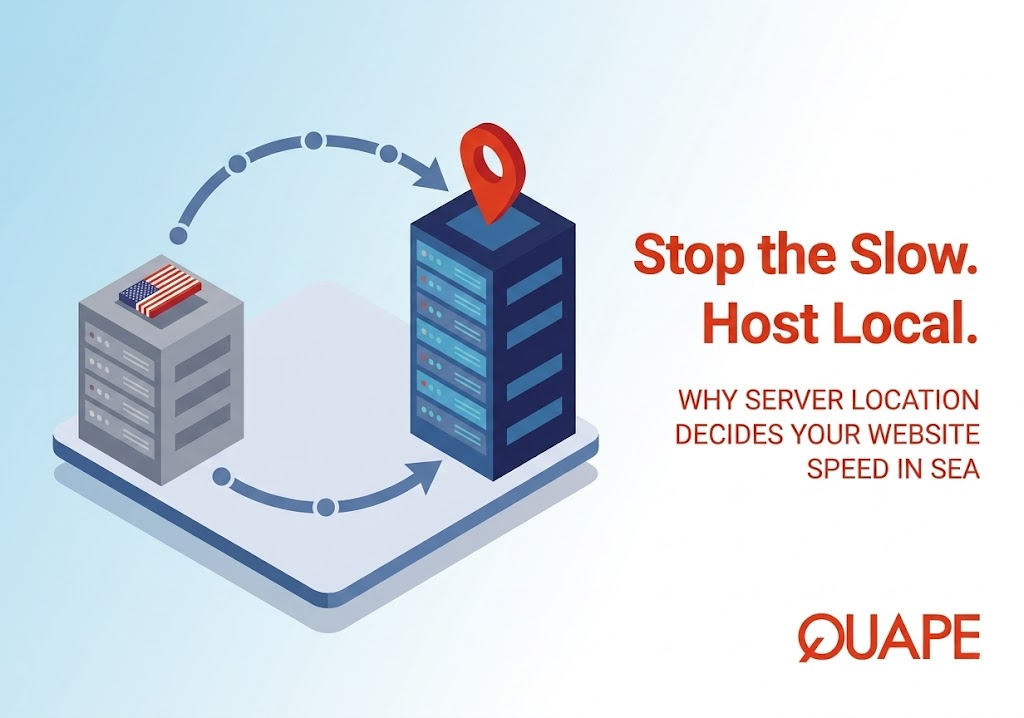
Latency is not a perception problem. It is a physics problem. When hosting infrastructure sits in the United States and the primary audience accesses that infrastructure from Singapore, Indonesia, Vietnam, or Malaysia, every page request must travel thousands of kilometers through international routing systems before the server responds. This increases Time To First Byte (TTFB), which is the measurable delay between a browser sending a request and receiving the first byte of a response. According to the International Telecommunication Union, physical distance between users and hosting infrastructure directly increases latency because data packets must traverse longer network paths and submarine cable systems. No amount of optimization on the website itself fully compensates for that fundamental routing distance.
Why slow hosting impacts SMEs, bloggers, and startup teams more than large enterprises
Large enterprises can absorb infrastructure costs, deploy CDN layers, and maintain dedicated engineering resources to compensate for hosting limitations. SMEs and startups typically cannot. A slow server response directly translates to higher bounce rates and lower search engine rankings, especially in a region where more than 90% of Southeast Asian internet users access the web primarily through smartphones. Google research shows that bounce probability increases by 32% as page load time moves from one second to three seconds. For a small business running a lead generation page or a blogger building organic traffic, those fractions of a second have measurable consequences.
What Bluehost Still Does Well for Certain Users
Bluehost is familiar to many first-time WordPress users
Bluehost has a long history as a WordPress-recommended host. Its onboarding experience is approachable, its interface is well-documented, and there is a large community of tutorials written specifically for its platform. For someone building a personal blog with a predominantly North American or global audience, that combination of beginner accessibility and existing ecosystem support is genuinely useful.
Bluehost’s ecosystem works fine for US-centric traffic
If the majority of a website’s visitors come from North America, Bluehost’s US-based infrastructure operates as expected. The latency problem that SEA businesses encounter simply does not exist in that context. CDN configurations can also extend performance to international audiences, which partially mitigates geographic distance for some content types.
When Bluehost can still be a reasonable choice
For hobby projects, low-traffic personal websites, or businesses whose customer base is geographically distributed across Western markets, Bluehost remains a functional option. The entry-level pricing is accessible, and the introductory plans cover basic hosting needs adequately.
Where Bluehost Creates Friction for Southeast Asia Businesses
Higher latency for Singapore, Indonesia, Vietnam, and Malaysia visitors
Southeast Asia is one of the world’s most mobile-first internet regions, and website responsiveness carries stronger UX consequences here than in desktop-dominant markets. When a visitor in Jakarta or Ho Chi Minh City loads a website hosted in the US, the request routes across the Pacific, processes on a remote server, and returns across the same distance. During peak network congestion periods, this routing adds unpredictable latency spikes on top of the baseline distance cost. Singapore hosts one of the densest concentrations of regional submarine cable landings in Asia, which means that locally hosted infrastructure can resolve requests without that transcontinental overhead.
Generic global support vs regionally relevant support
Global hosting providers optimize their support processes for scale, which produces standardized response flows that may not align with the operational realities of a business in Singapore or Indonesia. Timezone mismatches matter most during high-urgency incidents: a website outage during a campaign launch or a payment processing failure during peak checkout hours cannot wait for a support queue to cycle through overnight. Regional support teams that operate in compatible timezones reduce mean time to resolution in exactly these situations.
The renewal pricing problem many Bluehost customers discover later
Aggressive introductory pricing is a common acquisition tactic across the hosting industry. The practical issue is that long-term ownership costs rise substantially after renewal periods if pricing structures are not transparent. Many Bluehost customers report that their second-year renewal comes at a significantly higher rate than the promotional plan they signed up with. For a business that builds infrastructure dependencies around a hosting platform, discovering a large pricing step-up at renewal creates unnecessary operational friction.
Why developers and agencies in SEA often move away from US shared hosting
Developers managing client websites need reliable infrastructure, predictable support, and migration tooling that actually works. Shared hosting environments at global scale often overload server resources because the provider’s economics depend on maximising the number of accounts per server. This creates variable performance that is difficult to diagnose and harder to communicate to clients. Agencies building regional ecommerce or lead generation sites for SEA businesses increasingly need hosting that reflects the geographic distribution of their clients’ customers.
What Makes a Better Bluehost Alternative for Southeast Asia
Why server location matters more than most hosting reviews admit
Most hosting comparison articles focus on features, pricing tiers, and storage quotas. Server location receives a paragraph at best. For SEA audiences, it is one of the most operationally significant variables. Singapore consistently ranks among the top countries globally for internet connectivity and digital infrastructure readiness, and a TIA-942 certified data center in Singapore provides a materially different performance baseline than US-shared infrastructure accessed from across the Pacific. Quape’s servers are housed in a Singapore Tier 3 datacenter certified to TIA 942 standards, which directly reduces the routing distance for SEA visitors.
Regional support matters when your website is revenue-critical
Operational support is a different product depending on who delivers it. A support team in the same region understands local business contexts, can communicate across compatible business hours, and is more likely to resolve issues before they compound. Small businesses are disproportionately affected by downtime because they typically lack dedicated IT resources to diagnose and escalate hosting incidents internally. Regional support reduces the gap between identifying a problem and resolving it.
Transparent pricing becomes important after the first year
Hosting plans that renew at the same rate as the original signup remove a common source of budget uncertainty for SMEs. Knowing the long-term cost of infrastructure allows businesses to plan accurately, rather than discovering a pricing increase when the renewal invoice arrives. This is not a minor convenience. For a startup managing tight operational budgets, a sudden renewal increase requires renegotiation or another migration cycle, both of which carry cost and disruption.
Quape vs Bluehost for Southeast Asia Hosting Performance
| Dimension | Quape | Bluehost |
|---|---|---|
| Primary datacenter location | Singapore (TIA-942 Tier 3) | United States |
| Latency for SEA visitors | Regionally optimized | Trans-Pacific routing overhead |
| Support alignment | Regional, timezone-compatible | Global, standardized queue |
| Renewal pricing | Transparent, same renewal rate | Introductory rate, higher on renewal |
| WordPress management | Managed with WP Toolkit, monthly security updates | Shared environment, self-managed updates |
| Migration support | Free migration within 1-3 business days | Available with conditions |
| Network connectivity | Multi-homed, at least 3 upstream providers | Standard US shared hosting network |
Singapore-based infrastructure vs US-based infrastructure
Quape's Singapore WordPress hosting runs on NVMe storage within a TIA-942 certified facility. TIA-942 is a data center design standard that specifies requirements for redundancy, uptime reliability, and infrastructure resilience. For SEA visitors, the practical effect is that requests resolve without the trans-Pacific routing path that US-hosted infrastructure requires. This is not a marginal improvement for audiences in the region. It is a structural difference in how the hosting relationship between server and visitor operates.
Multi-homed connectivity and why it affects real-world website speed
A hosting provider connected to multiple upstream transit providers can reroute traffic during congestion or partial outages. Quape connects through at least three upstream providers, which means that disruption on any single network path does not produce equivalent disruption for the website. This multi-homed architecture reduces single points of failure and stabilizes performance during the kind of regional network events that a single-upstream provider cannot gracefully handle.
Managed WordPress maintenance vs DIY plugin management
The majority of WordPress vulnerabilities originate from plugins rather than WordPress core software. WordPress powers over 40% of websites globally, which makes it a consistent target for automated exploit campaigns. Quape’s managed WordPress plans include monthly security updates and daily backups with one-click restore, offloading the plugin maintenance burden from site owners who do not have active developers managing their installations. The WP Toolkit integration allows plugin updates across the account without requiring individual logins to each site. For SME owners who built their site with help and now manage it alone, this removes one of the most operationally risky aspects of running a WordPress installation.
Business hosting considerations for teams using email and multiple websites
For teams that need both web presence and professional email under a single plan, Quape’s business hosting includes unlimited email accounts, SSL certificates, WAF firewall protection, and support for both POP3 and IMAP. The server cap of 20 accounts per shared server is a deliberate density limit that reduces the performance degradation common in oversold shared environments. Plans renew at the same rate shown at signup, which removes the renewal pricing uncertainty that SEA businesses frequently encounter on global hosting platforms.
Which type of user benefits most from moving away from Bluehost
| User type | Primary benefit of switching |
|---|---|
| Bloggers targeting local SEA audiences | Lower latency improves page speed, which supports local SEO and reduces bounce rate for mobile visitors |
| SMEs with inquiry or checkout pages | A 1-second delay in mobile load times can reduce conversion rates by up to 20%, making infrastructure proximity a direct revenue variable |
| Agencies managing multiple client sites | Free migration support, managed WordPress maintenance, and regional support alignment reduce operational overhead across client portfolios |
| Startups on tight budgets | Transparent renewal pricing removes the risk of a surprise cost increase at the end of the introductory period |
Migration considerations before leaving Bluehost
What to audit before migrating your hosting
Before initiating a migration, a structured audit prevents post-migration issues. According to ICANN, DNS propagation delays can temporarily affect availability after migration, particularly across geographically distributed DNS resolvers. A practical pre-migration checklist covers:
- Export a full WordPress backup including database and file system
- Document all active plugins and confirm whether any are paid licenses requiring reactivation
- Record existing DNS records, particularly MX entries for email routing
- Note SSL certificate configurations, especially for subdomains
- List all active email accounts and confirm IMAP or POP3 client settings
- Identify any staging or development environments that depend on the current hosting setup
How free migration support reduces downtime risk
Quape includes free migration for WordPress sites and email accounts, with completion typically within one to three business days. The migration process includes an initial plugin audit to identify outdated or vulnerable plugins before the site is transferred. For urgent situations, faster migration timelines are available. This supported migration path removes the primary risk that causes businesses to delay switching providers: the fear of extended downtime during cutover. The Singapore WordPress hosting plans cover the full transfer, including an initial security review of the WordPress installation before it goes live on the new infrastructure.
Is Quape the right Bluehost alternative for Southeast Asia?
When Quape makes more sense than Bluehost
Quape is the stronger choice for any SEA-based business whose primary visitors are located in Singapore, Indonesia, Vietnam, or Malaysia. The infrastructure proximity reduces TTFB without requiring CDN configuration. The managed WordPress maintenance offloads plugin security from non-technical owners. The regional support operates in compatible timezones. And the pricing structure does not change at renewal. These four factors combine to remove the most common points of friction that SEA businesses report when running websites on US-hosted infrastructure.
When Bluehost may still be good enough
If a website’s audience is predominantly based in North America, Bluehost’s US datacenter serves that audience well. If the primary requirement is the lowest possible entry-level price for a low-traffic personal site with no revenue dependency, Bluehost’s introductory pricing remains competitive. The consideration is whether that introductory rate accurately represents the long-term cost of staying on the platform.
For SEA businesses that need infrastructure built around their region rather than retrofitted for it, the case for switching is straightforward. Lower routing distance, managed security, regional support, and transparent pricing are not premium add-ons. They are the baseline that regional hosting should provide.
Câu Hỏi Thường Gặp
Why does hosting server location affect website speed in Southeast Asia?
Every page request travels from the visitor’s browser to the server and back. When that server is in the United States, requests from Singapore or Indonesia must cross trans-Pacific submarine cable systems, adding measurable latency at every step. A Singapore-based server processes and returns those requests without that routing overhead, which reduces Time To First Byte and produces faster load times for SEA visitors.
Is Bluehost a bad hosting provider overall?
No. Bluehost is a functional hosting provider with a large global user base and strong documentation for WordPress beginners. It works well for websites serving North American audiences. The limitation is geographic: its US-based infrastructure introduces structural latency for SEA visitors that regionally hosted alternatives do not have.
What does TIA-942 Tier 3 certification mean for a business website?
TIA-942 is a data center design standard that specifies requirements for power redundancy, cooling, and fault tolerance. A Tier 3 facility is engineered to maintain uptime even during infrastructure maintenance or single-component failures. For a business website, this means the hosting environment is less likely to experience downtime from data center-level events than non-certified or lower-tier facilities.
How long does migration from Bluehost to Quape typically take?
Standard WordPress site migration is completed within one to three business days and is included at no charge. Urgent migrations can be arranged for faster completion. The migration process includes a plugin audit and initial security review before the site goes live, which reduces the risk of transferring vulnerabilities from the previous hosting environment.
What happens to my email if I migrate my website to Quape?
Email accounts are included in the free migration for standard setups. Before migration, it is important to document existing MX records and IMAP or POP3 client configurations. DNS propagation after the migration may cause brief intermittent delivery delays, which is a standard characteristic of any DNS change rather than a migration-specific issue.
Do I need a developer to manage a site on Quape’s WordPress hosting?
No. The managed WordPress plans are specifically designed for site owners without active development support. Monthly security updates, daily automated backups with one-click restore, and WP Toolkit-based plugin management are handled at the hosting level. For site owners who built their WordPress installation with outside help and now maintain it independently, this removes the most operationally risky maintenance tasks.
Is there a scenario where Bluehost is actually the better choice over Quape?
Yes. If the website’s primary audience is in North America, Bluehost’s US infrastructure serves that audience well and Quape’s Singapore location offers no geographic advantage. Bluehost is also a reasonable choice for purely personal projects with minimal traffic and no revenue dependency, where the introductory pricing and familiar interface outweigh the infrastructure considerations that matter more to business-critical sites.
Why does Quape cap shared hosting at 20 accounts per server?
Overselling server capacity is a common cost optimization in shared hosting environments. By capping shared server accounts at 20, Quape limits resource contention between tenants on the same infrastructure. This density limit reduces the performance variability that businesses experience on more aggressively oversold shared hosting platforms.

- Squarespace Alternative: Bespoke UI/UX Design that Converts High-Ticket Clients - Tháng 6 17, 2026
- Wix Alternative for Enterprises: Why You Need Custom Corporate Web Design - Tháng 6 16, 2026
- Dropbox Business Alternative: Avoid High User Licensing Fees with Private Nextcloud - Tháng 6 15, 2026