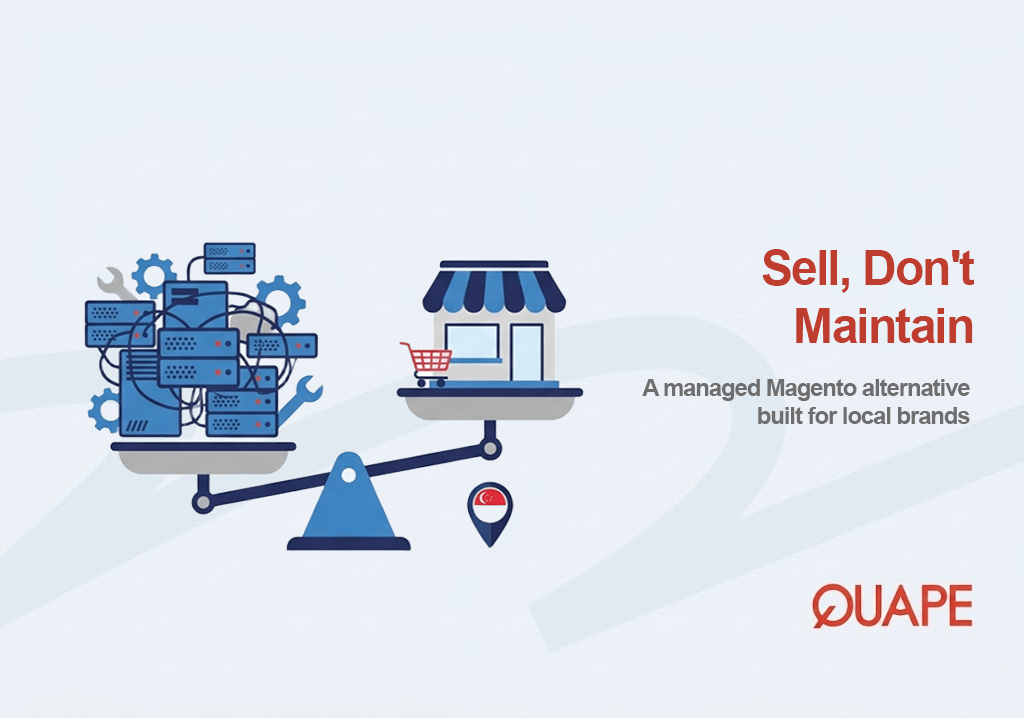
For a Singapore or Southeast Asian SME deciding how to sell online, the choice between Magento and a managed e-commerce solution is rarely about which platform is more powerful. It is about which one matches how a small team actually operates. Magento, now Adobe Commerce, is a genuinely capable enterprise platform, but its flexibility comes with infrastructure, security, and developer demands that many local retail, lifestyle, and F&B brands neither need nor have the team to support. This article compares the two honestly, acknowledging where Magento excels for complex commerce operations while showing why a fully managed, done-for-you store fits a growing local brand better. If your goal is to spend your budget on selling rather than on maintaining a commerce engine, the comparison that follows is for you.
Mục lục
Chuyển đổiIntroducing the Two Approaches
Magento earns its reputation among large merchants for good reason. It supports highly customized business logic, complex catalogs, B2B workflows, ERP integrations, and multi-store operations, the kind of architecture that an enterprise-focused commerce platform is built to handle and that many SMEs simply do not require. For an organization with a dedicated development team and intricate commerce needs, that extensibility is a real advantage. The platform’s ecosystem of extensions and APIs lets enterprises model almost any workflow they can imagine.
Quape approaches the same goal from the opposite direction. Rather than handing a business a powerful but demanding engine to run on its own, it delivers a fully designed, conversion-focused store with inventory sync, integrated payment gateways, SEO-ready product pages, and loyalty features built in, all running on managed VPS or WordPress hosting optimised for e-commerce. The maintenance, patching, and server tuning that Magento offloads onto the merchant are handled by Quape’s team as standard, with managed DevOps support included rather than billed as a separate retainer. Where a Magento store owner absorbs the risk of self-hosting, a Quape store sits on Singapore Tier 3 TIA-942 infrastructure that keeps customer and transaction data under local PDPA jurisdictional accountability.
Những điểm chính
- Magento is an enterprise-grade platform that rewards businesses with in-house developers and complex commerce requirements, but it asks a lot of smaller teams.
- The license is rarely the real cost. Hosting, security patching, performance tuning, and developer time push total cost of ownership far beyond the sticker price.
- Magento is slow out of the box and often needs Varnish caching, Redis, and image optimization work before it performs acceptably.
- The pool of experienced Magento developers is shrinking, which raises rates and makes specialist talent harder to retain.
- Quape delivers a managed, done-for-you store with inventory sync, Stripe, PayPal and 2C2P integration, and loyalty systems built in, removing the need to assemble these yourself.
- Quape includes managed DevOps support as standard instead of charging it as a separate add-on.
- Quape stores run on Singapore Tier 3 TIA-942 infrastructure, keeping data under PDPA jurisdictional accountability with transparent fixed SGD pricing between 4,800 and 15,000.
- For retail, lifestyle, F&B, and growing regional brands without a dev team, the managed approach converts an unpredictable enterprise commitment into a predictable project cost.
Why Many Southeast Asian SMEs Are Reconsidering Magento
Singapore’s digital economy has matured to the point where a capable online store is no longer optional for local brands. The country’s e-commerce market reached approximately US$9 billion in 2024, with SMEs contributing roughly one-third of total sales. That growth has pulled many smaller businesses toward platforms originally designed for far larger operations, and Magento is a common landing point. The problem is that an enterprise commerce platform behaves very differently in the hands of a five-person retail brand than it does inside a corporation with an IT department.
When an Enterprise Commerce Platform Becomes a Daily Operational Burden
Magento Open Source and Adobe Commerce both assume a level of technical ownership that most SMEs underestimate at the point of purchase. The platform expects someone to manage deployments, test extension compatibility, monitor performance, and apply updates. For a business whose actual job is selling products, every hour spent on platform maintenance is an hour not spent on merchandising, marketing, or customer service. Developer dependency becomes a structural feature of the business rather than an occasional cost, and that dependency rarely shrinks over time as a catalog and its customizations grow.
The Difference Between Selling Online and Managing an E-Commerce Infrastructure
There is a meaningful gap between operating a store and operating the infrastructure beneath it. A self-hosted commerce platform requires maintaining the storefront alongside security patches, performance optimization, backups, monitoring, and incident response. The talent needed to do this well is increasingly scarce and expensive. In Uptime Institute’s research, 58% of operators reported difficulty filling open positions in its 2023 staffing and recruitment survey, a shortage that pushes specialist rates upward across the board. An SME competing for that same talent pool is competing against data centers and AI infrastructure projects with far deeper pockets.
What Magento Does Well for Complex Commerce Businesses
It would be misleading to frame Magento as a weak product. It is not. It is a deliberate choice for businesses whose requirements genuinely exceed what a managed solution can offer, and understanding its strengths clarifies who should actually stay on it.
Deep Customization and Extensibility
Magento’s architecture is built for modification. Its extension marketplace and open APIs allow merchants to build custom pricing engines, integrate with ERP and warehouse systems, and model unusual commerce workflows that off-the-shelf platforms cannot accommodate. For a business with genuinely bespoke logic, this extensibility is the entire point and difficult to replicate elsewhere.
Multi-Store, Multi-Currency, and Enterprise-Level Commerce Capabilities
The platform handles multiple storefronts, currencies, and regional catalogs from a single backend, which suits international retailers managing distinct brands or markets. Enterprises running complex B2B and B2C operations side by side benefit from this consolidation in a way a simpler store cannot match.
Why Large Enterprises Continue to Invest in Magento
Large organizations with dedicated IT teams and a place in the Adobe ecosystem continue to invest in Magento because the operational overhead is absorbed by staff who are already there. When the developers, infrastructure, and testing processes exist in-house, the platform’s demands stop being a burden and start being leverage.
Where Magento Creates Friction for Singapore and Regional SMEs
The same flexibility that serves enterprises creates friction for smaller teams. The friction is mostly financial and operational, and it tends to surface after the build rather than before it.
The Hidden Costs Beyond Magento Licensing
Magento Open Source carries no licensing fee, which is precisely why its cost is so easily underestimated. By Quape’s market observation, the total cost of ownership for a mid-market store routinely lands between US$30,000 and US$100,000 a year once hosting, security, performance tuning, and developer time are counted, while Adobe Commerce on-premise begins around US$22,000 annually and scales with revenue. These are industry estimates rather than universally fixed figures, but the direction is consistent: the license is the smallest line in the budget.
| Cost factor | Magento (self-managed) | Quape (managed) |
|---|---|---|
| Licensing | Free (Open Source) or from ~US$22,000/yr (Adobe Commerce) | Included in project price |
| Hosting | Sourced and managed by merchant | Managed VPS or WordPress hosting included |
| Security patching | Merchant responsibility | Handled as standard |
| Performance tuning | Often US$10,000 to US$25,000 to reach acceptable speed | Optimised on managed infrastructure |
| DevOps support | Paid add-on or in-house hire | Included as standard |
| Pricing model | Open-ended TCO | Fixed SGD 4,800 to 15,000 |
Why Magento Performance Often Requires Additional Infrastructure
Magento is not fast out of the box. Reaching acceptable page speed typically requires Varnish caching, Redis, and image optimization work that can run between US$10,000 and US$25,000 before the store performs well. Speed is not a vanity metric here. Google research has found that page complexity, image count, and the number of page elements are among the strongest predictors of conversion outcomes, which means the performance work Magento demands is directly tied to revenue rather than being optional polish.
The Shrinking Magento Developer Talent Pool
The experienced Magento developer is becoming harder to find and more expensive to keep. Senior rates now sit between US$125 and US$200 an hour by Quape’s observation of the market, a trend reinforced by the broader infrastructure talent squeeze where 53% of respondents in Uptime Institute’s 2022 survey reported difficulty finding qualified candidates. For an SME, recruiting and retaining that specialist competes directly with much larger budgets.
The Risk of Building a Store That Requires Constant Specialist Attention
Beyond cost, there is operational risk. Enterprise commerce platforms require ongoing patch management because newly discovered vulnerabilities can affect payment systems and customer accounts. Adobe regularly issues security patches for Magento and Adobe Commerce, including critical fixes that demand prompt remediation, which TechRadar has documented in its reporting on Adobe’s e-commerce security advisories. A merchant without an internal technical team has to answer an uncomfortable question every time a patch ships: who is monitoring, testing, and deploying it before an attacker acts.
What Most Local Brands Actually Need From an E-Commerce Platform
Strip away the enterprise feature list and the needs of a growing local brand are remarkably consistent. They want to add products quickly, take payment reliably, keep stock accurate, and bring customers back. The trend across modern commerce reinforces this: unified models increasingly depend on synchronized inventory, orders, customer records, and payment systems rather than isolated software components.
Fast Product Management, Reliable Checkout, and Predictable Operations
A local brand needs to update a catalog without filing a developer ticket, trust that checkout works on every device, and know that inventory reflects reality. Synchronized stock levels and a streamlined checkout do more for a small store’s revenue than any amount of backend configurability, because they remove the daily friction that quietly costs sales.
Local Support and Faster Decision-Making for Growing Brands
When something breaks, a growing brand needs an answer in hours, not a support ticket routed across time zones. A local agency partnership with managed services shortens the distance between a problem and its resolution, which matters far more to a lean team than the theoretical ceiling of a platform’s capabilities.
How Quape Approaches E-Commerce Differently
Quape’s model is built around the way local brands actually work, which is why its managed approach to building and running a conversion-focused store removes the operational weight that Magento places on the merchant.
A Fully Managed Store Instead of a Self-Managed Commerce Engine
The core difference is ownership of the work. Instead of a self-managed engine, Quape delivers a managed store where hosting, maintenance, and server tuning are handled on the merchant’s behalf. The DevOps support that a Magento merchant either hires for or pays an agency retainer to access is included as standard, which changes both the cost structure and the day-to-day experience of running the store.
Built-In Inventory Sync, Payment Integration, and Loyalty Features
Where a Magento build assembles these capabilities from extensions, a Quape store ships with them. Inventory sync keeps stock and sales aligned, while integrated gateways including Stripe, PayPal and 2C2P cover the payment methods Singapore shoppers expect. Membership and loyalty systems with CRM integration and points redemption are built in to support customer retention rather than bolted on later. You can see how this conversion-focused approach to e-commerce web design is structured around selling rather than configuration.
SEO-Ready Product Pages Without Extensive Platform Engineering
Visibility should not require a dedicated engineering effort. Quape builds product pages with on-page SEO factors handled from the start, so search engines can index and rank them without the merchant commissioning a separate optimization project. This keeps a core growth channel open without adding to the technical maintenance load.
Singapore-Based Infrastructure and PDPA Accountability
For a Singapore business, where data lives matters. Quape stores run on Singapore Tier 3 TIA-942 infrastructure, which keeps customer and transaction data within local jurisdiction. Storing and processing data on Singapore-based infrastructure simplifies governance, accountability, and compliance oversight under PDPA compared with data dispersed across distributed international cloud regions.
Magento vs Quape for a Singapore SME: The Decision Factors That Actually Affect Profitability
The comparison that matters is not feature-by-feature. It is which model protects a small business’s margin and attention.
Upfront Project Cost vs Long-Term Ownership Cost
Magento presents a lower or zero entry price and an open-ended ownership cost, where the first year is commonly overspent by thirty to fifty percent on unplanned infrastructure and development. Quape presents a fixed, transparent project cost in Singapore dollars, which trades the appearance of cheapness for the reality of predictability.
Developer Dependency vs Managed Support
A Magento store ties operational continuity to access to scarce developer talent. A managed store ties it to an included support relationship. Given that staffing and organizational challenges were cited by 54% of operators as a key operational requirement, reducing dependency on hard-to-find specialists is a structural advantage rather than a convenience.
Self-Hosted Complexity vs Done-for-You Operations
Self-hosting means owning every layer of the stack and every failure within it. A done-for-you operation removes that surface area entirely, letting the brand treat its store as a tool rather than a system to be administered.
Enterprise Flexibility vs Business Simplicity
Magento offers near-unlimited flexibility that an SME will rarely use in full. Quape offers operational simplicity that an SME will use every single day. The right choice depends on which of those two your business will actually draw on.
Which Option Fits Your Business Stage Today?
A mid-market business with bespoke requirements and a technical team is a Magento candidate. A growth-stage local brand that wants to focus on sales is better served by a managed store. Business stage, not ambition, is the deciding factor.
When Magento Is Still the Better Choice
Honesty about fit cuts both ways, and there are clear cases where Magento remains the stronger option.
Organizations With Dedicated Development and Infrastructure Teams
If a business already employs developers, DevOps staff, and infrastructure specialists, Magento’s demands are absorbed rather than added. For these organizations the platform’s flexibility becomes pure upside, because the cost of operating it is already on the payroll.
Businesses Requiring Highly Customized Commerce Architectures
Companies that need custom pricing engines, deep ERP integration, or complex multi-store B2B workflows will hit the ceiling of a managed solution. For genuinely bespoke commerce architecture, Magento’s extensibility is the right tool and a managed store would be a poor fit.
Why Quape Is a Strong Magento Alternative for Local Brands That Want Predictable Growth
For the businesses this article is written for, the case for a managed alternative is straightforward, and it rests on matching the solution to how the business spends its time and money.
The Ideal Fit for Retail, Lifestyle, F&B, and Growing Regional Brands
Retail, lifestyle, F&B, and growing regional brands share a profile: strong products, lean teams, and no appetite for running infrastructure. Given that SMEs account for roughly a third of Singapore’s e-commerce sales, this is not a niche segment but the core of the local market, and it is precisely the segment a managed store serves best.
Focusing Resources on Sales and Marketing Instead of Platform Maintenance
Every dollar and hour not spent on patching, tuning, and developer retainers can be redirected into merchandising, marketing, and customer experience. That reallocation, rather than any single feature, is what makes the managed model profitable for a growing brand.
Next Steps for Businesses Evaluating a Magento Alternative
Choosing a platform is ultimately a decision about where your business should spend its limited attention.
Evaluate Your Current Cost, Technical Overhead, and Growth Requirements
Before committing either way, total your real cost of ownership: hosting, development, patching, and the hours your team spends on the platform rather than on customers. Set that against your growth plans. If the honest number is large and the technical overhead is a drag, a managed alternative deserves serious consideration.
Get a Fixed SGD Quote for Your E-Commerce Store
If that evaluation points toward a simpler operating model, the next step is a concrete number. See what a fixed-scope e-commerce project would cost for your business and get a fixed SGD quote for your e-commerce store, so you can compare a predictable project price directly against your current Magento ownership cost.
For a Singapore or regional SME, the Magento decision comes down to a single honest question: is your business built to operate a commerce engine, or to sell products through one? Magento rewards the organizations that have the teams to run it and the bespoke requirements to justify it. For a retail, lifestyle, or F&B brand that wants a high-converting store without inheriting an infrastructure department, the managed alternative converts an unpredictable enterprise commitment into a predictable, locally supported one. The better choice is the one that lets you put your budget where your customers are.
Câu Hỏi Thường Gặp
Is Magento more powerful than a managed e-commerce solution from Quape?
In raw flexibility, yes. Magento can model almost any commerce workflow and suits highly customized enterprise requirements. For most local SMEs, though, that power goes largely unused while its operational cost is paid in full, which is why a managed store is often the more profitable fit.
Why is Magento described as expensive when Open Source is free?
The license is free, but the cost of running the store is not. Hosting, security patching, performance optimization, and developer time push the real total cost of ownership well into five figures annually. The free license simply hides where the budget actually goes.
When is Magento actually the better choice over Quape?
Magento is the stronger option for organizations that already have dedicated development and infrastructure teams, or that require highly customized commerce architecture such as complex B2B workflows or deep ERP integration. When the technical capacity already exists in-house, Magento’s demands become an advantage rather than a burden.
What does Quape include that I would have to assemble myself on Magento?
A Quape store ships with inventory sync, integrated payment gateways including Stripe, PayPal and 2C2P, SEO-ready product pages, and built-in membership and loyalty features. On Magento these are typically assembled from separate extensions that each add maintenance and compatibility overhead.
How does data residency differ between the two approaches?
Quape hosts stores on Singapore Tier 3 TIA-942 infrastructure, keeping customer and transaction data within local jurisdiction and simplifying PDPA accountability. A self-hosted Magento store’s data location depends on the hosting the merchant sources, which is often dispersed across international cloud regions.
Will I still own and control my store with a managed solution?
Yes. A managed model changes who handles the maintenance and infrastructure, not who owns the business. You retain control over your products, branding, and customer relationships while Quape’s team handles patching, hosting, and server tuning.
How is Quape’s pricing structured compared with Magento’s?
Quape quotes e-commerce projects in a transparent fixed band between SGD 4,800 and 15,000 depending on complexity. Magento’s cost is open-ended and tied to ongoing hosting, development, and maintenance, with first-year budgets commonly overspent by thirty to fifty percent.
- Mindbody Alternative: Avoid Expensive Monthly SaaS Fees with Custom Software - Tháng 7 13, 2026
- Bubble Alternative: Hand-Coded React Mobile Apps for Scalable Businesses - Tháng 7 10, 2026
- Klook Merchant Alternative: Own Your Ticketing Engine with Custom Web Apps - Tháng 7 9, 2026