Enterprises deploying SAP workloads in Singapore operate within one of Asia-Pacific’s most structured regulatory environments. The intersection of data protection law, financial sector technology risk requirements, and international security standards creates a compliance landscape that directly shapes how hosted SAP systems must be designed, governed, and audited. For IT managers, CTOs, and procurement leads, understanding this landscape is not a compliance formality; it is a material business risk consideration. PDPA enforcement fines can reach up to 10% of annual turnover, which positions non-compliance as a direct threat to organisational profitability. Getting hosting architecture and governance right from the outset reduces exposure and supports long-term operational confidence.
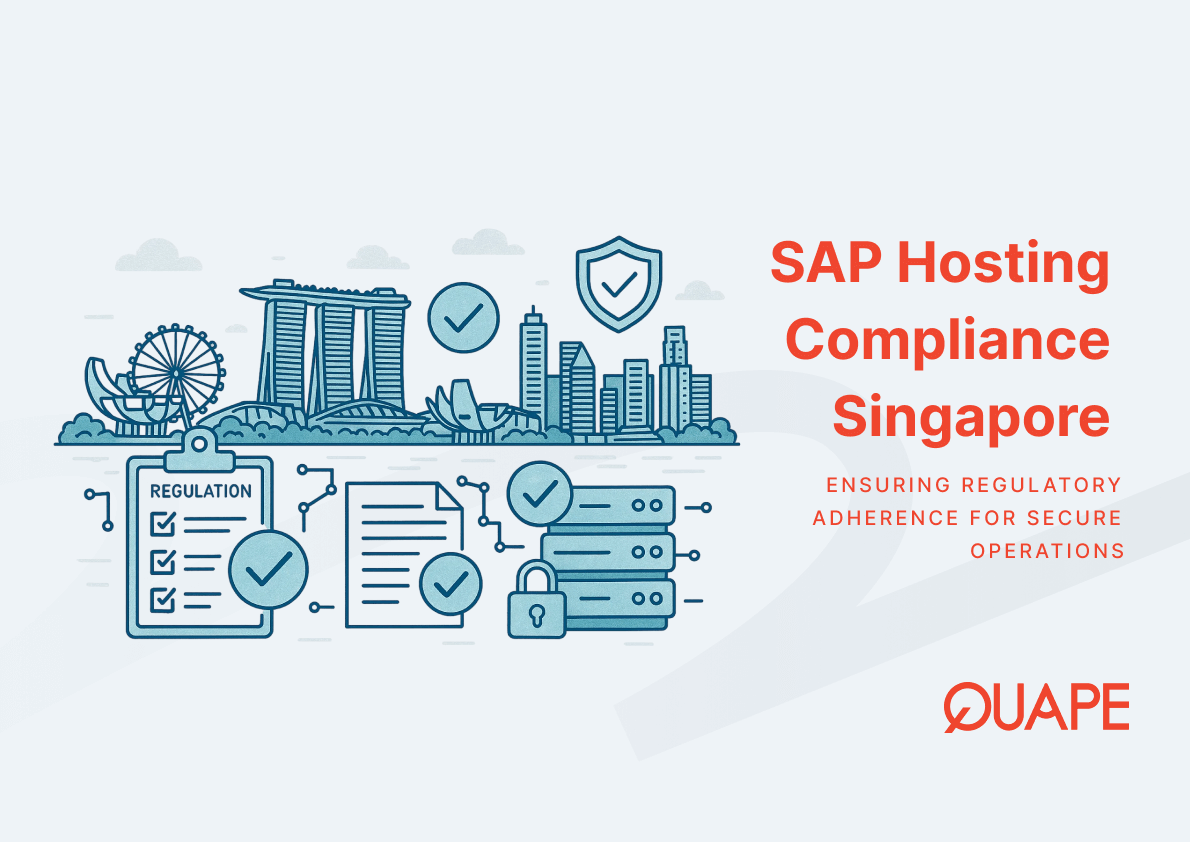
SAP hosting compliance refers to the alignment of hosted SAP infrastructure, access controls, data handling practices, and operational governance with applicable legal, regulatory, and standards-based requirements. In Singapore, this involves three primary frameworks: the Personal Data Protection Act (PDPA), the Monetary Authority of Singapore’s Technology Risk Management (TRM) Guidelines, and ISO/IEC 27001 information security controls. Together, these frameworks govern how personal data is protected, how technology risk is managed in regulated industries, and how security controls are documented and verified.
The relationship between these frameworks is not purely additive. Each one addresses a different dimension of risk. PDPA governs data protection obligations across all private sector organisations. MAS TRM targets technology risk governance for licensed financial institutions. ISO/IEC 27001 provides a risk-based control framework that can serve as an assurance foundation across both. For organisations running SAP workloads in Singapore, understanding how these frameworks interact within a managed SAP hosting infrastructure helps clarify which controls are mandatory, which are advisory, and which generate verifiable audit evidence.
Những điểm chính
- PDPA’s Protection Obligation requires SAP hosting environments to implement security measures that protect personal data held within ERP systems, including encryption, access controls, and monitoring.
- Non-compliance with PDPA can result in fines of up to 10% of annual turnover or SGD 1 million, making it a measurable financial risk rather than an abstract regulatory concern.
- MAS TRM Guidelines are not statute but carry strong regulatory weight for licensed financial institutions, requiring documented technology risk governance and third-party oversight for SAP hosting arrangements.
- ISO/IEC 27001 certification provides a credible, audit-supported compliance foundation that maps to both PDPA and MAS TRM requirements, reducing duplicated effort across frameworks.
- Data residency in Singapore-based data centres simplifies PDPA cross-border transfer obligations and supports data sovereignty requirements for regulated workloads.
- Hybrid SAP hosting architectures allow workload segmentation by compliance requirement, giving organisations flexibility to meet both regulatory and operational needs.
- Managed SAP hosting with built-in compliance controls shifts significant operational governance burden to the provider, helping organisations meet ongoing obligations without scaling internal compliance teams.
Introduction to SAP Hosting Compliance in Singapore
Singapore’s regulatory environment for enterprise IT is layered in a way that few jurisdictions match in the Asia-Pacific region. Organisations operating SAP systems here must contend with privacy obligations under PDPA, sector-specific technology risk expectations from MAS, and internationally recognised information security standards that auditors and enterprise counterparties increasingly expect to see in place.
The challenge for IT decision-makers is that each framework uses different terminology, covers different entities, and requires different types of evidence. PDPA focuses on data subjects and personal data handling. MAS TRM focuses on technology risk governance and operational resilience. ISO/IEC 27001 focuses on the systematic management of information security risks through documented controls. SAP hosting compliance sits at the convergence of all three, because a hosted SAP environment processes personal data, runs business-critical financial workloads, and must demonstrate security control maturity to internal and external auditors.
Enterprise IT governance for SAP in Singapore therefore requires a compliance-aware hosting strategy, not just a technically capable one. Infrastructure choices, provider selection, and service-level definitions all carry compliance weight that IT managers and procurement leads must factor into deployment decisions.
Regulatory Landscape Affecting SAP Hosting in Singapore
Singapore operates a mature regulatory environment that draws on domestic data protection law, sector-specific financial regulation, and international standards. For SAP hosting, these frameworks do not operate in isolation. They create overlapping obligations that, when mapped carefully, reveal significant areas of alignment alongside specific requirements that each framework introduces independently.
Singapore PDPA Requirements for Hosted SAP Systems
Các Personal Data Protection Act 2012 is Singapore’s primary legislation governing how private sector organisations collect, use, disclose, and protect personal data. For SAP hosting, the most operationally significant obligation is the Protection Obligation, which requires organisations to implement reasonable security arrangements to protect personal data in their possession or under their control. This obligation extends to hosted environments because data processed within a SAP system, including HR records, customer information, and financial data, typically constitutes personal data under PDPA’s definitions.
The practical implication for SAP hosting is that the security posture of the hosting environment becomes a PDPA compliance matter. Organisations cannot satisfy their Protection Obligation by relying on a provider’s security capabilities without establishing that those capabilities are adequate, documented, and subject to oversight. Access control policies, encryption standards, monitoring configurations, and data handling procedures within SAP hosting security architectures must be structured to meet PDPA’s reasonableness standard, which the Personal Data Protection Commission (PDPC) assesses in the context of the sensitivity and volume of data involved.
The enforcement consequence of failing to meet this standard is material. PDPA allows fines of up to 10% of annual turnover or SGD 1 million, depending on the organisation’s size and the nature of the breach. For large enterprises running SAP with significant personal data volumes, this means non-compliance is a risk that should be modelled alongside other financial exposures.
MAS TRM Compliance for SAP Workloads in Regulated Industries
Các Monetary Authority of Singapore’s Technology Risk Management Guidelines set out risk governance and IT resilience practices that MAS expects licensed financial institutions to follow. The Guidelines are not statute, but MAS expects alignment from regulated entities, and supervisory assessments use TRM adherence as an evaluative benchmark. For financial institutions running SAP workloads, including core banking support systems, treasury platforms, or finance and controlling modules, TRM alignment shapes how hosting arrangements must be structured and governed.
MAS TRM places specific emphasis on technology risk governance, third-party risk management, and IT resilience. For SAP hosting, this means that the hosting provider is not a peripheral vendor but a component of the institution’s technology risk profile. Regulated institutions must demonstrate that they have conducted due diligence on hosting providers, established contractual risk controls, and retained sufficient oversight to manage technology risks associated with SAP workloads. Governance documentation, incident response procedures, and audit rights over the hosting environment are all relevant to TRM alignment in managed SAP industries serving financial services.
The trade-off is real: strong TRM alignment improves operational resilience and regulatory standing, but it requires investment in documented governance processes that go beyond standard IT operations. Organisations that establish this governance structure early benefit from cleaner audit trails and more defensible compliance positions during MAS supervisory reviews.
ISO/IEC 27001 Controls in SAP Hosting Environments
ISO/IEC 27001:2022 defines requirements for establishing, implementing, maintaining, and improving an Information Security Management System (ISMS). It provides a risk-based framework that organisations use to systematically manage information security risks by applying a structured set of controls. Its adoption is significant: more than 70,000 organisations in over 150 countries hold certification, reflecting its status as a globally accepted information security assurance standard.
For SAP hosting environments, ISO/IEC 27001 matters in two ways. First, hosting providers that hold certification have demonstrated to an independent auditor that their security management system meets the standard’s requirements, providing organisations with a credible third-party assurance mechanism. Second, the control set within ISO/IEC 27001 maps closely to the types of controls that PDPA and MAS TRM require, including access management, incident management, cryptography, and supplier relationships. This alignment means that pursuing or requiring ISO/IEC 27001 certification within a Singapore data centre SAP hosting environment can simultaneously advance compliance objectives across multiple frameworks.
The trend direction here is instructive. ISO/IEC 27001’s continued global adoption indicates that it is moving from a differentiator to a baseline expectation in enterprise-grade hosting compliance. Organisations evaluating SAP hosting providers should treat certification not as a bonus but as a minimum competency indicator.
Infrastructure-Level Compliance Controls for SAP Hosting
Compliance frameworks establish obligations, but infrastructure design determines whether those obligations can be met operationally. For SAP hosting in Singapore, several infrastructure-level controls are directly relevant to PDPA, MAS TRM, and ISO/IEC 27001 requirements.
Data Residency and Sovereignty for SAP Hosting in Singapore
Data residency refers to the physical or jurisdictional location where data is stored and processed. For PDPA compliance, data residency in Singapore simplifies obligations because transfers of personal data outside Singapore require organisations to ensure comparable data protection standards are maintained at the destination. Keeping SAP data within Singapore-based data centres eliminates the complexity of managing cross-border transfer obligations for most operational data types.
For regulated financial institutions, data residency in Singapore also supports MAS TRM’s expectations around data governance and technology oversight. When data remains within a known, local infrastructure environment, oversight is more straightforward and audit documentation is easier to maintain. Singapore-based data centres with established uptime, connectivity, and physical security records provide a stable foundation for SAP workloads where data sovereignty and operational continuity intersect.
Access Control, Identity Management, and Audit Logging
Access control within a SAP hosting environment must satisfy both PDPA’s protection obligations and MAS TRM’s governance requirements. Role-based access control (RBAC) in SAP systems limits data access to authorised users based on defined roles, reducing the risk of unauthorised access to personal data and supporting the principle of least privilege. In a hosted environment, RBAC must be implemented at both the application layer within SAP and at the infrastructure layer by the hosting provider.
Privileged access management adds a further control layer by governing how administrators with elevated access rights interact with the SAP environment. Audit logging ensures that privileged and standard user actions are recorded, timestamped, and retained in a tamper-evident format. For compliance purposes, particularly under MAS TRM and ISO/IEC 27001, these logs provide the evidence trail that auditors require to verify that access control policies are being enforced in practice. Organisations can learn more about how SAP remote access security controls integrate with hosting governance requirements.
Backup, Retention, and Disaster Recovery Compliance
Business continuity planning and disaster recovery are compliance requirements under both MAS TRM and ISO/IEC 27001. MAS expects licensed financial institutions to maintain IT resilience sufficient to support their critical functions, which for SAP workloads means that backup frequency, recovery time objectives (RTOs), and recovery point objectives (RPOs) must be defined, tested, and documented. ISO/IEC 27001’s control set includes requirements for information backup and redundancy that align closely with these expectations.
SAP data backup policies must address both the technical execution of backups and the governance of retention periods, because PDPA’s data protection obligations extend to backed-up personal data. Retaining personal data longer than necessary creates unnecessary exposure, while failing to restore systems within acceptable timeframes creates operational and regulatory risk. Structured SAP disaster recovery planning integrates these considerations into a coherent governance framework that satisfies compliance expectations across all three regulatory dimensions.
Compliance Considerations for SAP Hosting Deployment Models
SAP workloads can be deployed across several infrastructure models, and each carries distinct compliance characteristics. The choice of deployment model affects how compliance obligations are allocated, monitored, and evidenced.
Compliance Trade-offs Between Cloud and On-Prem SAP Hosting
Cloud SAP hosting introduces shared responsibility for compliance controls. The hosting provider manages infrastructure-level security, while the organisation retains responsibility for application configuration, data classification, and access governance. This division simplifies some compliance tasks but requires clear contractual definition of each party’s obligations, particularly for PDPA’s Protection Obligation, where responsibility cannot simply be delegated to a provider without documented oversight.
On-premise SAP environments give organisations full control over infrastructure and compliance implementation but require internal investment in the security controls, monitoring capabilities, and governance processes that compliance frameworks demand. The compliance cost of on-premise hosting is often underestimated: maintaining ISO/IEC 27001 alignment, running continuous monitoring, and documenting MAS TRM governance without a managed provider’s support requires significant internal resources. Understanding the full SAP hosting versus on-premises comparison helps organisations make deployment decisions that account for both capability and compliance cost.
Hybrid SAP Hosting for Regulatory Flexibility in Singapore
Hybrid SAP hosting combines hosted and on-premise components to allow workload segmentation by compliance requirement. Organisations can place the most sensitive or regulated workloads within a compliant hosted environment while retaining other functions on-premise, using a secure interconnect architecture to maintain data integrity and performance across both environments.
For Singapore-based organisations with MAS-regulated and non-regulated business units, a hybrid SAP hosting architecture offers the flexibility to apply different compliance controls to different workload categories without requiring a single uniform infrastructure standard. This segmentation supports regulatory workload management in complex enterprise environments where multiple compliance regimes apply simultaneously.
Operational Governance and Ongoing Compliance Management
Compliance in SAP hosting is not a point-in-time achievement. It is an ongoing operational responsibility that requires governance structures, monitoring capabilities, and documented processes to sustain over time. Infrastructure controls provide the technical foundation, but operational governance determines whether compliance is maintained as systems evolve, incidents occur, and regulatory expectations develop.
SLA, Incident Response, and Compliance Reporting
Service-level agreements (SLAs) between organisations and SAP hosting providers define the performance and availability commitments that underpin operational compliance. For MAS TRM alignment, SLAs must address IT resilience requirements, including uptime targets, incident response timeframes, and escalation procedures that match the criticality of SAP workloads to regulated business functions. An SLA that lacks specificity on incident notification timelines or recovery commitments creates a gap in the governance chain that MAS supervisory reviews may identify.
Incident management procedures within the hosting environment must produce audit-ready documentation. When a security incident occurs affecting SAP data, PDPA may require notification to the PDPC if the incident is a notifiable data breach. MAS TRM requires institutions to maintain incident response processes that enable timely reporting and containment. ISO/IEC 27001 requires documented incident management procedures as a control requirement. Organisations evaluating providers should assess SAP hosting SLA evaluation criteria that cover all three compliance dimensions, not just technical uptime metrics.
How Managed SAP Hosting Supports SAP Hosting Compliance
Managed SAP hosting shifts infrastructure management, security operations, and ongoing governance responsibility to a provider equipped with the technical capabilities and compliance frameworks to maintain them. For organisations subject to PDPA, MAS TRM, or ISO/IEC 27001 expectations, this operational responsibility model reduces the internal burden of maintaining compliance controls while providing access to a compliance-by-design infrastructure environment.
QUAPE’s Quản lý SAP Hosting is built on SAP-certified hardware with multi-layered security controls including encrypted data at rest and in transit, VPN access, two-factor authentication, role-based access control, intrusion detection, and 24/7 monitoring. These controls map directly to PDPA’s Protection Obligation requirements, ISO/IEC 27001 control categories, and the infrastructure governance expectations embedded in MAS TRM. Daily backups and proactive system health management support both business continuity planning and disaster recovery compliance requirements.
The managed service model also supports compliance reporting and audit readiness by maintaining documented operational processes and making performance and security data available for governance reviews. For organisations that need to demonstrate to regulators, auditors, or enterprise counterparties that their SAP hosting environment meets a credible compliance standard, a managed provider with verifiable controls and certifications provides a more defensible position than a self-managed alternative.
Kết luận
Enterprises operating SAP workloads in Singapore must align infrastructure design, security controls, and operational governance with PDPA, MAS TRM, and ISO/IEC 27001 to maintain regulatory compliance and reduce business risk. These frameworks are not independent checklists; they form an interconnected compliance architecture where gaps in one area can create exposures across others. The organisations best positioned to manage this complexity are those that treat hosting provider selection as a compliance decision, not just a technical one, and that establish governance structures capable of sustaining compliance through audit cycles, regulatory changes, and operational incidents.
Organisations seeking structured compliance alignment in their SAP hosting environment are welcome to liên hệ với nhóm của chúng tôi to discuss how our Managed SAP Hosting supports PDPA, MAS TRM, and ISO/IEC 27001 requirements for their specific SAP landscape.
Câu Hỏi Thường Gặp
What does PDPA require of SAP hosting environments in Singapore? PDPA’s Protection Obligation requires organisations to implement reasonable security arrangements to protect personal data in their possession or control. For SAP hosting, this means the hosting environment must include access controls, encryption, monitoring, and data handling procedures that can be demonstrated to the PDPC as adequate safeguards for the volume and sensitivity of personal data processed within the SAP system.
Does MAS TRM apply to all organisations using SAP hosting? MAS TRM Guidelines apply specifically to licensed financial institutions regulated by the Monetary Authority of Singapore. Other organisations are not directly subject to MAS TRM, but the governance practices it describes, particularly around third-party risk, incident management, and IT resilience, represent sound operational practice for any organisation running business-critical SAP workloads.
How does ISO/IEC 27001 certification help with PDPA and MAS TRM compliance? ISO/IEC 27001’s control framework maps closely to the security and governance requirements embedded in both PDPA and MAS TRM. A hosting provider that holds ISO/IEC 27001 certification has demonstrated to an independent auditor that its information security management system meets a globally recognised standard, giving organisations a credible assurance foundation that supports compliance conversations with regulators and auditors across both frameworks.
What are the financial consequences of a PDPA breach involving SAP data? Organisations found in breach of PDPA can face fines of up to 10% of annual turnover or SGD 1 million, whichever is higher for organisations above a specified revenue threshold. For large enterprises with significant personal data volumes in SAP systems, this makes PDPA compliance a material financial risk that should be managed as part of the organisation’s overall risk governance framework.
What is data residency and why does it matter for SAP compliance in Singapore? Data residency refers to the physical or jurisdictional location where data is stored and processed. Keeping SAP data within Singapore-based data centres simplifies PDPA cross-border transfer obligations and supports data sovereignty requirements for regulated workloads. It also makes technology oversight more straightforward for MAS TRM purposes, because the infrastructure remains within a known regulatory and operational context.
How does managed SAP hosting differ from self-managed SAP hosting in terms of compliance? Managed SAP hosting places infrastructure security operations, monitoring, and governance responsibility with the provider, which reduces the internal compliance burden for the organisation. Self-managed environments require the organisation to build and maintain all compliance controls internally, including access management, audit logging, backup governance, and incident response, which demands significant in-house expertise and operational resources.
What should organisations look for in a SAP hosting SLA from a compliance perspective? A compliance-relevant SLA should specify incident notification timeframes, recovery time and recovery point objectives, audit rights over the hosting environment, and escalation procedures that align with the criticality of SAP workloads to regulated business functions. SLAs that address only uptime metrics without covering incident governance and compliance reporting create gaps in the evidence chain required by MAS TRM and ISO/IEC 27001 audits.

- Squarespace Alternative: Bespoke UI/UX Design that Converts High-Ticket Clients - Tháng 6 17, 2026
- Wix Alternative for Enterprises: Why You Need Custom Corporate Web Design - Tháng 6 16, 2026
- Dropbox Business Alternative: Avoid High User Licensing Fees with Private Nextcloud - Tháng 6 15, 2026