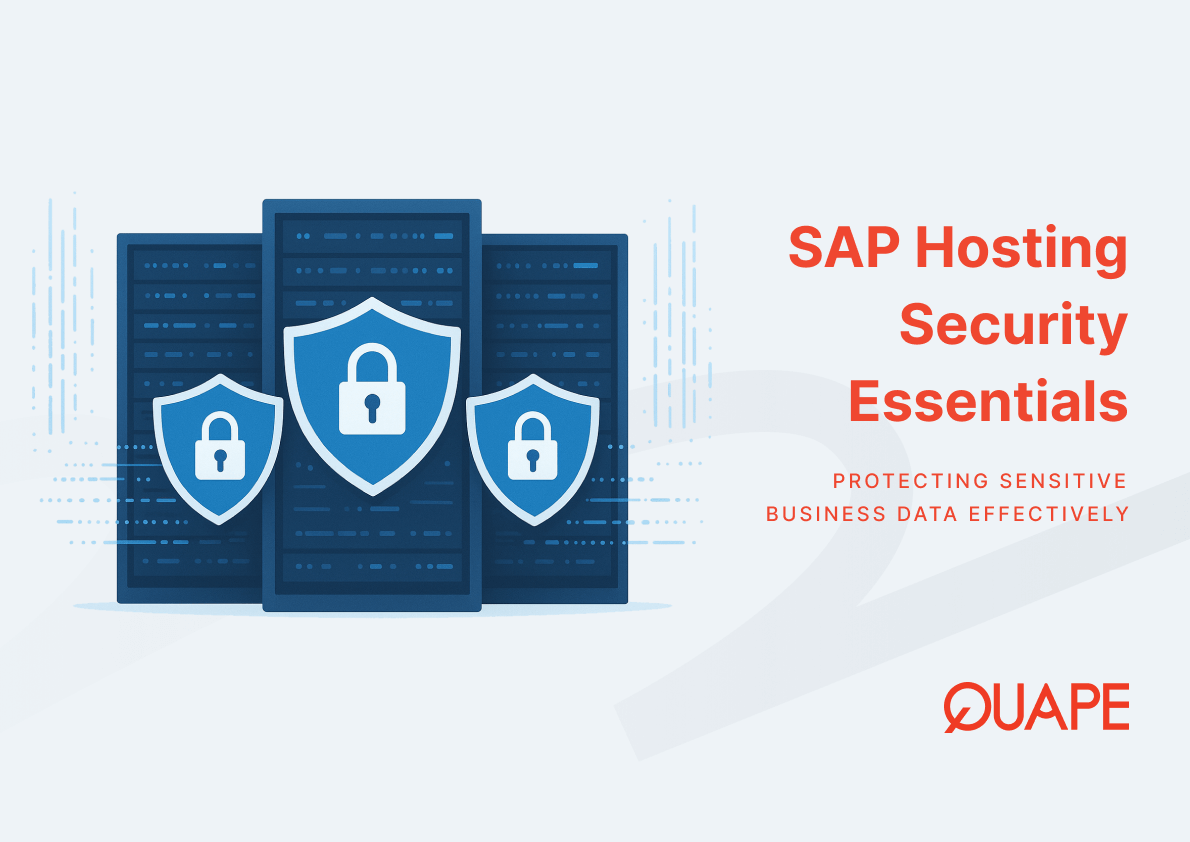
Securing an SAP environment is not optional for businesses that rely on ERP systems to manage finance, supply chain, and operations. SAP HANA workloads process sensitive transactional data at high volumes, making them a persistent target for credential theft, lateral movement, and data exfiltration. Organizations that treat security as a post-deployment concern rather than an architectural requirement consistently face greater exposure. For IT managers, CTOs, and procurement leads evaluating hosted SAP infrastructure, understanding the security layers that protect these environments is a prerequisite for confident decision-making.
Introduction to SAP Hosting Security
SAP hosting security refers to the collection of technical controls, policies, and operational processes that protect SAP HANA environments from unauthorized access, data loss, and service disruption. Unlike generic cloud workloads, mission-critical ERP systems require layered defenses that account for both the sensitivity of the data processed and the business continuity risks that any downtime creates.
For organizations running SAP Business One or S/4HANA on managed infrastructure, the security model extends beyond the application layer. It encompasses the hosting environment itself, including the network, storage, identity systems, and monitoring capabilities that a provider maintains on behalf of the business. Understanding how these components interact is central to evaluating any SAP hosting in Singapore arrangement.
Những điểm chính
- Identity and access management, including RBAC and MFA, reduces credential-based attack vectors in SAP environments.
- Encryption of data at rest and in transit forms the baseline of any defensible SAP security architecture.
- Zero Trust segmentation limits lateral movement by isolating SAP workloads at the network level.
- Continuous monitoring and intrusion detection enable faster incident response before damage spreads.
- Backup encryption ensures that recovery assets do not become an additional vulnerability.
- Singapore-based SAP deployments benefit from local data residency controls that support regional compliance expectations.
- Security readiness must be maintained across SAP lifecycle transitions, including migrations and version upgrades.
- Managed SAP hosting consolidates these controls under a single operational framework, reducing the burden on internal IT teams.
Key Components of SAP Hosting Security Architecture
Effective SAP hosting security is not built on a single control. It requires identity management, encryption, and network segmentation to work together as a unified system. Each component addresses a distinct attack vector, and the failure of any one element can undermine the effectiveness of the others. For organizations hosting SAP HANA, the architecture must account for how these controls interact across users, data flows, and network boundaries.
Identity and Access Management in SAP Hosting
Identity management functions as the primary gatekeeper for SAP environments. Role-Based Access Control (RBAC) structures permissions around job functions, ensuring that a finance user cannot access manufacturing configuration data and that system administrators cannot modify financial records without audit trails. This least-privilege approach directly reduces the attack surface exposed by any single compromised account.
Multi-Factor Authentication (MFA) strengthens identity verification by requiring a second form of confirmation beyond a password. Given that 65% of security breaches involve inadequate access control, identity-centric controls like MFA are among the highest-return investments an organization can make in SAP security. Privileged access management extends this further by applying stricter controls to administrative accounts that can modify configurations, export bulk data, or alter system permissions. For teams managing SAP remote access, layering MFA with privileged session monitoring creates an audit-ready access environment.
Encryption at Rest and In-Transit for SAP Data
SAP HANA stores structured business data ranging from payroll records to customer transactions, all of which carry regulatory and commercial sensitivity. Encryption at rest protects this data from physical storage compromise or unauthorized extraction, while TLS-based encryption in transit secures data as it moves between users, application layers, and the database itself.
Industry adoption of these controls is high and accelerating. Approximately 87% of cloud security teams now use encryption for both in-transit and at-rest data protection, according to industry analysis. SAP HANA supports native encryption capabilities at the database layer, which a managed hosting provider should configure, maintain, and audit as part of standard operations. Certificate lifecycle management and key rotation are operational responsibilities that many internal IT teams lack the capacity to manage consistently, which is one reason why SAP hosting compliance frameworks benefit from external management.
Zero Trust Segmentation for SAP Workloads
Zero Trust security operates on a single governing principle: no user, device, or network segment is trusted by default, regardless of its location inside or outside the corporate perimeter. For SAP workloads, this model is particularly relevant because ERP systems often connect to multiple business units, integration layers, and external APIs, each of which represents a potential entry point.
Network micro-segmentation applies Zero Trust principles at the infrastructure level by isolating SAP workloads into discrete network zones. East-west traffic protection, which governs communication between internal systems rather than just inbound and outbound flows, prevents an attacker who gains access to one segment from moving freely toward the SAP database. More than 81% of organizations globally have adopted or are actively working toward a Zero Trust model, reflecting how broadly this framework has been accepted as an enterprise security standard. For hybrid SAP hosting configurations that span on-premises and cloud infrastructure, Zero Trust segmentation becomes the connective tissue that maintains consistent access enforcement across both environments.
Operational Security Controls for SAP Hosting Environments
Architecture defines the security posture, but ongoing operations determine whether that posture holds over time. Patch management, monitoring, and backup integrity are the disciplines that translate a well-designed security architecture into a consistently protected environment. Without these controls, even correctly configured systems accumulate exposure as vulnerabilities are discovered and threat patterns evolve.
Continuous Monitoring and Threat Detection
Intrusion detection systems observe network and application behavior against known attack signatures and anomalous patterns. For SAP HANA environments, this includes monitoring for unusual query volumes, failed authentication sequences, and unexpected privilege escalations, each of which can indicate an active compromise or a misconfiguration being exploited.
Log monitoring connects individual events into behavioral sequences that reveal threats not visible from any single data point. Security incident response depends on the quality and completeness of these logs, particularly when tracing the origin and scope of a breach. A managed SAP infrastructure support arrangement typically includes these monitoring capabilities as continuous operations rather than periodic audits, reducing the detection-to-response interval meaningfully.
Backup Security and Disaster Recovery Readiness
Backups represent the recovery foundation for any SAP environment, but they also represent a secondary risk if not properly secured. Backup encryption ensures that recovery assets stored offsite or in cloud repositories cannot be accessed or manipulated without authorization. An unencrypted backup of an SAP HANA database is, effectively, an unprotected copy of all the data the primary encryption controls were designed to protect.
Recovery Point Objective (RPO) and Recovery Time Objective (RTO) define the acceptable boundaries for data loss and downtime in a recovery scenario. These parameters need to be defined before a disruption occurs, not during one. Organizations planning SAP disaster recovery strategies should align RPO and RTO targets with business continuity requirements and verify that backup schedules and infrastructure redundancy support those targets. For operations with zero tolerance for extended downtime, SAP high availability configurations supplement backup strategies with active failover capabilities.
SAP Hosting Security Considerations for Singapore-Based Organizations
Singapore’s position as a regional data hub introduces specific security and compliance considerations for organizations deploying SAP infrastructure locally. Data residency requirements, particularly for regulated industries such as financial services and healthcare, can restrict where SAP data is stored and processed. A hosting arrangement that places SAP HANA workloads in a Singapore data center directly addresses these requirements by keeping data within a defined jurisdictional boundary.
Latency-sensitive SAP workloads, including real-time analytics and high-frequency transactional processing, also benefit from local infrastructure proximity. Beyond performance, local deployments enable tighter alignment with Monetary Authority of Singapore (MAS) technology risk guidelines and PDPA obligations, both of which influence how enterprise data environments are structured. Evaluating a Singapore data center for SAP against these compliance criteria is a practical starting point for procurement decisions. Businesses exploring the SAP hosting benefits specific to Singapore should also assess provider certifications, such as ISO 27001, as indicators of baseline security maturity.
Security Readiness Across SAP Lifecycle Stages
SAP environments are not static. Migration projects, version upgrades, and digital transformation initiatives each introduce periods of elevated security risk, where configurations change, data moves between systems, and access patterns shift. Security readiness must be maintained across these transitions rather than treated as a property of the steady-state environment alone.
SAP migration security involves validating access controls, encryption configurations, and network segmentation in the destination environment before data transfer begins. A poorly secured migration can expose sensitive records during transit or leave them in an intermediate state where normal monitoring controls do not apply. For organizations planning a move to managed cloud SAP, pre-migration security assessments and post-migration validation steps should be treated as mandatory rather than optional. The transition to S/4HANA in particular introduces new infrastructure dependencies that affect security architecture, making S/4HANA infrastructure readiness a security concern as much as a technical one.
How Managed SAP Hosting Strengthens SAP Hosting Security
A managed SAP hosting arrangement consolidates the security controls described throughout this article under a single operational framework, maintained by a provider with dedicated SAP expertise. Rather than distributing responsibility for identity management, encryption, monitoring, and patch management across an internal IT team, managed hosting centralizes these functions and applies them consistently across the entire environment.
QUAPE’s Quản lý SAP Hosting includes encrypted data at rest and in transit, firewall protection, intrusion detection, VPN access, and role-based access control, all maintained within an ISO 27001-aligned environment. Daily backups, 24/7 monitoring, and proactive security operations mean that threat detection and response do not depend on internal capacity or availability. For IT managers and CTOs managing lean teams, this model transfers the operational burden of security maintenance to specialists who apply it as a continuous discipline rather than a periodic task.
Conclusion and Secure Next Steps for SAP Hosting
SAP hosting security requires coordinated application of identity management, encryption, network segmentation, and ongoing operational controls. No single measure provides sufficient protection on its own, and the interactions between these components determine the overall resilience of the environment. For Singapore-based organizations, aligning these controls with local data residency requirements and regional compliance expectations adds an additional dimension that a knowledgeable hosting partner is well-positioned to support.
If you are evaluating managed infrastructure for your SAP HANA environment, QUAPE’s team is available to discuss your specific security and operational requirements. Liên hệ bán hàng to start the conversation.
Câu Hỏi Thường Gặp
What is SAP hosting security and why does it matter for ERP systems? SAP hosting security refers to the technical and operational controls that protect SAP HANA environments from unauthorized access, data loss, and service disruption. ERP systems process sensitive financial and operational data, making them high-value targets that require structured, layered defenses rather than generic cloud security defaults.
How does identity management reduce risk in an SAP hosting environment? Identity management controls who can access which parts of an SAP system and under what conditions. Role-Based Access Control (RBAC) limits permissions to job-relevant functions, while MFA adds a verification layer that reduces the impact of compromised credentials, which are implicated in the majority of enterprise breaches.
What encryption standards should a managed SAP hosting provider maintain? A reliable provider should encrypt SAP HANA data both at rest and in transit using current standards, including TLS for transport security. They should also manage key rotation and certificate lifecycles as part of standard operations, since these are common sources of misconfiguration when managed informally.
What does Zero Trust mean in the context of SAP network security? Zero Trust removes implicit trust from network-level access decisions, requiring every user and device to be verified before accessing SAP resources. For hosted SAP environments, this includes micro-segmentation that isolates SAP workloads and east-west traffic controls that prevent lateral movement within the hosting network.
How does backup encryption protect SAP data beyond primary security controls? An unencrypted backup creates a secondary copy of data that bypasses all primary access controls. Encrypting backups ensures that recovery assets stored offsite or in cloud repositories remain protected from unauthorized access, maintaining the same confidentiality standard as the live database.
What compliance considerations apply to SAP hosting in Singapore? Singapore-based organizations must consider PDPA requirements for personal data and MAS Technology Risk Management guidelines for financial sector workloads. Hosting SAP infrastructure in a local data center supports data residency compliance, and providers holding ISO 27001 certification demonstrate a baseline commitment to information security management.
How does managed SAP hosting differ from self-managed cloud hosting in terms of security? Managed SAP hosting transfers responsibility for configuring and maintaining security controls to a specialized provider, ensuring consistent application of encryption, monitoring, patching, and access management. Self-managed cloud hosting places this responsibility on internal IT teams, which may lack the depth of SAP-specific security expertise needed to sustain those controls over time.
What security checks should organizations perform before migrating to a managed SAP hosting platform? Before migration, organizations should audit current access controls, document encryption configurations, and verify that monitoring coverage will transfer to the new environment. Post-migration validation should confirm that all security controls are active, that backup schedules align with RPO targets, and that no data was left in an unprotected intermediate state during the transition.

- Squarespace Alternative: Bespoke UI/UX Design that Converts High-Ticket Clients - Tháng 6 17, 2026
- Wix Alternative for Enterprises: Why You Need Custom Corporate Web Design - Tháng 6 16, 2026
- Dropbox Business Alternative: Avoid High User Licensing Fees with Private Nextcloud - Tháng 6 15, 2026