Enterprise systems remain operational only when infrastructure absorbs failure without cascading into downtime. For SAP workloads, high availability depends on architecting redundancy, replication, and orchestration into every layer of the stack. Single points of failure at the database or application server level can disrupt financial close processes, halt supply chain execution, and breach regulatory reporting windows. Organizations deploying SAP in Singapore increasingly prioritize availability design that integrates fault tolerance with regional compliance requirements and low-latency performance expectations.
What SAP High Availability Means
SAP high availability refers to system design that minimizes unplanned downtime by distributing workloads across redundant infrastructure and automating recovery processes. High availability in enterprise systems is achieved through redundancy, fault detection, and automated failover mechanisms rather than relying solely on hardware durability. Unlike disaster recovery, which restores service after catastrophic failure, high availability maintains service continuity during localized faults. This distinction shapes how SAP hosting infrastructure balances cost, complexity, and operational resilience.
For production SAP environments, availability architecture addresses database layer stability, application server distribution, and replication strategy. Each design choice introduces trade-offs between data consistency, geographic separation, and recovery speed. Effective high availability transforms system behavior under failure conditions rather than preventing failure itself.
Những điểm chính
- Redundant nodes eliminate single points of failure at the database and application server layers, reducing total outage probability during hardware or OS-level failures.
- Failover orchestration automates recovery processes and lowers Mean Time to Recovery compared to manual intervention, directly improving operational resilience.
- Synchronous replication guarantees zero data loss but constrains node separation to low-latency environments, limiting geographic distribution.
- Asynchronous replication enables regional resilience by tolerating network latency but accepts controlled data loss during failover events.
- Network latency between primary and secondary nodes directly impacts replication efficiency for in-memory databases like SAP HANA.
- Automated failover combined with health monitoring reduces downtime duration by 45–55% compared to manual recovery setups, according to IDC research.
- Over 70% of SAP-related outages stem from infrastructure or configuration issues rather than application bugs, making architectural choices critical to uptime.
- Singapore-based SAP deployments must align high-availability design with data residency requirements and regional network topology.
Key Components of SAP High-Availability Architecture
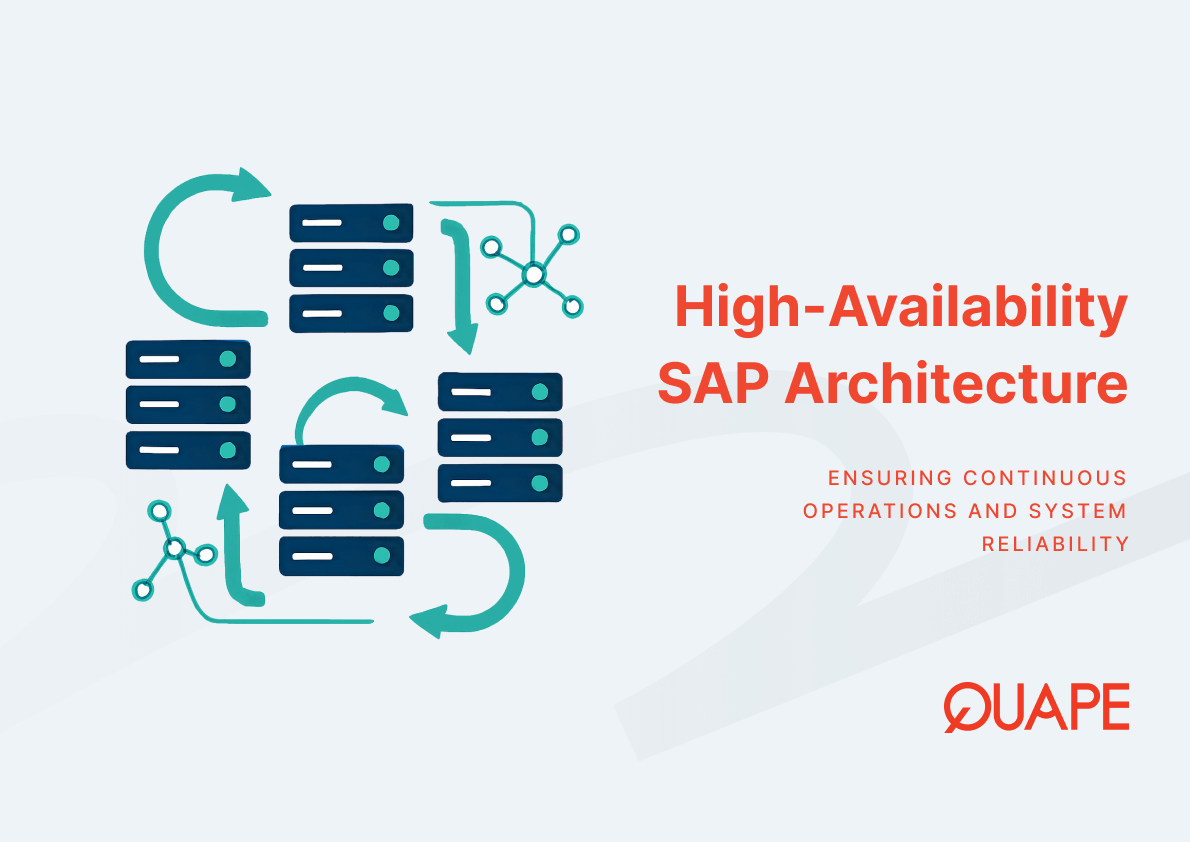
High-availability architecture for SAP workloads integrates three interdependent layers: redundant nodes that distribute processing capacity, failover orchestration that automates recovery, and data replication strategies that balance consistency with geographic separation. Each component interacts with the others to determine how the system behaves under failure conditions.
Redundant Nodes and Active–Passive vs Active–Active Models
Redundant nodes distribute SAP application servers and database instances across multiple physical or virtual machines. In active-passive configurations, a standby node remains idle until the primary node fails, at which point failover orchestration transfers workloads to the standby system. This model simplifies licensing and resource allocation but accepts brief service interruption during cutover. Active-active configurations run workloads across both nodes simultaneously, eliminating failover delay by distributing traffic continuously. However, active-active deployments require careful management of session state and transaction coordination to prevent data conflicts.
Application server redundancy operates independently from database node clustering. SAP workloads separate presentation logic, business logic, and database operations across distinct server roles. Clustering application servers improves load distribution and resilience, but database layer availability determines overall system stability. Organizations evaluating SAP hosting compared to on-premises deployment must assess whether infrastructure supports multi-node clustering without introducing latency bottlenecks.
Failover Orchestration and Automated Recovery
Failover orchestration shifts recovery from human-driven processes to policy-driven automation. Health checks continuously monitor node status, network connectivity, and resource utilization. When predefined thresholds are breached, orchestration tools initiate failover sequences that reassign IP addresses, mount storage volumes, and restart SAP services on standby nodes. Automated failover significantly reduces Mean Time to Recovery by eliminating manual diagnosis and intervention steps.
Orchestration platforms integrate with SAP workload management to preserve session consistency during failover events. Without orchestration, administrators manually verify system state, configure network routing, and validate database integrity before restoring service. This manual process extends downtime from minutes to hours, particularly during off-hours incidents. Organizations relying on SAP infrastructure support benefit from pre-configured orchestration policies that align with business continuity requirements.
Synchronous vs Asynchronous Replication Trade-offs
Data replication ensures secondary nodes maintain current copies of database transactions. Synchronous replication writes data to both primary and secondary storage before acknowledging transaction completion. This approach guarantees zero data loss (RPO ≈ 0) but introduces latency because the primary node must wait for confirmation from the secondary node before proceeding. Network latency above 5 milliseconds between nodes degrades synchronous replication efficiency, particularly for in-memory databases like SAP HANA that depend on rapid transaction processing.
Asynchronous replication acknowledges transactions after writing to the primary node, then replicates data to secondary nodes without blocking subsequent operations. This approach reduces latency impact and enables geographic separation between nodes, but accepts controlled data loss if the primary node fails before replication completes. The Recovery Point Objective (RPO) increases proportionally to replication lag. Organizations designing SAP disaster recovery strategies must evaluate whether their operational context tolerates asynchronous replication’s RPO trade-off or requires synchronous replication’s latency constraints.
Architectural Design Considerations for SAP Workloads
SAP HANA architecture amplifies the importance of infrastructure decisions because in-memory processing depends on low-latency access to storage and network resources. High-availability design must account for latency sensitivity, storage IOPS requirements, and security boundaries that interact with redundancy models.
Network Latency and Inter-Node Communication
Low-latency networking determines whether synchronous replication remains viable for geographically separated nodes. SAP HANA replicates data continuously between primary and secondary database instances, and network delays directly extend transaction commit times. Deployments targeting sub-millisecond latency typically colocate nodes within the same data center or availability zone. Regional high-availability architectures that separate nodes across multiple facilities must accept asynchronous replication or invest in dedicated low-latency interconnects.
Interconnect design also affects cluster communication protocols that coordinate failover decisions and maintain quorum. Split-brain scenarios occur when network partitions prevent nodes from determining which instance should assume the primary role. Properly designed interconnects use redundant paths and heartbeat mechanisms to detect failures without creating ambiguity. Organizations evaluating SAP hosting latency considerations must verify that infrastructure supports both replication throughput and cluster communication requirements.
Security and Access Control in HA Environments
High-availability environments introduce multiple access points and replication channels that expand the attack surface. Role-based access control restricts administrative privileges to specific nodes and functions, preventing unauthorized failover initiation or replication configuration changes. Secure remote access mechanisms authenticate users before granting entry to management interfaces, and encrypted channels protect data in transit between nodes.
Security models must account for automated processes that orchestrate failover without human intervention. Service accounts require sufficient privileges to reassign network addresses and mount storage volumes, but excessive permissions increase risk if credentials are compromised. Organizations implementing SAP hosting security frameworks should audit orchestration service accounts and apply least-privilege principles. Additionally, SAP remote access security policies must extend to failover management tools that administrators use during incident response.
Compliance and Availability SLAs
Compliance requirements influence availability design when regulations mandate specific recovery objectives or data residency constraints. Service-level agreements formalize uptime commitments and define penalties for breaches, creating accountability between hosting providers and customers. Availability SLAs typically specify monthly uptime percentages, but these metrics may not reflect business impact if downtime occurs during critical operational windows.
Các tổ chức đánh giá SAP hosting compliance alignment should verify that availability architecture supports both uptime targets and regulatory obligations. For example, synchronous replication within a single jurisdiction may satisfy data residency requirements while maintaining high availability, whereas asynchronous cross-border replication introduces regulatory complexity. Reviewing SAP hosting SLA structures helps clarify how availability guarantees interact with compliance boundaries.
Practical Application for SAP Deployments in Singapore
Singapore’s regulatory environment emphasizes data sovereignty and operational resilience for financial services, healthcare, and government sectors. SAP deployments in Singapore benefit from localized availability zones that enable synchronous replication within the same geographic region while meeting residency requirements. Regional infrastructure supports low-latency interconnects between zones, allowing organizations to separate primary and secondary nodes without introducing replication delays that exceed acceptable thresholds.
Organizations leveraging Singapore data center infrastructure for SAP workloads gain access to carrier-neutral connectivity and redundant power systems that reduce infrastructure-related failure modes. Singapore’s position as a regional hub also facilitates hybrid architectures that combine local high-availability clusters with disaster recovery nodes in adjacent markets. Understanding SAP hosting benefits specific to Singapore helps organizations align availability design with market conditions and regulatory expectations.
Operational Scenarios Where High Availability Becomes Critical
High-availability architecture proves essential during periods of operational change and when workloads span multiple environments. SAP migration events and hybrid deployments introduce complexity that amplifies the consequences of downtime.
During SAP Migration and System Modernization
Migration cutover windows create vulnerability because legacy and target systems must synchronize data while maintaining service availability. Organizations that delay implementing high-availability architecture until after migration accept extended outage risk during the transition. Conversely, deploying redundant nodes and orchestration before migration allows parallel operation of old and new environments, enabling gradual workload transfer without total service interruption.
Downtime minimization during SAP migration to cloud infrastructure depends on orchestration tools that automate DNS updates, storage remapping, and service restarts across environments. Without automation, manual coordination between teams introduces human error and extends cutover duration. High-availability design transforms migration from a high-risk event into a controlled process with defined rollback capabilities.
Hybrid and Multicloud SAP Architectures
Hybrid SAP hosting distributes workloads between on-premises infrastructure and cloud environments, creating dependencies on network connectivity and cross-environment orchestration. High availability in hybrid deployments requires failover policies that account for both local node failures and connectivity loss between environments. Multicloud connectivity introduces additional complexity because replication and orchestration must span different providers’ APIs and network topologies.
Organizations implementing hybrid SAP hosting models should verify that failover orchestration supports cross-environment recovery without manual intervention. SAP multicloud connectivity strategies must address latency variability and ensure that replication mechanisms tolerate differences in storage performance and network characteristics between providers.
How Managed SAP Hosting Supports SAP High Availability
Managed SAP Hosting eliminates the operational burden of designing and maintaining high-availability infrastructure by providing fully managed environments with pre-configured redundancy, orchestration, and replication. SAP-certified environments ensure that infrastructure meets performance and stability requirements without requiring organizations to specify hardware configurations or network topologies. Managed providers implement health monitoring, automated failover, and 24/7 incident response, shifting availability operations from internal IT teams to specialized service providers.
Organizations adopting Quản lý SAP Hosting gain access to architectures that integrate redundant nodes, low-latency replication, and compliance-aligned data residency without capital investment in duplicate infrastructure. Managed services also include regular system health checks, patch management, and performance tuning that maintain availability over time as workloads evolve.
Kết luận
High-availability architecture is not a single component but a system of interdependent design decisions that span redundancy, replication, orchestration, and regional infrastructure. When aligned correctly, these elements ensure SAP systems remain resilient, compliant, and performant even under failure conditions. Organizations deploying SAP in Singapore must balance technical requirements with regulatory obligations, latency constraints, and operational complexity.
If you want to evaluate or design a high-availability SAP architecture tailored to Singapore-based operations, liên hệ với đội ngũ bán hàng của chúng tôi để thảo luận về các yêu cầu cụ thể của bạn.
Câu Hỏi Thường Gặp
What is the difference between high availability and disaster recovery for SAP systems?
High availability maintains service continuity during localized infrastructure failures by using redundant nodes and automated failover within the same operational environment. Disaster recovery restores service after catastrophic events that affect entire data centers or regions, typically involving backup restoration and manual intervention. High availability targets minutes of recovery time, while disaster recovery accepts hours or days depending on the event severity.
How does synchronous replication affect SAP HANA performance?
Synchronous replication introduces latency because the primary database node must wait for confirmation from the secondary node before acknowledging transaction completion. This delay becomes significant when network latency between nodes exceeds 5 milliseconds, as in-memory databases like SAP HANA depend on rapid transaction processing. Organizations must balance zero data loss guarantees against performance requirements when choosing replication strategies.
Can active-active configurations eliminate all downtime during failover events?
Active-active configurations reduce downtime by distributing workloads across multiple nodes simultaneously, but they do not eliminate all service interruption. Session state management and transaction coordination introduce complexity, and network partitions can still create temporary inconsistencies. Active-active designs minimize user-visible disruption but require careful application-level design to handle split-brain scenarios and maintain data integrity.
What role does failover orchestration play in reducing recovery time?
Failover orchestration automates the sequence of actions required to transfer workloads from failed nodes to standby systems, including IP address reassignment, storage mounting, and service restart. Automation eliminates manual diagnosis and intervention steps that extend recovery time from minutes to hours, particularly during off-hours incidents. Orchestration also reduces human error by following predefined policies consistently.
How do compliance requirements influence high-availability architecture in Singapore?
Singapore’s data residency regulations require certain workloads to remain within national boundaries, which constrains geographic distribution of redundant nodes. High-availability designs must balance synchronous replication’s low-latency requirements with compliance obligations by colocating primary and secondary nodes within Singapore’s availability zones. Cross-border disaster recovery introduces regulatory complexity that requires separate consideration.
Why do most SAP outages result from infrastructure rather than application issues?
Infrastructure and configuration problems account for over 70% of SAP-related outages because SAP applications depend on stable database layers, network connectivity, and storage performance. Misconfigurations in clustering, replication settings, or network routing create failure modes that applications cannot compensate for. High-availability architecture addresses these infrastructure vulnerabilities through redundancy and automated recovery.
What are the cost implications of implementing high-availability architecture?
High-availability architecture requires duplicate infrastructure for redundant nodes, increased storage for replication, and orchestration software licensing. However, organizations often discover that optimizing orchestration and replication strategies reduces over-provisioning costs while improving uptime compared to simply adding more hardware. The cost of downtime, which can exceed $100,000 per hour for mission-critical systems, typically justifies high-availability investment.
How does network topology affect high-availability design for SAP deployments?
Network topology determines latency between nodes, which directly impacts replication strategy and failover coordination. Low-latency interconnects within the same data center support synchronous replication, while higher latency between regional facilities requires asynchronous replication or dedicated network infrastructure. Redundant network paths prevent single points of failure in cluster communication and replication channels.

- Squarespace Alternative: Bespoke UI/UX Design that Converts High-Ticket Clients - Tháng 6 17, 2026
- Wix Alternative for Enterprises: Why You Need Custom Corporate Web Design - Tháng 6 16, 2026
- Dropbox Business Alternative: Avoid High User Licensing Fees with Private Nextcloud - Tháng 6 15, 2026