SiteGround is one of the most recommended WordPress hosting platforms in the world, and that reputation is earned. But for Singapore businesses serving local customers, a single structural limitation quietly undermines everything else the platform does well: the servers are not in Singapore. Every page request from a Singapore visitor travels to an overseas origin server and back, adding latency that no amount of caching fully eliminates. For a business owner who found SiteGround through WordPress.org and is now noticing slower-than-expected load times, or realising their customer data sits in a foreign jurisdiction, this article explains what is actually happening and what a genuinely local alternative looks like.
Why Singapore Businesses Start Looking Beyond SiteGround
When “Recommended Hosting” Doesn’t Match Local Performance Expectations
SiteGround appears on WordPress.org’s recommended host list, which carries significant weight for first-time buyers. The recommendation is based on global performance standards, support quality, and WordPress compatibility. None of those criteria account for server geography relative to a Singapore audience. A business owner who signs up based on that recommendation is making a reasonable decision with incomplete information. The performance gap only becomes visible after launch, when Core Web Vitals scores come in below expectations, when a developer points to a high Time to First Byte figure, or when a customer mentions the site feels slow on mobile.
Google’s web performance research confirms that a 100ms increase in latency reduces conversion rates in e-commerce environments by measurable margins. For a Singapore retailer, F&B operator, or professional services firm whose customers browse and transact locally, that latency is not a marginal issue. It compounds across every page load, every form submission, and every checkout step.
The Hidden Cost of Distance: Why Server Geography Matters More Than You Think
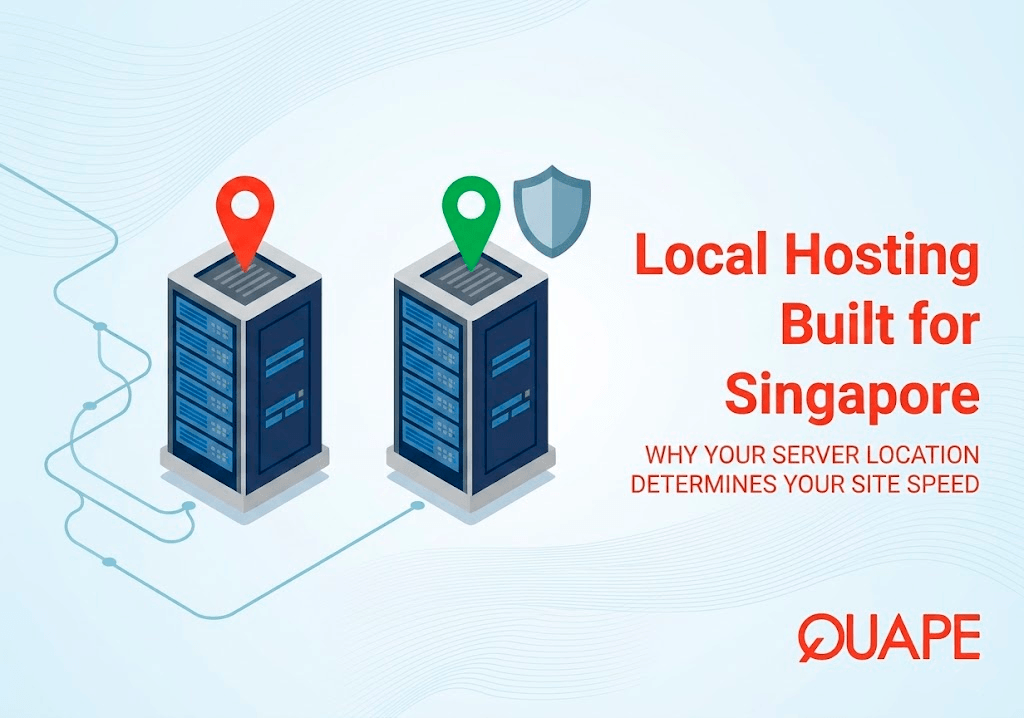
Các Internet Engineering Task Force establishes that physical distance between a user and a server directly increases roundtrip time because data travels through multiple network hops before a response returns. For a Singapore visitor reaching a server in Europe or a general Asia-Pacific node that is not Singapore-local, that roundtrip typically sits between 150 and 250 milliseconds. A Content Delivery Network reduces this for static assets: images, stylesheets, and cached HTML pages load from an edge node closer to the visitor. But dynamic requests bypass the CDN entirely. When a visitor logs in, submits a contact form, adds a product to cart, or triggers any database interaction, that request travels to the origin server regardless of CDN configuration. For Singapore visitors on an overseas-hosted site, that origin penalty applies to every meaningful interaction on the page.
Where SiteGround Performs Well (And Why Many Businesses Choose It First)
Strong Global Brand, Beginner-Friendly Platform
SiteGround’s onboarding experience is genuinely well designed for non-technical users. The control panel is clean and logically structured, domain connection is guided step by step, and the WordPress installer removes most of the setup complexity that puts first-time website owners off self-hosted WordPress. For a business owner with no IT background launching their first website, these qualities are real and valuable. The platform’s automated backup system, staging environment, and email tools provide a solid foundation that many cheaper hosts do not offer at comparable price points.
Reliable Uptime and Solid WordPress Ecosystem Integration
SiteGround maintains strong uptime records globally and integrates well with the WordPress ecosystem. WP-CLI access, automatic WordPress core updates, and broad plugin compatibility make it a stable platform for sites that do not depend on Singapore-local latency. WordPress powers 43% of all websites globally, and SiteGround’s infrastructure is built around that reality. For a business with an international or regionally distributed audience, or a content-focused site without transactional pages, it remains a credible and capable option.
Where SiteGround Creates Friction for Singapore-Based Websites
No Singapore Data Center: The Latency Gap for Local Visitors
SiteGround does not operate a datacenter in Singapore. Its Asia-Pacific presence does not include a Singapore-local node. For visitors in Singapore, every request to a dynamically generated page carries the full propagation delay of a cross-regional roundtrip. The practical result shows up in Core Web Vitals scores, particularly Largest Contentful Paint and Time to First Byte, and in the perceived responsiveness of interactive pages. For a booking form, a product page, or a consultation request on a professional services site, that latency directly affects whether the visitor completes the action or abandons it.
Data Residency Concerns Under PDPA for Customer Data Collection
Các Personal Data Protection Commission makes clear that Singapore-registered organisations are responsible for personal data in their custody regardless of where that data is physically stored. When a Singapore business hosts its website on overseas servers, customer data submitted through contact forms, checkout pages, or membership portals travels to and is stored in a foreign jurisdiction. This does not automatically constitute a PDPA violation, but it introduces cross-border data transfer obligations that require active management: contractual safeguards, transfer impact assessments, and ongoing compliance oversight. The PDPC has authority to impose fines of up to 10% of annual turnover for significant data breaches, making this a risk worth addressing through infrastructure choice rather than legal documentation alone.
Shared Hosting Density and Performance Variability During Traffic Spikes
SiteGround’s shared hosting is better managed than most budget alternatives, but it still operates on a shared resource model where multiple accounts compete for the same server capacity. The noisy neighbour effect, where one account’s traffic spike degrades performance for co-hosted accounts, is a documented characteristic of high-density shared environments. During a campaign launch, a media mention, or a seasonal sales period, a Singapore business on standard shared hosting has no visibility into what other accounts on the same server are doing and no control over the performance impact.
What a True SiteGround Alternative in Singapore Should Provide
Local Data Center Presence (Not Just “Asia-Pacific”)
A meaningful SiteGround alternative for Singapore businesses is not any host with an Asia-Pacific node. The distinction between a Singapore-local datacenter and a regional node in Tokyo, Sydney, or Hong Kong is material. Latency differences between those locations and Singapore can range from 30ms to well over 100ms depending on routing. Singapore sits at the centre of a dense subsea cable network that makes it one of Asia’s primary internet exchange hubs, and a hosting provider with servers physically located in Singapore delivers a fundamentally different performance profile for local visitors than one routing traffic from a distant regional node.
Clear Data Residency for Compliance and Customer Trust
For businesses collecting personal data from Singapore customers, where that data is stored is a compliance question before it is a technical one. The OECD has documented a clear global trend toward data localisation requirements as governments and regulators move to ensure that personal data remains subject to domestic jurisdiction. A hosting provider with Singapore-only infrastructure resolves this by design. There is no cross-border transfer to document, no foreign jurisdiction to consider, and no additional configuration required. The compliance posture is structural rather than procedural.
Predictable Performance Through Controlled Server Density
Performance consistency is as important as peak performance. A hosting environment that delivers fast load times on a quiet weekday but slows during Friday evening traffic is not a reliable operational platform for a business that depends on its website for leads or transactions. The direct lever for consistency in shared hosting is the number of accounts per server. When that number is controlled and explicitly capped, the available CPU, memory, and I/O per account becomes more predictable, and the impact of any single account’s traffic spike on the rest of the server is proportionally reduced.
How Quape Positions Itself Differently for Singapore SMBs
Singapore-Based Tier 3 TIA 942-Certified Infrastructure
Quape hosts all its servers in a Singapore datacenter certified to TIA 942 Rated-3 standard. The Uptime Institute defines Tier III facilities as designed to achieve 99.982% availability with concurrently maintainable infrastructure, meaning scheduled maintenance does not require downtime. For a Singapore SMB whose website is a primary channel for leads or transactions, this removes a category of operational risk that lower-tier or non-certified facilities introduce. The servers are not located in a general Asia-Pacific region. They are physically in Singapore, serving Singapore visitors with the sub-10ms latency that only local infrastructure can deliver. Details on how Quape’s Singapore datacenter is built and certified are available before any commitment to a plan.
Built for PDPA-Sensitive Businesses Handling Customer Data
Because Quape’s infrastructure is Singapore-only, customer data submitted through hosted websites stays in Singapore without any additional configuration. There is no overseas transfer, no cross-border processing agreement to establish, and no jurisdictional ambiguity to resolve. For a law firm collecting client enquiries, a retailer processing orders, or an F&B business taking reservations, this structural data residency removes a compliance obligation that would otherwise require ongoing legal and technical management. The infrastructure makes the compliant choice the default choice.
Performance Stability with a 20-Account Server Cap
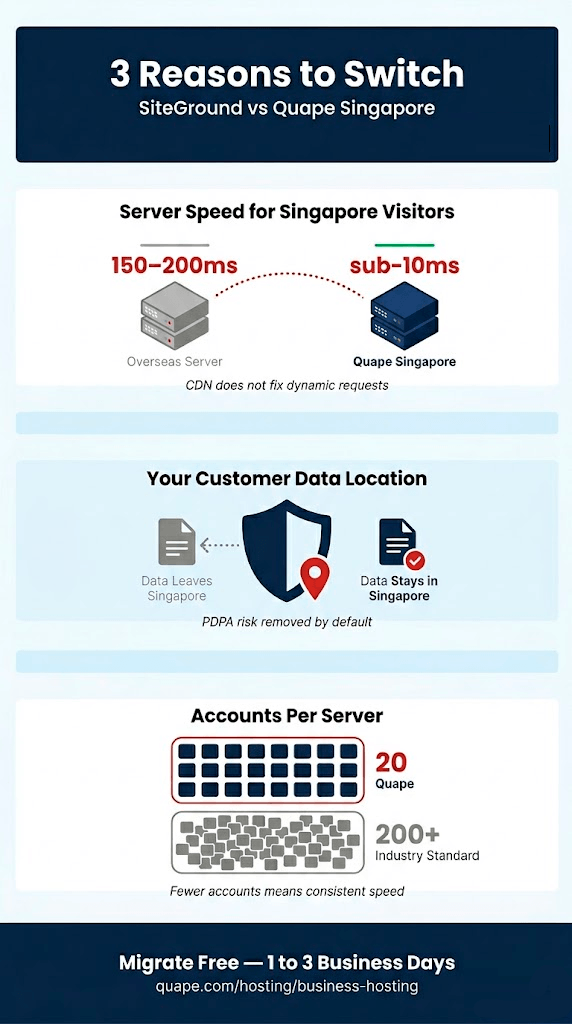
Quape explicitly caps its Business Hosting plans at 20 accounts per server. The industry standard for comparable shared hosting tiers typically places 200 or more accounts on a single server. With 20 accounts rather than 200, the available server resources per account are substantially higher and more consistent. Traffic spikes from co-hosted accounts carry a proportionally smaller impact on overall server performance. A Singapore SMB running a product launch or a promotional campaign can do so with reasonable confidence that other accounts on the same server will not consume the headroom their campaign needs. You can review Quape’s business hosting plans and server density policy alongside the full feature and pricing breakdown.
Direct Comparison: SiteGround vs Quape for a Singapore-Based Business Website
Speed for Singapore Visitors (Real Latency Impact, Not Just CDN Claims)
| Nhân tố | SiteGround | Quape |
| Datacenter location | No Singapore node | Singapore Tier 3 TIA 942 |
| Latency for SG visitors | 150 to 250ms typical roundtrip | Sub-10ms from local servers |
| CDN included | Yes, Cloudflare | Yes, Cloudflare |
| Static asset delivery | Fast via CDN edge | Fast via CDN edge |
| Dynamic request performance | Routed to overseas origin | Served from Singapore origin |
Both providers include Cloudflare CDN. The difference is entirely at the origin server level, which determines performance for every dynamic interaction on the site.
Data Control and Compliance (PDPA vs Overseas Jurisdiction)
| Nhân tố | SiteGround | Quape |
| Server location | Overseas | Singapore only |
| PDPA data residency | Cross-border transfer involved | In-country by default |
| Compliance management | Requires contractual safeguards | Structural, no extra steps |
| Customer data jurisdiction | Subject to foreign law | Subject to Singapore law |
Performance Consistency Under Business Traffic Conditions
| Nhân tố | SiteGround | Quape |
| Accounts per server | Industry standard, 200 or more | Capped at 20 |
| Noisy neighbour risk | Present on shared plans | Substantially reduced |
| Performance during campaigns | Variable, dependent on neighbours | More predictable |
| Upgrade path | Higher shared tier or cloud | VPS from same provider |
Operational Simplicity for Non-Technical Teams
Both platforms are accessible to non-technical users. SiteGround uses a custom dashboard with a familiar structure. Quape uses DirectAdmin, which provides comparable functionality including email management, DNS control, SSL management, and one-click WordPress installation. For a marketing manager or business owner managing hosting without dedicated IT support, both platforms are workable day to day. The difference shows when something goes wrong: Quape’s support team operates in Singapore time and is staffed by engineers with direct access to the infrastructure, not first-line agents working from a script.
Which Hosting Is Actually Better for Your Situation?
When SiteGround Still Makes Sense
SiteGround is a strong choice for specific situations. If your website serves an internationally distributed audience across multiple regions, a host with distributed global infrastructure may suit your needs better than a Singapore-only provider. If you are running a content site or blog without transactional pages and your visitors are not concentrated in Singapore, the latency difference will have minimal impact on your business outcomes. If you are at the very beginning of your website journey and ease of setup is your primary concern, SiteGround’s onboarding experience is genuinely well executed and the platform’s support resources are extensive.
When a Singapore-Hosted Alternative Becomes the Smarter Choice
The calculus shifts when most of your visitors are in Singapore, when your site handles personal data through forms or checkout, when you operate in professional services, healthcare, or any compliance-sensitive sector, or when persistent performance issues have not been resolved through WordPress optimisation alone. In those scenarios, the advantages of Singapore-local hosting address root causes rather than symptoms. Faster origin response times, in-country data residency, and controlled server density are infrastructure decisions that compound positively over the life of the website.
Choosing a Hosting Setup That Matches Your Business Growth
Business Hosting vs WordPress Hosting: What Fits Your Setup
Quape offers two primary options depending on how your website is managed. The Business Hosting plans bundle web hosting and email hosting from SGD 11 per month, suited to businesses that manage their own WordPress installation or run non-WordPress sites. The managed WordPress Hosting plans add monthly plugin updates, security patching, and automated daily backups for businesses that want their hosting provider to handle ongoing maintenance. For Singapore SMBs without a dedicated developer, the managed WordPress plans remove the operational burden that tends to accumulate silently until a security incident or plugin conflict makes it visible.
Ready to Move Away from Overseas Hosting Limitations?
Remove Migration Risk with a Defined Timeline and Local Support
The primary reason businesses stay on underperforming hosting is not satisfaction. It is inertia, driven by the perception that migration is risky and disruptive. Quape’s free migration service for WordPress sites and email accounts runs on a defined timeline: 1 to 3 business days for standard migrations, with same-day options available for urgent cases. The process includes a pre-migration security audit covering plugin status, paid plugin identification, and a hardening checklist before the site goes live on Singapore servers. The migration risk is lower than most business owners assume, and the cost is zero.
Make the Shift to Infrastructure Built for Singapore-Based Traffic
Server location is infrastructure. Like any infrastructure decision, the right choice depends on where your business operates and who it serves. A Singapore business serving Singapore customers benefits measurably from Singapore servers, not as a marketing point but as a consequence of how network routing works. Add PDPA-aligned data residency and controlled server density, and the argument for local hosting becomes straightforward for any SMB that has moved past the entry-level phase of its digital presence.
SiteGround is a capable platform that serves its global customer base well. For Singapore businesses specifically, the absence of a local datacenter, the complexity of managing PDPA compliance on overseas infrastructure, and the performance variability of high-density shared hosting create friction that local infrastructure resolves at the foundation. If your website is a business asset, it deserves servers that are built for the market it serves. Move your site to Quape’s Singapore infrastructure free of charge and be operational on local servers within 1 to 3 business days.
Câu Hỏi Thường Gặp
Does SiteGround have a datacenter in Singapore?
SiteGround does not operate a Singapore-based datacenter. Its Asia-Pacific infrastructure does not include a Singapore-local node, which means visitors in Singapore experience the full roundtrip latency of a cross-regional request. For businesses whose customers are predominantly in Singapore, this is a structural performance consideration rather than a minor technical detail.
Is hosting outside Singapore a PDPA violation?
Hosting outside Singapore does not automatically constitute a PDPA violation, but it introduces cross-border data transfer obligations that require active compliance management. These include establishing contractual safeguards with overseas providers and documenting transfer impact assessments. Hosting within Singapore eliminates this complexity by keeping customer data within the jurisdiction of Singapore law by default.
What is the actual latency difference for Singapore visitors?
A Singapore-hosted site typically delivers sub-10ms roundtrip time from the origin server for local visitors. An overseas-hosted site, depending on routing and congestion, typically delivers 150 to 250ms or more. The gap is most visible on dynamic pages such as checkout, login, and contact forms, where CDN caching does not apply and the full origin roundtrip determines response time.
What does the 20-account server cap mean in practice?
It means your website shares server resources with at most 19 other accounts rather than 200 or more. In practical terms, resource contention is substantially reduced, and the performance impact of traffic spikes from co-hosted accounts is proportionally smaller. Your site’s speed during peak periods becomes more predictable and less dependent on what other tenants on the same server are doing.
When is SiteGround actually the better choice?
SiteGround remains the better option when your audience is globally distributed rather than concentrated in Singapore, when your site is content-focused without transactional or form-based data collection, or when you are in the early stages of building a web presence and prioritise ease of setup and onboarding support. Quape’s advantages are most relevant to Singapore-audience-first businesses with compliance-sensitive data handling or persistent performance issues.
How does Quape’s free migration work?
Free migration covers WordPress sites and email accounts, completed within 1 to 3 business days for standard migrations with same-day options available on request. The process includes a pre-migration security audit, plugin review, and hardening checklist. Larger migrations involving custom systems or extensive mailboxes may involve a small fee to cover the additional work required.
Does a CDN solve the latency problem for overseas-hosted sites?
A CDN solves latency for static assets: images, CSS, and cached HTML. It does not solve latency for dynamic requests such as database queries, login sessions, or checkout flows, which must travel to the origin server regardless of CDN configuration. For Singapore visitors on an overseas-hosted WordPress site, the CDN reduces some load times but leaves the origin penalty intact for all interactive page elements.

- Squarespace Alternative: Bespoke UI/UX Design that Converts High-Ticket Clients - Tháng 6 17, 2026
- Wix Alternative for Enterprises: Why You Need Custom Corporate Web Design - Tháng 6 16, 2026
- Dropbox Business Alternative: Avoid High User Licensing Fees with Private Nextcloud - Tháng 6 15, 2026