For a Singapore SME founder, CTO, or product owner, the decision to build software rarely fails at the idea stage. It fails at the engagement model. Upwork makes it fast to find a developer, but speed at the point of hiring is not the same as safety across a project lifecycle, and that gap is where most teams get hurt. This comparison looks at where a global freelancer marketplace genuinely serves you and where it quietly shifts risk back onto your business, particularly around vetting, intellectual property, continuity, and data compliance under Singapore law. The short version: if you need a short, contained task done cheaply, Upwork is hard to beat, but if you are building or maintaining a product that must survive turnover and hold up under PDPA scrutiny, a dedicated development partner with local accountability is the safer alternative.
Mục lục
Chuyển đổiBrief Introduction: Upwork and Quape
Upwork does one thing exceptionally well. It aggregates an enormous global supply of freelance talent and connects you to it within hours. The scale is real: research from the Oxford Internet Institute estimates that online labour platforms host roughly 163 million registered freelancer profiles worldwide, with software and technology work sitting among the largest categories. For a founder who needs a landing page built this week or a bug squashed before a launch, that depth of supply and the platform’s hourly and fixed-price flexibility are difficult to replicate through any other channel. Human Rights Watch
Quape approaches the same need from the opposite direction. Instead of handing you a marketplace and leaving the screening, contracting, and governance to you, it provides pre-vetted full-stack developers under a single accountable contract, whether you need a full dedicated team or one specialist. The trade is deliberate. You give up the self-serve immediacy of a marketplace, and in return you get one local point of responsibility, clearer ownership of code and data, and a contract structure that absorbs the compliance complexity most SMEs are not equipped to handle on their own.
Những điểm chính
- Upwork wins on speed and supply for short, contained, well-defined tasks where the project lifespan is measured in days or weeks.
- The marketplace model pushes vetting, contracting, continuity planning, and project governance back onto the hiring company, and that hidden labour is a real cost.
- When a single freelancer holds undocumented knowledge and then leaves, the business inherits the delivery risk, not the platform.
- Quape consolidates delivery under pre-vetted developers on a single accountable contract, giving you one local point of responsibility instead of a roster of strangers to manage.
- Under Singapore’s PDPA, your company remains accountable for personal data even after it is transferred to an overseas contractor, so outsourcing does not outsource the compliance risk.
- Quape’s contract-based engagement absorbs tax, insurance, and employment-law complexity and keeps data handling within a familiar local legal framework.
- For long-term product development and maintenance, knowledge retention and accountability matter more than the headline hourly rate.
Why Singapore SMEs Are Looking Beyond Upwork for Software Development
The reason is not dissatisfaction with freelancers as individuals. It is a structural mismatch between what a marketplace is built to do and what a maturing software product needs. A marketplace optimizes for matching and transaction speed. A product, on the other hand, depends on continuity, documentation, and a single party who remains answerable when something breaks six months after launch. Singapore SME founders and CTOs increasingly recognize that the engagement model they choose at the start quietly determines how much management overhead, legal exposure, and delivery risk they absorb later. As products move from prototype to revenue-generating platform, the questions shift from “who can build this cheaply” to “who stays accountable as this evolves,” and that shift is what pushes teams to look beyond the marketplace.
What Upwork Does Well for Fast and Flexible Hiring
It would be dishonest to pretend Upwork is the wrong tool in every situation. For a large class of work, it is precisely the right one, and understanding why clarifies when it is not.
Access to a Large Global Talent Pool
The platform’s core strength is reach. A buyer in Singapore can engage a React specialist in Eastern Europe, a QA tester in South Asia, and a UI designer in Latin America inside a single afternoon. That breadth supports experimentation: you can try a developer on a small task before committing to anything larger. The same scale that makes this possible, however, introduces a verification problem we return to below.
Rapid Engagement for Short-Term Technical Tasks
Upwork excels at bounded, well-specified work. An MVP prototype, a discrete bug fix, a single feature implementation, or a UI tweak can be scoped, assigned, and delivered without the friction of a formal vendor relationship. When the deliverable is clear and the timeline is short, the marketplace removes almost all the overhead between intent and execution.
Flexible Hiring Models for Different Budgets
Hourly billing and fixed-price contracts let a founder match spend to budget with precision. For early-stage teams testing an idea before they have revenue, the ability to commit a few hundred dollars rather than sign a retainer is genuinely enabling. This flexibility is the model’s strongest argument, and for the right task it outperforms any heavier engagement.
Where the Upwork Model Creates Risk for Singapore Businesses
The risks below are not failures of individual freelancers. They are consequences of where the marketplace draws the line on responsibility. The platform connects buyer and seller and then steps back, which means everything past the match becomes your job.
The Hidden Cost of Vetting Developers Yourself
Scale creates information asymmetry. The same Oxford Internet Institute research found that of those 163 million profiles, only around 19 million had ever obtained work through a platform, and roughly 5 million had completed ten or more projects or earned more than USD 1,000. In other words, the depth of the pool is mostly inactive or unproven, and separating signal from noise is entirely on you. Technical screening, portfolio validation, reference checks, and skill assessment all consume founder or CTO time that rarely gets counted as a project cost, yet it is one of the most expensive parts of the whole exercise.
What Happens When a Freelancer Disappears Mid-Project?
A single freelancer is a single point of failure. When that person becomes unresponsive, takes another contract, or simply stops replying, the project does not pause politely. Architectural decisions live in their head, undocumented choices become invisible, and the knowledge transfer that should have happened never does. The marketplace does not deliver your software for you; it introduced you to someone who was going to, and the continuity risk sits with your business alone.
Managing Multiple Freelancers Creates Fragmented Accountability
Most real products need more than one skill set. The moment you assemble a frontend developer, a backend developer, and a QA tester from separate marketplace engagements, you become the integration layer. Coordination, conflicting assumptions, and finger-pointing when something breaks all land on you, because no single party is accountable for the whole. You are not just paying for development; you are doing unpaid project management.
Cross-Border Hiring, Data Handling, and Compliance Considerations
This is where Singapore businesses face exposure that has nothing to do with code quality. Singapore’s PDPA includes a Transfer Limitation Obligation, which requires that an organization transferring personal data overseas ensure the receiving party provides a standard of protection comparable to the PDPA. When you share customer records, user data, or production databases with a freelancer in another jurisdiction, that obligation does not transfer with the data. Your company remains accountable, and a scattered set of individual freelancer accounts across unknown jurisdictions is a difficult thing to govern, let alone evidence to a regulator. Human Rights Watch
Why IP Ownership and Code Accountability Matter More Than Hourly Rates
The cheapest developer can become the most expensive hire. A low hourly rate looks attractive on a spreadsheet, but it says nothing about rework, documentation quality, or who legally owns the output. On a marketplace, intellectual property terms depend on the contract you remember to put in place and the developer’s willingness to honor it. If ownership of source code is ambiguous, the asset you thought you were building may not be cleanly yours, and that ambiguity surfaces at the worst possible moment, usually during a funding round or an acquisition.
The Difference Between Hiring a Freelancer and Hiring an Accountable Delivery Partner
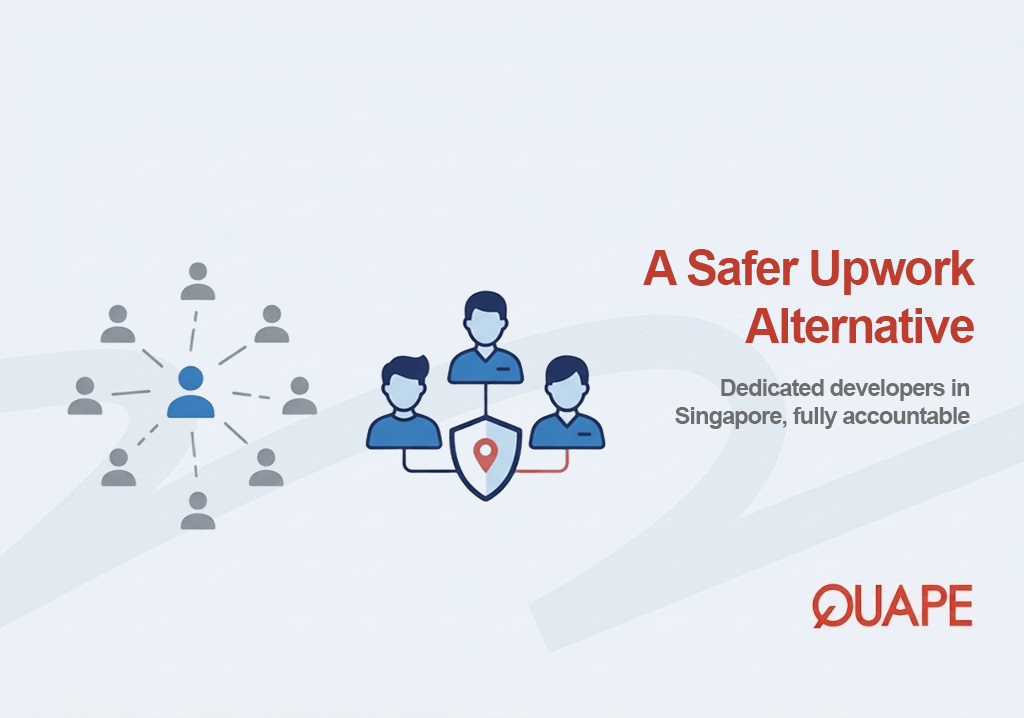
A freelancer marketplace primarily connects buyers and sellers. Screening, contracting, project governance, continuity planning, and IP assignment remain your responsibility. A dedicated outsourcing model shifts that operational weight to a single vendor relationship, where one party is contractually answerable for delivery, ownership, and continuity. The distinction is not freelancer versus employee; it is fragmented responsibility versus consolidated accountability.
When a Dedicated Development Team Becomes the Safer Alternative
A dedicated team earns its premium in exactly the scenarios where a marketplace struggles: long horizons, evolving requirements, and work that must survive personnel changes.
Growing a SaaS Product Without Building a Full Internal Engineering Department
A SaaS company with a live product roadmap needs engineering capacity that scales with the roadmap, not with whoever happened to be available on a marketplace last quarter. A dedicated team lets you grow output without standing up a full internal department, and it keeps the people who understand your architecture engaged across releases.
Supporting Long-Term Platforms That Require Ongoing Development
Software is never finished. Bug resolution, security updates, and future features all depend on retained project knowledge. A team that stays with the platform carries that knowledge forward, whereas a rotating cast of freelancers forces you to rebuild context with every engagement.
Scaling Development Capacity Without Recruitment Overhead
Hiring in-house brings recruitment cost, training, equipment, office space, and employee benefits. A dedicated contract lets you scale capacity up or down with project demand and avoid that overhead entirely, which is the cost flexibility founders go to a marketplace for, delivered without the marketplace’s continuity problem.
Why Quape Is a Stronger Fit for SMEs That Need Accountability, Compliance, and Continuity
This is the scenario where Quape’s model directly answers the risks above. Its dedicated development and outsourcing service is built around consolidated responsibility rather than self-serve matching, which is the structural difference that matters for a maturing product.
Pre-Vetted Full-Stack Developers Under a Single Contract
The vetting that would otherwise consume your time is done before you ever speak to a developer. You engage pre-screened full-stack talent under one contract, which removes the screening burden and the uncertainty that comes with an unproven marketplace profile.
One Local Point of Responsibility Instead of Multiple Freelancers
Instead of being the integration layer between several independent contractors, you work with a single accountable party. When a deliverable slips, there is one place the responsibility sits, and it is not your inbox at midnight.
Compliance, Tax, and Employment Complexity Handled for You
Engaging talent across borders raises tax, insurance, and employment-law questions, and the regulatory environment is tightening. In June 2026, the International Labour Organization adopted its first binding international convention setting labour standards for platform and gig workers, approved by 406 votes to 8, a signal that the compliance landscape around platform-based engagement is becoming more demanding rather than less. Quape’s contract-based model absorbs that complexity and keeps data handling within a familiar Singapore legal framework, which is materially easier to reconcile with your PDPA accountability than data scattered across overseas freelancer accounts. Human Rights WatchAl Jazeera
Transparent Scaling Without Recruitment, Equipment, or Benefit Costs
Pricing is scalable and transparent, with no hidden fees, so you add or reduce capacity as the project demands without absorbing the fixed costs of in-house hiring or the unpredictable churn of marketplace freelancers.
Upwork vs Quape: The Factors That Actually Matter After the First 90 Days
The first sprint always looks fine. The differences show up once the product has to live, evolve, and answer to a regulator.
| Nhân tố | Upwork | Quape |
|---|---|---|
| Risk ownership when deliverables slip | Sits with you | Sits with the vendor under contract |
| Management time required | High; you coordinate everyone | Low; one accountable contact |
| Vetting burden | Yours to perform | Done before engagement |
| Knowledge retention | Tied to individual availability | Retained by a continuous team |
| Data handling for PDPA | Scattered, hard to govern | Consolidated, local framework |
| IP ownership clarity | Depends on per-contract terms | Defined under a single contract |
Should You Choose Upwork or a Dedicated Development Partner?
There is no universal answer, only a fit between the work and the model.
Choose Upwork if you have a short-term, clearly scoped task, you are comfortable doing your own vetting and coordination, the data involved is non-sensitive, and the engagement is unlikely to extend into ongoing maintenance.
Choose Quape if you are building or maintaining a long-term product, you need continuity that survives personnel changes, you handle data that falls under PDPA obligations, and you want one accountable party responsible for delivery, compliance, and IP rather than a roster you manage yourself.
Build Your Product With a Team You Can Hold Accountable
The honest conclusion is that Upwork and a dedicated partner are not competing for the same job. A marketplace is the better choice for fast, contained, low-sensitivity tasks, and pretending otherwise would not serve you. But for a Singapore SME building a product that must endure turnover, retain its institutional knowledge, and hold up under PDPA accountability, the safer engagement is one where responsibility is consolidated rather than distributed back to you. If that describes where your product is heading, you can explore your development team options and discuss the safest engagement model for your project before you commit a roadmap to a marketplace that was never designed to carry it.
Câu Hỏi Thường Gặp
Is Upwork ever the better choice over a dedicated team?
Yes. For a short, well-defined task such as a single bug fix, a one-off design, or a quick prototype with no sensitive data, Upwork’s speed and flexible pricing are hard to beat. The dedicated model earns its value on continuity and accountability, which a one-week task does not need.
Does outsourcing development to an overseas freelancer transfer my PDPA responsibility?
No. Under Singapore’s PDPA Transfer Limitation Obligation, your organization remains accountable for ensuring personal data sent overseas receives protection comparable to the PDPA. The responsibility stays with you regardless of who performs the work, which is why a locally accountable partner is easier to govern.
What is the real risk if a freelancer leaves mid-project?
The main risk is lost knowledge. Architectural decisions, undocumented logic, and context that lived with that individual can disappear, leaving you to reconstruct or rebuild. A continuous team retains that knowledge across the project’s life.
How does a single contract change IP ownership compared to a marketplace?
A single accountable contract defines ownership of source code and deliverables up front, rather than depending on per-engagement terms you have to negotiate and enforce yourself. This removes the ambiguity that often surfaces during due diligence or fundraising.
Will a dedicated team cost more than hiring freelancers?
The headline rate may be higher, but the comparison should include vetting time, coordination overhead, rework, and continuity risk. For long-term products, consolidated accountability frequently lowers total cost even when the hourly figure looks higher.
Can I scale a dedicated team down if my project slows?
Yes. Quape’s contract-based model is designed to scale capacity up or down with project demand, without the recruitment, equipment, and benefit costs of in-house hiring or the churn of finding new freelancers each time.
- Mindbody Alternative: Avoid Expensive Monthly SaaS Fees with Custom Software - Tháng 7 13, 2026
- Bubble Alternative: Hand-Coded React Mobile Apps for Scalable Businesses - Tháng 7 10, 2026
- Klook Merchant Alternative: Own Your Ticketing Engine with Custom Web Apps - Tháng 7 9, 2026