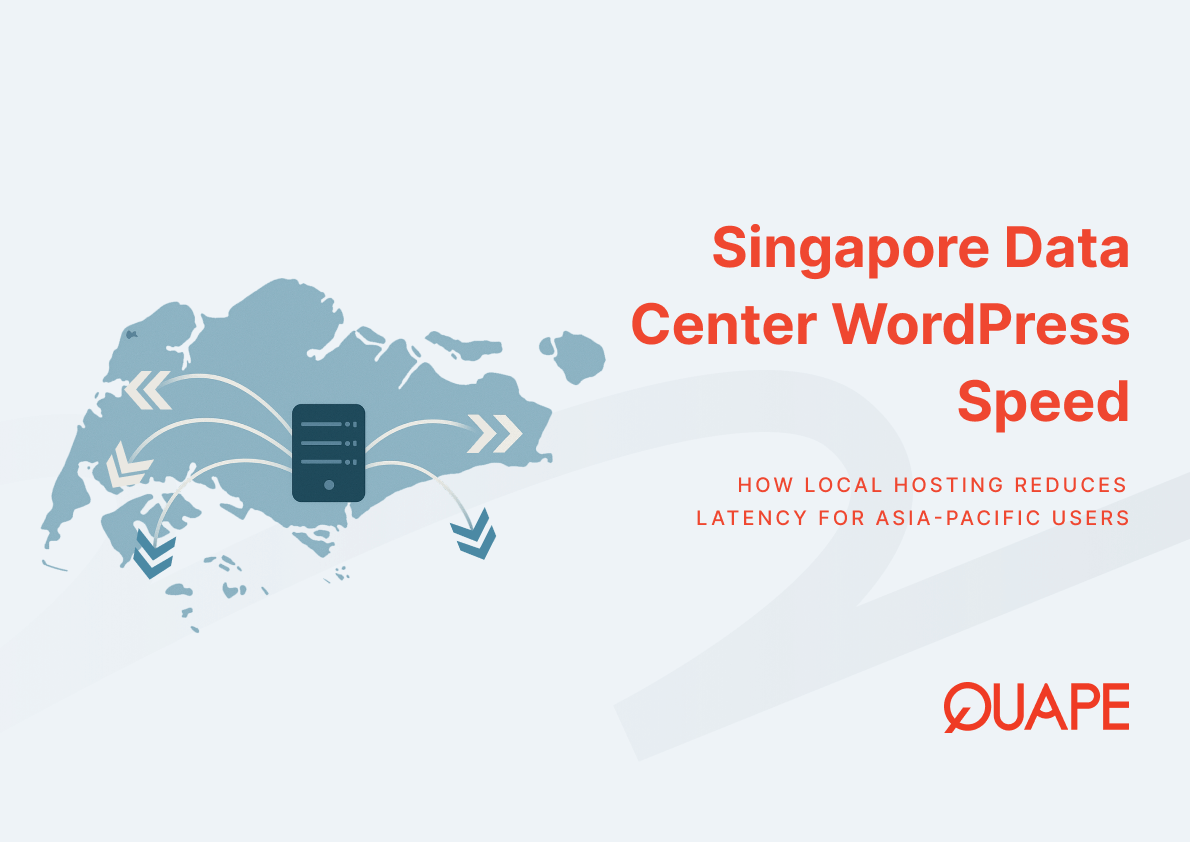
Singapore’s dense data center ecosystem, with over 1.4 GW of capacity across more than 70 facilities, creates natural proximity between web hosting infrastructure and regional users. This physical closeness reduces the distance data travels between server and browser, directly improving page load times for WordPress sites serving Asia-Pacific audiences. Businesses hosting WordPress applications in Singapore benefit from low-latency connections to Southeast Asia’s largest internet exchange point, the Singapore Internet Exchange (SGIX), which peaks at 4.60 Tbit/s of traffic. For IT managers and CTOs evaluating hosting decisions, understanding how data center location influences WordPress performance helps optimize both user experience and search engine rankings. The relationship between server proximity, network infrastructure, and content delivery determines whether a website loads in under two seconds or frustrates visitors with delays.
A Singapore data center refers to a physical facility located within Singapore’s borders that houses servers, storage systems, and networking equipment used to host websites, applications, and databases. When a WordPress site operates from a Singapore data center, the web server processing visitor requests sits geographically close to users in Singapore, Malaysia, Indonesia, Thailand, and other regional markets. This proximity matters because every HTTP request must travel from the user’s device to the server and back, and shorter physical distances mean faster round-trip times. Singapore’s position as a regional connectivity hub, supported by submarine cable landings and high-capacity peering infrastructure, amplifies this advantage by enabling efficient data exchange between local data centers and global networks.
Những điểm chính
- Singapore hosts over 70 operational data centers with approximately 1,039 MW of live IT capacity, creating dense infrastructure that reduces latency for regional users
- The Singapore Internet Exchange connects data centers with 4.60 Tbit/s peak traffic, enabling fast content delivery through efficient local routing
- Latency decreases when WordPress servers sit closer to end users, improving Core Web Vitals scores that Google uses for search rankings
- CDN integration with Singapore data centers allows static content to cache at edge locations near visitors, reducing load on origin servers
- Singapore’s Green Data Centre Roadmap adds 300 MW of new capacity with power usage effectiveness targets of 1.3 or lower, balancing performance with sustainability
- High-performance NVMe storage in modern Singapore facilities delivers the fast disk I/O operations WordPress databases require during page generation
- Local hosting in Singapore ensures compliance with regional data residency preferences while maintaining sub-50ms response times to Southeast Asian markets
- Managed WordPress hosting services in Singapore combine infrastructure proximity with security updates, daily backups, and performance optimization
Introduction to Singapore Data Center WordPress Hosting
WordPress hosting connects website files, databases, and server configurations to deliver web pages when visitors request them. The location where these components physically operate influences how quickly browsers receive and render content. Singapore-based WordPress hosting leverages regional infrastructure advantages that generic cloud platforms distributed across continents cannot replicate. When a user in Jakarta requests a page from a WordPress site hosted in Singapore, the TCP connection establishes faster than if the server sat in Frankfurt or Virginia because fewer network hops separate the two endpoints.
Singapore’s Ministry of Trade and Industry confirms the city-state operates more than 70 data centers, representing the highest concentration of hosting infrastructure in Southeast Asia. This density creates redundancy and competitive connectivity options that benefit WordPress site operators. Multiple submarine cables terminate in Singapore, linking the region to Australia, Japan, Europe, and the United States. Data centers tap into this connectivity through the Singapore Internet Exchange, which functions as a neutral meeting point where internet service providers, content delivery networks, and hosting companies exchange traffic without routing through distant third parties.
The relationship between data center capacity and website performance becomes clear when examining how WordPress generates pages. Each page request triggers database queries, PHP script execution, and file retrieval operations that depend on server hardware responsiveness. Singapore data centers equipped with NVMe storage complete these operations in microseconds rather than milliseconds, which compounds into noticeable speed differences across hundreds of site elements. Regional proximity reduces network latency, while modern hardware reduces processing latency, and together these factors determine whether a WordPress site feels instant or sluggish to its audience.
Key Components of Singapore Data Center Hosting
Three infrastructure elements interact to determine WordPress performance in Singapore data centers: physical proximity between server and user, network quality connecting data centers to internet service providers, and edge caching that distributes content closer to visitors. Each component addresses a different bottleneck in the content delivery path. Physical proximity reduces the time light takes to travel through fiber optic cables. Network quality ensures packets flow through high-capacity, low-congestion routes. Edge caching eliminates repetitive requests to the origin server by serving static files from intermediate locations.
Hiểu biết how server location impacts performance requires examining the round-trip time between user device and web server. A request from Singapore to a Singapore-hosted server completes its journey in 1 to 5 milliseconds under normal conditions. The same request to a server in London requires 150 to 200 milliseconds simply to traverse the distance, even with perfect network conditions. WordPress sites loading dozens of resources per page multiply this latency across every script, stylesheet, image, and API call. The cumulative delay determines whether Core Web Vitals metrics fall within Google’s acceptable ranges or trigger ranking penalties.
Singapore’s internet exchange infrastructure supports low-latency hosting by enabling direct connections between hosting providers and regional networks. When QUAPE operates servers within data centers connected to SGIX, traffic from Malaysian or Indonesian users reaches the WordPress hosting environment through one or two network hops rather than routing through international transit providers. This direct connectivity reduces packet loss and jitter while improving consistency in response times. Hosting providers with strong SGIX presence deliver measurably faster experiences to regional audiences than providers relying solely on upstream transit connections to reach Asian markets.
Latency and Its Effect on WordPress Performance
Latency measures the time required for a packet to travel from source to destination, typically expressed in milliseconds. WordPress performance depends heavily on latency because each page view initiates multiple sequential requests that cannot begin until previous requests complete. The browser must receive the HTML document before it can discover linked CSS files. It must parse CSS before it can determine which font files to download. High latency stretches each sequential step, causing the waterfall of requests to elongate dramatically.
Time to First Byte (TTFB) represents the most latency-sensitive metric WordPress sites face. TTFB measures how long the browser waits after sending an HTTP request before receiving the first byte of the response. This interval includes network latency to reach the server, server processing time to generate the page, and network latency to return the response. When the WordPress server sits in Singapore and the user browses from Singapore, network latency contributes perhaps 2 to 10 milliseconds to TTFB. When the server operates from a distant region, network latency alone can consume 100 to 300 milliseconds before PHP even begins processing the request.
WordPress database queries amplify latency impact because each page generation requires multiple round trips between PHP and MySQL. A complex page might execute 50 to 200 database queries, and each query incurs the latency between web server and database server. High IOPS NVMe storage mitigates this bottleneck by returning query results in microseconds rather than milliseconds, but physical distance between data center and user remains the dominant factor for total page load time. Strategies to cải thiện tốc độ WordPress thông qua tối ưu hóa lưu trữ must address both server responsiveness and geographic positioning to achieve consistently fast results.
The Role of CDN and Edge Servers
Content delivery networks distribute copies of static website assets across geographically dispersed edge servers that sit closer to end users than origin servers. When properly configured, a CDN intercepts requests for images, scripts, and stylesheets before they reach the WordPress server, serving cached versions from the nearest edge location. This arrangement reduces load on the origin server while simultaneously decreasing latency for static content delivery. CDN integration approaches vary in complexity, but all share the goal of minimizing the distance between cached content and requesting browser.
Edge servers function as temporary storage locations that CDN providers operate in major cities worldwide. Cloudflare, BunnyCDN, and other providers maintain edge locations in Singapore that serve cached content to regional users with latency comparable to locally hosted servers. When a WordPress site hosted in a Singapore data center integrates with a CDN that also has Singapore edge presence, the content delivery path for regional users becomes remarkably short. HTML generates in the Singapore data center, while static assets serve from the Singapore edge node, keeping all components of the page within the same metropolitan area as the user.
The interaction between origin server location and CDN edge network topology determines overall performance gains. A WordPress site hosted in Europe with CDN caching in Singapore still requires the origin server in Europe to generate HTML responses, which must traverse intercontinental links before reaching Asian users. By contrast, a WordPress site hosted in Singapore with CDN caching in Singapore serves all content types with minimal latency to regional audiences. This configuration also benefits users in other regions because the CDN’s global edge network ensures static assets load quickly worldwide while dynamic content generation happens closer to the primary target market.
Practical Applications for Singapore-Based Businesses
Small and medium enterprises operating in Singapore, Malaysia, Indonesia, and broader Southeast Asia gain competitive advantages from hosting WordPress sites in Singapore data centers. E-commerce platforms selling to regional customers reduce cart abandonment rates when product pages load in under two seconds. Corporate websites targeting regional B2B audiences project professionalism through responsive page delivery. SaaS applications serving Asia-Pacific markets meet user expectations for instant interactions when backend infrastructure sits within the region rather than defaulting to US or European data centers.
IT managers evaluating hosting decisions balance performance requirements against operational complexity and cost constraints. Local hosting in the Asia-Pacific context simplifies compliance with regional data preferences while eliminating the latency penalties associated with serving Asian users from distant continents. Procurement teams comparing hosting options should measure actual response times from target user locations rather than relying on provider claims about global reach. A provider with Singapore data center presence delivers provably faster experiences to Singapore users than a provider routing all traffic through Sydney or Tokyo.
The choice between local and global hosting strategies depends on where a business’s primary audience resides. WordPress sites serving primarily Singaporean visitors gain little from distributing infrastructure across six continents but benefit substantially from concentrated resources in Singapore data centers with strong regional connectivity. Businesses with genuinely global audiences require multi-region deployments or sophisticated CDN strategies, but even in these scenarios, identifying the primary market and hosting origin infrastructure accordingly optimizes performance for the largest user segment.
Singapore’s regulatory environment supports reliable hosting operations through frameworks that encourage resilience and security. The Infocomm Media Development Authority’s advisory guidelines for cloud and data center operators establish baseline expectations for redundancy, incident response, and cybersecurity practices. WordPress hosting providers operating in Singapore data centers that align with these guidelines offer more predictable service levels than providers in jurisdictions with less developed digital infrastructure oversight. For CTOs responsible for business-critical WordPress applications, this regulatory maturity reduces operational risk and provides clearer recourse options when service issues arise.
How Quape WordPress Hosting Supports High-Speed Singapore Websites
Managed WordPress hosting services combine Singapore data center infrastructure with maintenance, security, and performance optimization that individual businesses might struggle to implement independently. QUAPE operates WordPress hosting within TIA-942 certified data centers in Singapore, placing web servers, databases, and storage systems within facilities designed specifically for high-availability hosting workloads. This infrastructure foundation supports optimized WordPress configurations that deliver consistent sub-second response times to regional users while maintaining 99.9% uptime commitments.
High IOPS NVMe storage accelerates the database operations WordPress relies on for every page generation. Traditional spinning hard drives complete perhaps 100 to 200 input/output operations per second, creating bottlenecks when WordPress executes multiple database queries simultaneously. NVMe solid-state drives exceed 100,000 IOPS, effectively eliminating storage as a performance constraint for WordPress installations. This hardware advantage compounds with Singapore’s low network latency to regional users, creating hosting environments where page generation completes in 50 to 150 milliseconds and total page load times fall below two seconds even for complex layouts.
Security updates, daily backups, and plugin management represent operational burdens that distract businesses from their core activities. Managed WordPress hosting transfers these responsibilities to specialists who monitor CVE databases, test updates in staging environments, and apply patches during maintenance windows that minimize user impact. WordPress hosting security practices require consistent attention because vulnerability disclosure happens continuously and exploitation attempts begin within hours of public announcements. Singapore-based managed hosting services maintain security posture while ensuring performance optimizations remain in place across system updates.
The WordPress Toolkit included in QUAPE’s managed hosting plans allows site administrators to update plugins, manage multiple WordPress installations, and restore from backups through a unified control panel rather than logging into individual WordPress admin dashboards. This centralized management reduces the time required to maintain WordPress sites while decreasing the likelihood of human error during routine operations. For businesses managing multiple WordPress properties or for IT departments supporting several business units, consolidated management interfaces streamline workflows and improve operational efficiency.
Scalability paths matter when WordPress traffic patterns grow beyond initial hosting plan specifications. QUAPE’s infrastructure supports migration from shared WordPress hosting to VPS environments without changing data center location or losing established performance characteristics. This progression allows businesses to start with cost-effective managed hosting while retaining the option to expand resources as traffic, database size, or application complexity increases. Continuity in geographic hosting location preserves the latency advantages that make Singapore data center hosting valuable for regional audiences.
Kết luận
Singapore’s concentrated data center infrastructure, with 1.4 GW of capacity supported by high-throughput peering through SGIX, creates optimal conditions for WordPress hosting serving Southeast Asian markets. The physical proximity between servers and users reduces network latency to levels that measurably improve page load times, Core Web Vitals scores, and user engagement metrics. Businesses choosing Singapore data center hosting gain these performance advantages while benefiting from Singapore’s regulatory maturity, energy efficiency standards that target PUE of 1.3 or lower, and expanding capacity under the Green Data Centre Roadmap. For WordPress sites where regional performance determines competitive positioning, hosting location represents a strategic infrastructure decision with direct impact on business outcomes. Contact our team to learn how Singapore-based WordPress hosting can improve your website’s performance and reliability: https://www.quape.com/contact-us/
Câu Hỏi Thường Gặp
Why does server location in Singapore improve WordPress speed compared to other regions?
Server location in Singapore reduces the physical distance data must travel between the web server and users in Southeast Asia, which directly decreases network latency. Lower latency means faster Time to First Byte and quicker overall page loads, particularly for dynamic WordPress content that cannot be fully cached.
How does the Singapore Internet Exchange benefit WordPress hosting performance?
The Singapore Internet Exchange enables direct traffic exchange between hosting providers and regional internet service providers without routing through distant transit networks. This direct connectivity reduces the number of network hops between server and user, improving response consistency and reducing packet loss.
What role does NVMe storage play in WordPress hosting speed?
NVMe storage delivers over 100,000 input/output operations per second compared to traditional hard drives’ 100-200 IOPS, eliminating storage bottlenecks during database queries. WordPress sites execute dozens to hundreds of database operations per page view, so faster storage directly translates to faster page generation.
Can Singapore hosting benefit websites with global audiences?
Singapore hosting primarily benefits websites where the majority of users reside in Southeast Asia, but integrating with a global CDN allows static content to serve quickly worldwide. The origin server generates dynamic content in Singapore for optimal regional performance while the CDN handles static asset delivery to distant users.
How does data center density in Singapore create hosting advantages?
High data center density creates competitive connectivity options and redundancy that improve reliability and performance. Multiple facilities connected to diverse network providers give hosting companies more routing paths to reach users, reducing the impact of individual network outages.
What is the relationship between hosting location and SEO rankings?
Google considers Core Web Vitals metrics including Largest Contentful Paint and First Input Delay as ranking factors, and these metrics improve when server proximity reduces latency. Faster page loads from Singapore hosting can contribute to better rankings for searches originating in Southeast Asian markets.
How do Singapore’s energy efficiency standards affect WordPress hosting?
Singapore’s PUE targets of 1.3 or lower and the new SS 715:2025 IT energy efficiency standard reduce operational costs for data center operators, which can translate to more competitive hosting pricing. These standards also ensure hosting infrastructure remains sustainable as capacity expands under the Green Data Centre Roadmap.
What makes managed WordPress hosting different from standard hosting in Singapore data centers?
Managed WordPress hosting includes security updates, daily backups, performance optimization, and WordPress-specific support alongside the infrastructure advantages of Singapore data center location. This combination ensures both technical performance and operational reliability without requiring in-house WordPress expertise.

- Squarespace Alternative: Bespoke UI/UX Design that Converts High-Ticket Clients - Tháng 6 17, 2026
- Wix Alternative for Enterprises: Why You Need Custom Corporate Web Design - Tháng 6 16, 2026
- Dropbox Business Alternative: Avoid High User Licensing Fees with Private Nextcloud - Tháng 6 15, 2026