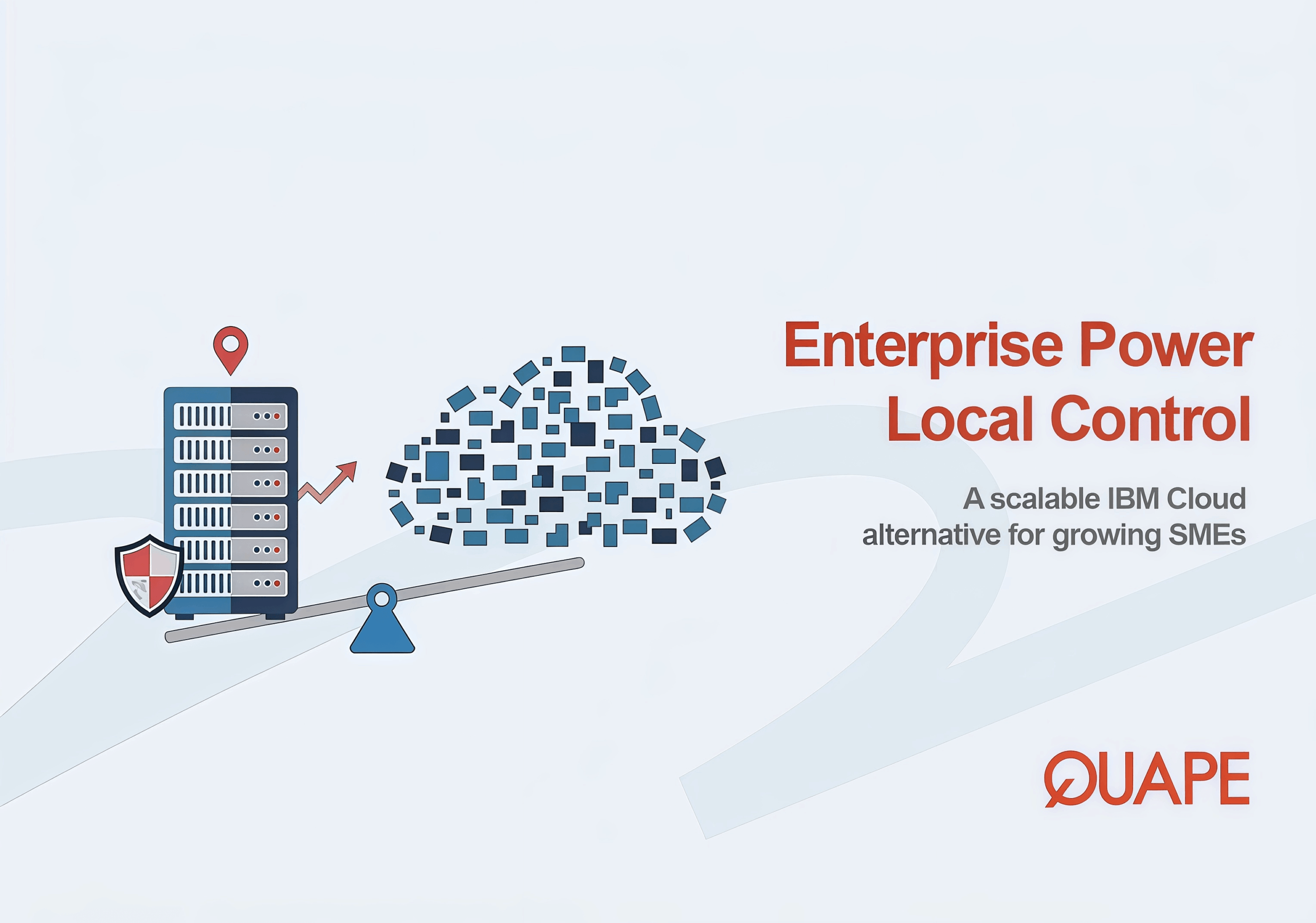
For a growing Singapore or Southeast Asian business weighing IBM Cloud for private infrastructure, the real question is rarely whether the platform is capable. It clearly is. The question is whether a hyperscale enterprise platform fits the way a mid-sized company actually operates, budgets, and scales. IT decision-makers and founders often discover that consumption-based pricing makes monthly costs hard to forecast, that the management surface assumes a dedicated cloud operations team, and that support escalation paths are built for organizations far larger than theirs. This comparison looks at where IBM Cloud genuinely earns its place and where a dedicated Singapore infrastructure approach becomes the smarter choice for businesses that need enterprise-grade performance, predictable costs, and local accountability without enterprise-tier overhead.
A Quick Look at Both Sides
IBM Cloud is a hyperscale platform engineered for large enterprises that run distributed, multi-region workloads and need deep compliance programs, broad service catalogues, and fault-tolerant architecture spanning continents. It does this work well, and for a multinational with the teams to manage it, that breadth is a genuine advantage.
Quape approaches the same infrastructure need from the opposite direction. Instead of asking a growing business to operate like an enterprise, it provides enterprise-grade hardware on dedicated servers housed in its own Tier 3 data centre in Singapore. Pricing is fixed and transparent each month, data sits physically within Singapore for genuine PDPA alignment, and support comes directly from DevOps engineers who know the customer’s environment rather than from a tiered ticket queue. The trade is straightforward: less global sprawl, more local control, performance consistency, and a cost a finance team can actually plan around.
要点总结
- IBM Cloud is built for multinational enterprises that need multi-region distribution, complex cloud architectures, and global compliance coverage.
- Growing SMEs frequently struggle with hyperscale platforms on two fronts: unpredictable consumption-based billing and operational complexity that assumes a large in-house cloud team.
- Quape offers transparent fixed monthly pricing, so a business knows its infrastructure cost from day one instead of forecasting variable usage charges.
- Data residency in a Singapore-based Tier 3 data centre supports PDPA obligations and answers customer questions about where sensitive information actually lives.
- Direct 24/7 DevOps engineering support replaces multi-layer escalation, which matters most during incidents and infrastructure changes.
- Dedicated servers with enterprise hardware and high IOPS NVMe storage deliver resource isolation without the need to architect and manage a sprawling cloud console.
- The right choice depends on scenario: global reach favours IBM Cloud, while predictable cost, local hosting, and workload consistency favour dedicated Singapore infrastructure.
Why Growing SMEs Are Reassessing IBM Cloud for Private Infrastructure
Digital infrastructure has moved from a support function to a business-critical foundation across Singapore, and the pace of that shift is reshaping how smaller companies evaluate their options. Singapore’s digital economy reached S$128.1 billion and represented 18.6% of national GDP in 2024, a signal that dependence on reliable infrastructure now extends well beyond the technology sector. That dependence raises the stakes on every infrastructure decision, because a platform that is hard to forecast or hard to operate creates friction that compounds as the business grows.
For many growing companies, the friction surfaces in three predictable places: a monthly bill that moves in ways the team cannot anticipate, a management console that expands faster than the operations team can absorb, and a support relationship that feels calibrated for an organization ten times their size. None of these reflect a failure of the platform. They reflect a mismatch between an enterprise-scale tool and a mid-scale operation. Recognizing that mismatch early is what prompts a reassessment.
What IBM Cloud Does Well for Enterprise Organizations
Before building any case for an alternative, it helps to be clear about what IBM Cloud does genuinely well, because those strengths define exactly which businesses should stay with it.
Strong Global Footprint for Multinational Operations
IBM Cloud operates an extensive global network of regions and data centres engineered for high availability and multinational deployment. IBM Cloud provides deployment options across multiple geographic regions, allowing organizations to place workloads closer to end users for latency and availability objectives. For an enterprise serving customers across several continents, that distributed footprint enables workload placement that a single-region provider cannot match. Enterprise IT teams with the staffing to manage multi-region deployments gain real architectural flexibility from this reach.
Broad Service Ecosystem for Complex Enterprise Architectures
Beyond raw infrastructure, IBM Cloud integrates a wide catalogue of managed services that support hybrid architectures and complex enterprise applications. This breadth enables organizations to assemble sophisticated systems within a single ecosystem, and it supports the kind of governance and integration work that large enterprises require. The depth of the catalogue is an asset precisely for teams equipped to use it.
Where IBM Cloud Can Become Challenging for Growing Businesses
The same characteristics that serve large enterprises can work against a smaller operation, and the strain tends to appear in cost, complexity, and support.
Consumption-Based Pricing and Budget Predictability Concerns
Hyperscale platforms are optimized around elastic resource allocation, where storage, network transfer, API requests, and compute each scale independently. This model suits enterprises that run FinOps teams and formal cloud governance, but it can frustrate a leaner business trying to plan a budget. The difficulty is widespread rather than isolated: 94% of IT decision-makers surveyed reported difficulties optimizing cloud costs, and 44% reported limited visibility into their cloud spending. When costs depend on usage patterns that shift month to month, forecasting becomes guesswork, and guesswork undermines the confidence a growing business needs when committing to long-term infrastructure.
Enterprise-Level Complexity for Teams With Limited Resources
As an organization adopts more cloud services, the management layers, security tools, policies, and billing components multiply alongside them. That accumulation is absorbable for a large enterprise IT department, but it strains a small operations team that has to administer all of it. The platform does not become less capable; it becomes harder to operate relative to the resources on hand, and that operational drag pulls attention away from the actual business.
Support Escalation Paths That May Not Match SME Expectations
Hyperscale support is structured around tiered ticketing and extensive documentation, which scales efficiently across millions of customers. For a smaller business facing an urgent infrastructure issue, though, navigating documentation and escalation tiers can feel slow and impersonal at exactly the moment speed matters most. The expectation gap is rarely about competence. It is about whether the support model fits how a smaller team needs to work during a problem.
Why Data Residency and Local Accountability Matter in Singapore and Southeast Asia
For businesses operating in this region, where infrastructure physically sits has consequences that reach beyond technical architecture into regulation and customer trust.
Regulatory and Customer Expectations Around Data Location
Singapore’s Personal Data Protection Act places obligations on organizations handling personal data, including requirements related to collection, disclosure, storage, and transfers. Meeting those obligations is more straightforward when data resides in a known, local jurisdiction rather than distributed across distant regions. Increasingly, the question is not only legal. Customers and partners now ask where their information is stored, who manages the infrastructure, and which jurisdiction governs it during a dispute. Infrastructure located within Singapore makes those conversations simpler and reinforces trust.
The Operational Value of Infrastructure Located Near End Users
Application responsiveness depends in part on the geographic distance between users and the servers serving them. For a company whose customers cluster in Singapore, Indonesia, Malaysia, and Vietnam, regional infrastructure placement supports more consistent performance for customer-facing applications. Proximity reduces the network distance every request travels, which improves the experience that end users actually feel.
The Alternative Approach: Dedicated Infrastructure Without Hyperscale Complexity
A dedicated infrastructure model answers the same underlying need, enterprise-grade performance and reliability, while removing the cost unpredictability and operational sprawl that come with hyperscale. Rather than renting elastic capacity across a global console, a business runs its workloads on physical servers reserved entirely for its use.
Fixed Monthly Infrastructure Costs Instead of Variable Consumption Charges
The clearest difference is financial. A dedicated server carries a fixed monthly cost, which means budget planning starts from a known number rather than an estimate. This matters more as fee structures grow opaque on usage-based platforms: 48% of cloud storage spending was consumed by fees rather than actual storage capacity, according to the Wasabi Cloud Storage Index. Fixed pricing removes that category of surprise entirely, because the cost of the infrastructure does not move with fluctuating usage metrics.
Enterprise-Grade Hardware Without Shared Resource Contention
Performance consistency depends on resource isolation, and dedicated hardware delivers it by design. Quape’s dedicated servers run on enterprise-grade Dell PowerEdge systems with Intel Xeon and AMD EPYC processors, ECC memory, and high IOPS NVMe storage, all reserved for a single tenant. Because no other customer shares those resources, a growing workload performs predictably rather than competing for capacity. For businesses that need that stability, the available Singapore dedicated server configurations range from balanced production setups to high-core systems suited to databases and virtualization.
Direct Access to Engineers Instead of Navigating Multiple Support Layers
When something goes wrong, the difference between a ticket queue and a direct line to an engineer is the difference between waiting and resolving. Quape provides 24/7 DevOps engineering support from a team that knows the customer’s specific environment, which shortens the path from problem to fix. That direct relationship also helps during planned changes, where context about the existing setup prevents missteps that a generalized support tier would not catch.
IBM Cloud vs Dedicated Singapore Infrastructure: The Factors That Actually Affect Growing Businesses
Comparing the two models is most useful when framed around the decisions a growing business actually makes.
| 因素 | IBM Cloud | Quape Dedicated Singapore Infrastructure |
|---|---|---|
| Pricing model | Consumption-based, scales with usage | Fixed transparent monthly cost |
| 成本可预测性 | Requires forecasting and FinOps discipline | Known from day one |
| Data location | Distributed across global regions | Physically in Singapore, Tier 3 data centre |
| PDPA alignment | Compliance program coverage | Genuine local data residency |
| Operational model | Sprawling console, assumes cloud ops team | Dedicated servers, no console to architect |
| 支持 | Tiered ticketing and documentation | Direct 24/7 DevOps engineers |
| Best fit | Multinational, multi-region enterprises | Growing SMEs needing local, predictable infrastructure |
Cost Predictability Over a 12 to 36 Month Growth Period
Growth amplifies whichever cost model a business chooses. On a consumption platform, rising adoption drives rising and variable spend, which is precisely the period when forecasting matters most. This is not a hypothetical concern as regional businesses scale: Singapore SME AI adoption rose sharply within a single year, and heavier workloads translate directly into heavier and less predictable usage charges. A fixed monthly model holds the infrastructure cost steady across that same growth window, so the business can plan capacity and budget together rather than reacting to bill fluctuations.
Data Residency, Compliance, and Customer Trust
Over a multi-year horizon, data residency tends to grow in importance rather than fade. As workloads become business-critical and customer relationships deepen, the assurance that sensitive data sits in a Singapore data centre under clear local jurisdiction becomes a recurring advantage in compliance reviews and customer conversations alike.
Operational Control, Performance Consistency, and Resource Isolation
Dedicated infrastructure gives a business full control over its environment and isolates its performance from other tenants. For workloads where consistency is non-negotiable, that isolation is more valuable than elastic flexibility the team may never fully use.
Support Experience During Incidents and Infrastructure Changes
Incidents test an infrastructure relationship more than steady-state operation ever does. Direct engineering access shortens response during outages and reduces risk during migrations or configuration changes, which is where many growing teams feel the limits of a tiered support model most acutely.
Which Businesses Should Choose IBM Cloud and Which Are Better Served by Dedicated Singapore Infrastructure?
Neither option is universally better. The right answer follows the shape of the business.
When IBM Cloud Remains the Right Choice
IBM Cloud is the stronger fit for organizations that genuinely need its strengths. Its deployment options across multiple geographic regions let organizations place workloads closer to end users for latency and availability objectives, which serves multinationals with distributed users. A business running complex multi-region architectures, requiring broad managed-service ecosystems, or operating with a dedicated cloud team and FinOps function will get value from that platform depth that a single-region dedicated model cannot replicate.
When Dedicated Infrastructure Becomes the Smarter Business Decision
Dedicated Singapore infrastructure becomes the smarter decision when predictable monthly costs, direct engineering access, local hosting, and workload consistency matter more than global hyperscale flexibility. This describes a large share of growing SMEs, regional SaaS platforms, e-commerce businesses, and companies running internal business applications whose customers and obligations are concentrated in Southeast Asia. For these businesses, the enterprise breadth of a hyperscaler is capacity they pay for and rarely use.
Building a Private Infrastructure Foundation That Can Scale Without Enterprise Overhead
The goal for a growing business is infrastructure that scales with it, not infrastructure that demands the business scale its operations team first. Dedicated servers in a Singapore Tier 3 data centre provide a foundation that grows through predictable upgrades rather than expanding management complexity, which keeps the focus on the business instead of the console.
Getting a Dedicated Server Quote Tailored to Your Workload
Right-sizing matters, because the value of dedicated infrastructure comes from matching hardware to the actual workload rather than over-provisioning. The most productive next step is a short conversation about requirements, where you can discuss infrastructure requirements with the team and review available Singapore dedicated server options before committing to a long-term cloud architecture. That clarity at the start is what makes the cost predictable and the performance dependable later.
常见问题 (FAQ)
Is a dedicated server a real alternative to IBM Cloud?
For many growing businesses, yes. A dedicated server delivers enterprise-grade compute, storage, and isolation for workloads that do not require global multi-region distribution. The fit depends on whether your priorities are predictable local infrastructure or distributed hyperscale flexibility.
When is IBM Cloud actually the better choice over dedicated infrastructure?
IBM Cloud is the better choice when your business runs multi-region workloads, needs a broad catalogue of managed cloud services, or operates with a dedicated cloud operations and FinOps team. If global distribution and elastic service breadth are central to how you operate, a hyperscaler’s depth is hard to replace.
How does fixed pricing compare to consumption-based cloud billing?
Fixed pricing gives you a known monthly infrastructure cost regardless of usage fluctuations, which simplifies budgeting and removes billing surprises. Consumption-based billing can be more efficient for highly variable or seasonal workloads, but it requires active cost management to stay predictable.
Why does data residency in Singapore matter for my business?
Hosting data in Singapore supports your PDPA obligations and keeps your information under a clear local jurisdiction. It also answers a question customers and partners increasingly ask, which is where their sensitive data is physically stored and who manages it.
What kind of support comes with dedicated infrastructure?
Quape provides direct 24/7 DevOps engineering support from a team familiar with your environment, rather than tiered ticketing. This tends to shorten resolution during incidents and reduces risk during infrastructure changes.
Will dedicated servers limit my ability to scale?
Scaling on dedicated infrastructure happens through hardware upgrades and additional servers rather than instant elastic capacity. For steady or planned growth this works well, while workloads with sudden, unpredictable demand spikes may benefit from elastic cloud capacity.
Do I need technical staff to run a dedicated server?
You need less than you might expect, because managed support handles much of the operational burden. The dedicated model also avoids the layered complexity of a large cloud console, which often demands more specialized cloud expertise than a single well-managed server environment.