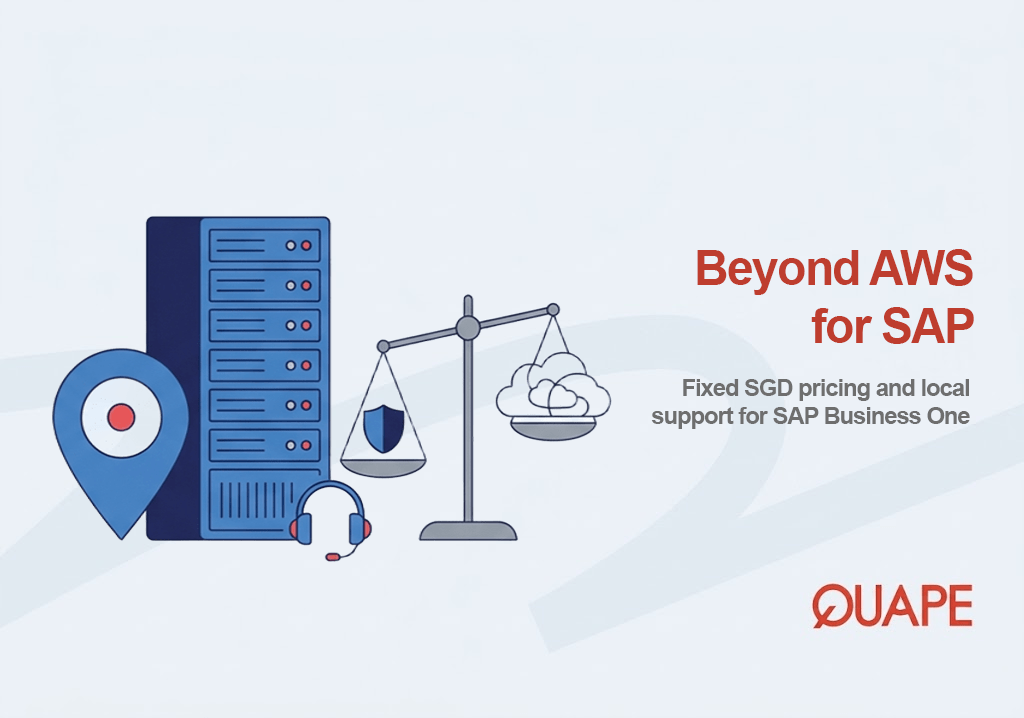
Choosing where to host SAP Business One HANA shapes how much your ERP costs, how reliably it runs, and who answers when something breaks. AWS dominates enterprise cloud infrastructure, and for large corporations with dedicated cloud teams it remains a powerful platform. For SME business owners, finance directors, and IT managers across Singapore and Southeast Asia, however, the AWS route often brings unpredictable bills, USD invoicing, and a technical burden that small teams struggle to absorb. This comparison examines where AWS genuinely excels, where it creates friction for SAP Business One deployments, and why a fully managed alternative with fixed SGD pricing and local support better fits most SME scenarios. If your business runs SAP Business One in wholesale, distribution, manufacturing, logistics, retail, or professional services, this guide will help you evaluate both paths before your next renewal cycle.
Amazon Web Services supplies the raw infrastructure behind a large share of the world’s enterprise SAP environments. Its global network of regions, deep service catalogue, and proven track record with complex S/4HANA deployments make it the default choice for corporations that employ their own cloud engineers. AWS generated US$37.6 billion in quarterly revenue in Q1 2026, a figure that reflects sustained enterprise demand and validates its strength at scale.
Quape approaches the same problem from the opposite direction. Its Managed SAP B1 HANA Cloud delivers SAP Business One as a complete service: SAP-certified hardware in Singapore Tier 3 certified infrastructure, with setup, patching, performance tuning, daily backups, and 24/7 monitoring handled by Quape’s team rather than sold as separate professional services. The comparison, then, is not about which platform is more capable in absolute terms. It is about which operating model fits an SME running SAP Business One.
要点总结
- AWS excels at large enterprise S/4HANA deployments backed by dedicated cloud teams, but it hands SMEs raw infrastructure and leaves the hard part to the customer.
- Running SAP HANA on AWS means architecting EC2 instances, EBS storage, availability zones, and backup routines yourself, or paying a third-party partner on top of the hosting bill.
- AWS pay-as-you-go billing moves with usage, storage growth, and data transfer, which turns ERP budgeting into a moving target for finance teams.
- Quape’s Managed SAP B1 HANA Cloud includes infrastructure management, updates, performance tuning, daily backups, and 24/7 monitoring as standard.
- Transparent fixed SGD pricing removes surprise overages and the currency exposure of USD-denominated cloud invoices.
- A dedicated Account Manager and 24/7 local Singapore support replace global ticket queues and paid support tiers.
- Data resides physically in Singapore on SAP-certified hardware within Tier 3 certified infrastructure, supporting PDPA jurisdictional accountability.
Why Singapore SMEs Are Reconsidering AWS for SAP Business One HANA
ERP decisions in Singapore are no longer experimental. According to the Infocomm Media Development Authority, 95.1% of Singapore SMEs had adopted at least one digital capability by 2024, which means the question has shifted from whether to digitalise to how to run business-critical systems sustainably. SAP Business One sits at the centre of operations for thousands of regional wholesalers, manufacturers, and logistics firms. Where its HANA database lives determines performance, cost behaviour, and operational risk.
The growing pressure of unpredictable cloud costs in Southeast Asia
Hyperscaler invoices arrive in US dollars and fluctuate with consumption. For a Singapore SME that budgets in SGD, this combination creates two layers of uncertainty: the usage itself, and the exchange rate applied to it. An ERP system is supposed to behave like a fixed operating expense. When the hosting line item changes every month, finance teams lose the predictability that ERP adoption was meant to provide.
Why ERP hosting decisions affect finance, operations, and IT teams differently
A hosting choice touches three stakeholders at once. Finance directors care about cost certainty and currency exposure. Operations leaders care about uptime during order processing, inventory movements, and month-end close. IT managers care about who carries the pager when the HANA database needs patching at 2am. A platform that optimises for one stakeholder while burdening the others creates internal friction that compounds over time.
What AWS Does Well for SAP Workloads
Credibility in this comparison requires acknowledging genuine strengths, and AWS has several.
AWS offers extensive global infrastructure and scalability
AWS operates availability zones across dozens of regions, and its EC2 instance families include memory-optimised configurations certified for SAP HANA workloads. A business that needs to deploy SAP environments across multiple continents, replicate between regions, or scale memory into the terabytes will find that AWS supports these requirements better than almost any alternative.
Why large enterprises often choose AWS for SAP S/4HANA environments
S/4HANA deployments at enterprise scale involve complex landscapes: development, quality assurance, and production tiers, integration layers, and disaster recovery architectures spanning regions. Enterprises that run these landscapes employ cloud architects and SAP Basis teams whose full-time job is optimising them. For that buyer, AWS’s depth of services becomes an asset rather than a burden.
The flexibility advantage of infrastructure-as-a-service platforms
Infrastructure as a Service maximises architectural control. Customers choose their own compute, storage, networking, and resilience configurations down to the finest detail. That flexibility is real value, but it carries an inherent trade: the customer inherits responsibility for ongoing optimisation, monitoring, maintenance, and governance. The platform provides the parts; the customer assembles and maintains the machine.
Where AWS Creates Challenges for SAP Business One SMEs
The same characteristics that serve enterprises become obstacles when the buyer is an SME with a lean IT function.
Managing SAP HANA on AWS often requires specialist expertise
A production SAP HANA environment on AWS requires correctly sized EC2 instances, EBS volumes configured for HANA’s IOPS demands, availability zone placement for resilience, and a backup architecture that protects the database without degrading performance. None of this configures itself. An SME either hires AWS-skilled engineers, retrains existing staff, or pays a third-party migration and management partner whose fees sit on top of the infrastructure bill.
The hidden operational burden beyond infrastructure costs
The sticker price of compute is only the visible cost. Performance tuning, patch management, security monitoring, and disaster recovery testing continue for the life of the system. Each of these tasks demands time from people who could otherwise support the business directly. The hidden cost of cloud is rarely the infrastructure itself. It is the complexity of operating mission-critical systems on it.
Why fluctuating monthly invoices make ERP budgeting difficult
Consumption-based pricing aligns cost with usage, which works well for variable workloads. ERP is not a variable workload. It runs continuously, grows steadily, and supports daily operations. When storage expands or data transfer spikes, the invoice follows. Reserved instances can reduce the rate, but only through upfront commitments that SMEs find difficult to forecast accurately. The result is an ERP bill that changes every month for a system whose demands barely do.
The Singapore-Specific Considerations Many SMEs Overlook
Local accountability matters when ERP systems support daily operations
When SAP Business One stops, warehouses stop picking, invoices stop issuing, and deliveries stall. At that moment, the difference between a global ticket queue and a dedicated Account Manager in the same timezone becomes tangible. Meaningful AWS support tiers are paid add-ons, and responses come from engineers who have never seen your environment before. Local relationship-based support improves accessibility, continuity, and alignment with Singapore business hours, which is precisely what an operational crisis demands.
Data jurisdiction and governance considerations for Singapore businesses
Singapore’s Personal Data Protection Act takes an accountability-based approach: organisations remain responsible for personal data under their possession or control, even when external vendors host it. The PDPA does not mandate that data stay physically in Singapore, but accountability becomes simpler to demonstrate when infrastructure, contracts, and support all sit within the same jurisdiction. Hosting ERP data on Singapore soil with a Singapore-registered provider shortens the governance chain that a compliance officer must document and defend.
How Managed SAP B1 HANA Cloud Addresses These SME Challenges
Removing the need for in-house cloud engineering resources
Quape’s model inverts the IaaS arrangement. Instead of handing the customer infrastructure to assemble, it delivers SAP Business One HANA as a finished environment. The customer’s team logs in and works; Quape’s team carries responsibility for everything beneath the application layer. For an SME without cloud engineers on payroll, this removes an entire hiring requirement from the ERP business case.
What is included in a fully managed SAP HANA hosting service?
The managed scope covers infrastructure maintenance, system updates, patch management, performance tuning, daily backups, and 24/7 monitoring with automated alerts, all handled by SAP-certified professionals. Security controls include VPN access, two-factor authentication, encryption of data at rest and in transit, and intrusion detection. These capabilities come as standard within Quape’s Managed SAP HANA Hosting, not as a professional services engagement billed separately, which is the structural difference from the hyperscaler model.
Why predictable SGD pricing resonates with finance leaders
Fixed monthly pricing in SGD converts ERP hosting into a true fixed operating expense. There are no overages when storage grows within plan, no surprise data transfer charges, and no exchange rate variance between forecast and invoice. Singapore’s broader digitalisation experience supports the value of cost discipline: IMDA reports that SMEs adopting digital solutions through the Productivity Solutions Grant achieved average cost savings of roughly 50% between 2018 and 2023, savings that only hold when the recurring costs underneath remain predictable.
AWS vs Managed SAP B1 HANA Cloud: The Factors That Matter Most to SMEs
| 因素 | AWS (self-managed) | Quape Managed SAP B1 HANA Cloud |
|---|---|---|
| Infrastructure responsibility | Customer architects and operates EC2, EBS, availability zones, backups | Fully managed by Quape’s team as standard |
| Cost structure | Pay-as-you-go in USD, varies with usage; reserved instances need upfront commitment | Transparent fixed monthly pricing in SGD |
| Support model | Paid support tiers, global ticket queue | Dedicated Account Manager, 24/7 local Singapore support, SAP-certified professionals |
| Operational tasks | Patching, tuning, monitoring, DR handled by customer or paid partner | Patching, tuning, daily backups, 24/7 monitoring included |
| Data residency | Region selectable within a multi-region global footprint | Physically in Singapore on SAP-certified hardware, Tier 3 certified infrastructure |
| Best fit | Large enterprises with in-house cloud and SAP Basis teams | SMEs running SAP Business One without dedicated cloud engineers |
Infrastructure responsibility: Self-managed versus fully managed
On AWS, the customer owns the operational outcome. On a managed platform, the provider does. This single distinction determines whether ERP hosting consumes internal headcount or frees it. For SMEs whose IT staff already juggle endpoint support, networking, and business applications, transferring infrastructure responsibility outward is often worth more than any per-unit compute saving.
Cost structure comparison: Variable consumption versus fixed monthly investment
Neither model is universally cheaper. Consumption pricing can win for genuinely variable workloads. ERP is the opposite case: a steady, always-on system where budget certainty matters more than elasticity. Fixed SGD pricing lets a finance director enter one number into the annual budget and trust it through every quarter.
Support experience: Global ticket queues versus local relationship management
Global support structures let hyperscalers serve millions of customers efficiently, but efficiency at scale and familiarity with your business pull in opposite directions. A dedicated Account Manager who guided your setup knows your environment, your integrations, and your growth plans. When ERP supports daily operations, that continuity shortens every future conversation.
Security and operational resilience approaches
Both models can deliver strong security; the difference is who configures and maintains it. Quape’s environment ships with VPN access, two-factor authentication, daily backups, and continuous monitoring already in place. The underlying facility holds Tier 3 certification, a benchmark from the Uptime Institute’s internationally recognised Tier framework for evaluating data centre resilience and operational capability. Tier classifications describe infrastructure standards rather than guaranteeing zero downtime, but they give buyers an objective reference point for resilience.
Which Option Is Right for Your Business?
When AWS may still be the better fit
Choose AWS if you run SAP S/4HANA at enterprise scale, operate complex multi-region landscapes, employ internal cloud engineering and SAP Basis teams, or need architectural control that only raw IaaS provides. In those scenarios the platform’s depth justifies its complexity, and the in-house expertise absorbs the operational load.
When a managed SAP HANA environment becomes the smarter choice
Choose a managed environment if you run SAP Business One, employ a lean IT team without dedicated cloud engineers, budget in SGD, and expect support from people in your timezone who know your name. For this buyer, the managed model converts ERP hosting from an engineering project into a utility, which is what most SMEs wanted from the cloud in the first place.
Questions to ask before migrating from AWS to an alternative hosting model
- What does our AWS environment actually cost per month once support, partner fees, and internal staff time are included?
- What performance baseline must the new environment match for our user count and transaction volume?
- How will migration downtime be planned, and what validation happens before cutover?
- What support response do we expect during Singapore business hours and outside them?
- Does the new arrangement simplify or complicate our PDPA accountability documentation?
Explore Your Options Before Your Next ERP Renewal Cycle
Understanding the migration path from self-managed infrastructure to a fully managed environment
Migrating SAP HANA between hosting environments follows a known sequence: planning, data transfer, system validation, and post-migration support. Quape’s team handles this end to end, whether the source is on-premise hardware or another cloud provider, with downtime windows agreed in advance and data integrity verified before cutover. The migration itself becomes part of the managed service rather than a separate project the SME must staff.
The strategic insight from this comparison is simple: AWS and managed SAP hosting are not competing on the same axis. AWS sells infrastructure capability; a managed provider sells operational outcome. For Singapore and Southeast Asian SMEs running SAP Business One, the outcome model wins because it aligns with how these businesses actually operate: lean teams, SGD budgets, and zero appetite for 2am infrastructure incidents. If your AWS invoice keeps surprising your finance director, or your IT manager spends more time on EC2 than on the business, it is worth quantifying the alternative. Arrange a free consultation and migration assessment with Quape’s local SAP specialists to evaluate whether a managed SAP HANA environment better aligns with your operational and budgeting needs.
常见问题 (FAQ)
Is AWS ever the better choice for SAP hosting?
Yes. Large enterprises running SAP S/4HANA across multiple regions, with internal cloud engineering and SAP Basis teams, are genuinely better served by AWS. The platform’s global infrastructure and architectural flexibility justify its complexity at that scale.
Why is AWS pricing hard to predict for ERP workloads?
AWS bills on consumption, so the invoice moves with instance usage, storage growth, and data transfer. ERP systems run continuously and grow steadily, which means the bill changes monthly even though the workload is stable. Invoices are also denominated in USD, adding exchange rate variance for SGD-budgeting businesses.
What does “fully managed” mean in Quape’s SAP HANA hosting?
It means Quape’s team handles infrastructure maintenance, updates, patch management, performance tuning, daily backups, and 24/7 monitoring as part of the service. The customer works inside SAP Business One while SAP-certified professionals operate everything beneath it.
Does the PDPA require my ERP data to stay in Singapore?
No. The PDPA takes an accountability-based approach: your organisation remains responsible for personal data wherever it is hosted. Singapore-based hosting does not become mandatory, but it simplifies the governance chain you must document and defend.
Can Quape migrate an existing SAP HANA system from AWS?
Yes. Migration support covers planning, data transfer, system validation, and post-migration support, whether the source is AWS, another cloud, or on-premise hardware. Downtime is planned in advance and data integrity is verified throughout.
Is fixed pricing always cheaper than AWS consumption pricing?
Not always, and that is not the core argument. The stronger case is budget predictability: a fixed SGD fee removes overages, forecasting risk, and currency exposure for a workload that runs continuously. For steady ERP workloads, certainty is usually worth more than theoretical elasticity.
What security controls are included in Managed SAP B1 HANA Cloud?
The environment includes VPN access, two-factor authentication, encryption of data at rest and in transit, firewall protection, intrusion detection, and role-based access control. These controls come pre-configured rather than left for the customer to assemble.
How does local support differ from AWS support in practice?
Meaningful AWS support tiers are paid add-ons answered from a global queue. Quape assigns a dedicated Account Manager backed by 24/7 Singapore-based support, so the person responding already knows your environment and operates in your timezone.