Corporate website design determines whether your organization earns trust or loses credibility within the first 50 milliseconds of a visitor’s arrival. For IT managers and CTOs managing digital infrastructure, this reality transforms web design from an aesthetic concern into a strategic business function. A brand-led website integrates organizational storytelling with technical excellence to create digital experiences that convert visitors into stakeholders, partners, and customers. Understanding how design elements influence perception, usability, and business outcomes enables technology leaders to build websites that perform as revenue-generating assets rather than static brochures.
Corporate web design represents the digital manifestation of an organization’s brand entity, encompassing visual identity, information architecture, technical infrastructure, and user experience design. Unlike consumer-facing websites that prioritize emotion and impulse, corporate websites must balance professional credibility with intuitive navigation while supporting complex business objectives like lead generation, investor relations, and talent acquisition.
要点总结
- Visual design quality directly influences credibility perception, with 75% of users judging company trustworthiness based on website design alone
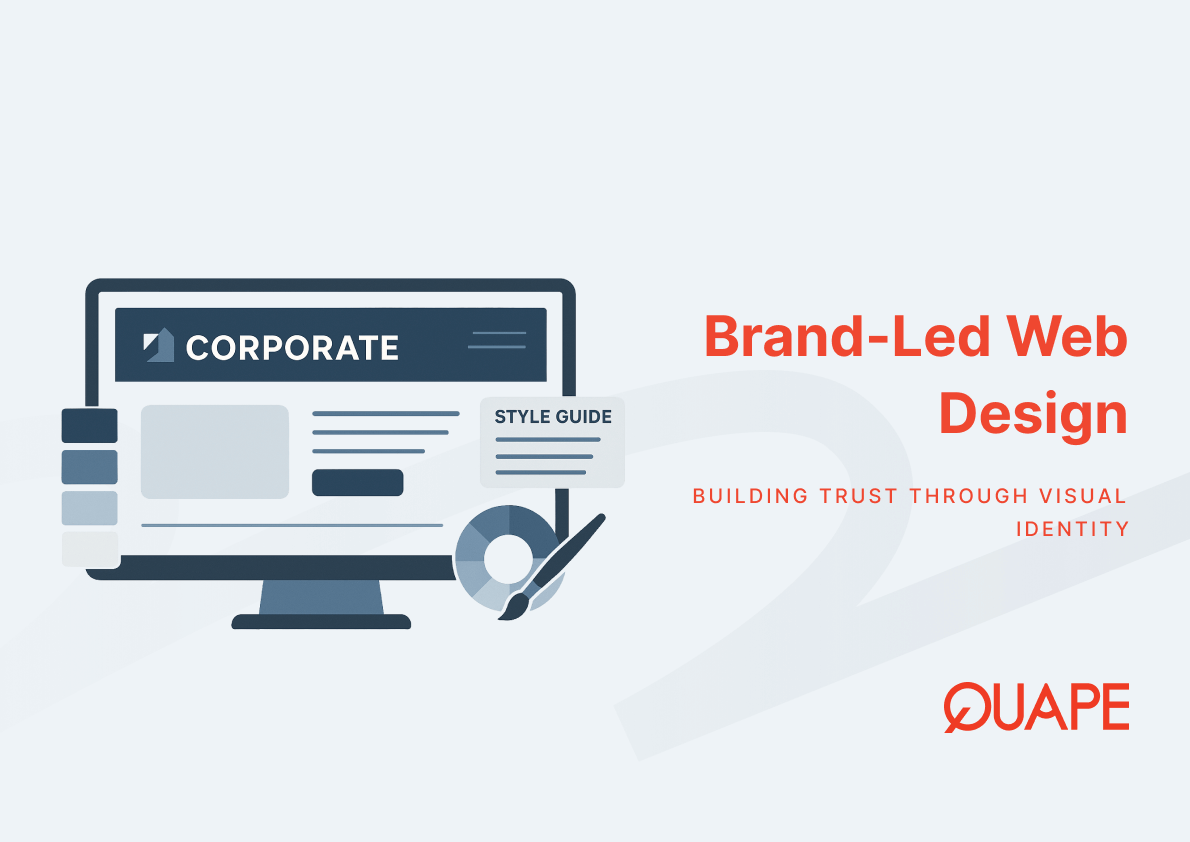
- Corporate brand entities guide every design decision, from color systems to content hierarchy, ensuring consistency between digital and physical brand experiences
- Technical foundations including CMS architecture, security protocols, and accessibility compliance determine long-term scalability and regulatory adherence
- Strategic UI/UX integration reduces cognitive load and can increase conversion rates by up to 400% when properly executed
- Regional adaptation for Singapore’s business culture and regulatory environment strengthens local market relevance and legal compliance
Core Principles of Brand-Led Corporate Websites
Successful corporate websites emerge when brand identity, organizational storytelling, and technical execution converge into coherent digital experiences. The corporate brand entity functions as the strategic anchor that determines visual hierarchy, content structure, and interaction patterns throughout the website. When digital brand identity aligns with web design decisions, organizations create recognizable patterns that reinforce brand recall and establish professional authority.
Strategic UX design for corporate websites transforms brand principles into navigational logic and interaction patterns. Corporate site visual design establishes the aesthetic language that communicates professionalism and industry positioning, while corporate website content strategy ensures messaging consistency across all touchpoints. These elements function interdependently rather than sequentially, requiring integrated planning from project inception.
Corporate Brand Entity and Organizational Storytelling
The corporate brand entity shapes design decisions by establishing constraints and priorities that maintain brand integrity across digital channels. Organizational storytelling translates abstract brand values into concrete visual and textual elements that resonate with target audiences. When brand narrative guides design implementation, websites communicate authentic organizational identity rather than generic corporate templates.
Effective digital brand identity integration ensures visual consistency between printed materials, physical spaces, and digital interfaces. This consistency builds recognition patterns that reduce cognitive friction for returning visitors while establishing credibility with new audiences. Brand-led design decisions prevent the visual fragmentation that occurs when marketing teams and technical teams work in isolation, creating unified experiences that strengthen brand positioning.
Visual Hierarchy and UI/UX Integration
Visual hierarchy controls attention flow by establishing contrast relationships between elements, guiding users toward high-priority actions and information. Font sizing, whitespace allocation, and color contrast combine to create visual pathways that reduce decision paralysis and improve task completion rates. Strategic corporate site visual design applies these principles to enterprise contexts where multiple user personas require different information architectures.
Effective UX design for corporate websites integrates visual hierarchy with interaction design, ensuring navigational patterns match user mental models and business process flows. Layout decisions influence engagement metrics directly by either facilitating or obstructing user goals. Navigation structures must balance comprehensive content access with focused user journeys, particularly for websites serving diverse stakeholder groups including investors, customers, partners, and employees.
Technical Foundations of Corporate Web Design
Technical architecture determines whether corporate websites can scale with organizational growth, maintain security against evolving threats, and deliver consistent performance across global user bases. Design systems and content management infrastructure provide the operational backbone that enables marketing teams to maintain brand consistency while publishing content efficiently.
Design Systems and Content Management
Design systems standardize UI components, interaction patterns, and visual styling rules into reusable libraries that accelerate development while maintaining consistency. Component libraries reduce design debt by establishing single sources of truth for buttons, forms, navigation elements, and content blocks. When development teams implement design systems properly, corporate websites gain visual coherence across thousands of pages without requiring manual oversight of every design decision.
这 best CMS for corporate websites balances editorial flexibility with governance controls, enabling content teams to publish updates without compromising brand standards or security protocols. Enterprise CMS platforms integrate with design systems to enforce approved styling and layout patterns automatically. This technical constraint paradoxically increases creative freedom by removing decision paralysis and ensuring all published content maintains professional quality standards.
Security, Speed, and Accessibility
Corporate website security protects organizational reputation and customer data through encryption protocols, authentication systems, and vulnerability monitoring. Corporate website security measures extend beyond technical implementation to include staff training, incident response planning, and regular security audits. Breaches damage brand credibility irreversibly, making security architecture a foundational rather than supplementary concern.
Corporate website speed optimization directly influences conversion rates and search visibility, with every 100-millisecond delay in load time reducing engagement metrics measurably. Performance optimization requires coordinated attention to server configuration, asset compression, code efficiency, and content delivery networks. Corporate web accessibility compliance ensures websites serve users with disabilities while meeting legal requirements in jurisdictions with accessibility mandates. Accessibility improvements often enhance usability for all users by enforcing clear information hierarchies and predictable interaction patterns.
Advanced Features for Modern Corporate Websites
Modern corporate websites leverage emerging technologies to deliver personalized experiences, demonstrate environmental responsibility, and adapt to global audiences while maintaining regulatory compliance. These advanced capabilities transform websites from static information repositories into dynamic platforms that respond to individual user contexts and organizational priorities.
AI personalization websites adapt content presentation based on user behavior patterns, industry segments, or referral sources, increasing relevance without requiring manual segmentation. Personalization engines analyze interaction data to surface case studies, product information, or content resources aligned with visitor interests. This contextual adaptation improves engagement by reducing the cognitive work required to locate relevant information.
Green hosting web design addresses environmental concerns by selecting data centers powered by renewable energy and optimizing code efficiency to reduce computational waste. Multilingual corporate websites enable global market expansion by providing localized content that respects cultural norms and linguistic nuances beyond simple translation. PDPA compliant websites implement consent management and data handling procedures that meet Singapore’s Personal Data Protection Act requirements, protecting organizations from regulatory penalties while respecting user privacy preferences.
Regional Considerations for Singapore-Based Corporate Websites
Singapore’s business landscape demands corporate websites that balance international sophistication with local market understanding. Regional digital behavior patterns, regulatory requirements, and cultural expectations shape design decisions for organizations operating in Southeast Asian markets. Singapore web design trends reflect the city-state’s position as a regional technology hub where users expect mobile-first experiences and rapid page load times.
Corporate websites serving Singapore audiences must accommodate multilingual requirements even when English serves as the primary language, recognizing the multicultural composition of the business community. Corporate website content strategy for Singapore markets emphasizes clarity and directness over elaborate storytelling, matching local communication preferences for efficient information delivery. Regulatory compliance extends beyond PDPA to include industry-specific requirements for financial services, healthcare, and professional services firms.
Common Challenges and Solutions in Corporate Web Design
Organizations implementing brand-led websites encounter predictable obstacles related to stakeholder alignment, technical constraints, and resource allocation. Corporate web design challenges frequently stem from disconnects between marketing objectives and technical capabilities, requiring integrated project teams that include brand strategists, UX designers, developers, and business stakeholders from project inception.
UI/UX issues often emerge when design teams prioritize visual innovation over user familiarity, creating interfaces that confuse rather than guide visitors. CMS limitations constrain content flexibility when platforms lack custom field structures or workflow automation capabilities required for enterprise content operations. Corporate web design ROI calculations must account for both direct conversion metrics and indirect brand equity improvements that manifest over quarters rather than weeks, requiring executive patience with iterative optimization processes.
Solutions involve establishing clear governance frameworks that define decision-making authority, implementing staged rollouts that enable user feedback incorporation, and selecting technology platforms that balance immediate requirements with future scalability needs.
Optimizing Corporate Websites for Growth and Engagement
Corporate websites generate business value through conversion optimization, trust building, and navigational clarity that reduces friction in user journeys. Corporate website trust elements including security badges, client testimonials, industry certifications, and transparent contact information combine to establish credibility with risk-averse enterprise buyers.
Corporate website navigation best practices balance comprehensive information access with focused user paths that guide visitors toward high-value actions. Navigation structures must serve multiple user types simultaneously, providing efficient pathways for repeat visitors while orienting first-time users through progressive disclosure. Website redesign timelines typically span 3-6 months for enterprise implementations, requiring careful staging to maintain business continuity during migration periods.
Conversion optimization extends beyond contact forms to include strategic content offers, interactive tools, and self-service resources that demonstrate expertise while capturing qualified leads. Performance measurement frameworks must track both quantitative metrics like conversion rates and qualitative indicators including brand perception shifts and customer satisfaction scores.
How Quape’s Corporate Web Design Services Enhance Your Brand
Quape’s corporate web design services integrate brand strategy with technical excellence to deliver websites that function as strategic business assets. Our approach begins with brand discovery sessions that clarify organizational identity and design requirements before technical planning begins. We implement design systems that maintain visual consistency while enabling content teams to publish updates efficiently through intuitive CMS interfaces.
Our technical implementations prioritize security protocols, performance optimization, and accessibility compliance as foundational requirements rather than optional enhancements. We configure hosting infrastructure that supports traffic growth and integrate tools ranging from AI chatbots to membership systems based on specific business requirements. Every project includes SEO optimization through Yoast integration, ensuring technical configuration supports search visibility from launch.
联系我们的销售团队 to discuss how brand-led corporate web design can transform your digital presence.
Conclusion and Key Takeaways
Corporate website design succeeds when brand identity, user experience, and technical architecture align to create digital experiences that build trust and drive business outcomes. Visual design quality influences credibility judgments within milliseconds, making aesthetic decisions strategic rather than superficial concerns. Technical foundations including CMS selection, security implementation, and performance optimization determine long-term scalability and operational efficiency.
Effective corporate websites integrate organizational storytelling with intuitive navigation and visual hierarchy to guide users toward meaningful actions. Regional considerations for Singapore markets require cultural adaptation and regulatory compliance beyond generic best practices. Strategic investment in brand-led design, supported by robust technical infrastructure, positions corporate websites as revenue-generating assets that strengthen market positioning and support business growth.
Ready to elevate your corporate digital presence? 联系我们的团队 to explore custom solutions tailored to your organization’s unique requirements.
常见问题 (FAQ)
What distinguishes corporate web design from standard website design? Corporate web design prioritizes brand consistency, stakeholder communication, and enterprise-level technical requirements over consumer-focused emotional appeals. It balances multiple audience needs including investors, partners, customers, and employees while maintaining professional credibility and regulatory compliance standards that consumer sites typically bypass.
How long does a typical corporate website project require from planning to launch? Enterprise corporate website projects typically span 3-6 months depending on scope, stakeholder complexity, and content migration requirements. This timeline includes discovery and strategy phases, design iterations, development implementation, content population, testing cycles, and staged deployment to minimize business disruption during launch.
Can corporate websites integrate with existing business systems and databases? Modern corporate websites integrate with CRM platforms, marketing automation tools, ERP systems, and custom databases through API connections and middleware solutions. These integrations enable real-time data synchronization, personalized content delivery, and streamlined workflows that connect web interactions with back-office operations.
What ongoing maintenance does a corporate website require after launch? Corporate websites require continuous security monitoring, software updates, performance optimization, content refreshes, and analytics review to maintain effectiveness. Technical maintenance includes plugin updates, security patches, backup verification, and uptime monitoring, while content maintenance involves publishing updates, refreshing outdated information, and optimizing underperforming pages.
How do you measure corporate website success beyond traffic metrics? Corporate website success encompasses conversion rates, lead quality scores, average session duration, return visitor rates, and goal completion metrics alongside qualitative measures like brand perception surveys and customer satisfaction feedback. Enterprise sites also track metrics specific to business objectives such as investor document downloads, partner portal usage, or employee recruitment application rates.
What accessibility standards should corporate websites meet? Corporate websites should comply with WCAG 2.1 Level AA standards at minimum, addressing keyboard navigation, screen reader compatibility, color contrast ratios, and alternative text for images. Organizations serving government contracts or operating in regulated industries may require WCAG 2.1 Level AAA compliance or jurisdiction-specific accessibility regulations.
How does mobile responsiveness affect corporate website performance? Mobile responsiveness directly impacts search rankings, user engagement, and conversion rates as mobile devices generate the majority of web traffic globally. Responsive design ensures content readability, navigation usability, and form completion functionality across device sizes, preventing the revenue loss that occurs when mobile users encounter broken layouts or unusable interfaces.
What role does content strategy play in corporate web design? Content strategy determines information architecture, messaging hierarchy, and publication workflows that enable corporate websites to serve diverse audiences effectively. Strategic content planning ensures websites address user questions at appropriate journey stages while maintaining brand voice consistency and supporting SEO objectives through semantic topic coverage and internal linking structures.