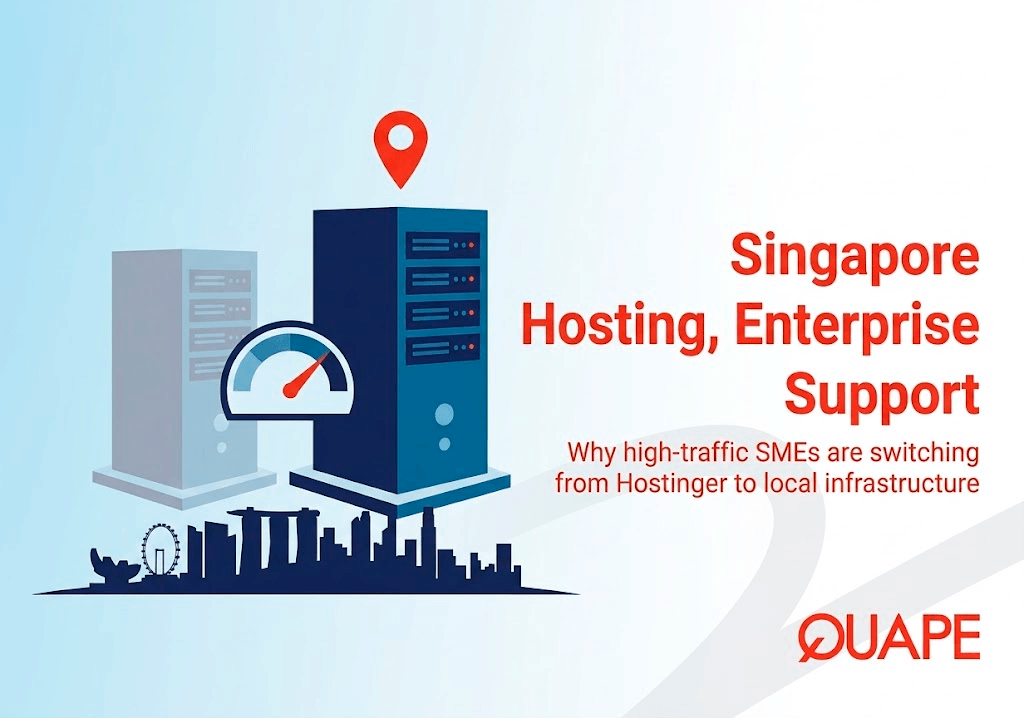
Singapore SMEs running high-traffic websites have more hosting options than ever, but not all of them are built for local operational demands. If your business is currently on Hostinger and you’re noticing slower load times, inconsistent uptime during traffic peaks, or support tickets that take hours to resolve, the issue is rarely just the plan you’re on. It’s the infrastructure model behind it. This comparison is for business owners and IT decision-makers who have moved past the startup phase and need a hosting environment that can absorb real traffic without becoming a liability. For that specific scenario, Quape offers a materially different proposition than Hostinger.
Why Growing Singapore Businesses Eventually Outgrow Entry-Level Hosting
Digital dependence among Southeast Asian SMEs is accelerating. According to the World Economic Forum, SMEs across the region are embedding digital infrastructure deeper into their core operations, which raises the stakes when that infrastructure underperforms. A hosting plan that worked fine at 500 daily visitors may start showing cracks at 5,000. The cracks don’t always appear as full outages. They appear as slower page loads during lunch hour, email delivery delays, or checkout errors that only happen during a promotion.
The Hidden Operational Cost of Slow Hosting Support During Business Hours
When a website goes down at 10 AM on a Tuesday, the business doesn’t pause to wait for a ticket queue to clear. Revenue stops. Customer trust erodes. Staff scramble for workarounds. IBM’s research on downtime costs indicates that operational losses during unplanned outages can reach significant figures per hour, depending on how revenue-dependent the digital channel is. For Singapore SMEs running e-commerce or service booking platforms, even a 90-minute outage during business hours has measurable consequences. The ability to reach a technically capable support contact quickly, in the same timezone, directly determines how fast that situation resolves.
When Traffic Growth Starts Exposing Shared Hosting Resource Limits
Shared hosting distributes finite compute resources across many accounts on the same physical server. When one account generates a traffic spike, neighboring accounts absorb the collateral effect through CPU throttling and I/O slowdowns. The HTTP Archive reports that the median webpage now exceeds 2 MB, which places increasing pressure on shared environments that were not designed for content-heavy or database-intensive sites. For businesses running WooCommerce stores, booking systems, or content platforms with dynamic queries, shared hosting resource contention is not a theoretical risk. It’s an operational one.
What Hostinger Still Does Well for Small and Budget-Conscious Websites
Hostinger built its position in the market by making web hosting genuinely accessible. Its pricing is among the lowest in the industry, its dashboard is beginner-friendly, and its onboarding process requires almost no technical knowledge. For a personal blog, a portfolio site, or a startup testing product-market fit with minimal traffic, Hostinger removes the cost and complexity barriers entirely.
Why Startups and Small Personal Sites Often Choose Hostinger First
The combination of an integrated website builder, affordable WordPress hosting, and self-service account management makes Hostinger an efficient starting point. It serves its intended audience well. Businesses in their earliest stage rarely need dedicated resources, local support engineers, or traffic spike resilience. They need to get online quickly without overpaying, and Hostinger reliably delivers that.
Where Hostinger’s Globalized Support and Infrastructure Become a Limitation
The same model that makes Hostinger accessible at scale also introduces structural limitations for businesses operating in a specific market with specific performance expectations. Hostinger’s support operates through a global ticketing system. Resolution time depends on queue depth, agent availability across time zones, and the complexity of the issue being escalated. For a Singapore business experiencing downtime at 2 PM SGT, waiting in an international support queue is a meaningful operational risk, not just an inconvenience. Similarly, hosting infrastructure that is not anchored to a Singapore data center introduces cross-region routing, which adds network hops and increases latency for local visitors.
The Singapore-Specific Problems That High-Traffic Sites Cannot Ignore
Singapore operates on world-class digital infrastructure. Internet penetration exceeds 95%, according to Statista, and user expectations for load speed and reliability reflect that environment. A site that loads acceptably in a lower-connectivity market may still feel sluggish to a Singapore visitor conditioned by consistently fast digital experiences. That gap matters for conversion.
Why Local Data Center Routing Matters More for Singapore Visitors Than Most Businesses Realize
When a website is hosted in a data center physically located in Singapore, visitor requests travel through fewer network hops to reach the server and return a response. Cloudflare’s documentation on latency explains this clearly: proximity to a regional internet exchange reduces round-trip time in direct proportion to the reduction in routing distance. For e-commerce sites, that reduction is not cosmetic. Google research found that the probability of a mobile visitor bouncing increases by 32% when load time increases from one second to three seconds. Hosting location is one of the few infrastructure variables a business can directly control to influence that number.
Why Generic Global Hosting Support Often Fails During Critical Downtime Events
Globalized support models are built for volume, not urgency. Tickets enter a queue, get categorized, and escalate through layers before reaching an engineer with the context to diagnose the issue. For a routine configuration question, that process is acceptable. For a live outage affecting customer transactions, each layer of that process adds time that the business is actively losing. The structural problem is that the support model was not designed with a specific market’s business hours, timezone, or operational context in mind.
Quape’s Advantage for Businesses Experiencing Growth-Related Hosting Problems
Quape is a Singapore-based hosting and web services provider. Its infrastructure is housed in a TIA 942-certified Tier 3 data center in Singapore, and its support team operates in SGT business hours. For businesses that have outgrown Hostinger’s model, Quape’s business hosting 和 VPS托管 plans are designed specifically around the infrastructure and support requirements that high-traffic Singapore sites depend on.
Why Singapore-Based Support Teams Create Faster Resolution Cycles
A support engineer who operates in the same timezone, understands the local business environment, and can be reached directly during SGT business hours compresses the resolution cycle for hosting incidents. There is no queue handoff across regions. There is no delay waiting for a shift to begin in a different timezone. For SMEs without in-house DevOps staff, this direct line to a technically capable contact is particularly valuable during time-sensitive situations like campaign launches, product releases, or post-incident recovery.
Business Hosting vs VPS Hosting for Sites Already Experiencing Traffic Spikes
The choice between Quape’s business hosting and VPS plans depends on the nature of the traffic and the complexity of the workload. Business hosting plans, which cap accounts at 20 per server rather than the industry norm of much higher densities, reduce resource contention and improve stability for small-to-medium sites. For businesses running e-commerce platforms, APIs, or applications with sustained concurrent traffic, the VPS tier provides dedicated vCPU and RAM allocations, NVMe SSD storage, and network throughput scaled to the workload. The VPS SG-Elite plan, for example, allocates 8 vCPU, 16 GB RAM, and 6 TB bandwidth at 500 Mbps, and is specifically noted as being designed for high-traffic sites and e-commerce platforms.
The distinction is summarized below:
| Workload Type | Recommended Plan | Key Reason |
| SME website, up to 15 users | Business Hosting Two or Three | Shared but low-density, cost-effective |
| High-traffic WooCommerce store | VPS SG-精英版 | Dedicated resources, NVMe SSD, high bandwidth |
| SaaS, APIs, multi-tenant apps | VPS SG-Max or SG-Ultra | High vCPU, RAM, and throughput for compute loads |
| E-commerce during traffic spikes | VPS SG-Pro and above | Isolated resources prevent contention-related instability |
Why Personalized Migration Support Matters for SMEs Without Dedicated DevOps Teams
Migrating a live website carries operational risk. For SMEs that do not have an in-house developer managing the transition, the risk of downtime, broken configurations, or email disruption during migration is real. Quape provides free migration support for WordPress sites and email accounts, with a small fee applying only for larger or more complex migrations. That structured handover reduces the barrier to switching and removes the self-managed migration risk that stops many SMEs from moving away from a hosting provider they have already outgrown.
Hostinger vs Quape for Singapore Businesses Handling Real Traffic Growth
The comparison below focuses on the dimensions that matter most to businesses that have moved past the startup phase and are experiencing the operational consequences of growth.
Comparing Support Responsiveness During High-Impact Downtime Scenarios
| Dimension | Hostinger | Quape |
| Support model | Global ticket queue | Singapore-based team, SGT hours |
| Escalation path | Multi-layer international routing | Direct access to local engineers |
| Response context | Generalized, non-market-specific | Singapore business environment |
| Migration assistance | Self-service | Guided, free for WordPress and email |
The Uptime Institute’s annual outage analysis found that over 60% of significant outages result in losses exceeding USD 100,000. The differentiating factor between a 90-minute recovery and a 6-hour recovery is rarely the hardware. It is the speed and quality of the support response.
Comparing Infrastructure Readiness for E-Commerce, APIs, and Content-Heavy Sites
Hostinger’s infrastructure serves a global user base efficiently. For Singapore visitors, however, routing through non-local data centers introduces additional latency that compounds with page weight and query complexity. Quape’s Tier 3 certified Singapore data center uses multi-homed bandwidth, meaning traffic routes through multiple upstream providers for redundancy and speed. For e-commerce platforms and API-dependent applications, that infrastructure design supports the VPS托管 workloads where consistent low-latency response is a functional requirement, not a preference.
Which Hosting Environment Fits Different Stages of Business Growth?
- Early stage, low traffic, budget priority: Hostinger’s entry-level plans are a reasonable choice. The cost efficiency is real and the onboarding friction is minimal.
- Growing SME with 1,000 to 10,000 daily visitors: Quape’s business hosting plans, particularly Business Two or Three, offer a more controlled shared environment with a lower server density cap and local support access.
- High-traffic or transactional site with performance sensitivity: Quape’s VPS tier provides the resource isolation and infrastructure resilience needed to sustain performance during traffic peaks.
- Complex applications or multi-tenant workloads: VPS SG-Max or SG-Ultra, combined with Quape’s local technical support, reduces operational dependency on internal DevOps resources.
Signs It May Be Time to Leave Hostinger for a More Scalable Singapore Hosting Provider
Not every Hostinger user needs to switch. The decision to migrate should be driven by operational evidence, not just cost comparisons or marketing claims. These are the signals worth taking seriously.
Frequent Downtime During Campaigns or Traffic Peaks
If your site slows significantly or becomes unstable during Harmon festivals, promotional campaigns, or product launches, the shared hosting environment is likely reaching its resource ceiling. Traffic surges expose the limits of shared server allocations in ways that normal traffic patterns do not. A hosting environment designed for traffic resilience handles these events without requiring advance configuration changes or manual intervention.
Increasing Dependence on Technical Workarounds Just to Maintain Performance
When teams start implementing caching layers, compressing media manually, or disabling plugins just to keep a site stable, the underlying infrastructure is constraining the product rather than enabling it. These workarounds absorb developer time and introduce fragility. They are signs that the hosting environment is undersized for the workload it is being asked to carry.
Your Team Needs Direct Access to Engineers Who Understand Singapore Business Operations
If your last support interaction involved a ticket that took hours to receive a first response, or the resolution required multiple back-and-forth exchanges with agents who were not familiar with your setup or market context, the support model is creating operational risk. Singapore SMEs operating customer-facing platforms need direct access to engineers who can diagnose and resolve issues within the same business day.
Choosing the Right Hosting Environment Before Growth Becomes a Business Risk
新加坡的 IMDA has positioned resilient digital infrastructure as a core competency for SME competitiveness. For businesses running on shared hosting that was selected at an earlier, lower-traffic stage of growth, the question is no longer whether to upgrade, but when. Waiting until the first major outage during a peak traffic event is a costly way to discover the limits of the current infrastructure.
When Business Hosting Is Enough and When VPS Becomes the Safer Option
Quape的 business hosting plans are the right starting point for SMEs that need a managed, low-density shared environment with local support access and free migration assistance. For businesses already handling consistent traffic, running transactional workloads, or planning campaigns that will generate traffic spikes, the VPS托管 tier provides the dedicated resource allocation and infrastructure isolation that shared environments structurally cannot offer. The decision point is not arbitrary. It is determined by the traffic patterns, workload complexity, and support expectations the business is already operating against.
Get Expert Guidance Before Your Next Traffic Spike Causes Downtime
For Singapore SMEs that have outgrown entry-level hosting, the combination of local infrastructure, Singapore-based technical support, and guided migration support makes Quape a materially stronger operating environment than Hostinger for high-traffic and growth-stage sites. Hostinger remains a legitimate choice for early-stage, low-traffic, or budget-constrained sites where self-service and cost efficiency are the primary criteria. The decision to switch should be made before the next campaign, not after the next outage. If your current hosting is already showing signs of strain, speak with Quape’s team through a free hosting consultation and assess whether your infrastructure is ready for the traffic your business is building toward.
常见问题 (FAQ)
Is Hostinger a bad hosting provider?
Hostinger is a well-established provider that serves millions of users globally and does entry-level hosting well. It is a practical choice for personal sites, portfolios, and early-stage businesses with low traffic. The limitations become relevant specifically when businesses outgrow shared hosting resources or need localized support during critical downtime events.
Why does data center location affect website performance in Singapore?
When a website is hosted in a Singapore data center, visitor requests travel a shorter network distance to the server and back. Fewer network hops reduce round-trip latency. For Singapore visitors on mobile or accessing high-complexity pages, that difference directly affects load time and, by extension, conversion behavior.
What makes Quape’s support different from Hostinger’s?
Quape’s support team operates in Singapore during SGT business hours, which means incidents that occur during the Singapore working day are handled by engineers in the same timezone with direct accountability. Hostinger’s support model relies on a global ticket system that distributes requests across international queues, which can extend resolution time for time-sensitive issues.
Do I need VPS hosting, or is business hosting enough?
Business hosting works well for sites with moderate, relatively consistent traffic, particularly if you are running a standard WordPress or content site. VPS hosting becomes the better choice when your site handles sustained concurrent traffic, runs e-commerce transactions, depends on APIs, or experiences performance instability during campaigns. The resource isolation that VPS provides eliminates the contention risk inherent in shared environments.
Is migration from Hostinger to Quape complicated?
Quape provides free migration support for WordPress sites and email accounts. For most SMEs, this means the technical transition is handled by Quape’s team rather than managed internally. Larger or more complex migrations may involve a small fee. The process is structured to minimize downtime during the transfer.
Would Hostinger still be the better choice for some Singapore businesses?
Yes. If your site is in its early stage, generates low traffic, and does not depend on fast support resolution for business continuity, Hostinger’s pricing and ease of use make it a sensible choice. The case for switching to Quape applies specifically to businesses that have grown to the point where infrastructure reliability and support responsiveness are operational requirements.
How does Quape’s server density policy affect performance?
Quape caps its business hosting plans at 20 accounts per server, compared to higher densities common in the shared hosting industry. This directly reduces resource contention, meaning your site is less affected by traffic spikes from neighboring accounts. For businesses that experienced slowdowns on previous shared hosting plans, this structural difference is worth noting.