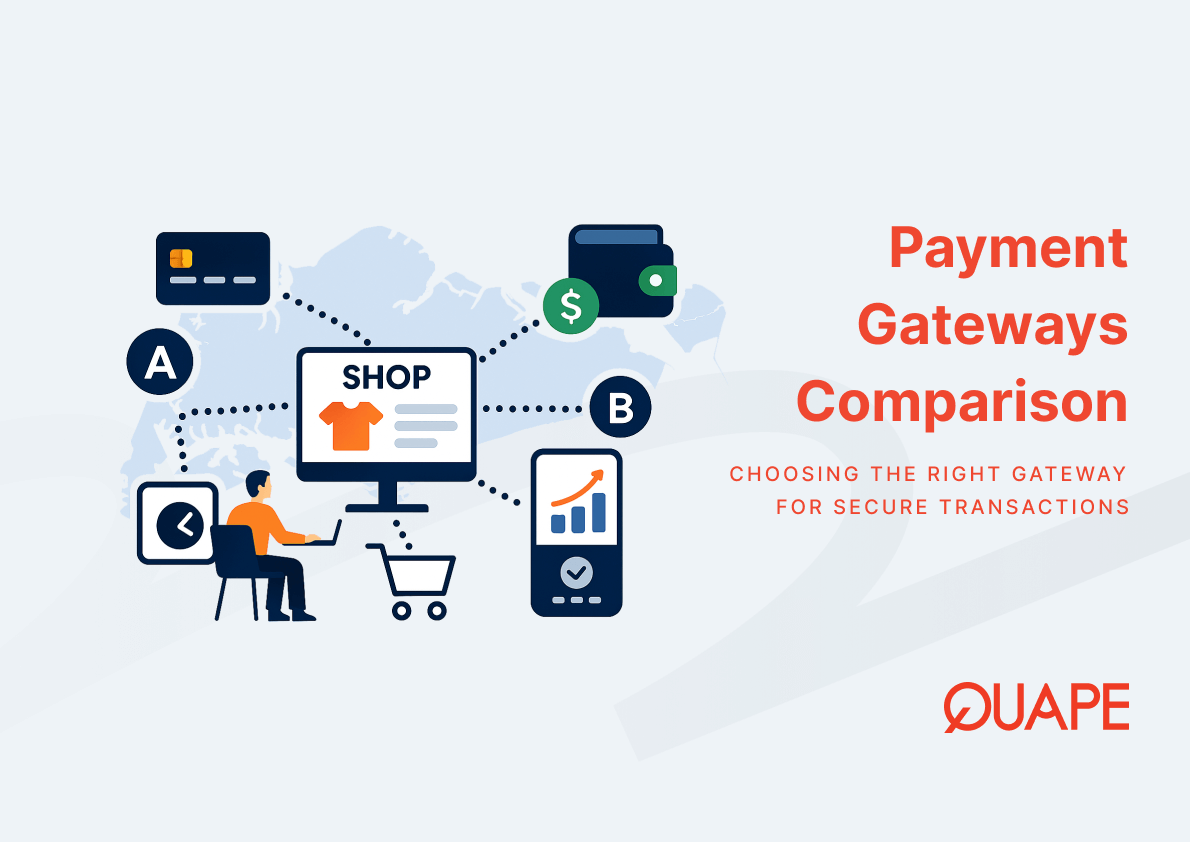
Choosing the right payment gateway shapes how smoothly transactions flow through your e-commerce store and whether customers complete their purchases. In Singapore, where digital wallets now account for 39% of e-commerce transaction value, payment infrastructure decisions directly influence conversion rates, operational costs, and regulatory compliance. Singapore’s Payment Services Act 2019 establishes clear oversight frameworks that payment providers must follow, creating an environment where trust and innovation coexist. For businesses building or upgrading their online stores, understanding how payment gateways integrate with local preferences, security standards, and technical platforms determines whether checkout experiences support growth or create friction that drives customers away.
A payment gateway is a technology service that authorizes and processes payment transactions between customers, merchants, and financial institutions. It encrypts sensitive card data, routes transaction requests to payment networks, verifies account availability, and returns approval or decline responses within seconds. Payment gateways enable e-commerce platforms to accept multiple payment methods while maintaining security standards that protect both merchants and consumers from fraud and data breaches.
Những điểm chính
- Payment gateways process transactions by encrypting card data, routing authorization requests, and returning real-time approval responses that determine checkout success.
- PCI DSS compliance establishes mandatory security controls for any system that stores, processes, or transmits payment card data, protecting merchants from breach liability.
- Singapore’s shift toward digital wallets (PayNow, GrabPay, Apple Pay) requires gateways that support diverse payment methods beyond traditional cards.
- Transaction fees, settlement cycles, and cross-border processing costs vary significantly across gateway providers and directly impact profit margins.
- API quality and CMS compatibility determine how easily payment systems integrate with platforms like WooCommerce, Shopify, or custom-built stores.
- Checkout experience quality, including payment latency and method variety, directly influences cart abandonment rates and conversion optimization.
- MAS regulatory frameworks under the Payment Services Act 2019 require licensed oversight for payment service providers, ensuring consumer fund protection.
- Monitoring transaction analytics and funnel performance reveals where payment friction occurs and guides optimization priorities.
Introduction to Payment Gateways in Singapore
Payment gateways serve as the technical bridge between e-commerce platforms and financial networks, enabling online payments to move securely from customer accounts to merchant settlement accounts. In Singapore’s digital economy, where internet penetration exceeds 99% and smartphone adoption reaches 97%, payment infrastructure supports a sophisticated ecosystem where consumers expect instant authorization, multiple payment options, and seamless checkout flows. The gateway validates transaction data, applies fraud detection rules, communicates with card networks or digital wallet providers, and returns authorization codes that either complete or reject purchases.
Singapore’s regulatory environment, governed by the Monetary Authority of Singapore through the Payment Services Act 2019, consolidates oversight of payment accounts, transfers, e-money issuance, and merchant acquisition services. This framework ensures that payment providers operate with adequate capital reserves, implement consumer protection mechanisms, and maintain operational resilience. For businesses operating e-commerce platforms in Singapore, selecting gateways that comply with these regulatory standards reduces legal risk while building customer confidence in transaction security.
E-commerce transactions in Singapore increasingly rely on digital wallets and real-time payment systems rather than traditional card networks alone. This shift reflects changing consumer payment behavior, where convenience, mobile accessibility, and trust in local financial institutions influence method selection. Payment gateways that integrate multiple payment types, from credit cards to PayNow transfers, enable merchants to capture purchases across customer preference segments without forcing payment method compromises that increase cart abandonment.
Key Components and Decision Factors of Payment Gateways
Payment processing involves sequential steps where transaction data flows from checkout interfaces through encryption layers, authorization networks, and settlement systems before funds reach merchant accounts. The gateway captures payment details entered by customers, encrypts sensitive information using Transport Layer Security protocols, and transmits authorization requests to acquiring banks or payment networks. Card networks query issuing banks to verify account status and available credit, then return approval or decline messages that the gateway relays back to the e-commerce platform. This entire cycle typically completes in two to four seconds, though latency variations depend on network routing, fraud screening complexity, and international transaction processing requirements.
Merchant accounts serve as the financial holding structure where approved transaction amounts accumulate before settlement transfers to business bank accounts. Some gateway providers offer integrated merchant account services, while others require separate relationships with acquiring banks. The distinction influences settlement speed, fee structures, and operational complexity. Integrated solutions simplify onboarding but may impose higher per-transaction costs, while separate arrangements offer fee negotiation flexibility at the expense of additional relationship management overhead.
API integration quality determines how efficiently payment gateways connect with e-commerce platforms and custom checkout implementations. Well-documented APIs with comprehensive SDKs reduce development time, while poorly maintained integration tools create technical debt and increase maintenance costs. Fraud prevention capabilities built into gateway services apply machine learning algorithms and rule-based filters that flag suspicious transactions before authorization completes, protecting merchants from chargeback liability and customers from unauthorized purchases.
Regulatory and Compliance Requirements in Singapore
PCI DSS compliance establishes the security baseline for any environment where payment card data is processed, stored, or transmitted. Developed by the Payment Card Industry Security Standards Council, this framework comprises twelve core requirements covering network security, data encryption, access controls, and ongoing monitoring practices. Merchants using payment gateways that handle card data on their behalf can achieve compliance through simplified validation procedures, since the gateway provider assumes responsibility for securing the payment processing environment. However, businesses that store card details or handle sensitive authentication data directly must implement full PCI DSS controls and undergo annual assessments.
MAS regulatory considerations under the Payment Services Act extend beyond card security to encompass operational resilience, consumer fund safeguarding, and anti-money laundering controls. Payment service providers must obtain appropriate licenses based on the services they offer, maintain minimum capital reserves, and implement technology risk management frameworks that prevent system failures from disrupting payment availability. For businesses evaluating gateway options, verifying that providers hold valid MAS licenses ensures regulatory alignment and reduces the risk of service interruptions due to compliance failures. E-commerce trust and security depends on these foundational controls that protect transaction integrity and customer data confidentiality.
Data security obligations require gateways to encrypt cardholder data during transmission and storage, implement strong access controls that limit who can view sensitive information, and maintain audit logs that track system access and data modifications. Financial regulations in Singapore also mandate timely reporting of security incidents and breaches that could compromise customer information. Payment gateways that achieve SOC 2 Type II certification or ISO 27001 compliance demonstrate adherence to international security standards, providing additional assurance beyond minimum regulatory requirements.
Local Payment Preference Trends
PayNow is a near-instant real-time inter-bank payment system operated by the Association of Banks in Singapore, enabling person-to-merchant and person-to-person transfers using mobile numbers or national identification numbers as payment identifiers. Its integration with Singapore’s banking infrastructure allows customers to authorize payments directly from bank accounts without entering card details, reducing checkout friction while leveraging existing trust relationships with financial institutions. Payment gateways that support PayNow integration enable merchants to capture transactions from customers who prefer bank-direct payment methods over card networks.
Digital wallets including GrabPay, ShopeePay, Apple Pay, and Google Pay have transformed consumer payment behavior in Singapore, collectively representing significant market share in e-commerce transactions. These platforms store payment credentials securely on mobile devices, allowing one-tap checkout experiences that minimize data entry and accelerate purchase completion. For merchants, supporting multiple digital wallet options requires gateways with broad payment method integration capabilities, since each wallet provider maintains distinct API protocols and settlement processes. Mobile commerce trends in Singapore indicate continued growth in wallet adoption, particularly among younger demographics who prioritize mobile-first experiences.
Consumer payment behavior reflects preferences shaped by convenience, security perception, and rewards program incentives. While cards remain important for certain transaction types, the shift toward digital wallets demonstrates how trust in technology platforms and seamless user experiences influence method selection. Singapore buyer psychology reveals that offering familiar, locally-preferred payment options reduces perceived transaction risk and increases likelihood of purchase completion, particularly for first-time customers who have not yet established trust with a merchant brand.
Technical Integration and Platform Compatibility
Payment gateway APIs provide the programmatic interfaces through which e-commerce platforms submit transaction requests and receive authorization responses. RESTful APIs have become the standard architecture, offering JSON-formatted data exchange that integrates cleanly with modern web frameworks and mobile applications. Comprehensive API documentation, including code examples, testing environments, and versioning policies, reduces integration complexity and helps development teams implement payment processing without extensive trial-and-error troubleshooting.
CMS integration varies significantly across gateway providers, with some offering native plugins for platforms like WooCommerce and Shopify while others require custom development work. Native integrations simplify implementation for businesses using standard e-commerce platforms, typically involving plugin installation and configuration rather than code-level development. Custom e-commerce platforms built on frameworks like Laravel, Django, or Node.js require direct API integration, where development teams implement payment request formatting, response handling, webhook processing, and error management logic. Shopify vs WooCommerce in Singapore contexts often hinges on which platform’s payment gateway ecosystem better matches business requirements and available technical resources.
Integration testing ensures that payment flows work correctly under various scenarios including successful authorizations, declined transactions, timeout conditions, and network failures. Gateways that provide sandbox environments with simulated responses enable thorough testing before production deployment, reducing the risk of checkout failures that damage customer experience and revenue. Webhook mechanisms allow gateways to notify e-commerce platforms asynchronously when transaction status changes, supporting workflows like delayed capture, subscription renewals, and refund processing.
Cost Structures and Transaction Fees
Transaction fees typically consist of percentage-based charges on transaction value plus fixed per-transaction amounts, creating cost structures that vary based on payment method, card type, and merchant industry classification. Domestic card transactions usually incur lower fees than international cards due to reduced interchange costs and simpler authorization routing. Digital wallet transactions may carry different fee schedules depending on agreements between wallet providers and gateway operators, while bank transfer methods like PayNow often involve lower percentage fees but may include setup or monthly access charges.
Settlement cycles determine how quickly approved transaction funds become available in merchant bank accounts. Standard settlement timeframes range from one to three business days, though some gateway providers offer faster settlement options at premium pricing. Longer settlement cycles impact working capital availability, particularly for businesses with tight cash flow management requirements or those purchasing inventory with short payment terms. E-commerce platform costs in Singapore include these hidden financing costs that accumulate when revenue remains locked in settlement pipelines.
Cross-border fees apply when customers pay using cards issued outside Singapore or when transactions involve currency conversion. These fees can significantly exceed domestic transaction costs, sometimes reaching 3-4% of transaction value plus unfavorable exchange rate margins. For businesses serving regional markets or accepting international customers, understanding cross-border fee structures helps forecast true transaction costs and determine whether geographic payment method optimization could reduce overall payment processing expenses.
Total cost of ownership extends beyond transaction fees to include monthly gateway fees, PCI compliance costs, chargeback fees, integration development expenses, and ongoing maintenance requirements. A gateway with low transaction fees but expensive integration requirements may cost more over time than one with slightly higher per-transaction charges but turnkey implementation. Calculating break-even transaction volumes helps businesses determine which fee structures align with their sales patterns and growth trajectories.
Practical Application for Singapore E-Commerce Businesses
SMEs in Singapore face distinct payment gateway selection challenges compared to enterprise e-commerce operations, primarily driven by transaction volume, technical resources, and budget constraints. Small businesses benefit from gateways offering simple onboarding, minimal technical complexity, and transparent pricing without hidden fees or volume commitments. Enterprise operations prioritize customization capabilities, dedicated support resources, and advanced features like dynamic currency conversion, subscription billing, and multi-entity settlement across regional subsidiaries.
Checkout flow optimization depends on how smoothly payment gateways integrate with overall user experience design, including form field reduction, payment method display, and error message clarity. Conversion optimization research consistently demonstrates that each additional step or required field in checkout processes increases abandonment likelihood, making payment gateway selection inseparable from broader UX architecture decisions. Gateways supporting tokenization and one-click repeat purchases reduce friction for returning customers, while guest checkout options prevent forced account creation that deters first-time buyers.
Impact of Payment Gateways on Checkout Experience
Checkout UX quality directly correlates with cart abandonment rates, where payment friction created by confusing interfaces, slow loading times, or limited payment options causes customers to exit purchase flows before completion. Payment gateways that render payment method selection and data entry fields efficiently, with responsive design that adapts to mobile screen sizes, reduce cognitive load and technical barriers that interrupt buying momentum. Checkout UX and cart abandonment analysis reveals that even small improvements in payment interface clarity can yield measurable conversion rate gains.
Payment friction manifests when gateways require excessive information entry, redirect customers to external payment pages that appear unrelated to merchant branding, or display error messages without clear resolution guidance. Embedded payment fields that remain within the merchant’s domain maintain visual continuity and trust signals, while redirect-based flows risk breaking the purchase narrative. Modern gateways increasingly support embedded iFrame implementations or JavaScript SDK integrations that balance security isolation with seamless user experience.
Mobile payment optimization requires gateways that recognize device types and automatically present mobile-optimized payment interfaces, including support for digital wallet APIs that enable biometric authentication and stored payment credentials. The prevalence of mobile commerce in Singapore makes mobile checkout performance a critical gateway evaluation criterion, since poor mobile experiences disproportionately impact conversion rates relative to desktop channels.
Performance, Reliability, and Scalability Considerations
Payment latency affects checkout completion rates because customers perceive slow authorization responses as system failures or reasons to abandon purchases. Gateways with robust network infrastructure and optimized routing paths typically complete authorization cycles in under three seconds, while those with architectural bottlenecks or distant processing centers may introduce delays that customers interpret as errors. Fast e-commerce sites require payment processing speed that matches overall page performance standards, since inconsistent responsiveness undermines user confidence.
Uptime reliability determines whether payment acceptance remains available during peak sales periods, seasonal traffic surges, or unexpected viral marketing successes. Gateways backed by redundant infrastructure, load balancing, and failover mechanisms maintain availability even when individual system components fail. Service level agreements that guarantee specific uptime percentages and define compensation for outages provide contractual protection, though prevention remains preferable to financial remediation after revenue-impacting downtime.
Scalability considerations address whether gateway infrastructure can handle transaction volume growth without performance degradation or rate limiting that rejects legitimate payment requests. Businesses experiencing rapid growth or seasonal spikes need gateways that automatically scale processing capacity, rather than imposing hard transaction limits that require manual intervention or platform upgrades. API rate limits, if present, should accommodate realistic peak transaction volumes with sufficient headroom for unexpected surges.
Monitoring and Optimization of Payment Performance
Transaction analytics provide visibility into approval rates, decline reasons, average authorization times, and payment method distribution across customer segments. Gateways offering comprehensive reporting dashboards enable merchants to identify patterns such as specific card types experiencing elevated decline rates, time-of-day variations in authorization success, or geographic regions with unusual transaction behavior. This data informs optimization strategies like payment method prioritization, fraud rule refinement, or customer communication improvements that address common decline triggers.
Funnel analysis tracks how many customers reach payment stages, initiate authorization attempts, and successfully complete transactions, revealing exactly where checkout abandonment occurs. When significant drop-off happens during payment method selection, it suggests insufficient options or confusing presentation. Abandonment during authorization processing may indicate performance issues or overly aggressive fraud filters. E-commerce analytics and A/B testing methodologies apply to payment gateway performance just as they do to product pages and marketing funnels.
A/B testing different payment gateway configurations, such as payment method ordering, embedded versus redirect flows, or required versus optional data fields, quantifies which implementation choices actually improve conversion rates rather than relying on assumptions. Gateways supporting multiple configuration profiles or easy switching between integration modes facilitate experimentation without extensive redevelopment work. Testing should run for sufficient duration and transaction volume to achieve statistical significance, typically requiring hundreds of completed transactions per variant.
How E-Commerce Web Design Supports Effective Payment Gateway Implementation
Thiết kế web thương mại điện tử establishes the architectural foundation that determines how efficiently payment gateways integrate with checkout flows, inventory systems, and customer account management. Well-designed e-commerce platforms structure payment integration as a modular component that can accommodate multiple gateway providers without requiring fundamental redesigns, protecting businesses from vendor lock-in and enabling competitive bidding among payment processors. Payment integration architecture should isolate gateway-specific code from core business logic, allowing gateway switches or multi-gateway deployments with minimal technical disruption.
Secure checkout design extends beyond payment gateway selection to encompass SSL certificate implementation, form validation that prevents data entry errors before submission, and clear trust signals like security badges and privacy policy links positioned near payment fields. The visual hierarchy of checkout pages should guide attention naturally toward payment completion, using layout, color contrast, and button prominence to reduce decision paralysis. E-commerce designs that treat payment gateway integration as an afterthought often create technical debt that manifests as slow page loads, broken mobile experiences, or security vulnerabilities requiring expensive remediation.
Custom e-commerce platforms benefit from design flexibility that allows payment interfaces to match brand aesthetics completely, while template-based platforms trade some customization for faster implementation and proven conversion patterns. The choice between custom and template approaches influences which gateway integration methods work best, since some gateways offer superior plugins for popular platforms while others provide better developer documentation for custom implementations. Regardless of platform choice, payment gateway implementation quality directly impacts whether customers trust the checkout process enough to enter sensitive financial information.
Kết luận
Payment gateway selection requires balancing regulatory compliance, local payment preferences, technical compatibility, cost structures, and user experience quality against specific business requirements and growth objectives. Singapore’s sophisticated digital payments ecosystem rewards merchants who offer diverse payment options while maintaining security standards that protect customer data and financial integrity. The shift toward digital wallets and real-time payment systems continues reshaping transaction patterns, making gateway flexibility and method support increasingly valuable competitive advantages. Businesses that align payment infrastructure with customer expectations, platform capabilities, and operational scalability position themselves to capture conversions while controlling transaction costs over time.
Ready to build an e-commerce platform with optimized payment integration? Liên hệ với nhóm của chúng tôi to discuss how professional e-commerce web design supports payment gateway implementation that converts browsers into buyers.
Câu Hỏi Thường Gặp
What makes a payment gateway suitable for Singapore e-commerce businesses?
A suitable gateway must support locally preferred payment methods like PayNow, GrabPay, and major digital wallets while maintaining PCI DSS compliance and MAS regulatory alignment. It should offer competitive transaction fees for the Singapore market, provide reliable API documentation for platform integration, and deliver consistent uptime during peak shopping periods.
How does PCI DSS compliance affect payment gateway choice?
PCI DSS compliance determines the security controls required to protect payment card data throughout transaction processing. Gateways that handle card data on merchants’ behalf reduce compliance burden by assuming responsibility for secure processing environments, allowing businesses to use simplified validation procedures rather than implementing full security frameworks internally.
Why do digital wallets matter for Singapore checkout conversion?
Digital wallets now account for 39% of e-commerce transaction value in Singapore, reflecting strong consumer preference for mobile-optimized payment methods that reduce data entry friction. Offering familiar wallet options like Apple Pay, Google Pay, and GrabPay meets customer expectations and reduces cart abandonment caused by limited payment choices.
What transaction fees should Singapore merchants expect from payment gateways?
Domestic card transactions typically incur 2-3% plus small fixed fees, while digital wallet and PayNow transactions may range from 0.5-2% depending on provider agreements. International cards and cross-border transactions often carry higher fees reaching 3-4%, plus currency conversion margins that vary by gateway processor.
How do payment gateways integrate with platforms like WooCommerce or Shopify?
Most major gateways provide native plugins for popular platforms that simplify integration to configuration-level tasks rather than custom development. Custom e-commerce platforms require direct API integration where development teams implement request formatting, response handling, and webhook processing according to gateway documentation.
What causes payment authorization delays that frustrate customers?
Authorization delays typically result from slow network routing between gateways and card networks, complex fraud screening rules that require additional verification steps, or infrastructure bottlenecks during high-traffic periods. Gateways with optimized routing and robust infrastructure usually complete authorizations in under three seconds.
Can businesses use multiple payment gateways simultaneously?
Yes, multi-gateway deployments allow merchants to route transactions to different processors based on payment method, transaction value, or customer location, optimizing fees and approval rates. This approach requires e-commerce platforms designed with gateway abstraction layers that support multiple processor integrations without code conflicts.
How does gateway choice affect cart abandonment rates?
Gateways influence abandonment through payment method variety, checkout interface quality, authorization speed, and mobile optimization. Limited payment options force customers to abandoned purchases they cannot complete with preferred methods, while slow or confusing payment interfaces create friction that interrupts buying momentum regardless of payment type availability.

- From Design to Live Website: Converting Figma/PSD to WordPress the Right Way - Tháng 4 29, 2026
- How Singapore Businesses Benefit from Figma to WordPress Conversion - Tháng 4 27, 2026
- Integrating Design Systems Between Figma, WordPress, and Other Platforms - Tháng 4 24, 2026