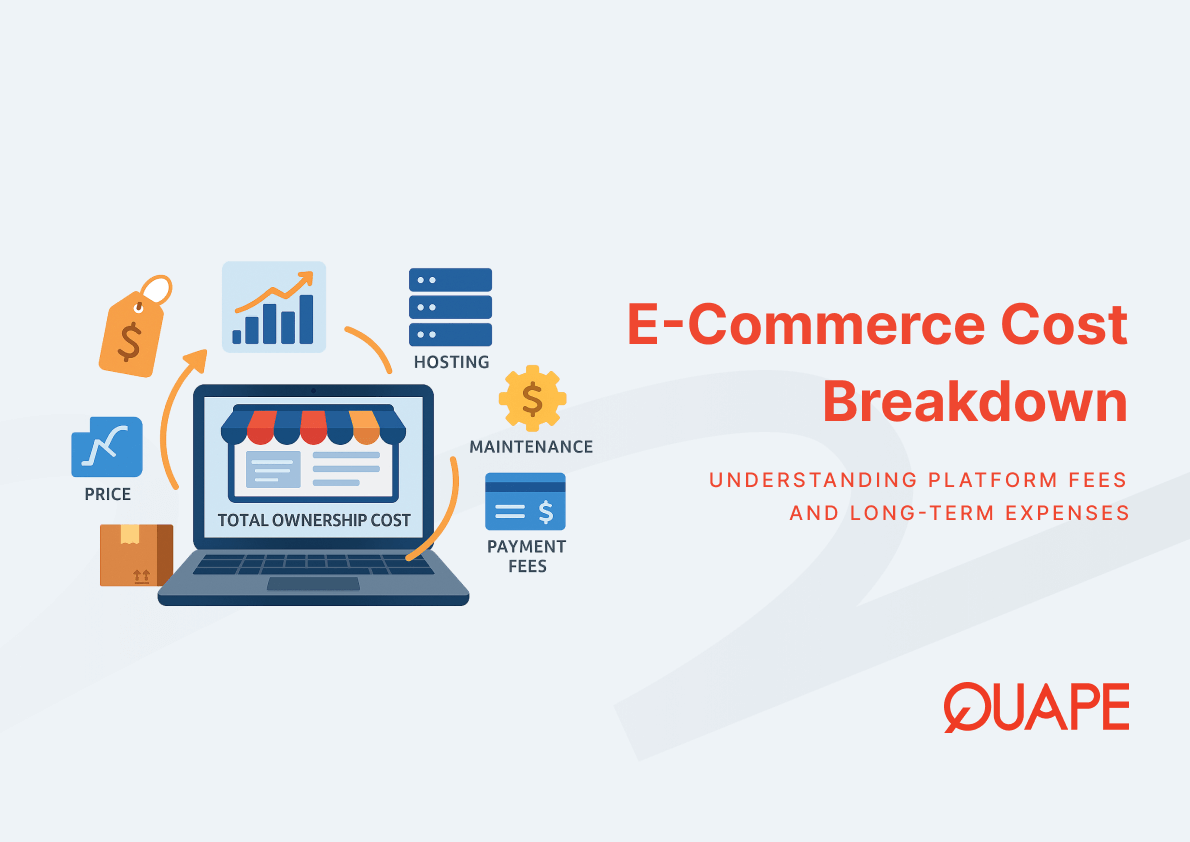
Selecting an e-commerce platform involves far more than comparing monthly subscription fees. For businesses operating in Singapore’s rapidly expanding digital commerce landscape, platform costs extend across licensing models, transaction percentages, payment processing margins, hosting infrastructure, and logistics integration. Understanding total cost of ownership (TCO) requires mapping how these cost layers interact with operational complexity, conversion performance, and long-term scalability. Singapore’s e-commerce market is projected to reach US $10 billion by 2026, making strategic platform selection a critical factor in business sustainability and competitive positioning.
E-commerce platform costs in Singapore represent the cumulative financial burden of building, operating, and scaling an online store. These costs include direct expenses like platform licensing and transaction fees, alongside indirect factors such as checkout friction, security compliance, and SEO performance. Total cost of ownership captures both visible charges and hidden revenue leakage caused by poor integration, slow performance, or suboptimal user experience. For IT managers, CTOs, and procurement leads, TCO analysis shapes platform decisions by revealing how architecture choices influence margins, operational efficiency, and customer retention over time.
Những điểm chính
- Platform costs combine fixed licensing fees with variable transaction percentages, payment gateway rates, and infrastructure expenses that scale with business growth.
- Transaction fees and merchant service charges can consume 3% to 7% of sales value before factoring in logistics or fulfilment costs.
- Checkout experience directly impacts conversion rates, with cart abandonment representing a significant hidden cost through lost revenue.
- Hosting and performance infrastructure must support peak traffic and mobile commerce demands without degrading site speed or user experience.
- Security compliance, PCI-DSS requirements, and fraud prevention add ongoing operational costs that protect both revenue and brand reputation.
- Logistics integration and delivery cost transparency influence consumer trust, particularly in Singapore where 57% of shoppers cite delivery costs as a top concern.
- Long-term TCO depends on platform flexibility, API integration capacity, and the ability to optimise analytics, testing, and customer acquisition costs over time.
- Proper e-commerce web design reduces technical debt, minimises rework, and supports efficient scaling while controlling maintenance expenditure.
Introduction to E-Commerce Platform Costs & Total Cost of Ownership in Singapore
E-commerce platform costs in Singapore encompass both transparent pricing structures and less visible operational burdens. Direct costs include platform licensing fees, whether through SaaS subscriptions or self-hosted open-source installations. Variable costs emerge through transaction fees charged by marketplaces, payment gateway processing rates, and merchant service charges that reduce net revenue per order. These expenses exist alongside infrastructure requirements for hosting, bandwidth, and server resources that support site performance during traffic surges.
Total cost of ownership extends beyond software and hosting. E-commerce web design in Singapore influences TCO by determining how efficiently platforms integrate with payment gateways, logistics providers, and customer relationship management systems. Poor design decisions generate technical debt, forcing costly rework when businesses need to scale or add functionality. Conversion loss from suboptimal checkout flows represents implicit cost through abandoned revenue, while security compliance and fraud prevention add recurring operational expenses.
Singapore’s digital commerce ecosystem introduces specific cost considerations. With internet penetration at 98% and over 3 million active e-commerce users, businesses face competitive pressure to deliver seamless mobile experiences, support diverse payment methods including digital wallets like PayNow and Apple Pay, and maintain transparent logistics pricing. These market conditions shape platform selection criteria and influence how cost structures align with buyer expectations and regional commerce patterns.
Core Cost Layers That Define E-Commerce Platform TCO
Platform cost structures separate into direct expenditures and indirect operational burdens. Direct costs include licensing fees, transaction percentages, and payment processing charges that appear on invoices. Indirect costs emerge through maintenance requirements, security updates, compliance management, and the opportunity cost of conversion loss from poor user experience. Together, these layers determine whether a platform delivers sustainable margins or erodes profitability through accumulated operational complexity.
Operational expenditure (OPEX) dominates most e-commerce cost models. Monthly SaaS subscriptions, payment gateway fees, and hosting charges recur regardless of sales performance, creating baseline overhead. Capital expenditure (CAPEX) applies primarily to self-hosted platforms requiring server hardware, software licenses, and upfront development investment. The choice between OPEX-heavy SaaS models and CAPEX-intensive custom builds influences cash flow, scalability planning, and long-term financial flexibility.
Cost efficiency depends on matching platform architecture to business scale and growth trajectory. Small merchants may find SaaS platforms economical due to bundled features and predictable monthly costs. Growing businesses encounter inflection points where transaction fees on gross merchandise value (GMV) exceed the cost of migrating to self-hosted solutions with greater control over margins. Enterprise operations prioritise integration capacity, API flexibility, and the ability to customise workflows without vendor lock-in that constrains competitive differentiation.
Platform Licensing Models and Software Cost Structures
Platform licensing determines baseline software costs and shapes operational flexibility. SaaS e-commerce platforms charge monthly or annual subscription fees that bundle hosting, security updates, and core functionality. These fees scale with features, transaction volume, or revenue tiers, creating predictable OPEX but limiting customisation depth. Vendors absorb infrastructure management, reducing internal IT burden while imposing platform constraints on design and integration options.
Open-source e-commerce platforms eliminate licensing fees but shift costs to implementation, hosting, and ongoing maintenance. Businesses gain complete architectural control, enabling custom workflows and unlimited API integrations. However, self-hosted models require dedicated development resources, security management, and server infrastructure investment. Total cost of ownership for open-source solutions depends on internal technical capacity and the frequency of customisation needs that justify the overhead.
Subscription-based pricing in SaaS models often introduces hidden cost escalation. Transaction volume tiers trigger automatic price increases as businesses grow, while premium features like advanced analytics, multi-currency support, or custom integrations carry additional monthly charges. Comparing Shopify vs WooCommerce in Singapore reveals how licensing models influence long-term cost trajectories, with SaaS platforms offering simplicity at the expense of margin compression as GMV scales, and open-source platforms demanding higher upfront investment for greater cost control over time.
Transaction Fees and Revenue Share Implications
Transaction fees reduce net revenue by charging a percentage of each sale. Marketplace platforms and hosted solutions commonly impose per-transaction costs ranging from 1.5% to 3% of order value, with some marketplaces combining these fees with additional service charges. These percentages compound with payment gateway fees, creating a cumulative revenue share that directly impacts gross margins. For high-volume sellers, even small percentage differences translate to significant annual cost disparities.
Gross merchandise value determines total transaction fee burden. Businesses processing $500,000 in annual GMV at a 2.5% platform commission pay $12,500 in transaction costs before accounting for payment processing. As sales scale, transaction fees grow proportionally, making percentage-based pricing increasingly expensive compared to flat-rate or self-hosted alternatives. This relationship drives many mid-market businesses to evaluate migration strategies when GMV crosses thresholds where fixed costs become more economical than variable fees.
Per-transaction cost structures also interact with average order value (AOV) dynamics. Low AOV businesses face proportionally higher fee burdens, as fixed payment processing components consume larger percentages of smaller transactions. Platform commissions on marketplaces like Shopee Singapore, where combined fees can exceed 3% to 7% of sales value, reduce competitiveness for merchants selling lower-margin products. Strategic platform selection requires modelling how transaction fee structures align with product mix, pricing strategy, and target margin requirements.
Payment Gateway Rates and Cost Variability in Singapore
Payment gateway rates represent unavoidable costs for processing customer transactions. Credit card processing fees in Singapore typically range from 2% to 3.5% per transaction, with merchant service charges varying based on card type, issuing bank, and merchant category codes. These fees include interchange components that flow to issuing banks, assessment fees collected by card networks, and processor margins. Merchants bear these costs, which reduce net revenue and must be factored into pricing strategies.
Digital wallets like PayNow, Apple Pay, and Google Pay introduce alternative payment methods with different cost structures. Some wallets charge lower processing fees than traditional credit cards, while others impose fixed per-transaction costs that benefit high AOV purchases. Supporting multiple payment methods increases conversion by meeting customer preferences, particularly in Singapore where buyers increasingly expect diverse payment options. However, each gateway integration adds technical complexity and potential maintenance overhead.
Cross-border payment fees escalate costs for merchants serving international customers. Currency conversion charges, cross-border interchange rates, and foreign transaction fees can add 1% to 4% to standard processing costs. For Singapore businesses targeting regional markets, these fees directly impact competitiveness and margin protection. Selecting payment gateways in Singapore requires evaluating both domestic transaction costs and international fee structures, balancing customer reach against processing expense and settlement speed.
Hosting, Infrastructure, and Performance-Related Costs
Hosting requirements for e-commerce platforms exceed those of informational websites due to transaction processing demands, database queries, and dynamic content generation. E-commerce sites require sufficient server resources, memory allocation, and bandwidth capacity to handle peak traffic without performance degradation. Shared hosting plans often fail under load, causing slow page speeds that increase bounce rates and reduce conversion. VPS hosting or dedicated servers provide the resource isolation necessary for reliable performance.
Server resources must scale with business growth and seasonal traffic patterns. Flash sales, holiday shopping periods, and marketing campaigns create traffic spikes that overwhelm undersized infrastructure. Scalability costs include both the capacity to handle increased load and the ability to scale down during low-traffic periods to control expenses. Cloud hosting models offer elastic scaling but introduce variable monthly costs that require careful monitoring to prevent budget overruns.
Site performance directly influences conversion rates and customer retention. Research shows that fast e-commerce sites achieve measurably higher conversion than slower competitors, as page load delays increase abandonment likelihood. Hosting infrastructure that delivers sub-second response times, efficient caching, and content delivery network (CDN) integration reduces the implicit cost of lost sales. Performance-related costs thus represent investments in revenue protection rather than pure operational overhead.
Logistics, Fulfilment, and Margin Impact
Logistics costs represent a significant component of e-commerce TCO, extending beyond platform technology to physical delivery infrastructure. Delivery costs in Singapore vary based on provider, service level, and package dimensions, with courier fees, warehousing charges, and last-mile logistics consuming margins on each sale. Fulfilment partners may offer volume discounts, but integrate these services with platform inventory management requires API connectivity and workflow automation that add integration complexity.
Logistics margin impact becomes particularly acute when delivery fees are subsidised to remain competitive. Merchants absorbing shipping costs to offer free delivery reduce per-order profitability, forcing higher AOV thresholds or increased product margins to maintain sustainability. Delivery and return policies in Singapore influence buyer behaviour, with transparent logistics pricing and clear return terms building trust while managing cost exposure.
Return handling costs compound logistics burden through reverse logistics expenses, restocking labour, and inventory management complexity. Products with high return rates erode margins through doubled shipping costs and potential product depreciation. Effective platform integration with fulfilment systems enables real-time inventory tracking, automated return authorisations, and efficient restocking workflows that minimise the operational cost of managing returns while preserving customer satisfaction.
Indirect and Hidden Costs That Influence Long-Term Ownership
Maintenance costs accumulate over time as platforms require security patches, feature updates, and compatibility fixes. SaaS platforms bundle maintenance into subscription fees, shifting this burden to vendors. Self-hosted solutions demand internal resources for ongoing upkeep, with developer time, plugin updates, and security monitoring creating recurring OPEX. Deferred maintenance generates technical debt, where delayed updates create compatibility issues, security vulnerabilities, and compounding remediation costs.
Technical debt emerges when platforms are implemented with shortcuts, inadequate architecture, or poor integration planning. Rushed launches often produce systems that function initially but become increasingly difficult to modify or scale. The cost of technical debt manifests as extended development timelines for new features, increased bug frequency, and eventual replatforming expenses that exceed the initial savings from compromised implementation quality.
Operational complexity multiplies as businesses add features, integrations, and customisations to meet evolving requirements. Each additional plugin, API connection, or workflow automation introduces potential failure points and maintenance obligations. Excessive complexity increases training costs, reduces operational efficiency, and elevates risk exposure through interdependencies that make troubleshooting difficult. Strategic TCO management requires balancing feature completeness against maintainability and operational clarity.
Checkout Experience, Conversion Loss, and Cost Leakage
Checkout UX determines how efficiently browsers convert to buyers. Complex checkout flows with excessive form fields, unclear progression, or inadequate trust signals increase friction that drives abandonment. Industry data shows that cart abandonment rates frequently exceed 60%, with checkout complexity cited as a significant contributor to lost sales. Each abandoned cart represents revenue leakage that accumulates into substantial implicit costs when aggregated across traffic volume.
Cart abandonment functions as a hidden cost multiplier. If a business drives $100,000 in annual traffic to checkout pages but converts only 40% due to poor UX, the lost revenue of $60,000 represents opportunity cost equivalent to significant direct platform expenses. Investing in conversion rate optimisation through streamlined checkout design, guest checkout options, and preferred payment method integration yields returns that often exceed the cost of platform upgrades or custom development.
Lost revenue from checkout friction compounds with customer acquisition cost waste. Businesses invest in SEO, advertising, and content marketing to drive traffic. When that traffic abandons at checkout due to avoidable UX issues, the acquisition cost becomes stranded expense without corresponding revenue. Improving checkout UX to reduce cart abandonment transforms platform investment from cost center to margin protection, making checkout optimisation a strategic TCO consideration rather than superficial design preference.
Security, Compliance, and Trust-Related Cost Factors
E-commerce trust and security represent foundational operational costs. Businesses must maintain SSL certificates, implement secure authentication, and protect customer data through encryption and access controls. Security breaches carry direct costs through regulatory penalties, forensic investigation, customer notification, and potential litigation. Indirect costs include brand damage, customer attrition, and lost revenue from eroded trust that persists long after technical remediation.
PCI-DSS compliance imposes mandatory security standards for businesses handling credit card data. Compliance requirements include network security, vulnerability management, access control policies, and regular security testing. Achieving and maintaining PCI compliance requires both technical infrastructure and ongoing validation processes. Non-compliance exposes businesses to fines, increased processing fees, and potential loss of payment processing privileges that would halt e-commerce operations entirely.
Fraud prevention systems add operational costs while protecting revenue. Transaction monitoring, address verification, velocity checks, and manual review processes consume resources but prevent chargebacks, unauthorised purchases, and account takeovers. Balancing fraud prevention against customer friction requires calibrated risk thresholds that minimise false declines while maintaining security. Investing in e-commerce trust and security reduces long-term cost through chargeback prevention and sustained customer confidence that supports repeat purchase behaviour.
SEO, Traffic Acquisition, and Cost of Visibility
Organic traffic generation through e-commerce SEO strategy reduces dependence on paid advertising and lowers customer acquisition cost (CAC) over time. Platforms that support technical SEO fundamentals like clean URL structures, schema markup, page speed optimisation, and mobile responsiveness enable better search visibility. Poor platform architecture that generates duplicate content, slow load times, or crawl inefficiencies increases the cost of visibility by forcing greater reliance on paid channels to compensate for organic shortfalls.
Search visibility directly influences CAC economics. Businesses ranking organically for high-intent product searches acquire customers at lower marginal cost than competitors dependent on paid search or social advertising. As organic rankings improve, the blended CAC across all channels decreases, improving unit economics and enabling more aggressive pricing or higher profitability. Platform selection that prioritises e-commerce SEO strategy capabilities treats search performance as a TCO component rather than isolated marketing concern.
Customer acquisition cost compounds when platforms lack SEO-friendly features or require extensive workarounds to achieve basic optimisation. Businesses may need to invest in additional plugins, custom development, or third-party SEO tools to compensate for platform limitations. These incremental costs, combined with delayed time-to-visibility as technical issues are resolved, elevate total cost of ownership. Strategic platform evaluation should assess SEO capabilities alongside licensing costs, recognising that poor organic performance creates perpetual acquisition cost burden that erodes margins over the platform’s operational lifetime.
Practical Cost Considerations for Businesses Operating in Singapore
Singapore market conditions shape platform cost priorities through regulatory environment, consumer expectations, and competitive intensity. SMEs pursuing digitalisation face different cost constraints than enterprise procurement teams evaluating multi-market platforms. Small businesses prioritise low initial investment and rapid deployment, making SaaS platforms attractive despite higher long-term transaction fees. Enterprises evaluate regional scalability, integration depth, and total cost projections across multi-year horizons that justify custom development investment.
Regulatory compliance in Singapore, including data protection requirements and consumer protection standards, adds operational costs regardless of platform choice. Platforms must support GDPR-equivalent privacy controls, secure data storage, and transparent data handling practices. Failure to maintain compliance exposes businesses to regulatory penalties and reputational damage. Platform selection should verify built-in compliance features or assess the cost of implementing necessary controls through custom development or third-party services.
Regional scalability considerations influence platform architecture decisions. Businesses planning expansion beyond Singapore require platforms that support multi-currency pricing, localised payment methods, and cross-border logistics integration. The cost of retrofitting regional capabilities into platforms not designed for internationalisation often exceeds the incremental investment in scalable architecture from inception. Strategic TCO analysis models growth scenarios to ensure platform choices support expansion without prohibitive migration costs.
Buyer Behaviour, Mobile Usage, and Cost Allocation Priorities
Singapore buyer psychology emphasises convenience, speed, and transparent pricing. Consumers expect fast page loads, intuitive navigation, and frictionless checkout experiences. Platforms that fail to deliver mobile-optimised interfaces alienate the majority of users who browse and purchase via smartphones. Mobile commerce adoption in Singapore exceeds desktop usage for many product categories, making mobile performance a non-negotiable platform requirement that influences infrastructure costs and development priorities.
Mobile commerce trends drive cost allocation toward responsive design, accelerated mobile pages (AMP), and progressive web app (PWA) capabilities. Businesses must invest in mobile testing, device compatibility validation, and touch-optimised checkout flows. Platforms with poor native mobile support require additional development expense to deliver acceptable experiences, increasing TCO. Assessing mobile commerce trends in Singapore reveals that mobile performance directly impacts conversion rates, making mobile-focused cost allocation a revenue protection strategy.
Omnichannel behaviour among Singapore consumers integrates online research, in-store browsing, and cross-device purchasing. Platforms supporting unified inventory management, click-and-collect fulfilment, and consistent pricing across channels enable businesses to serve omnichannel expectations without operational fragmentation. The cost of implementing true omnichannel capabilities includes POS integration, real-time inventory synchronisation, and customer data unification. However, omnichannel support reduces customer friction and cart abandonment, generating returns that justify the integration investment through improved conversion and customer lifetime value. Understanding Singapore buyer psychology helps businesses align cost investments with behaviours that drive purchasing decisions.
Analytics, Testing, and Cost Optimisation Over Time
E-commerce analytics enable data-driven cost optimisation by revealing conversion bottlenecks, traffic patterns, and customer behaviour insights. Platforms with integrated analytics reduce the cost of assembling fragmented data from multiple sources. Comprehensive analytics support includes funnel analysis, cohort tracking, revenue attribution, and customer segmentation. Businesses lacking robust analytics make optimisation decisions based on assumptions rather than evidence, increasing the risk of misdirected investment in features or marketing that fail to improve performance.
A/B testing capabilities allow businesses to validate changes before full deployment, reducing the cost of ineffective redesigns or feature launches. Testing checkout variations, pricing presentations, product page layouts, and promotional messaging identifies improvements that increase conversion without guesswork. Platforms supporting native A/B testing eliminate the need for third-party tools that add licensing costs and integration complexity. Continuous testing culture transforms platforms from static implementations into evolving systems that compound performance gains over time.
Performance measurement frameworks connect platform costs to business outcomes. Tracking metrics like cost per acquisition, average order value, customer lifetime value, and conversion rate by traffic source reveals which investments generate positive returns. Continuous optimisation based on measurement reduces waste by eliminating underperforming features or channels while amplifying successful tactics. Implementing e-commerce analytics and A/B testing capabilities creates feedback loops that improve TCO by directing resources toward high-impact improvements and away from speculative initiatives with uncertain returns.
How E-Commerce Web Design Influences Platform Costs and Long-Term TCO
E-commerce web design decisions during initial implementation determine platform flexibility and future cost burden. System architecture choices including database design, API structure, and frontend framework selection influence how easily businesses can add features, integrate services, or migrate to different hosting environments. Poor architectural decisions create rigid systems that resist modification, forcing costly workarounds or eventual complete rebuilds when business requirements evolve.
Scalability planning embedded in initial design prevents expensive infrastructure upgrades or performance crises during traffic growth. Designers who anticipate scaling needs implement caching strategies, database optimisation, and modular code structures that accommodate increased load without architectural overhaul. Businesses that defer scalability considerations face emergency upgrades, rushed migrations, and potential revenue loss during downtime or performance degradation. Strategic design investment upfront reduces total cost of ownership by avoiding reactive crisis management.
Integration efficiency depends on API design quality and standardised data models. Well-designed platforms expose clean APIs that simplify connections to payment gateways, shipping providers, CRM systems, and marketing automation tools. Poorly designed integrations require custom middleware, frequent maintenance, and extensive testing with each platform update. The cumulative cost of managing fragile integrations exceeds the initial savings from expedited but inadequate implementation. Engaging professional e-commerce web design services establishes architectural foundations that minimise integration friction and long-term technical debt.
Reducing Rework, Integration Costs, and Technical Debt Through Proper Design
Custom e-commerce architecture tailored to specific business requirements reduces rework by eliminating the need to force-fit generic solutions. Businesses with unique workflows, specialised product configurations, or complex pricing logic benefit from purpose-built systems that handle edge cases natively. Generic platforms require extensive customisation through plugins or code modifications that introduce compatibility issues and maintenance burden. The cost of continuous rework to maintain customisations often exceeds the upfront investment in proper custom architecture.
API integrations form the connective tissue between e-commerce platforms and external services. Clean API design with comprehensive documentation, versioning, and error handling reduces integration costs by enabling efficient connections to inventory systems, accounting software, and marketing platforms. Poor API implementations require extensive custom development for each integration, multiplying costs as businesses add services. Investing in robust API architecture during initial design pays dividends through reduced integration time and lower maintenance overhead across the platform’s lifecycle.
CMS flexibility supports content-driven merchandising strategies without requiring developer intervention. Platforms with intuitive content management enable marketing teams to create landing pages, update product descriptions, and launch promotions independently. Inflexible CMSs create bottlenecks where routine content changes require development tickets, slowing time-to-market and increasing operational costs. Evaluating product page design in Singapore contexts alongside e-commerce category structure planning ensures content flexibility that reduces long-term maintenance costs.
Long-term maintainability depends on code quality, documentation completeness, and adherence to development best practices. Well-maintained platforms accommodate updates, security patches, and feature additions without cascading failures or extended testing cycles. Technical debt from shortcuts, undocumented customisations, or outdated dependencies compounds maintenance costs and limits platform agility. Prioritising maintainability during initial development establishes sustainable cost structures that prevent the exponential expense growth common in poorly architected systems.
Kết luận & CTA
E-commerce platform costs extend far beyond monthly subscription fees to encompass transaction percentages, payment processing margins, hosting infrastructure, logistics integration, and the hidden costs of conversion loss and technical debt. Total cost of ownership in Singapore’s competitive digital commerce environment requires strategic evaluation of how platform architecture, design quality, and operational complexity interact to influence long-term profitability. Businesses that treat platform selection as a purely tactical software decision often face compounding costs through revenue leakage, inefficient integrations, and expensive migrations when initial choices prove inadequate for growth requirements.
Strategic platform investment balances immediate affordability with long-term cost efficiency, scalability, and competitive sustainability. By understanding how licensing models, transaction fees, checkout experience, security compliance, and SEO capabilities collectively shape TCO, businesses can make informed decisions that align platform capabilities with market positioning and growth objectives. Proper e-commerce web design establishes architectural foundations that minimise rework, reduce integration costs, and support continuous optimisation, transforming platforms from cost centers into revenue enablers that compound competitive advantage over time.
Ready to build an e-commerce platform optimised for long-term cost efficiency and market performance? Liên hệ với nhóm của chúng tôi to discuss how strategic web design reduces total cost of ownership while supporting sustainable growth in Singapore’s digital commerce landscape.
Câu Hỏi Thường Gặp
What are the main cost components of e-commerce platform total cost of ownership?
Total cost of ownership includes platform licensing fees (subscription or self-hosted setup costs), transaction fees as a percentage of sales, payment gateway processing rates, hosting infrastructure expenses, logistics and fulfilment costs, security and compliance requirements, SEO and traffic acquisition investments, and ongoing maintenance. Indirect costs include conversion loss from poor checkout experience, technical debt from inadequate initial design, and operational complexity that increases support requirements.
How do transaction fees impact profitability for Singapore e-commerce businesses?
Transaction fees typically range from 1.5% to 7% of gross merchandise value depending on platform and marketplace participation. Combined with payment processing fees of 2% to 3.5%, these percentages can consume 5% to 10% of revenue before accounting for logistics or operating expenses. For businesses with thin margins or low average order values, transaction fees significantly impact profitability and may justify migration to platforms with lower variable costs as sales volume increases.
What hosting infrastructure do e-commerce sites require to maintain performance?
E-commerce platforms require VPS hosting or dedicated servers with sufficient memory, processing power, and bandwidth to handle transaction processing, database queries, and traffic spikes without performance degradation. Shared hosting typically lacks the resources needed for reliable e-commerce operation. Infrastructure must support scalability for seasonal traffic variations, mobile optimisation for fast page loads, and security requirements including SSL certificates and PCI-DSS compliance for protecting customer payment data.
How does checkout experience influence e-commerce total cost of ownership?
Poor checkout experience drives cart abandonment, creating hidden costs through lost revenue that compounds customer acquisition expense waste. When businesses invest in traffic generation but lose conversions at checkout due to friction, the effective cost per acquisition increases dramatically. Streamlined checkout flows with guest checkout options, preferred payment methods, and clear trust signals improve conversion rates, transforming checkout optimisation from design preference into strategic cost management that protects marketing investment.
What role does SEO play in reducing long-term e-commerce costs?
Strong organic search visibility reduces customer acquisition cost by decreasing dependence on paid advertising channels. Platforms that support technical SEO fundamentals enable better search rankings, driving qualified traffic at lower marginal cost. Over time, improved organic performance lowers blended CAC across all channels, improving unit economics and enabling more competitive pricing or higher profitability. Poor SEO capabilities force greater reliance on paid acquisition, creating perpetual cost burden that elevates total cost of ownership.
Why do some businesses choose self-hosted platforms despite higher upfront costs?
Self-hosted platforms eliminate ongoing transaction fees and percentage-based revenue sharing, making them more economical at higher sales volumes. Businesses gain complete architectural control, unlimited customisation capacity, and freedom from vendor lock-in that constrains competitive differentiation. While self-hosted solutions require development resources and infrastructure management, the long-term margin protection and operational flexibility justify the investment for growing businesses where transaction fee savings exceed the cost of internal platform management.
How do logistics costs affect e-commerce margin sustainability in Singapore?
Logistics costs including courier fees, warehousing, and last-mile delivery consume significant margins, particularly when businesses subsidise shipping to remain competitive. Return handling adds reverse logistics expenses and restocking complexity that further reduce profitability. Transparent logistics pricing builds consumer trust but requires careful margin planning to ensure sustainability. Effective platform integration with fulfilment systems enables inventory tracking and efficient return management that minimises operational costs while preserving customer satisfaction.
What makes proper initial e-commerce design important for controlling total cost of ownership?
Well-designed e-commerce architecture reduces technical debt, minimises costly rework, and supports efficient scaling without major platform overhauls. Clean API integrations simplify connections to external services, flexible CMS capabilities enable marketing autonomy without developer bottlenecks, and maintainable code structures accommodate updates without cascading failures. Poor initial design creates rigid systems that resist modification, forcing expensive workarounds or complete rebuilds when business requirements evolve, dramatically increasing total cost of ownership over the platform’s operational lifetime.

- Squarespace Alternative: Bespoke UI/UX Design that Converts High-Ticket Clients - Tháng 6 17, 2026
- Wix Alternative for Enterprises: Why You Need Custom Corporate Web Design - Tháng 6 16, 2026
- Dropbox Business Alternative: Avoid High User Licensing Fees with Private Nextcloud - Tháng 6 15, 2026