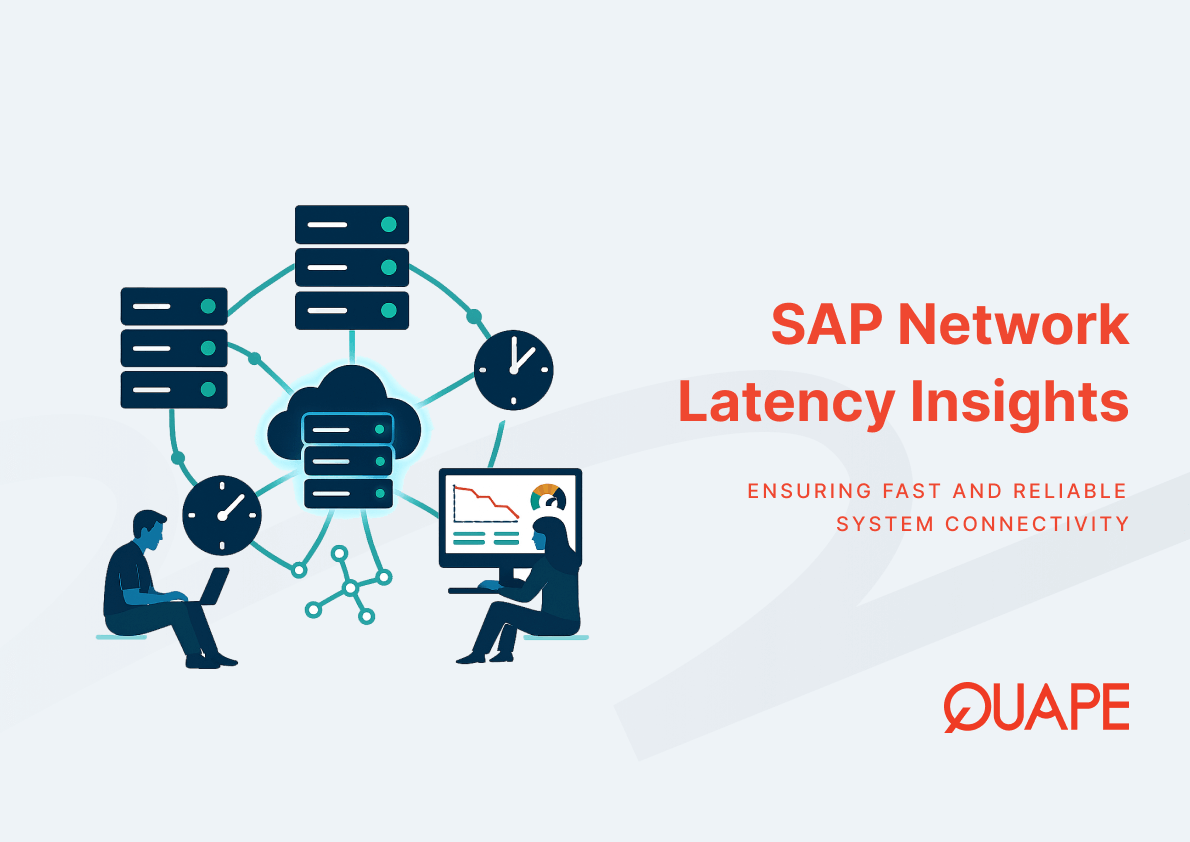
For businesses running SAP HANA in a hosted environment, network performance is not a background concern. It is a direct determinant of how fast your ERP responds, how reliably remote users connect, and whether real-time data processing actually delivers on its promise. Latency introduced by poor routing, weak carrier ecosystems, or suboptimal data center selection creates friction across every transactional workflow your business depends on. This article explains the network architecture decisions that shape SAP hosting performance, with particular relevance to businesses operating in Singapore and the wider ASEAN region. If your hosted SAP environment feels slower than expected, the answer is almost always in the network layer.
Introduction to SAP Hosting Latency
SAP hosting latency refers to the measurable delay introduced between a user action, or an application request, and the response returned by the SAP HANA database or application server. It is expressed in milliseconds and influenced by physical distance, routing path complexity, interconnection models, and the quality of the network infrastructure linking end users to the hosted environment.
For SAP workloads specifically, latency matters more than it does for most other enterprise applications. SAP HANA is optimized for in-memory, real-time processing, and that architectural strength is undermined whenever the network path introduces unpredictable delays. A well-configured SAP HANA instance sitting behind a poorly connected hosting environment will consistently underperform relative to its hardware capabilities.
Các doanh nghiệp đang đánh giá SAP hosting Singapore options should treat network architecture as a primary evaluation criterion, not a secondary specification to check after pricing and compute resources.
Những điểm chính
- Physical distance between users and the data center adds measurable, unavoidable latency. Geographic proximity to your user base is a foundational hosting selection criterion.
- Carrier-neutral data centers with dense peering ecosystems reduce routing complexity and lower latency by enabling direct traffic exchange between networks.
- Cross-connects provide private, direct links between infrastructure components within a data center, bypassing shared public network paths.
- MPLS routing delivers predictable latency and SLA-backed performance, while SD-WAN can approach similar performance levels with intelligent traffic policies across multiple transport links.
- Public internet paths introduce variable latency and packet loss that private or peered network paths do not. For SAP traffic, this distinction is operationally significant.
- Singapore’s position as a regional internet hub makes it a strong anchor for SAP hosting that serves ASEAN users, thanks to dense carrier ecosystems and IXP presence.
- Managed SAP hosting providers that operate within well-connected data centers remove the burden of network optimization from internal IT teams.
Key Components and Network Concepts Affecting SAP Hosting Latency
Physical Distance and Regional Proximity
Network packets travel at approximately the speed of light through fiber optic cable, but the physical path is never a straight line. Infrastructure routing, cable landing stations, and peering point locations all add distance. A commonly applied rule of thumb in network planning is roughly 10 milliseconds of round-trip latency per 1,000 kilometers of fiber. For Asia-Pacific deployments, this means a SAP HANA instance hosted in Singapore will respond measurably faster to users in Kuala Lumpur, Jakarta, or Manila than an equivalent instance hosted in Frankfurt or Sydney.
For SAP Business One deployments serving distributed teams across multiple ASEAN markets, the hosting location functions as the center of gravity for application response time. Moving that center closer to the majority of active users reduces round-trip time at the database layer, which compounds into faster screen loads, quicker report generation, and more responsive transactional workflows.
Data Center Carrier Ecosystems and Internet Exchange Presence
A carrier-neutral data center allows multiple ISPs, telecom carriers, and cloud providers to colocate and interconnect within the same facility. This concentration creates a dense peering ecosystem where network traffic can be exchanged directly between providers without traveling through expensive or circuitous transit paths. According to AIMS Data Centre insights, dense peering ecosystems in carrier-neutral data centers improve routing efficiency, lower latency, and reduce transit costs simultaneously.
Internet Exchange Points (IXPs) extend this principle at a regional or city-wide scale, allowing member networks to hand off traffic directly to one another. This reduces the number of network hops a packet must travel before reaching its destination and significantly improves local traffic exchange efficiency. At major IXPs like DE-CIX in Frankfurt, nearly 1,100 networks are interconnected, enabling high-volume traffic exchange with minimal routing overhead. Singapore operates similarly positioned exchanges that serve the ASEAN region with comparable density and reach.
Cross-Connects and Private Interconnection Models
A cross-connect is a direct physical or fiber link established between two parties within the same data center, typically between a hosting customer and a carrier, cloud provider, or network partner. It eliminates the need for traffic to exit the facility and traverse public network infrastructure before returning. According to DN.org, cross-connects create direct high-speed links within a data center, reducing latency and variability by bypassing shared public networks entirely.
For SAP hosting environments, cross-connects are particularly valuable when the hosted ERP must communicate with cloud services, financial platforms, or enterprise WAN connections. The latency reduction is not marginal. It translates into consistent, low-jitter communication that supports the deterministic performance SAP HANA workloads require. Private peering at the data center level provides a level of network stability that no public internet path can reliably match.
MPLS and SD-WAN Routing Behavior for SAP Traffic
MPLS (Multiprotocol Label Switching) has long been the enterprise standard for connecting branch offices to hosted applications with predictable performance. It provides tighter latency control, low jitter, and SLA guarantees that define acceptable performance thresholds. Within a country, MPLS latencies typically range from 20 to 40 milliseconds. Transcontinental paths may extend to 100 to 150 milliseconds, depending on routing topology.
SD-WAN has emerged as a cost-effective alternative capable of intelligent traffic steering across multiple transport links, including broadband internet, LTE, and MPLS. When configured with quality fiber paths and well-designed traffic policies, SD-WAN can reach latency levels that closely approach dedicated MPLS performance. Businesses evaluating SAP multicloud connectivity across hybrid infrastructure often deploy SD-WAN to balance cost efficiency and application performance across branch locations with varying connectivity options.
Public Internet vs Private Network Paths
Traffic routed across the public internet travels through multiple autonomous systems, each with its own congestion characteristics, routing policies, and maintenance windows. For most web browsing, this variability is invisible. For SAP HANA transactional workloads, it introduces unpredictable jitter and occasional packet loss that degrades application responsiveness in ways users notice immediately.
Private network paths, whether implemented through MPLS circuits, dedicated leased lines, or cross-connect arrangements, deliver consistent packet delivery and low variance latency. Businesses comparing SAP hosting vs on-premises deployments should assess not just compute and storage specifications, but the network architecture underpinning each model. A hosted SAP environment on a private network path frequently outperforms an on-premises deployment served by a congested or poorly managed enterprise internet connection.
Latency-Sensitive SAP Workloads and Operational Impact
Transactional Workloads and Real-Time Processing
SAP HANA’s columnar, in-memory database architecture is built to execute OLTP (Online Transaction Processing) workloads with sub-second response times. Every sales order entry, inventory update, or financial posting generates multiple database reads and writes, each of which depends on low-latency communication between the application layer and the database engine.
When hosting introduces network latency between these layers, the cumulative effect across hundreds of daily transactions is significant. A single database commit that should complete in under 10 milliseconds at the application layer may take 40 to 80 milliseconds when routed across a poorly connected path. Multiply that across concurrent users and high transaction volumes, and the performance gap becomes a business operations problem, not just a technical benchmark.
Remote User Access and Branch Connectivity
For organizations with branch offices or remote users connecting to a centrally hosted SAP environment, the network path from the end user to the hosted server directly determines their daily experience. Users connecting over VPN to SAP remote access security controls need reliable, low-latency connections that do not introduce session drops or authentication delays.
Branch connectivity depends on both the last-mile internet quality at the branch and the quality of the path from the branch ISP to the data center hosting the SAP instance. A carrier-neutral hosting facility with broad ISP peering supports shorter, more direct paths from a wider range of branch locations than a facility served by only one or two upstream carriers.
Practical Network Latency Considerations for the Singapore Market
Singapore’s infrastructure profile makes it one of the most favorable locations in Southeast Asia for hosting latency-sensitive enterprise applications. The city-state sits at the intersection of major submarine cable systems connecting Asia, Australia, the Middle East, and Europe. Its carrier-neutral data centers host dense collections of ISPs, regional cloud providers, and network operators, creating the peering depth that enterprise SAP workloads benefit from most.
For businesses with operations across ASEAN markets, a Singapore datacenter SAP deployment provides reasonable round-trip times to Bangkok, Kuala Lumpur, Jakarta, Manila, and Ho Chi Minh City. The routing efficiency enabled by Singapore’s IXP participation and carrier density shortens the effective network path to most major ASEAN destinations compared to hosting in less interconnected regional alternatives.
Các SAP hosting Singapore benefits extend beyond raw geography. The regulatory environment, data sovereignty considerations, and the availability of SAP-certified managed hosting providers combine to make Singapore a practical and technically sound anchor for regional ERP infrastructure.
Operational Dependencies: Availability, Recovery, and Network Design
Network latency considerations do not exist in isolation from availability and recovery architecture. A hosting environment optimized for low-latency primary operations must also account for what happens when a network link fails, a carrier experiences congestion, or a disaster recovery scenario activates.
SAP high availability configurations often depend on synchronous or near-synchronous database replication between nodes. High replication latency introduces lag between primary and secondary instances, increasing the risk of data loss in a failover scenario. Low-latency network paths between primary and secondary hosting sites are therefore not just a performance concern. They are a data integrity requirement.
Similarly, SAP disaster recovery planning must account for the network path quality between the production site and the recovery site. Recovery time objectives depend partly on how quickly data can be transferred and validated across that path. A network design that minimizes latency in normal operations also supports faster, cleaner recovery execution when it matters most.
How Managed SAP Hosting Improves SAP Hosting Latency Outcomes
Managed SAP hosting providers that operate within carrier-neutral, well-peered data center facilities remove many of the network optimization decisions from the customer’s hands. Instead of researching carrier ecosystems, cross-connect availability, and IXP participation independently, businesses rely on the hosting provider’s infrastructure choices to deliver consistent network performance within defined SLAs.
A well-structured managed hosting environment integrates private networking between the SAP application layer and database layer, eliminating the latency variability that public internet routing introduces between components. Performance SLAs define acceptable response time thresholds, and proactive monitoring detects degradation before it affects user experience. The managed model also supports predictable total cost of ownership, as private connectivity arrangements, cross-connect fees, and network engineering are absorbed into a consolidated service rather than managed as separate vendor relationships.
QUAPE’s Quản lý SAP Hosting is hosted in Singapore, supported by 24/7 monitoring, SAP-certified hardware, and private networking infrastructure designed to support the performance and availability requirements of business-critical ERP workloads.
Kết luận
Network latency shapes SAP hosting outcomes at every layer: how fast users interact with transactional workflows, how reliably branches connect to the central ERP, and how cleanly recovery procedures execute under pressure. Businesses that treat network architecture as a primary hosting criterion, rather than an afterthought, consistently achieve better application performance and lower operational friction. Singapore’s carrier density, IXP participation, and geographic position make it the most practical hosting anchor for SAP deployments serving ASEAN markets. Managed hosting within that environment converts complex network decisions into a defined, predictable service.
If your SAP environment is not performing to expectation, the network path is the right place to start the investigation. Contact the QUAPE sales team to discuss how our Managed SAP Hosting infrastructure addresses latency, connectivity, and performance at the architecture level.
Câu Hỏi Thường Gặp
What is SAP hosting latency and why does it matter? SAP hosting latency is the delay between a user action and the response returned by the SAP HANA database or application server, measured in milliseconds. It directly affects how fast transactional workflows complete, how responsive reports feel to users, and how reliably real-time processing operates. In high-volume ERP environments, even small latency increases compound significantly across concurrent users.
How does physical distance affect SAP hosting performance? Each additional kilometer of fiber between a user and the hosting environment adds to round-trip time. Network planners commonly estimate approximately 10 milliseconds of round-trip latency per 1,000 kilometers of fiber distance. For ASEAN businesses, this means a Singapore-hosted SAP environment will consistently outperform equivalently specified instances hosted in Europe or the US for users located in Southeast Asia.
What is a cross-connect and how does it benefit SAP deployments? A cross-connect is a direct physical link between two parties within the same data center, bypassing shared public network paths entirely. For SAP hosting, cross-connects reduce latency and jitter between the SAP application server, the HANA database, and external network carriers. The result is more consistent, lower-variance performance compared to routing traffic across public internet infrastructure.
What is the difference between MPLS and SD-WAN for SAP connectivity? MPLS provides dedicated, SLA-backed circuits with predictable latency and guaranteed packet delivery, traditionally the preferred choice for business-critical ERP connectivity. SD-WAN offers intelligent traffic steering across multiple transport links, including broadband internet, and can approach MPLS performance levels when configured with quality fiber paths and defined traffic policies. Many organizations deploy SD-WAN as a cost-effective complement to MPLS for branch connectivity.
Why is carrier-neutral data center selection important for SAP hosting? Carrier-neutral facilities allow multiple ISPs and network operators to interconnect within the same building, creating routing paths that reduce network hops and transit costs. For SAP hosting, this means shorter, more direct paths to a wider range of branch locations and end users. It also provides redundancy, since traffic can route through multiple carriers rather than depending on a single upstream provider.
How does Singapore’s infrastructure support low-latency SAP hosting for ASEAN operations? Singapore sits at the intersection of major submarine cable systems and hosts dense carrier peering ecosystems that shorten routing paths to destinations across Southeast Asia. Its IXP participation enables direct traffic exchange between member networks, reducing hops to major ASEAN cities. For businesses operating across multiple regional markets, a Singapore-based SAP hosting environment typically delivers the most balanced latency profile across the ASEAN footprint.
How does managed SAP hosting address network performance compared to self-managed infrastructure? A managed SAP hosting provider absorbs network architecture decisions, carrier selection, cross-connect arrangements, and performance monitoring into a single service layer. Customers receive defined SLAs that specify acceptable latency and availability thresholds, backed by proactive monitoring and private networking between infrastructure components. This removes the operational complexity of managing network performance independently while delivering consistent application responsiveness.

- Squarespace Alternative: Bespoke UI/UX Design that Converts High-Ticket Clients - Tháng 6 17, 2026
- Wix Alternative for Enterprises: Why You Need Custom Corporate Web Design - Tháng 6 16, 2026
- Dropbox Business Alternative: Avoid High User Licensing Fees with Private Nextcloud - Tháng 6 15, 2026