Selecting the right delivery model for WordPress conversion work has become one of the more consequential sourcing decisions facing Singapore IT leaders, procurement teams, and growing SMEs. The choice between building internal capacity and engaging external specialists now shapes delivery speed, security posture, and long-term maintenance cost in ways that were less visible a decade ago. Market data suggests this decision is no longer binary: according to the Deloitte Global Outsourcing Survey 2024, 70% of executives reported selectively insourcing work previously handled by third parties, while 80% still plan to maintain or increase investment in external partners. For teams converting Figma or PSD designs into production WordPress sites, the real question is not which model is cheaper, but which model aligns with governance maturity, technical ownership, and post-launch realities.
Defining the Core Entity
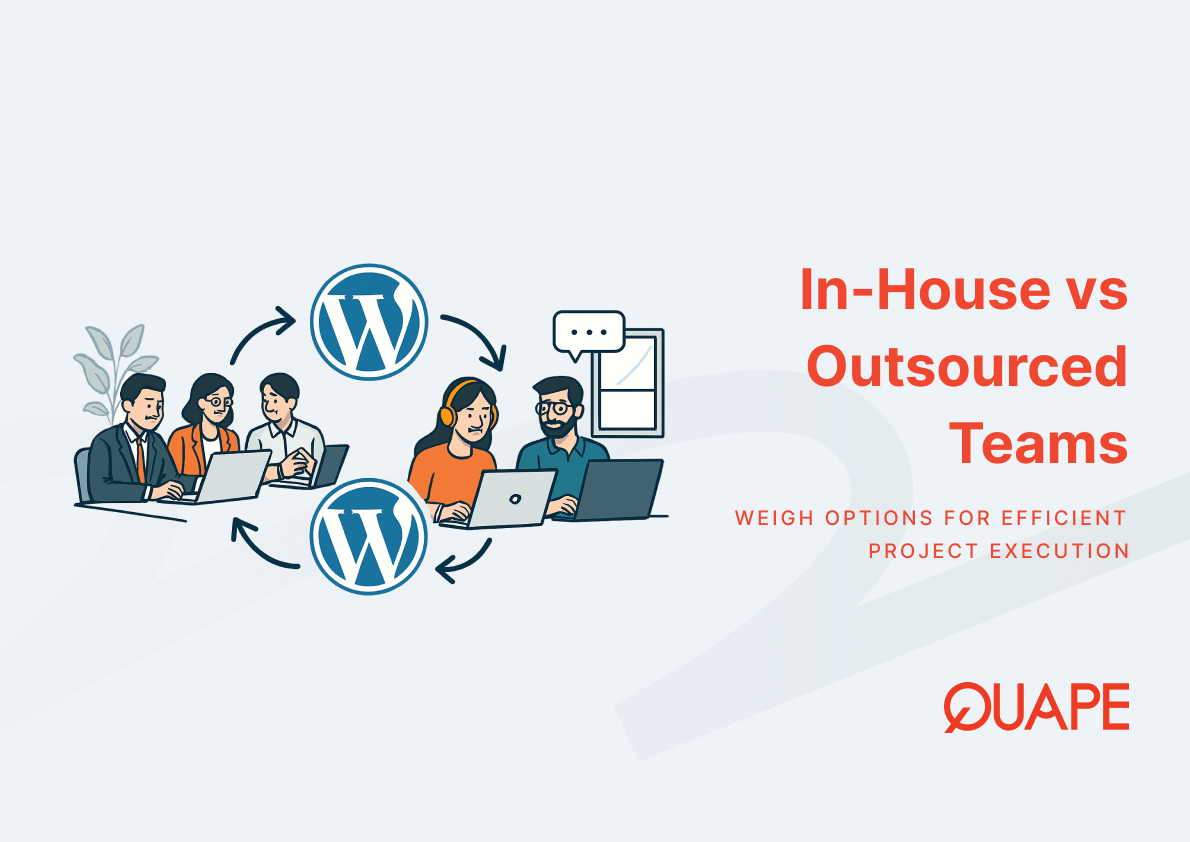
The comparison between in-house and outsourced WordPress conversion teams describes two structurally different ways of delivering the same outcome: translating a finalized visual design into a functional, responsive, maintainable WordPress site. An in-house team sits within the organization, shares institutional context, and owns the codebase continuously. An outsourced team operates under a contractual engagement, brings specialized conversion expertise, and typically follows a scoped delivery model defined by a project SLA. Neither model is inherently superior; each carries a different balance of control, flexibility, accountability, and cost structure.
要点总结
- Hybrid sourcing is replacing pure in-house and pure outsourced models, particularly for modular tasks like WordPress conversion.
- Vendor governance maturity predicts outsourcing success more reliably than the decision to outsource itself.
- Weak project SLAs and unclear QA ownership drive rework cycles that erode expected cost savings.
- Freelance marketplaces offer speed and flexibility but distribute accountability across multiple parties.
- Post-launch support arrangements determine whether faster launches translate into lower total cost of ownership.
- Singapore SMEs operate within a digital economy where 95.1% have adopted at least one digital capability, raising the stakes on implementation partner selection.
- Security and PDPA considerations make third-party oversight a core part of procurement, not an afterthought.
Introduction to In-House vs Outsourced WordPress Teams
An in-house development team integrates with internal product, design, and operations functions, which supports deeper technical ownership but raises fixed staffing overhead. An outsourced WordPress agency operates on a defined engagement model, bringing scalable capacity without adding headcount. Vendor selection criteria sit at the center of this decision, since the right choice depends on resource allocation constraints, project complexity, and the organization’s existing delivery maturity. Teams evaluating conversion work often benefit from reviewing a structured end-to-end conversion methodology before committing to a sourcing model, because the delivery approach should match the project’s technical demands rather than default assumptions about cost.
The WordPress delivery model chosen influences how decisions flow between stakeholders. Internal teams tend to align naturally with product roadmaps because they share daily context with business owners. Outsourced teams compensate for this distance through structured reporting, contractual checkpoints, and defined escalation paths. When these mechanisms are well designed, outsourced delivery can match or exceed in-house velocity for bounded scopes like design-to-theme conversion.
Key Components and Decision Factors in In-House vs Outsourced WordPress Models
Comparing Internal Team Control vs External Agency Workflow
Agency workflow differs from internal team workflow primarily in how governance is structured. An internal team typically operates inside a shared governance model where sprint ownership, development oversight, and stakeholder communication happen informally through daily interaction. An external agency replaces this informal flow with documented processes: kickoff briefs, sprint demos, and formal acceptance criteria. This structure can actually improve delivery clarity, especially when internal teams lack established rituals for conversion projects.
The relationship between process maturity and output quality matters more than team location. A well-run agency with mature QA gates often produces more consistent results than an internal team without standardized review procedures. Organizations focused on visual fidelity should evaluate how each model enforces design consistency across breakpoints and how it handles component-level design system governance. When internal teams lack these disciplines, outsourcing often improves quality rather than reducing it.
Evaluating Freelance Marketplace vs Structured Delivery Partners
Freelance marketplaces offer fast access to individual specialists but introduce a different accountability profile than managed service models. Contractor risk rises when a single freelancer holds isolated knowledge of the build, because project continuity depends on that individual remaining available. Structured delivery partners distribute this risk across teams, maintain documentation, and assign backup resources when needed. Research on freelance software delivery indicates that security and quality responsibility often gets distributed ambiguously across clients, contractors, and platforms, which complicates accountability when issues emerge.
Procurement leads evaluating these options should weigh immediate cost savings against continuity risk. A freelancer engagement may close faster and at a lower sticker price, but a managed partner typically offers clearer recourse when defects surface months after launch. Teams planning multi-year digital roadmaps benefit from understanding the evolving trajectory of conversion delivery models, since today’s procurement choice shapes tomorrow’s maintenance burden.
Project SLA and Delivery Timeframe Considerations
A project SLA defines the mechanical reality of a delivery engagement: milestone predictability, turnaround models, scope control, and remedies when timelines slip. In-house teams rarely operate under formal SLAs, which provides flexibility but can obscure accountability when projects stall. Outsourced engagements convert expectations into contractual language, which forces clarity about what “done” actually means. This clarity becomes particularly valuable for Figma-to-WordPress conversions, where scope creep around responsive breakpoints and custom interactions regularly extends timelines.
Delivery timeframe should be evaluated alongside total cost rather than in isolation. A faster build that requires extensive rework costs more than a slightly slower build delivered correctly the first time. Organizations benchmarking engagement pricing can reference typical conversion cost structures in the Singapore market to calibrate expectations before requesting proposals.
Quality Assurance Ownership Across Team Models
Quality assurance sits at the intersection of process and accountability. Internal teams often rely on peer review and developer self-testing, which can work well when engineering culture supports it but breaks down under deadline pressure. Outsourced teams typically implement staged QA gates: unit validation, cross-browser testing, responsive verification, and deployment validation. The presence of these gates, rather than the location of the team executing them, determines whether defects reach production.
Bug escalation paths differ meaningfully between models. An internal team can patch issues quickly because the developer, tester, and site owner often share the same workspace. An outsourced team needs defined escalation channels to match that responsiveness, which makes SLA terms around post-deployment fixes important. Teams prioritizing visual accuracy should confirm how each model handles pixel-level conversion validation, and those prioritizing performance should review theme speed and SEO optimization standards as part of acceptance criteria.
Post-Launch Support and Long-Term Maintenance Responsibility
Post-launch support is where many outsourcing engagements either prove their value or reveal hidden costs. A maintenance retainer clarifies who handles plugin updates, security patches, and performance monitoring after handover. Without this clarity, faster launches often produce higher downstream expenses because nobody owns the operational layer. Update governance becomes particularly important for WordPress sites, where plugin ecosystems evolve continuously and out-of-date components create security exposure.
The cybersecurity dimension of this decision has grown sharper. The World Economic Forum’s Global Cybersecurity Outlook 2026 found that 65% of large organizations consider third-party and supply-chain vulnerabilities their greatest cyber resilience challenge, which directly affects how vendor oversight should be structured for outsourced WordPress work. Organizations planning long-term operations benefit from aligning their delivery partner with their hosting and operational infrastructure, and from understanding how that partner supports ongoing WordPress security governance.
Practical Application for Singapore Procurement and Technical Teams
Singapore vendor evaluation differs from global procurement patterns because of local compliance obligations and the concentration of SMEs pursuing digital transformation. PDPA compliance shapes data handling requirements across the delivery lifecycle, which means any external team touching production data must operate under clear data processing terms. Enterprise WordPress governance frameworks need to accommodate these obligations without slowing down conversion timelines. CTOs evaluating partners should confirm alignment with PDPA and ISO compliance practices, and SMEs weighing the business case can review market-specific advantages of structured conversion engagements.
When In-House Teams Are Better Suited
Internal capability maturity is the strongest argument for in-house delivery. When an organization already maintains experienced WordPress engineers, documented coding standards, and established QA workflows, keeping conversion work internal reduces coordination overhead. Technical debt control also favors in-house teams in environments with highly proprietary workflows, complex integrations with internal systems, or codebases that require deep institutional knowledge to modify safely. Engineering capacity matters here: if the team has bandwidth without displacing other priorities, internal delivery preserves continuity.
When Outsourced Conversion Teams Create Strategic Advantage
Specialist outsourcing creates strategic advantage when the conversion work is bounded, timeline-sensitive, or requires expertise the internal team does not maintain regularly. Scalable delivery matters for organizations facing campaign-driven launches, multiple simultaneous site builds, or sudden capacity demands. External expertise leverage also helps when local requirements, such as Singapore-specific SEO and UX considerations, sit outside the internal team’s day-to-day focus. Faster implementation becomes genuinely valuable when the organization’s competitive position depends on launch timing rather than incremental feature development.
How Figma/PSD to WordPress Supports Better Outsourcing Decisions
A structured Figma/PSD to WordPress service addresses the main risks that make outsourcing decisions complex. Pixel-perfect conversion removes the quality variance that commonly appears in freelance engagements, while responsive development ensures consistent behavior across devices without requiring internal QA to catch breakpoint defects. SEO-friendly structure embeds technical best practices at the theme level, which reduces remediation work after launch. Custom WordPress functionality is handled through defined scope rather than open-ended requests, which keeps delivery predictable.
Using Structured Conversion Services to Reduce Vendor Risk
Conversion quality assurance becomes repeatable when the delivery partner works within standardized workflows rather than ad-hoc processes. Framework specialization matters here, because teams fluent in specific builders deliver faster and with fewer defects than generalists. Organizations weighing builder choices can compare conversion approaches across major WordPress frameworks and review the tooling that supports reliable handoffs between design and development.
结论
The in-house versus outsourced decision for WordPress conversion is rarely resolved by choosing one model exclusively. The organizations getting the best outcomes in Singapore are aligning sourcing strategy with governance maturity, selecting partners based on process rigor rather than sticker price, and building post-launch support into procurement from the start. If your team is planning a Figma or PSD to WordPress project and wants a conversion partner who can meet Singapore’s delivery and compliance expectations, reach out to discuss your requirements with Quape’s team.
常见问题 (FAQ)
Is outsourcing WordPress conversion always cheaper than building in-house?
No. Outsourcing can be cheaper for bounded, specialized projects, but total cost rises quickly when rework, scope changes, and post-launch fixes are included. In-house teams often appear more expensive on paper but retain institutional knowledge that reduces long-term maintenance costs.
What is the biggest risk of using a freelance marketplace for WordPress conversion?
Accountability fragmentation. When issues surface after launch, responsibility can be unclear between the freelancer, the platform, and the client, which complicates remediation. Structured delivery partners typically offer clearer recourse through contractual terms and dedicated support channels.
How should Singapore SMEs evaluate WordPress conversion vendors?
Evaluate process maturity, PDPA alignment, QA workflow, and post-launch support arrangements before comparing prices. Singapore’s digital economy now represents a meaningful share of GDP, so vendor selection shapes operational resilience beyond the immediate project.
Do in-house teams produce higher quality WordPress sites than outsourced teams?
Not automatically. Quality depends on process discipline, QA ownership, and review standards rather than team location. Mature external agencies often outperform under-resourced internal teams for conversion-specific work.
What project SLA terms matter most for WordPress conversion engagements?
Milestone definitions, acceptance criteria, revision scope, bug remediation windows, and post-launch support terms. These items protect against scope creep and clarify what happens when defects appear after handover.
How does cybersecurity affect the outsourcing decision?
Third-party code and external contributors expand the attack surface, which is why large organizations now cite supply-chain vulnerabilities as a top concern. Vendor oversight, secure development practices, and clear update governance should be confirmed before engagement.
When should a hybrid model be considered?
A hybrid model works well when an internal team handles strategy, product ownership, and complex integrations while an external partner executes bounded conversion work. This structure preserves institutional knowledge while accessing specialized delivery capacity on demand.
Does outsourcing WordPress conversion work for long-term maintenance too?
It can, provided the engagement includes a maintenance retainer with defined scope, response times, and update governance. Without these terms, post-launch support becomes reactive and expensive.