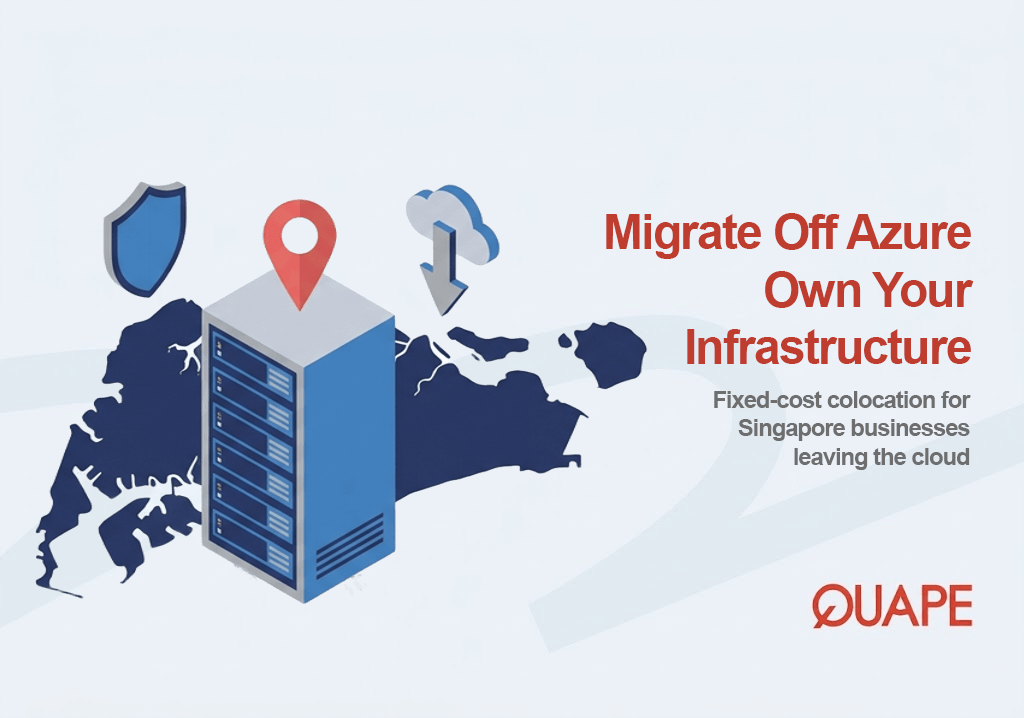
If your organisation has been running production workloads on Microsoft Azure and your monthly infrastructure bill no longer matches your forecast, you are not alone. Singapore-based IT managers and infrastructure teams are increasingly questioning whether a public cloud model designed for elasticity is the right long-term fit for stable, predictable business operations. For regulated industries including finance, healthcare, logistics, and professional services, data residency accountability under Singapore’s Personal Data Protection Act (PDPA) adds a layer of governance complexity that multi-region cloud routing does not simplify. This article is for decision-makers who already own or plan to own physical servers and want to understand whether colocation infrastructure in Singapore offers a more cost-predictable, operationally transparent alternative to Azure for their specific workload profile. The answer depends on your workloads, and this article helps you reason through that clearly.
Why Singapore businesses are reconsidering Azure for long-term infrastructure planning
Microsoft Azure entered the Singapore market as a genuinely compelling solution: global reach, deep integration with the Microsoft ecosystem, and the ability to spin up compute resources within minutes. For businesses that needed to scale fast and avoid capital expenditure, it delivered exactly what it promised. The problem rarely surfaces during growth phases. It tends to appear once workloads stabilise, teams start reviewing quarterly IT spend, or compliance officers begin asking where customer data is physically processed.
Singapore consistently ranks among the most strategic data centre locations in the Asia-Pacific region, supported by extensive subsea cable infrastructure, political stability, and a mature regulatory environment. That positioning makes local infrastructure options increasingly viable for businesses that want to keep operations close to home. According to IDC, enterprises are increasingly pursuing workload repatriation to improve long-term infrastructure economics and governance, driven not by dissatisfaction with cloud technology itself but by the recognition that some workloads simply do not benefit from elastic pricing models over the long run.
What Azure still does well for fast-growing and cloud-native teams
Rapid provisioning and global scalability for distributed workloads
Azure’s ability to provision virtual machines, managed databases, and container environments within minutes is genuinely difficult to replicate with physical infrastructure. For businesses that need to deploy services across multiple geographies simultaneously, or that experience unpredictable seasonal demand spikes, the on-demand compute model reduces time-to-market significantly. Development teams working with CI/CD pipelines and automated deployment workflows benefit from the tight integration between Azure DevOps, container registries, and compute environments.
Strong ecosystem integration with Microsoft business software
Organisations already running Microsoft 365, Active Directory, and Teams benefit from native identity federation, single sign-on capabilities, and deeply integrated security tooling across the Microsoft stack. Azure Active Directory integrates with thousands of SaaS applications, and hybrid cloud architectures that connect on-premise Active Directory to Azure AD are well-documented and widely supported. For businesses where the Microsoft ecosystem is central to daily operations, keeping at least some workloads on Azure reduces integration overhead considerably.
Where Azure remains a strong fit compared to physical infrastructure
Cloud-native applications built around managed services, auto-scaling policies, and serverless functions gain the most from staying on Azure. Burst workloads with unpredictable traffic patterns benefit from elastic compute that colocation cannot replicate without overprovisioning. DevOps environments that require frequent resource creation and teardown, SaaS applications with globally distributed user bases, and teams that rely on managed databases with automatic failover are all cases where Azure’s abstraction layers genuinely reduce operational burden. Colocation is not the answer for every workload, and a sound infrastructure strategy recognises that distinction.
The cost predictability problem many Singapore SMEs encounter on Azure
Why consumption-based billing becomes difficult to forecast over time
Azure charges on a consumption-based model where compute, storage, egress traffic, and licensing costs compound month on month, making long-term budget forecasting difficult for SMEs. What begins as a manageable monthly commitment often expands as storage grows, as backup retention policies accumulate data, and as teams add services incrementally without a central cost governance process. According to Flexera’s State of the Cloud report, 82% of enterprises identify managing cloud spend as their top cloud challenge, and approximately 28% of public cloud spending is wasted through overprovisioning and underutilised resources. Gartner has also noted that organisations consistently underestimate ongoing cloud operational costs due to limited visibility into networking, storage, and workload scaling consumption.
How traffic spikes and scaling events affect operational budgets
Autoscaling is one of Azure’s most promoted capabilities. It is also one of the primary drivers of bill unpredictability. When a campaign, a product launch, or an unexpected news event drives traffic spikes, compute and bandwidth consumption scales automatically and charges follow proportionally. Data egress fees have become a major contributor to unexpected cloud spending for enterprises managing high-volume traffic workloads, as covered extensively by infrastructure analysts at The Register. For Singapore businesses with relatively stable user bases and predictable traffic patterns, paying for elastic headroom that rarely gets used is a structural inefficiency in the pricing model.
Why fixed colocation pricing appeals to cost-sensitive infrastructure teams
Quape的 colocation server plans in Singapore start from SGD 280 per month for a 1U rack space, with fixed allocations for bandwidth, power, and IPv4 addresses. There are no egress fees, no surprise billing cycles, and no tier upgrades pushed through vendor upselling. Infrastructure teams working within defined annual budgets can forecast colocation costs with precision because the pricing model is transparent and fixed regardless of traffic fluctuations. For businesses that have already purchased physical servers and are carrying the capital cost, colocation converts those assets into a predictable operating cost rather than a liability sitting in a server room with unreliable power and consumer-grade connectivity.
Data sovereignty and PDPA concerns with multi-region cloud infrastructure
Why physical data location matters for regulated Singapore businesses
Singapore’s Personal Data Protection Act does not impose a blanket prohibition on overseas data transfers, but it does require organisations to ensure comparable protection standards are in place when personal data leaves Singapore. For businesses in financial services, healthcare, and logistics, that accountability extends to understanding precisely where data is processed, who has access to it, and under what legal jurisdiction infrastructure operations occur. Uncertainty around those questions creates compliance risk, not because cloud providers are negligent, but because the shared responsibility model of public cloud diffuses accountability across provider policies that organisations do not directly control.
The operational ambiguity of shared global cloud routing
Azure operates on a shared global cloud infrastructure where workloads sit alongside millions of other tenants, and regional routing decisions are made by the platform to optimise performance and resource utilisation. For most applications this is operationally invisible. For organisations subject to audit requirements, data residency attestation, or sector-specific regulatory frameworks, the inability to assert with full certainty where data transits during processing creates documentation challenges. Multi-tenant environments are designed for scalability, not for infrastructure transparency, and those priorities do not always align with governance requirements in regulated Singapore industries.
How Singapore-based colocation improves infrastructure accountability
Quape’s colocation facility holds TIA 942 Rated 3 (Tier 3) certification, an internationally recognised standard covering redundancy, cabling, physical security, and resilience requirements for data centres. When a business houses its servers in that facility, it retains full ownership of the hardware and the data stored on it. There is no dependency on a third-party hyperscaler’s compliance posture or policy changes. Regulated organisations can audit physical access logs, document exactly where servers reside, and satisfy compliance requirements with a level of infrastructure specificity that shared cloud environments do not provide by default. Singapore’s position as a premier connectivity hub also ensures that colocated infrastructure benefits from the same high-speed, multi-homed network access that makes the country attractive to hyperscale cloud providers in the first place.
Dedicated hardware control vs vendor dependency
The long-term operational risks of cloud vendor lock-in
Cloud dependency deepens gradually and often invisibly. Teams adopt managed databases with proprietary query extensions. Applications begin calling platform-specific APIs. Monitoring and alerting pipelines integrate with native tooling. Each integration delivers real operational value in isolation, but collectively they increase migration complexity over time. The OECD has identified vendor lock-in as one of the top structural concerns among enterprises adopting hyperscale cloud environments precisely because migration costs grow as workloads become more tightly coupled to provider-specific services. For Singapore SMEs operating with lean IT teams, the prospect of migrating a tightly integrated Azure environment represents a project of significant time, cost, and risk.
Why some businesses prefer owning their own hardware stack
Bare metal server ownership offers a form of operational clarity that managed cloud services deliberately abstract away. Infrastructure teams that understand their hardware know its performance envelope, its failure modes, and its lifecycle. Server lifecycle management, capacity planning, and security patching remain within the organisation’s direct control. For businesses that have already made capital investments in server hardware, colocation enables those assets to operate within professional data centre infrastructure rather than being retired prematurely in favour of recurring cloud consumption charges.
Scaling from 1U racks to full private racks without rearchitecting workloads
Quape’s colocation tiers progress from a single 1U rack space to a full 42U dedicated private rack, supporting infrastructure growth without requiring teams to redesign how their applications are built or deployed. A business starting with two or three physical servers can begin with a 2U or 5U plan and expand to a 10U, 20U half rack, or full 42U private rack as hardware requirements grow. That path does not involve renegotiating cloud contracts, migrating between service tiers, or adapting application architecture to fit a new platform. The hardware stack remains the same. Only the physical footprint in the Singapore data centre facility changes.
Azure vs Singapore colocation: comparing real operational priorities
| Priority | Azure | Quape Colocation |
| Billing model | Consumption-based, variable monthly cost | Fixed monthly pricing from SGD 280 |
| Egress fees | Applies, scales with traffic volume | No egress fees |
| Hardware ownership | Provider-owned, abstracted | Customer-owned, physically housed in facility |
| Data residency | Multi-region routing, shared infrastructure | Physical Singapore location, dedicated rack |
| Uptime standard | SLA-based per service | 99.9% uptime, 99.99% power availability (TIA 942 Rated 3) |
| Infrastructure access | API and portal-based management | Authorised physical access, 24/7 monitoring |
| 可扩展性 | Instant elastic compute | 1U to 42U dedicated rack, hardware-based scaling |
| PDPA compliance fit | Shared responsibility model | Full hardware and data ownership accountability |
| Vendor lock-in risk | High with deep platform integration | None: bring your own hardware and stack |
Which businesses benefit most from moving away from Azure
SMEs with stable workloads and predictable resource usage
Businesses running database servers, ERP systems, internal business applications, and backup infrastructure on consistent utilisation patterns gain very little from elastic cloud pricing. These workloads consume roughly the same compute and bandwidth week after week, which means they are effectively paying for reserved capacity at consumption pricing rates. For that profile, fixed colocation costs are structurally more efficient.
Businesses operating under strict compliance or customer data policies
Singapore’s Infocomm Media Development Authority identifies data centres as critical national digital infrastructure specifically because of their role in supporting financial services, healthcare, and logistics industries. Organisations in those sectors are increasingly required to document infrastructure provenance, maintain audit trails for data access, and demonstrate regulatory compliance through evidence that shared cloud environments make difficult to produce with precision. Physical infrastructure ownership within a certified Singapore facility simplifies that documentation considerably.
Organisations already managing physical servers internally
A business running servers in an office environment is absorbing costs it often does not measure: unstable power, inadequate cooling, consumer-grade internet connectivity with high contention ratios, and the operational distraction of managing physical hardware in a space not designed for it. Moving those servers into a professional colocation facility removes those variables without changing the underlying software stack or operational workflows.
Teams seeking operational control without hyperscaler complexity
Lean IT teams that prefer direct infrastructure visibility over platform abstraction often find that managed cloud services introduce troubleshooting layers that slow incident response. When hardware behaviour is known and access is direct, operational clarity improves. Colocation provides professional facility management around a hardware stack that the organisation controls entirely, without the learning curve of a proprietary cloud management plane.
Planning a secure Azure-to-colocation migration in Singapore
Assessing which workloads should remain in cloud environments
A thoughtful migration strategy does not involve moving everything out of Azure at once. Hybrid infrastructure approaches are increasingly common precisely because different workload types have genuinely different infrastructure requirements. Latency-sensitive customer-facing applications, globally distributed services, and DevOps toolchains with elastic compute needs often belong in cloud environments. The decision to repatriate should be made at the workload level, not at the platform level. IBM Institute for Business Value research confirms that hybrid cloud adoption is frequently driven by regulatory requirements, workload predictability, and latency considerations rather than purely technical preference.
Identifying workloads better suited for dedicated colocation infrastructure
Database servers with stable query volumes, ERP platforms with predictable concurrent user counts, internal file and collaboration infrastructure, and backup systems with defined retention policies are all strong candidates for colocation. These workloads have known resource profiles, they benefit from dedicated hardware performance rather than shared compute, and they accumulate significant ongoing cost under consumption-based pricing without generating proportional business value from cloud elasticity.
Infrastructure considerations before migrating out of Azure
Before committing rack space, infrastructure teams should map current bandwidth consumption patterns to ensure colocation tier allocations cover peak operational requirements. Power allocation needs to account for all physical hardware including networking equipment. Disaster recovery planning should address how backup and failover strategies change when moving from cloud-native replication to hardware-based approaches. Quape offers managed equipment services, allowing businesses that prefer additional operational support to retain direct hardware ownership while delegating day-to-day monitoring and management to the colocation team.
Choosing a Singapore infrastructure strategy that balances cost, control, and reliability
The debate between Azure and colocation is not a binary choice between modern and legacy infrastructure. It is a question of which model best fits the operational and financial profile of specific workloads within a specific regulatory context. Singapore businesses in regulated industries with stable, predictable compute needs, existing hardware investments, and clear accountability requirements under PDPA have strong structural reasons to evaluate whether dedicated colocation infrastructure delivers better long-term value than consumption-based cloud spending.
When Azure remains the better option
If your workloads are genuinely cloud-native, if your team scales globally, or if your business depends on rapid provisioning and tight Microsoft ecosystem integration, Azure continues to be the more operationally efficient platform. Businesses with volatile traffic patterns, early-stage growth phases, or internationally distributed operations should not view colocation as a wholesale replacement for cloud infrastructure.
When colocation becomes the more strategic long-term choice
When infrastructure costs have become unpredictable, when compliance accountability requires physical clarity over data location, when existing hardware assets are underutilised, or when operational teams prefer direct visibility over platform abstraction, a Singapore-based colocation environment addresses each of those concerns within a fixed and transparent cost model. The TIA 942 Rated 3 certification, 99.9% uptime, and 99.99% power availability that Quape’s facility delivers ensures that moving off Azure does not mean accepting lower infrastructure standards.
For Singapore businesses evaluating whether their Azure workloads belong on dedicated infrastructure, the clearest next step is to map your current workload profile against the cost and governance criteria outlined here. Quape’s team can help you assess rack requirements, bandwidth planning, and migration scope.
Frequently asked questions
Is colocation actually cheaper than running workloads on Azure?
It depends entirely on workload predictability and utilisation patterns. For stable, consistently used infrastructure such as ERP systems, databases, and internal applications, fixed colocation pricing typically delivers better long-term economics than consumption-based cloud billing. For elastic workloads with unpredictable demand, cloud pricing often remains more cost-efficient because you only pay for what you use.
Does moving to colocation mean giving up cloud flexibility entirely?
Not at all. Most organisations adopting colocation use a hybrid approach, keeping cloud-native and burst-capacity workloads on platforms like Azure while moving stable, hardware-bound workloads to dedicated colocation. The two models are complementary rather than mutually exclusive.
Does PDPA require all data to be stored physically inside Singapore?
PDPA does not mandate that all personal data remain physically within Singapore, but it does require organisations to ensure comparable protection standards apply when data is transferred overseas. For businesses in regulated sectors with strict governance requirements, keeping data physically in Singapore removes ambiguity and simplifies compliance documentation rather than satisfying a strict legal mandate.
What is TIA 942 Rated 3 certification and why does it matter?
TIA-942 is an internationally recognised data centre design standard covering redundancy, physical security, cabling infrastructure, and operational resilience. A Rated 3 (Tier 3) facility provides at least 99.9% uptime and 99.99% power availability through concurrent-maintainable infrastructure. For businesses migrating servers out of an office environment, certification provides independently validated assurance that physical infrastructure meets professional data centre standards.
When is Azure still the better choice over Quape colocation?
Azure remains the stronger option for cloud-native applications, globally distributed services, rapid provisioning use cases, and organisations that are deeply integrated into the Microsoft ecosystem and benefit daily from that integration. If your workloads are elastic by design, early-stage, or globally distributed, the overhead of managing physical hardware in a colocation facility likely outweighs the cost savings for your specific scenario.
Can Quape manage my servers at the colocation facility?
Yes. Quape offers managed equipment services covering hardware monitoring, software management, and backup provisions. Businesses that want to retain physical hardware ownership without fully managing day-to-day operations can delegate facility-level management while keeping full administrative control over their server environments.
How do I decide which workloads to migrate out of Azure first?
Start by identifying workloads with stable and predictable resource consumption: databases, ERP systems, internal applications, and backup infrastructure. These generate consistent cloud costs without benefiting from elastic pricing, making them the strongest candidates for colocation. Latency-sensitive customer applications and anything relying on cloud-native managed services or global distribution should be evaluated separately as part of a hybrid strategy.
What rack sizes does Quape offer and how do I choose the right one?
Quape offers plans from 1U rack space (SGD 280/month) through to a full 42U dedicated private rack (SGD 2,200/month), with 2U, 5U, 10U, and 20U half-rack options between. The right plan depends on the number of physical servers you are migrating, their power draw, and your bandwidth requirements. Quape’s team can assist with rack sizing as part of the migration planning process.