Singapore law firms increasingly face client due diligence questionnaires asking exactly where privileged matter files physically sit and who can legally compel access to them. Google Drive remains a productive workplace tool for general collaboration, yet its data region controls do not include Singapore as a primary residency option, and the underlying infrastructure sits with a US-headquartered provider subject to US legal process.
For firms handling Singapore-seated arbitration, cross-border M&A, or sensitive investigations, a self-hosted Nextcloud instance running on a Singapore-resident VPS provides a defensible answer to those questions without requiring the firm to forfeit modern file sync and collaboration features. This article compares the two approaches across data residency, jurisdictional control, configurability, and operating cost, and identifies which type of firm is best served by each. The specific scenario where Quape outperforms Google Drive is the small to mid-sized Singapore practice that needs physical Singapore data residency, firm-controlled encryption and audit logs, and a predictable SGD-denominated operating cost.
Google Drive earned its place in legal operations honestly. The product compresses turnaround time on transactional matters through real-time collaborative editing, captures revisions automatically for the kind of paper trail legal teams rely on, and reduces context switching by integrating with Gmail and Calendar. Most lawyers entering the workforce today have used Google Docs since university, which makes onboarding nearly frictionless. For a firm whose work is primarily general advisory in nature, those product strengths are real and worth weighing.
What has shifted is the texture of client expectations. Clients now ask infrastructure questions that used to live inside in-house IT departments: where are our files stored, who operates the data centre, what legal jurisdiction governs access. A self-hosted Nextcloud running on a Singapore-resident VPS answers those questions with specificity. The firm receives full root access to a private virtual server provisioned inside a Singapore Tier 3 TIA-942 certified data centre, owned and operated by a Singapore-incorporated entity accountable under the PDPA. Quape positions itself in that scenario, not as a blanket replacement for Google Drive across every firm.
Key takeaways
- Google Drive remains a strong fit for sole practitioners and small firms whose client base does not raise infrastructure governance questions during onboarding.
- Google Workspace data region controls cover the United States and the European Union, but Singapore is not currently available as a primary data residency region.
- The US CLOUD Act extends US legal process to data held by US-headquartered providers regardless of which region the customer selects.
- A self-hosted Nextcloud on a Quape VPS gives the firm root access, firm-controlled encryption keys, and complete audit logs inside a Singapore Tier 3 facility.
- Quape Pte Ltd is a Singapore-incorporated entity accountable under the PDPA, which removes the foreign-parent ambiguity during client audits.
- A VPS SG-Pro plan at SGD 80 per month provides 6 vCPU, 12GB RAM, and 150GB NVMe SSD storage, sufficient for a small to mid-sized firm with room to grow.
- The trade-off is operational: the VPS approach asks the firm or its IT consultant to take on a defined management role in exchange for genuine sovereignty over the file sharing stack.
Why Singapore Law Firms Are Reassessing Google Drive for Privileged Matter Files
Law firms in Singapore have spent the past decade migrating matter files, client correspondence, and deal documentation onto cloud productivity suites because the operational gains were significant. Real-time collaboration on a draft contract, instant link sharing with co-counsel, and reliable mobile access reshaped how teams work across time zones. The conversation has shifted recently, however, because clients now ask infrastructure questions that were once reserved for in-house IT departments. Where are our files stored. Who operates the data centre. What legal jurisdictions could compel disclosure. These questions appear with growing frequency in client due diligence questionnaires, particularly for matters involving Singapore-seated arbitration or cross-border M&A where counterparties want demonstrable governance over sensitive deal documents.
Google Drive is not a poor product. The challenge is that its design optimizes for scale and convenience across a global customer base, while the questions Singapore law firms are now answering require infrastructure specificity that a hyperscale managed service was not architected to provide.
What Google Drive Does Well for Legal Collaboration
Google Drive earned its position in legal operations through genuine product strengths. The integration with Google Docs enables multiple lawyers and paralegals to edit a single contract draft simultaneously without merge conflicts, which compresses turnaround time on transactional matters. Version history captures every change automatically, supporting the kind of paper trail that legal teams rely on for internal review and client audit purposes. The mobile applications work cleanly, search across documents is responsive, and the integration with Gmail and Calendar reduces context switching for fee-earners juggling multiple matters.
Fast Deployment Without Infrastructure Management
A small firm can subscribe to Google Workspace on a Friday and have its entire team operating inside the suite by Monday. There is no server provisioning, no storage capacity planning, and no operating system patching to coordinate. Google’s engineering teams handle availability, scaling, and platform security continuously, which removes a substantial operational burden from firms that do not have a dedicated IT lead or systems administrator on staff. For boutique practices focused on legal work rather than infrastructure, this trade-off has clear value.
Familiar Workflows for Lawyers, Paralegals, and Support Staff
Most lawyers entering the workforce today have used Google Docs since university, which means the onboarding curve for new joiners is minimal. Matter management workflows built around shared drives, folder permissions, and link-based sharing are easily understood by support staff, and external counsel or clients can be added to specific folders without complex provisioning. That familiarity is itself a meaningful productivity asset.
Where Google Drive Creates Challenges for Firms Handling Sensitive Legal Work
The same architectural choices that make Google Drive frictionless also create governance questions when the documents in question carry legal privilege or contain commercially sensitive information that could move markets. The product is built for breadth, not for the narrow, high-assurance requirements of legal custody.
The Singapore Data Residency Question During Client Audits
Google Workspace offers data region controls that allow administrators to pin data to either the United States or the European Union, but Singapore is not currently available as a primary data residency region. For a Singapore law firm whose client base includes regulated financial institutions or sovereign-linked entities, this gap matters during compliance reviews. Singapore’s Personal Data Protection Act under Section 26 of the PDPA requires organisations transferring personal data outside Singapore to ensure that the recipient provides a standard of protection comparable to the PDPA itself. The transfer is not prohibited, but the firm carries the burden of demonstrating that comparable protection exists, which becomes a documentation exercise during every client audit cycle.
Limited Control Over the Underlying Storage, Audit, and Encryption Environment
Google Drive is a managed product, meaning the firm has no access to the underlying servers, cannot inspect what runs on them, and cannot configure the storage layer beyond what the Admin Console exposes. Encryption keys remain under Google’s operational control by default, audit logs are limited to the events Google chooses to surface, and the firm cannot independently verify what happens at the infrastructure layer. For matters where client agreements require demonstrable control over encryption and access logging, this constraint becomes a structural problem rather than a configuration one.
Why US-Headquartered Cloud Custody Can Become a Discussion Point in Sensitive Matters
The US CLOUD Act permits US authorities to compel US-based service providers to disclose customer data within their possession, custody, or control regardless of where that data is physically stored. Selecting a non-US data region in the Admin Console does not change the underlying corporate structure of the provider, which means a Singapore law firm storing privileged client documents in Google Drive remains, theoretically, within reach of US legal process directed at Google LLC. The likelihood of an actual disclosure event is low in routine practice, but the theoretical exposure is sufficient to require disclosure in client due diligence questionnaires and to create discussion points during conflict checks for sensitive mandates.
Why Nextcloud Has Become a Popular Google Drive Alternative for Law Firms
Nextcloud is open-source file sync and share software that replicates the practical features lawyers expect from Google Drive while removing the architectural constraints. It runs on infrastructure the firm controls, supports server-side and client-side encryption, integrates with Collabora Online or OnlyOffice for in-browser document editing, and includes Talk for secure internal video calls. Critically, it is not a SaaS product. The firm or its hosting partner runs the software, which inverts the control model entirely.
Keeping Documents, Metadata, and Audit Trails Under Firm Control
Self-hosting Nextcloud places the document files, the metadata describing them, and the audit trail recording who accessed what onto infrastructure the firm specifies. Audit logging is complete and inspectable rather than filtered through a vendor’s product decisions. Access controls can be tied to matter codes, practice groups, or individual lawyer accounts, and the firm can integrate the logs with its existing compliance monitoring rather than depending on a vendor dashboard. For practices facing increasingly granular client governance requirements, this level of visibility is becoming the baseline expectation.
Custom Security and Retention Policies for Litigation and Regulatory Requirements
Litigation hold scenarios require the firm to suspend normal deletion and retention policies for specific matter folders while continuing routine cleanup elsewhere. Nextcloud allows the firm to configure these policies at a granular level rather than choosing from a vendor menu, and client-side encryption can be enabled on a per-folder or per-matter basis when an engagement requires it. Retention schedules can be aligned with the firm’s matter lifecycle, professional conduct rules, and any specific contractual obligations to particular clients.
Why Hosting Location Matters More Than the File Sharing Software Itself
Choosing Nextcloud over Google Drive is only the first decision. Where the Nextcloud instance runs determines whether the data residency story actually holds up. A Nextcloud deployment on a generic public cloud region labelled “Asia Pacific” but operated by a US-headquartered provider does not fundamentally change the jurisdictional analysis discussed earlier. The hosting partner matters as much as the software.
The Difference Between Self-Hosted and Simply Cloud-Hosted
A self-hosted system grants the customer root or administrative access to the server, with the underlying infrastructure provided by a hosting company that physically operates the equipment. A simply cloud-hosted system runs the same software but on infrastructure owned and controlled by a hyperscaler whose corporate structure and legal exposure may replicate the same governance issues the firm was trying to solve by leaving Google Drive. The distinction is operationally significant, particularly for compliance reviews.
Building a Defensible Singapore Data Residency Position
A defensible position requires three elements working together. The data must physically sit on storage media located in Singapore. The infrastructure must be operated by an entity incorporated in Singapore and accountable under the PDPA. The firm must retain sufficient administrative control to demonstrate governance over access, encryption, and logging. When all three elements are satisfied, the firm can respond to client due diligence questionnaires with specificity rather than conditional language about region controls and contractual safeguards.
Quape VPS Plus Nextcloud: A Different Approach to Legal File Sharing
A self-hosted Nextcloud running on a Quape VPS in Singapore satisfies all three elements of the defensible position described above. The firm receives full root or administrator access to a private virtual server provisioned inside Quape’s Singapore Tier 3 TIA-942 certified data centre, and from that foundation can install Nextcloud or any equivalent self-hosted file sharing platform such as Seafile or ownCloud. The application stack, the database, the encryption keys, the audit logs, and the file storage itself all sit on infrastructure the firm controls, with Quape Pte Ltd as the locally accountable hosting partner. Firms scoping a deployment can review the available Singapore VPS hosting plans against fee-earner headcount and expected storage volume.
Full Administrative Control Instead of Vendor-Limited Configuration
Root or administrator access changes the configuration model entirely. The firm or its IT consultant can harden the server to its own security standards, install supplementary monitoring tools, configure backup schedules that match the firm’s retention policies, and integrate the Nextcloud instance with practice management software. Operating system choice spans Ubuntu, AlmaLinux, Debian, and Windows, and the VPS provides KVM or XCP-ng virtualization, giving consultants familiar with either hypervisor a clean foundation to build on.
Singapore-Based Infrastructure Operated by a Singapore Company
Quape Pte Ltd is a Singapore-incorporated company operating from a Singapore Tier 3 data centre, which means the entity providing the infrastructure is itself accountable under Singapore law and the PDPA. There is no foreign parent corporation, no extraterritorial reach into the underlying systems, and no ambiguity during client audits about where the data physically sits or which legal jurisdiction governs access. Central Singapore continues to host the majority of the country’s data centre activity, and the broader Singapore data centre market, valued at approximately USD 1.06 billion in 2025, reflects the strategic depth of the local infrastructure ecosystem that Singapore-resident hosting partners draw on.
Flexibility Beyond Nextcloud if Firm Requirements Change
Because the VPS is a general-purpose virtual server rather than a Nextcloud-specific appliance, the firm is not locked into one file sharing platform. Seafile, ownCloud, or any other self-hosted collaboration software can be deployed onto the same infrastructure if firm requirements change. The Linux and Windows operating system support also means the VPS can host complementary applications such as a private mail server, a matter management database, or a document automation tool, all within the same Singapore-resident environment.
Comparing Google Drive and Quape VPS-Hosted Nextcloud for Legal Practice Requirements
| Requirement | Google Drive | Quape VPS plus Nextcloud |
|---|---|---|
| Primary data residency in Singapore | Not available as a region option | Singapore Tier 3 TIA-942 data centre |
| Hosting entity jurisdiction | US-headquartered provider | Singapore-incorporated company |
| Root or administrator access | Not available | Full access included |
| Encryption key control | Vendor-managed by default | Firm controls server-side and client-side keys |
| Audit log scope | Limited to vendor-exposed events | Complete and inspectable |
| Matter-level access policies | Folder permissions only | Granular configuration possible |
| Pricing model | USD per user per month | Fixed SGD per VPS instance |
| Operational burden | Minimal, vendor-managed | Requires IT lead or consultant |
Data Residency and Jurisdictional Control
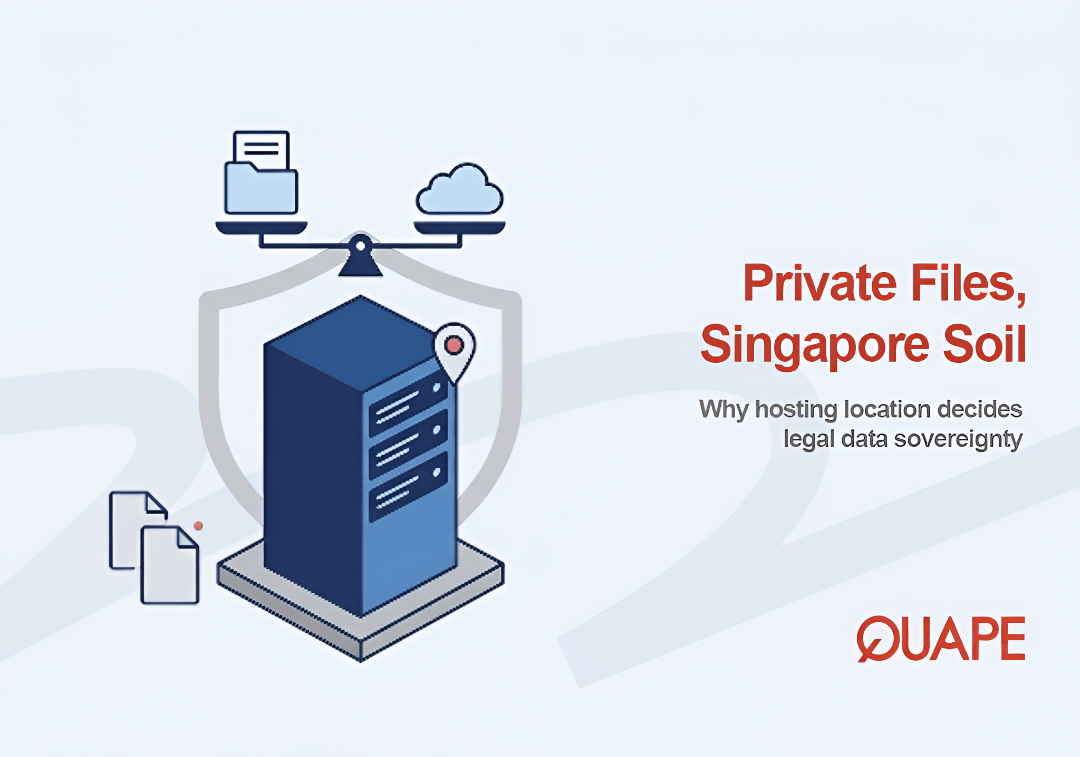
The jurisdiction question is conceptually separate from the residency question, even though the two are often discussed together. Data residency answers where the data physically sits. Data sovereignty asks which legal system can ultimately compel access. A US-headquartered provider offering a Singapore data region would resolve the first question while leaving the second one open. A Singapore-incorporated hosting partner running infrastructure inside a Singapore Tier 3 facility resolves both questions through the same corporate and physical structure.
Ownership of Encryption Keys, Audit Logs, and Storage Infrastructure
On a Quape VPS, the firm provisions, rotates, and stores its own encryption keys, configures audit logging at the granularity it requires, and inspects the storage infrastructure through standard system administration tools. With Google Drive, the firm relies on whatever the Admin Console exposes and whatever Google’s product roadmap chooses to prioritize. The difference is structural rather than incremental.
Customization for Matter-Level Security Policies
Matter-level security policies often require the firm to apply different access rules, retention schedules, and encryption requirements to different folders depending on the engagement. Nextcloud running on a VPS supports this through native folder permissions, group policies, and app extensions that can be configured to the firm’s exact specifications. Google Drive supports folder permissions but constrains the firm to the policies the vendor has built into the product.
Operational Responsibility Versus Operational Flexibility
The trade-off here is honest and important. Google Drive transfers nearly all operational responsibility to Google in exchange for accepting the product as configured. A Quape VPS transfers a defined operational burden back to the firm or its IT consultant in exchange for granting genuine configuration flexibility. Quape includes daily backups as standard and provides 24/7 DevOps engineering support, which reduces the operational load on the firm without removing the control that justified the migration in the first place.
Cost Predictability for Firms with 10 to 50 Fee-Earners
Google Workspace Business Plus is billed in USD per user per month, which means the firm’s monthly cost scales linearly with headcount and varies with the SGD to USD exchange rate. A VPS SG-Pro plan at SGD 80 per month, by contrast, includes 6 vCPU, 12GB RAM, and 150GB NVMe SSD storage, sufficient to run a Nextcloud instance for a small to mid-sized firm with headroom to grow. The cost is fixed regardless of whether the firm has 12 fee-earners or 38, and remains denominated in SGD throughout the contract.
Which Option Makes More Sense for Different Types of Law Firms?
When Google Drive Remains the Better Fit
Sole practitioners and very small firms, typically under 8 fee-earners, handling general advisory work, conveyancing, or matters where client governance requirements are not stringent will likely find that Google Drive’s operational simplicity outweighs the residency and control concerns discussed above. Firms without any internal IT resource and no budget for a periodic IT consultant should also lean toward the managed option, since the operational burden of running a VPS, even with Quape’s support, requires someone in the firm to coordinate.
When a Quape VPS Running Nextcloud Is the Stronger Choice
Firms in the 10 to 50 fee-earner range handling regulated industry clients, M&A advisory, arbitration, white-collar investigations, or any matters where client due diligence questionnaires routinely probe infrastructure governance will find the Quape VPS approach materially stronger. The same applies to firms whose partners have personally received client questions about data residency during conflict checks or engagement negotiations.
Considerations for Firms Handling Arbitration, M&A, and Highly Confidential Transactions
Singapore-seated arbitration and cross-border M&A both produce document volumes containing market-sensitive information, and the counterparties and tribunals involved increasingly expect demonstrable governance over where those documents reside. For firms with significant work in these areas, the ability to answer infrastructure questions with specificity rather than conditional language is becoming a competitive differentiator during pitches and engagement negotiations.
Final Verdict: Choosing a Google Drive Alternative for Privileged Legal Documents
The comparison ultimately comes down to which trade-off the firm is willing to make. Google Drive delivers convenience and operational simplicity in exchange for accepting US-headquartered cloud custody and the limited configurability that comes with a managed product. A Quape VPS running Nextcloud delivers full administrative control, physical Singapore data residency, and Singapore-incorporated hosting accountability in exchange for the firm or its IT consultant taking on a defined operational responsibility supported by Quape’s DevOps team. For small to mid-sized Singapore law firms whose practice areas attract scrutiny over infrastructure governance, the second trade-off increasingly aligns with where client expectations are heading. Firms ready to evaluate the technical fit can see Singapore VPS hosting options designed for private legal document infrastructure and assess whether a self-hosted Nextcloud deployment aligns with the firm’s compliance, residency, and operational requirements.
常见问题 (FAQ)