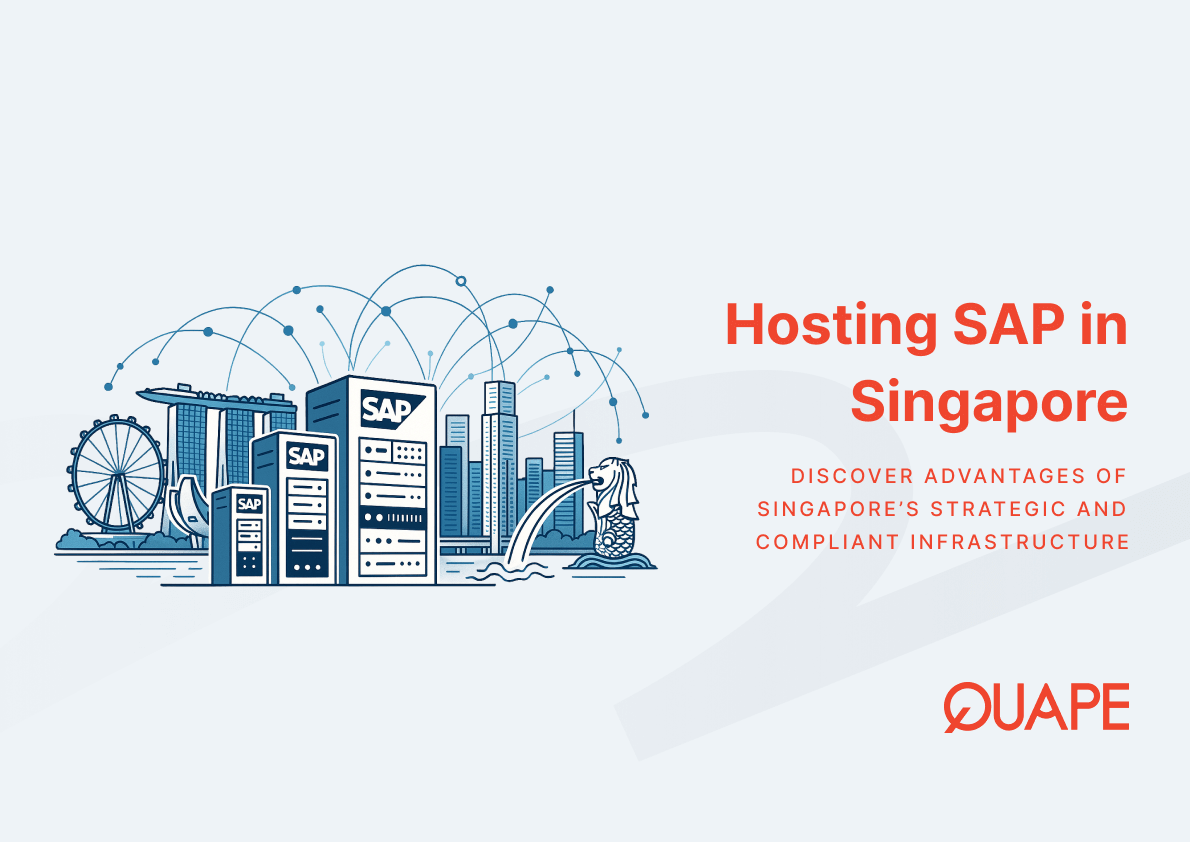
Singapore has established itself as one of the most strategically positioned hosting jurisdictions in Asia Pacific, and for enterprises running SAP workloads, that positioning translates directly into performance, governance, and operational advantages. As regional ERP deployments grow more complex and distributed, the hosting location increasingly influences how well SAP systems serve users across time zones and regulatory boundaries. IT managers and CTOs evaluating infrastructure decisions can no longer treat location as a secondary consideration when latency, data residency, and compliance reputation all interact to shape system reliability. This article examines the specific factors that make Singapore a defensible choice for SAP hosting, grounded in infrastructure realities and enterprise requirements.
Introduction to SAP Hosting Singapore Benefits
SAP systems, particularly those running on SAP HANA, depend on consistent performance from the infrastructure layer upward. The database engine processes in-memory workloads that are sensitive to network conditions, hardware reliability, and operational continuity. When enterprises choose where to host these systems, they are effectively choosing how well those workloads will behave for users, administrators, and integrated third-party systems across a region.
Singapore sits at the intersection of several forces that benefit SAP deployments: dense subsea cable infrastructure, a mature regulatory environment, and deep familiarity with enterprise compliance requirements. These are not marketing claims but measurable infrastructure and governance characteristics that affect how SAP HANA performs under real operational conditions. Organizations considering managed SAP infrastructure decisions need to understand how these characteristics interact before committing to a hosting location.
要点总结
- Singapore accounts for approximately 59% of Southeast Asia’s existing data center capacity, according to a UB-Speeda market report, making it the dominant hosting hub in the region.
- More than 26 active submarine cables connect Singapore to major global internet routes, directly reducing network hops and round-trip latency for enterprise applications.
- Singapore’s Personal Data Protection Act (PDPA) provides a structured, predictable compliance framework without imposing mandatory data localization requirements.
- SAP HANA’s in-memory processing architecture is highly sensitive to network latency, making Singapore’s network position a direct performance advantage.
- Singapore’s legal system and transparent governance reduce enterprise risk for organizations with contractual or regulatory obligations tied to their ERP environments.
- The ASEAN data center market is projected to grow from approximately 1,694 MW in 2023 to over 4,214 MW by 2028, reinforcing Singapore’s role as the anchor for regional digital infrastructure expansion.
- Compliance-centric industries including finance, healthcare, and logistics benefit from Singapore’s recognized alignment with international standards such as ISO 27001.
Singapore as a Low-Latency ASEAN Network Hub
Network infrastructure quality determines how quickly SAP applications respond to user actions and how reliably data replicates between systems. Singapore’s position as ASEAN’s primary connectivity hub is built on a physical foundation that other regional markets cannot easily replicate, particularly its concentration of active submarine cable landings that link it to both mature and emerging internet exchange points across Asia Pacific.
根据 ASEAN Access, Singapore connects to more than 26 active submarine cables, placing it on direct routing paths to markets across Southeast Asia, South Asia, and beyond. This cable density means that when an SAP user in Manila, Jakarta, or Kuala Lumpur sends a transaction request, the data travels fewer physical hops before reaching the hosting environment and returning a response. Fewer hops reduce round-trip time, which is the latency metric most directly tied to ERP responsiveness.
Network Proximity to Southeast Asia SAP Users
Enterprise ERP access depends on consistent responsiveness across all connected users, not just those co-located with the data center. When SAP Business One or SAP S/4HANA serves users distributed across multiple ASEAN countries, the hosting location’s proximity to regional internet exchange points shapes how evenly that responsiveness distributes across the user base. Singapore’s central position at the southern tip of the Malay Peninsula places it within low-latency reach of most major ASEAN commercial centers.
Cross-border data traffic between enterprise systems and branch offices, suppliers, or customers adds routing complexity. Singapore reduces this complexity because its network infrastructure connects directly to the transit routes that carry most intra-ASEAN traffic. For organizations managing multi-country SAP landscapes, this network centrality supports consistent session quality and reduces the risk of latency spikes that disrupt transaction workflows.
Impact of Latency on SAP HANA Transaction Performance
SAP HANA’s in-memory computing model processes analytical and transactional workloads simultaneously, but this architecture relies on rapid data retrieval from memory rather than disk. The database engine’s performance advantage over traditional disk-based systems only materializes fully when the network connecting users to the HANA layer does not introduce delays that offset those gains. Hosting HANA in a high-latency environment erodes the speed benefits that justify the system’s infrastructure requirements.
Real-time analytics in SAP HANA requires that query results return to the requesting application within response windows that support interactive decision-making. When latency is inconsistent or elevated, users experience delays that affect trust in the system and reduce adoption of real-time reporting features. Hosting SAP HANA in Singapore, within a network environment optimized for low round-trip times to ASEAN endpoints, directly supports the performance characteristics that HANA is designed to deliver. You can explore how this connects to broader SAP latency optimization considerations in more detail.
Sovereign Hosting and Data Residency Advantages in Singapore
Data sovereignty matters for SAP workloads because ERP systems store sensitive operational, financial, and personnel data that organizations have legal and contractual obligations to protect. The jurisdiction in which that data resides determines which legal frameworks govern access requests, breach notification requirements, and cross-border transfer conditions. Singapore provides a predictable environment for these obligations, which simplifies the compliance planning that precedes and follows an SAP deployment. Understanding how data residency intersects with SAP hosting compliance helps organizations build defensible governance models from the outset.
Local Jurisdiction Control for Enterprise SAP Data
Singapore’s Personal Data Protection Act establishes clear obligations for organizations that collect, use, and disclose personal data, including data processed within ERP systems. The PDPA does not impose data localization mandates that would restrict cross-border data flows, but it does require that organizations maintain accountability for how personal data is handled regardless of where processing occurs. This framework gives enterprises the ability to structure SAP data flows across regional subsidiaries without triggering automatic compliance conflicts.
Data residency within Singapore means that legal access requests, regulatory audits, and dispute resolution processes occur within a jurisdiction that operates under a transparent rule of law. For enterprise risk management teams, this predictability reduces the legal uncertainty that can complicate cross-border SAP deployments in markets with less stable or less internationally recognized governance frameworks. Organizations managing SAP environments that span multiple ASEAN countries often use Singapore as the primary data residency location precisely because it provides a stable anchor for regional governance models.
Singapore’s Role in Multi-National SAP Governance Models
Many multinational organizations treat Singapore as their ASEAN regional headquarters, which naturally aligns ERP architecture decisions with the hosting location. When the centralized SAP landscape resides in the same jurisdiction as regional management and finance functions, governance structures become simpler to enforce and audit. Access control policies, data handling procedures, and system change management processes all benefit from jurisdictional consistency between the hosting environment and the organizational units accountable for them.
Centralized ERP architecture that serves multiple ASEAN countries from a Singapore-based hosting environment also enables more coherent data consolidation for regional reporting. SAP systems designed to aggregate financial, inventory, or HR data from regional subsidiaries perform this aggregation more reliably when the primary HANA instance sits in a low-latency, high-availability environment. Singapore’s infrastructure supports this architecture both technically and legally.
International Compliance Reputation and Enterprise Trust
Singapore’s compliance reputation extends beyond its domestic regulatory framework. The country’s data center and hosting industry operates under internationally recognized standards including ISO 27001 for information security management, which enterprise procurement teams and legal departments reference when evaluating hosting providers. This standard alignment reduces the due diligence burden for organizations that need to demonstrate to their own customers or regulators that their SAP environment meets recognized security benchmarks. Organizations with specific security requirements can review how these standards apply to SAP hosting security architecture.
Why Compliance-Centric Organizations Choose Singapore
Regulated industries, particularly financial services, healthcare, and logistics, operate under contractual and regulatory requirements that specify minimum security and availability standards for systems that handle sensitive data. When these organizations evaluate hosting locations for SAP, they prioritize jurisdictions where the hosting ecosystem has already built compliance infrastructure around recognized standards. Singapore’s data center market, which UB-Speeda data indicates accounts for approximately 59% of Southeast Asia’s existing capacity, reflects the market’s confidence in the regulatory environment that governs it.
Audit readiness is a practical consideration that compliance teams raise during every major IT infrastructure review. When SAP systems are hosted in Singapore, the combination of PDPA obligations, ISO-aligned provider certifications, and transparent legal processes gives organizations a defensible audit trail. This readiness reduces the time and cost associated with compliance documentation cycles, particularly for organizations that undergo multiple audits per year from different regulatory bodies or enterprise customers.
Security Expectations for Mission-Critical SAP Systems
Mission-critical ERP systems require security architectures that protect data at rest and in transit, control access at multiple layers, and detect anomalous activity before it escalates. Singapore-based hosting providers that serve SAP workloads typically implement these controls as baseline requirements rather than optional add-ons, because the enterprise market they serve demands them as a condition of contract. This market-driven security baseline benefits organizations that might not have the internal resources to specify and verify every security control independently.
Access control models for SAP environments hosted in Singapore can leverage the network infrastructure advantages of the jurisdiction alongside security controls. VPN-based access, private network peering, and role-based authentication systems all integrate more cleanly in an environment where the hosting provider operates within a stable legal and technical framework. ERP security posture improves when the hosting environment’s physical, legal, and technical controls reinforce each other rather than creating gaps that require custom mitigation.
Practical Implications for IT Managers, CTOs, and SMEs in Singapore
IT operations strategy for organizations running SAP depends on balancing performance requirements against cost governance constraints. Singapore-based hosting offers a practical resolution to this balance: the infrastructure quality that enterprise SAP workloads require is available without the overhead of building and maintaining on-premises environments. IT managers evaluating SAP hosting compared to on-premises deployment consistently identify infrastructure maintenance, hardware refresh cycles, and staffing costs as the primary drivers of total cost increases in self-hosted models.
For SMEs that have adopted SAP Business One as their ERP platform, the hosting location decision often comes down to operational simplicity and budget predictability. Hosting in Singapore provides access to enterprise-grade infrastructure at a predictable cost structure, without requiring SMEs to negotiate complex cloud contracts or manage the performance variability that public cloud pricing models can introduce. CTOs at growing organizations benefit from hosting arrangements that scale with business demand rather than requiring capital investment ahead of actual growth. Detailed guidance on SAP hosting cost optimization strategies can help organizations structure their infrastructure spend more effectively.
Digital scalability in Singapore’s hosting market also benefits from the broader regional infrastructure investment described earlier. As ASEAN data center capacity grows toward the projected 4,214 MW by 2028, Singapore’s position as the region’s primary connectivity and compliance hub will likely strengthen rather than diminish, giving organizations that anchor their SAP environments here a stable foundation for long-term growth.
How Managed SAP Hosting Supports SAP Hosting Singapore Benefits
Managed SAP hosting combines Singapore’s infrastructure and compliance advantages with operational support that removes the burden of day-to-day system management from internal IT teams. Organizations that choose a managed model gain access to SAP-certified infrastructure without the capital expenditure and operational complexity of owning that infrastructure directly. The managed service model aligns particularly well with Singapore’s hosting ecosystem because the provider handles the compliance documentation, security monitoring, and performance tuning that Singapore-based enterprise deployments require.
Infrastructure Management Without Public Cloud Overhead
Dedicated SAP environments hosted on managed infrastructure offer predictable performance characteristics that public cloud multi-tenant environments cannot guarantee. SAP HANA’s memory-intensive workloads are sensitive to resource contention, and dedicated hosting eliminates the variability introduced when compute and memory resources are shared across tenants. For organizations that have experienced performance inconsistency on public cloud SAP deployments, moving to a dedicated managed environment in Singapore resolves this at the infrastructure layer without requiring application-level workarounds.
Predictable performance also simplifies capacity planning. When IT managers know that their SAP environment operates on dedicated resources with defined specifications, they can align capacity decisions with actual business growth rather than compensating for infrastructure unpredictability. This clarity reduces the engineering overhead that public cloud SAP deployments often generate through ongoing performance investigation and configuration adjustment.
Operational Simplicity for Growing SAP Landscapes
Managed services reduce the SAP system lifecycle burden on internal teams by handling infrastructure updates, patch management, backup verification, and proactive monitoring as included service functions. For organizations without dedicated SAP Basis administrators, this managed coverage fills a critical operational gap that would otherwise require either hiring specialist staff or accepting elevated risk from unmanaged system vulnerabilities. Growing SAP landscapes that add new modules, users, or integrations over time benefit from managed service structures that scale without requiring proportional increases in internal IT headcount.
SAP system lifecycle management includes not just ongoing operations but also migration planning, version upgrades, and disaster recovery testing. A managed provider operating within Singapore’s infrastructure ecosystem handles these lifecycle events with the advantage of local network proximity, regulatory familiarity, and established relationships with the data center and connectivity providers that underpin the hosting environment.
Conclusion and Strategic Next Steps
Singapore’s value as an SAP hosting location is not a function of any single advantage but of how its network infrastructure, regulatory environment, compliance reputation, and managed service ecosystem reinforce each other. For IT managers, CTOs, and procurement leads evaluating where to anchor their SAP HANA environments, Singapore offers a combination of latency performance, governance clarity, and operational maturity that few regional alternatives can match at scale. Organizations that align their SAP hosting strategy with Singapore’s infrastructure position are better placed to support growing ASEAN user bases, satisfy compliance obligations across multiple jurisdictions, and maintain the system reliability that business-critical ERP workloads demand.
To evaluate whether Singapore-based SAP hosting aligns with your operational and compliance needs, you can reach out to our team here.
常见问题 (FAQ)
Why is Singapore considered the best location for SAP hosting in Southeast Asia?
Singapore combines more than 26 active submarine cable connections, approximately 59% of Southeast Asia’s data center capacity, and a stable regulatory framework under the PDPA. These factors together create a hosting environment that supports SAP performance requirements, compliance obligations, and regional user access in ways that other ASEAN markets currently cannot replicate at the same scale.
How does Singapore’s network infrastructure affect SAP HANA performance?
SAP HANA processes in-memory workloads that require rapid response times to deliver their performance advantages over traditional ERP databases. Singapore’s subsea cable connectivity reduces the number of network hops between the HANA environment and ASEAN users, which lowers round-trip latency and supports the real-time transaction responsiveness that HANA is designed to provide.
What compliance frameworks apply to SAP data hosted in Singapore?
The primary framework is Singapore’s Personal Data Protection Act, which establishes accountability obligations for personal data without imposing data localization mandates. Hosting providers operating in Singapore also typically hold ISO 27001 certification, which aligns with international enterprise security requirements and supports audit readiness for regulated industries.
Does Singapore impose data localization requirements on SAP workloads?
Singapore does not impose mandatory data localization requirements that restrict cross-border data flows, which gives organizations flexibility in how they structure multi-country SAP architectures. The PDPA requires accountability for how personal data is handled but does not prevent organizations from transferring data across borders when appropriate safeguards are in place.
What is the difference between managed SAP hosting and public cloud SAP deployment? Managed SAP hosting provides dedicated infrastructure resources managed by a specialist provider, eliminating the resource contention that public cloud multi-tenant environments introduce. Public cloud deployments share compute and memory resources across customers, which can create performance variability that affects SAP HANA workloads. Managed hosting delivers predictable performance, included operational support, and cost structures that are easier to govern over time.
How does managed SAP hosting reduce operational burden for IT teams? A managed SAP hosting provider handles infrastructure updates, security patching, backup management, performance monitoring, and proactive troubleshooting as part of the service. This removes the need for dedicated SAP Basis expertise within the internal IT team and allows organizations to focus on business process optimization rather than infrastructure maintenance.
Is Singapore-based SAP hosting suitable for SMEs running SAP Business One? Singapore-based managed SAP hosting is well-suited for SMEs because it provides enterprise-grade infrastructure at predictable costs without requiring capital investment in hardware or specialist staffing. SAP Business One on HANA benefits from the same network and infrastructure advantages that larger enterprises use, giving SMEs access to performance and compliance standards that support growth without the overhead of managing the environment internally.