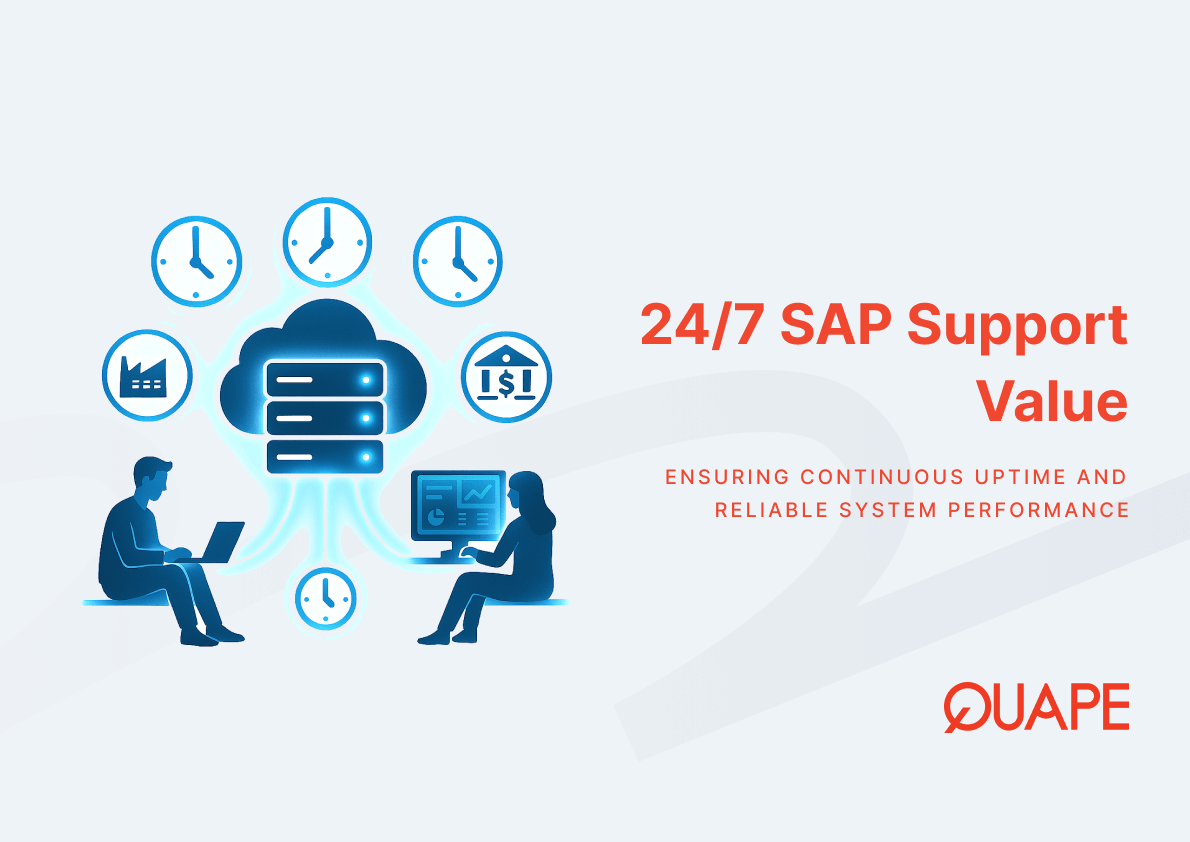
Businesses running SAP systems cannot afford infrastructure failures during critical transaction windows, financial close periods, or global operations that span multiple time zones. The cost of unplanned SAP downtime extends beyond immediate revenue loss to include damaged customer relationships, regulatory compliance risks, and operational disruptions that ripple across supply chains. According to Gartner research, the average cost of infrastructure downtime reaches approximately $5,600 per minute, translating to over $300,000 per hour for many enterprises. Organizations that deploy 24/7 SAP infrastructure support establish resilience against these risks by combining continuous monitoring, expert SAP Basis intervention, and automated incident response across all operational hours.
SAP infrastructure support represents the technical foundation that sustains system availability, performance consistency, and data integrity for enterprise resource planning operations. This support model integrates network operations center (NOC) monitoring, SAP Basis administration, and proactive system management to detect configuration drift, performance degradation, and security vulnerabilities before they escalate into production outages. Unlike reactive support models that respond only after users report failures, 24/7 infrastructure support operates on continuous visibility principles where baseline performance monitoring and automated alerting enable intervention during emerging issues rather than confirmed disruptions.
要点总结
- Continuous SAP infrastructure monitoring reduces mean time to resolution by detecting issues during early warning stages rather than waiting for user-reported failures
- NOC operations provide around-the-clock incident response capabilities that align with global business operations and eliminate coverage gaps during off-hours
- SAP Basis support functions as the operational backbone by managing transport requests, kernel updates, and system health checks that maintain platform stability
- Proactive monitoring automation leverages performance baselines and predictive analytics to shift from reactive firefighting toward anticipatory maintenance
- Downtime costs for enterprise infrastructure can exceed $300,000 per hour when accounting for transaction losses, operational delays, and reputation damage
- Organizations in Singapore benefit from regional data center proximity and compliance-aligned infrastructure that supports local regulatory requirements
- Managed SAP hosting integrates monitoring, security, and Basis expertise into unified operational accountability structures that reduce internal staffing complexity
Why 24/7 Availability Is a Business-Critical Requirement
Business continuity for SAP-dependent organizations relies on system uptime during all operational windows, including overnight batch processing, international transaction periods, and emergency change deployments. Many enterprises operate across multiple geographic regions where standard business hours in one location overlap with critical processing times in another, creating dependencies on infrastructure that never truly enters maintenance mode. When SAP systems become unavailable during financial reconciliation cycles or inventory updates, the impact extends beyond immediate transaction failures to include delayed reporting, compliance deadline risks, and manual workaround efforts that consume operational resources.
SLA expectations for enterprise ERP operations typically mandate 99.9% or higher availability thresholds, which translates to fewer than nine hours of acceptable downtime per year. Organizations that operate without 24/7 infrastructure support create vulnerability windows during nights, weekends, and holidays when technical issues can progress undetected for hours before business teams discover system unavailability. Real-time operations such as e-commerce order processing, manufacturing execution systems, and supply chain visibility platforms cannot tolerate delayed incident response, as even brief interruptions compound into customer experience failures and revenue leakage. Evaluating hosting provider SLA commitments helps organizations establish accountability frameworks that align infrastructure performance guarantees with business requirements.
Key Components of 24/7 SAP Infrastructure Support
Effective infrastructure support for SAP environments combines three operational pillars: network operations center monitoring, SAP Basis administration, and proactive automation tooling. Each component addresses distinct technical responsibilities while integrating into unified incident response workflows that minimize detection-to-resolution cycles. Organizations that deploy only partial support coverage, such as business-hours Basis administration without continuous NOC monitoring, create operational blind spots where system degradation can progress into cascading failures before technical teams gain visibility.
NOC Operations and Continuous System Visibility
Network operations center functions provide the first line of defense against infrastructure failures by monitoring server health metrics, network connectivity status, and application performance indicators across all hours. NOC teams establish alert escalation protocols that route critical incidents to on-call SAP Basis administrators, infrastructure engineers, and vendor support channels based on severity classifications and technical specialization requirements. Research from Technijian indicates that proactive monitoring can prevent up to 80% of potential IT outages by enabling early warning of configuration and performance issues.
Continuous system visibility enables NOC operations to detect subtle warning signals such as gradual memory consumption increases, storage capacity trends approaching thresholds, and network latency patterns that precede connectivity failures. These early indicators allow incident response teams to investigate root causes during low-activity periods rather than during peak transaction volumes when corrective actions risk additional disruption. Alert fatigue becomes a risk when monitoring systems generate excessive false positives, so effective NOC operations require tuned thresholds that balance sensitivity against operational noise. High availability architectures depend on coordinated monitoring across primary and standby systems to ensure failover mechanisms activate correctly during planned and unplanned events.
SAP Basis Support as the Operational Backbone
SAP Basis administration maintains the technical layer between infrastructure resources and SAP application functionality, managing database connections, work processes, transport management, and system kernel updates. Basis administrators perform health checks that verify database consistency, monitor RFC connections between integrated systems, and validate backup completion status to confirm disaster recovery readiness. Transport management requires careful coordination to prevent configuration conflicts when moving changes between development, quality assurance, and production environments, particularly when multiple teams deploy updates on overlapping schedules.
Patching and kernel updates introduce controlled risk windows where system stability depends on thorough testing protocols and rollback preparedness. Organizations running business-critical SAP operations cannot simply apply patches during arbitrary maintenance windows, as compatibility testing against custom code, integrated applications, and third-party add-ons requires validation cycles that span multiple system landscapes. 24/7 Basis support ensures technical expertise remains available when emergency patches address zero-day vulnerabilities or when unplanned issues require immediate diagnostic investigation. Infrastructure readiness for S/4HANA environments demonstrates how Basis administration evolves alongside platform modernization to accommodate in-memory computing requirements and simplified data models.
Proactive Monitoring Automation vs Reactive Support Models
Reactive support models wait for user reports, system error messages, or service desk tickets before initiating investigation workflows, creating inherent delays between failure onset and technical response. Proactive monitoring automation shifts this paradigm by establishing performance baselines that define normal operating parameters for transaction response times, database query performance, and resource utilization patterns. When actual metrics deviate from baseline expectations, automated alerting triggers investigation workflows before end users experience degraded performance or transaction failures.
Predictive monitoring extends beyond threshold-based alerting by analyzing trend data to forecast capacity exhaustion dates, identify recurring error patterns, and detect anomalous behavior that may indicate configuration drift or emerging security threats. Automation tooling can execute predefined remediation scripts for common issues such as locked database rows, hung work processes, or temporary connectivity interruptions, reducing the manual intervention burden on Basis administrators and accelerating incident resolution cycles. Organizations that implement automation must balance efficiency gains against the risk of automated responses masking underlying root causes that require architectural remediation. Network latency considerations illustrate how performance baselines must account for geographic distance, network path characteristics, and application-specific response time requirements.
Operational Risks of Non-24/7 SAP Infrastructure Support
Organizations that limit SAP infrastructure support to business hours expose themselves to extended incident resolution times when issues emerge during off-hours periods. A database corruption event that occurs at 2:00 AM on Sunday might not receive technical attention until Monday morning, potentially resulting in 30+ hours of system unavailability that blocks financial close activities, disrupts supply chain operations, and forces manual workarounds across dependent business processes. Downtime cost calculations must account for lost transaction revenue, idle workforce productivity, expedited shipping fees to compensate for delayed order processing, and potential contractual penalties for missed service commitments to customers.
Unplanned outages carry higher financial impact than scheduled maintenance windows because they occur without preparation, notification, or mitigation planning. Industry research cited by Cubro found that 98% of organizations reported one hour of downtime costs over $100,000, with 81% stating costs exceed $300,000 per hour. Security exposure increases when systems remain in failed or degraded states for extended periods, as attackers may exploit vulnerabilities introduced by partial system functionality or incomplete authentication enforcement during recovery processes. Recovery gaps emerge when backup validation occurs only during business hours, allowing corrupted or incomplete backup sets to persist undetected until disaster recovery procedures fail during actual restoration attempts. Disaster recovery planning addresses these risks through regular testing protocols, but effective execution requires 24/7 incident response capabilities to manage unplanned events regardless of when they occur. Security frameworks establish multi-layered protection mechanisms that require continuous monitoring to detect and respond to emerging threats before they escalate into data breaches or compliance violations.
Practical Application for Organizations in Singapore
Organizations operating SAP systems in Singapore must navigate regulatory requirements from the Personal Data Protection Act (PDPA), sector-specific guidelines such as MAS Technology Risk Management standards for financial services, and contractual obligations around data residency and access controls. 24/7 infrastructure support becomes particularly relevant when local business operations depend on SAP transactions during regional business hours that extend across ASEAN time zones, requiring system availability from early morning Singapore time through late evening as markets close in Australia and New Zealand.
Regional latency considerations influence application performance when SAP databases reside in distant geographic locations, as network round-trip times compound with transaction complexity to create user experience delays that impact productivity and operational efficiency. Local data centers in Singapore reduce latency by positioning infrastructure closer to end users and integrated systems, while compliance alignment benefits from providers who understand local regulatory expectations and maintain certifications relevant to Singapore business requirements. Organizations evaluating infrastructure support models should verify that monitoring operations, incident response teams, and escalation procedures account for Singapore time zone considerations rather than relying solely on global support centers that may prioritize incidents based on other regional demands. Compliance frameworks require documented evidence of security controls, change management procedures, and incident response capabilities that align with regulatory expectations for data protection and system reliability.
How Managed SAP Hosting Strengthens 24/7 SAP Infrastructure Support
托管 SAP 主机 integrates infrastructure resources, monitoring operations, and SAP Basis expertise into unified service delivery models that eliminate coordination complexity between separate vendors for servers, storage, networking, and application support. Fully managed infrastructure providers assume operational accountability for system availability, performance consistency, and security posture through service level agreements that define response times, resolution targets, and escalation procedures for incidents of varying severity. This consolidation reduces the internal staffing burden on organizations that would otherwise need to maintain 24/7 on-call rotations for infrastructure engineers, database administrators, and SAP Basis specialists across multiple technical domains.
SAP HANA operations introduce memory-intensive computing requirements and database administration considerations that differ from traditional disk-based systems, creating specialized support needs that benefit from providers with proven HANA expertise. Managed hosting services typically include automated backup validation, kernel patch testing against customer-specific configurations, and performance tuning recommendations based on workload analysis and resource utilization trends. Organizations transitioning from on-premise infrastructure to managed hosting models gain access to monitoring tooling, automation frameworks, and technical talent that would require significant capital investment and recruitment effort to replicate internally.
Integrated Monitoring, Security, and SAP Basis Expertise
Centralized monitoring platforms consolidate infrastructure metrics, application performance data, and security event logs into unified dashboards that provide holistic visibility across SAP landscapes. This integration enables correlation analysis between seemingly unrelated events, such as identifying how network packet loss in one data center segment contributes to database replication delays that eventually trigger failover mechanisms. Access control frameworks enforce principle of least privilege by limiting administrative permissions based on role definitions, approval workflows, and time-bound access grants that reduce insider threat risks while maintaining operational flexibility for authorized changes.
Operational accountability becomes clearer when a single provider manages the entire infrastructure stack rather than distributing responsibility across multiple vendors who may dispute root cause attribution during post-incident reviews. Managed hosting providers establish clear escalation paths from Level 1 monitoring alerts through Level 3 Basis administration and vendor support engagement, ensuring technical expertise matches incident complexity without coordination delays between disparate support organizations. Service delivery reviews provide regular opportunities to analyze incident trends, identify recurring issues that warrant architectural remediation, and validate that monitoring coverage adapts as SAP landscapes evolve through system upgrades and business process changes.
Cost Predictability Compared to On-Premise Support Models
Operational expenditure models for managed hosting convert the variable costs of maintaining infrastructure, staffing support teams, and responding to unplanned failures into predictable monthly fees that simplify budget planning and financial forecasting. Organizations operating on-premise SAP infrastructure face unpredictable expenses when hardware failures require emergency replacements, software licensing audits identify compliance gaps, or security incidents demand forensic investigation and remediation efforts. Infrastructure efficiency improves when hosting providers leverage economies of scale across multiple customers to justify investments in advanced monitoring platforms, automation tooling, and specialized technical talent that individual organizations cannot cost-effectively replicate.
Support staffing for 24/7 operations requires minimum team sizes to provide adequate coverage across all time zones while accounting for vacation time, training requirements, and turnover risks that create knowledge retention challenges. Comparing managed hosting against on-premise models reveals total cost of ownership differences that extend beyond simple infrastructure pricing to include operational overhead, opportunity costs of diverted IT resources, and risk mitigation value from guaranteed service levels. Cost optimization strategies examine how right-sizing resources, implementing automated scaling, and eliminating redundant tooling reduce ongoing expenses while maintaining or improving operational capabilities.
Conclusion: 24/7 SAP Infrastructure Support as a Strategic Advantage
Organizations that establish continuous infrastructure support for SAP environments gain digital resilience against unplanned disruptions, operational scalability to accommodate business growth without proportional increases in support complexity, and long-term SAP performance optimization through sustained monitoring visibility and proactive issue remediation. The shift from reactive break-fix models toward anticipatory infrastructure management represents a fundamental evolution in how enterprises approach system reliability, moving from accepting downtime as inevitable toward architecting environments where failures become increasingly rare through sustained operational discipline and technical excellence.
If your organization requires dependable SAP infrastructure that operates without interruption across all business hours, 联系我们的销售团队 to discuss how managed hosting services align continuous monitoring, expert Basis support, and proactive automation into unified operational accountability.
常见问题 (FAQ)
What distinguishes 24/7 SAP infrastructure support from standard business-hours coverage?
24/7 support provides continuous monitoring and incident response capabilities that detect and address issues during off-hours when standard support models would leave systems unattended. This eliminates vulnerability windows where problems can escalate undetected for hours or days before business teams discover system unavailability.
How does proactive monitoring reduce SAP system downtime?
Proactive monitoring establishes performance baselines and automated alerting that trigger investigation workflows when metrics deviate from expected parameters, enabling technical teams to intervene during early warning stages rather than waiting for complete failures. This early detection significantly reduces mean time to resolution and prevents minor issues from cascading into major outages.
What role does SAP Basis administration play in 24/7 support models?
SAP Basis administrators manage the technical layer between infrastructure resources and application functionality, including transport management, kernel updates, database health checks, and RFC connection monitoring. 24/7 Basis coverage ensures this expertise remains available when emergency patches or unplanned issues require immediate diagnostic investigation regardless of time of day.
Why do organizations in Singapore specifically benefit from local 24/7 infrastructure support?
Singapore-based organizations often operate across ASEAN time zones and must comply with local regulations including PDPA and sector-specific guidelines that require documented security controls and incident response capabilities. Local data center positioning reduces latency while support teams familiar with Singapore regulatory expectations provide compliance-aligned service delivery.
How does managed SAP hosting simplify 24/7 support requirements?
Managed hosting integrates infrastructure resources, monitoring operations, and SAP Basis expertise into unified service delivery with single-vendor accountability for system availability and performance. This eliminates coordination complexity between separate providers and reduces internal staffing needs for maintaining 24/7 on-call rotations across multiple technical domains.
What cost factors should organizations consider when evaluating 24/7 support models?
Total cost of ownership includes infrastructure expenses, support staffing requirements, monitoring tooling investments, and risk mitigation value from reduced downtime exposure. Managed hosting converts variable costs into predictable operational expenditure while providing access to specialized expertise and automation frameworks that individual organizations cannot cost-effectively replicate.
How does automation enhance 24/7 SAP infrastructure monitoring?
Automation tooling executes predefined remediation scripts for common issues such as locked database rows or hung work processes, accelerating incident resolution without requiring immediate manual intervention. Predictive analytics extend beyond threshold-based alerting to forecast capacity exhaustion and detect anomalous behavior that may indicate configuration drift or emerging security threats.
What happens when SAP systems fail during non-business hours without 24/7 support?
Systems may remain unavailable for extended periods until business-hours support teams resume coverage, potentially resulting in 30+ hours of downtime that blocks financial operations, disrupts supply chains, and forces expensive manual workarounds. Extended outages also increase security exposure and create recovery gaps when backup validation occurs only during limited operational windows.