If you are running infrastructure on Vultr and your business operates in Singapore, at some point your compliance team, your auditor, or a prospective enterprise client will ask a question Vultr cannot cleanly answer: where, precisely, does your data live? For IT managers and infrastructure leads in regulated sectors such as finance, healthcare, and legal services, that question is not theoretical. Singapore’s Personal Data Protection Act imposes accountability for how personal data is stored, processed, and transferred, and a cloud region label is not the same as a legally defensible data residency guarantee. This comparison is for organisations that have outgrown the self-managed cloud model, not because Vultr is a poor product, but because their compliance requirements now demand something Vultr is not designed to provide. Quape’s dedicated server infrastructure, housed entirely within Singapore, is built for exactly that scenario.
Key takeaways
- Vultr operates a developer-first, self-managed platform. Security, uptime, and compliance management fall on your internal team.
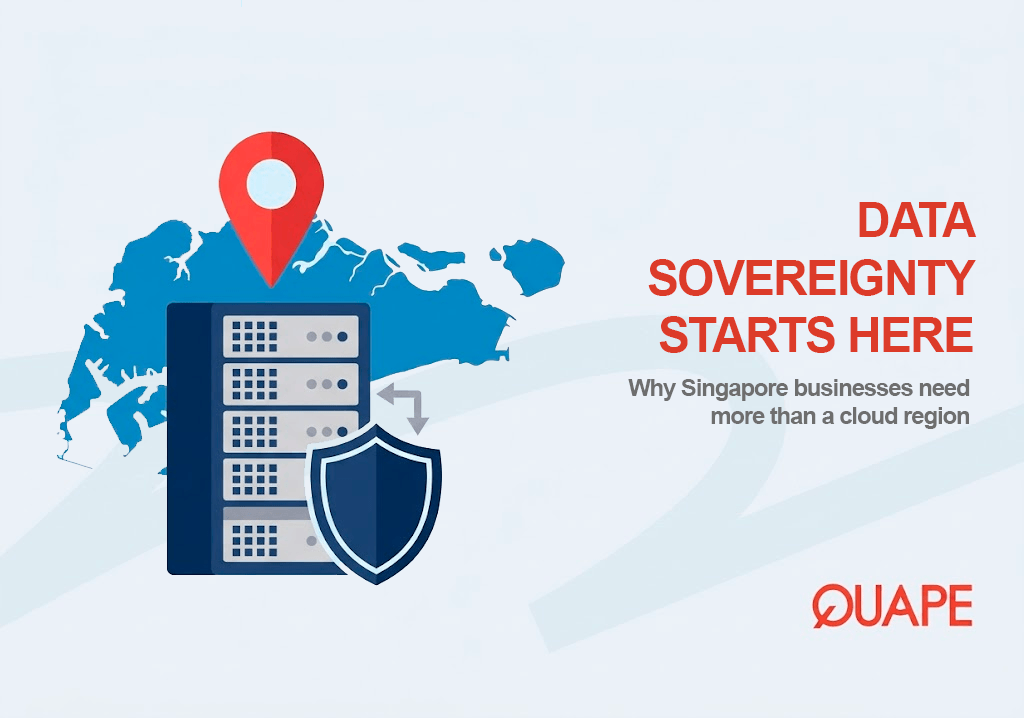
- A “Singapore region” in cloud infrastructure does not automatically guarantee that data remains within Singapore’s legal jurisdiction. Replication and failover mechanisms can move data across borders without explicit configuration.
- Quape’s dedicated servers are physically located in a Tier 3 certified data centre in Singapore, providing auditable data residency for PDPA compliance.
- Quape provides 24/7 DevOps engineering support with direct intervention capability, not ticket-based documentation routing.
- Enterprise-grade hardware, including Dell servers with ECC RAM, NVMe storage, and dual PSU redundancy, supports predictable performance for production workloads.
- Vultr remains the stronger choice for cloud-native, multi-region, and developer-led workloads that do not require strict data localisation.
- Regulated industries in Singapore increasingly need auditable proof of data location, not just contractual assurances from a global provider.
Why Singapore-based infrastructure decisions are no longer just about performance
The shift from cost-optimised cloud to compliance-driven architecture
For most of the last decade, infrastructure decisions in Southeast Asia were driven by a straightforward calculus: compute cost, latency to end users, and deployment speed. Global cloud providers won on all three dimensions, and regional alternatives struggled to compete on price or feature velocity. That calculus is changing. The data centre market in Singapore has grown into one of Asia-Pacific’s most significant digital infrastructure hubs, driven not only by connectivity but by regulatory stability and expanding compliance requirements. As organisations scale, the compliance cost of self-managed cloud infrastructure begins to outweigh the initial savings, particularly when security, patching, and uptime responsibility sit entirely with the internal team.
Why data jurisdiction now impacts vendor selection
Singapore’s PDPA requires organisations to ensure that personal data transferred overseas is protected to a standard comparable to Singapore law. This obligation extends to third-party processors, meaning the architecture of your hosting provider directly affects your legal exposure. The Personal Data Protection Commission is clear that accountability for cross-border data flows rests with the originating organisation, not the cloud vendor. For businesses in finance, healthcare, and legal services, this means infrastructure vendor selection is now a compliance decision, not just a technical one.
What Vultr gets right for modern infrastructure teams
Fast deployment across global regions including Singapore
Vultr has built one of the most developer-accessible infrastructure platforms available. Instances deploy in seconds, the control panel is clean and functional, and the pricing model is transparent and easy to forecast. The Singapore region gives engineering teams a low-latency entry point into Southeast Asia, which matters for applications where response time drives user experience. For startups and product teams moving fast, that speed of provisioning is genuinely valuable.
Flexible, API-driven infrastructure for engineering teams
Vultr’s API-first approach integrates cleanly with Terraform, Ansible, and most common DevOps toolchains. Teams that manage infrastructure as code benefit from the breadth of automation support. Vultr also offers Kubernetes integration, object storage, and managed databases, meaning a mature engineering team can build a comprehensive stack without switching providers.
Cost efficiency for stateless and non-regulated workloads
For stateless applications, development and test environments, or workloads that genuinely do not handle personal data, Vultr’s pricing model is hard to beat. The per-hour billing, combined with the ability to spin resources up and down quickly, makes it well-suited to workloads where the compliance overhead of a managed provider would add cost without adding value.
Where Vultr becomes limiting for Singapore-based businesses with compliance needs
“Singapore region” does not always equal guaranteed data residency
This distinction matters more than most infrastructure conversations acknowledge. A cloud region indicates the primary processing location, but data replication, automated backups, and failover mechanisms can move data across borders depending on platform defaults and configuration choices. Unless your team has explicitly audited and restricted every data movement path, the contractual location of your instance does not guarantee that no data crosses a jurisdictional boundary. The OECD’s analysis of cross-border data flows notes that such transfers introduce accountability obligations that extend to the originating organisation, regardless of how the provider labels its regional infrastructure.
Full responsibility for security, uptime, and compliance falls on your team
Vultr operates on a shared responsibility model, which is standard for cloud platforms. What this means in practice is that security configuration, patch management, uptime assurance, and compliance documentation are your organisation’s responsibility. For a business with a mature, well-staffed DevOps function, that is manageable. For the majority of Singapore SMEs and mid-market organisations, it creates a persistent operational burden and a compliance gap that widens as regulatory scrutiny increases.
Ticket-based support vs real-time engineering intervention
When something goes wrong on a self-managed cloud instance at 2am, Vultr’s support pathway routes you through documentation and ticketing. There is no direct line to an engineer who can access your infrastructure and intervene. For production environments where downtime carries real cost, that gap matters. Gartner’s widely cited research estimates that unplanned IT downtime costs enterprises an average of USD 5,600 per minute, a figure that reframes the economics of managed versus self-managed infrastructure quickly.
Why dedicated servers in Singapore change the equation for data sovereignty
Physical server ownership vs virtualised cloud abstraction
Dedicated servers eliminate the hypervisor layer that sits beneath every virtual machine in a cloud environment. That layer introduces performance variability known as the “noisy neighbour” effect, where other tenants on the same physical host affect your workload’s behaviour. On a dedicated server, your workload has exclusive access to every CPU core, every memory channel, and every storage controller. For databases, virtualisation stacks, and compute-intensive applications, that isolation produces predictable performance that shared cloud infrastructure cannot reliably match.
Ensuring data never leaves Singapore jurisdiction
A physical server located in Singapore does not route backups to a secondary region by default. It does not replicate state to a disaster recovery node in another country unless you explicitly configure it to do so. For organisations that need auditable proof of data location, not just contractual assurances, that physical certainty is the foundation of a defensible compliance posture. Latency improvements of 20 to 60 percent are also typical when workloads are hosted closer to end users geographically, according to the International Telecommunication Union, which means sovereign hosting and performance are not a trade-off in this context.
How Quape aligns infrastructure with Singapore compliance requirements
100% Singapore-based infrastructure with Tier 3 data centre assurance
Quape’s dedicated servers are housed in a Tier 3 certified data centre in Singapore. Tier III facilities are designed to achieve 99.982% availability, with full redundancy for power and cooling paths, as defined by the Uptime Institute. That standard is not a marketing claim. It is an independently verified infrastructure specification that translates directly into reduced downtime risk and a defensible compliance posture for organisations that require documented infrastructure assurances.
24/7 DevOps engineering support, not just a helpdesk queue
When an issue arises, Quape’s support model routes it to DevOps engineers with direct access to the infrastructure, not to a documentation portal. Those engineers can diagnose, intervene, and resolve infrastructure problems in real time. For regulated industries where incident response time is itself a compliance matter, that capability is not a nice-to-have. It is a material difference in operational risk profile.
Enterprise hardware built for stability and predictable performance
Quape的 dedicated server fleet in Singapore runs on Dell enterprise hardware, including Xeon Scalable processors and AMD EPYC options, with DDR4 ECC RAM, NVMe storage, and dual PSU configurations. ECC memory detects and corrects single-bit errors, reducing the risk of silent data corruption in long-running workloads. Dual PSU eliminates the power supply as a single point of failure. Enterprise SSDs with over 1PBW endurance support sustained write-intensive workloads without degradation over time.
Multi-homed network design for clean IPs and regional reliability
Multi-homed network architecture improves resilience by routing traffic through multiple upstream providers, removing the dependency on a single ISP. If one upstream path degrades, traffic routes through an alternative without requiring manual intervention. This matters particularly for Singapore businesses serving users across Southeast Asia, where routing efficiency and clean IP reputation both affect deliverability and application performance.
Vultr vs Quape: what actually matters in a Singapore infrastructure decision
| 因素 | Vultr | Quape dedicated server |
| Data residency guarantee | Region-based, not jurisdiction-locked by default | Physical server in Singapore, jurisdiction-confirmed |
| PDPA compliance posture | Customer responsibility | Supported by local data residency and Tier 3 certification |
| Support model | Documentation and ticket-based | 24/7 DevOps engineering with direct intervention |
| Infrastructure management | Fully self-managed | Managed with customer root access retained |
| Performance isolation | Shared hypervisor (standard VPS/cloud) | Dedicated hardware, no noisy neighbour effect |
| Hardware redundancy | Platform-managed (varies by product tier) | Dual PSU, ECC RAM, enterprise-grade SSD |
| Best fit | Cloud-native, stateless, dev/test, multi-region | Regulated workloads, databases, virtualisation, compliance-sensitive environments |
When staying on Vultr still makes sense
Rapid scaling across multiple regions
If your application serves users across multiple geographies and requires dynamic scaling across regions in minutes, Vultr’s cloud infrastructure is purpose-built for that. No dedicated server model matches the elasticity of a global cloud platform for workloads that genuinely need it.
Developer-led teams comfortable managing their own infrastructure
If your engineering team has the depth to manage security, patching, monitoring, and incident response internally, and your workloads do not involve personal data subject to PDPA obligations, Vultr’s self-managed model delivers strong value. The cost efficiency and tooling flexibility are real advantages for teams with the DevOps maturity to use them.
When a Singapore-based dedicated server becomes the smarter alternative
Regulated industries requiring strict data residency
Financial institutions, healthcare providers, legal firms, and government contractors operating under Singapore’s regulatory framework cannot treat data jurisdiction as a configuration option. Regulatory environments in these sectors often require auditable proof of data location, not simply contractual assurances from a global provider. A dedicated server with a verified Singapore physical address closes that audit gap in a way a cloud region cannot.
Businesses that need accountability, not just infrastructure access
There is a meaningful difference between a vendor that gives you access to infrastructure and a partner that shares accountability for its performance. For organisations where infrastructure failure carries reputational or legal consequences, that distinction shapes vendor selection as much as any technical specification.
Workloads that demand predictable performance and isolation
Database clusters, ERP systems, virtualisation hosts, and compute-intensive applications all benefit from the resource isolation that dedicated hardware provides. When your workload cannot tolerate the performance variability introduced by multi-tenant cloud environments, dedicated infrastructure removes that variable entirely.
Evaluating Singapore dedicated server options in practice
Matching workload requirements to dedicated hardware configurations
Quape’s server range covers five configurations designed for distinct workload profiles. The DS-Entry (from SGD 380/month) suits dev/test environments and low-load services with 8-core Intel Xeon Silver and 128GB ECC RAM. The DS-Performance (from SGD 680/month) provides a well-balanced production setup with 24-thread processing and 256GB RAM on dual NVMe storage. For databases and virtualisation, the DS-Pro Gold (from SGD 850/month) scales to 40 threads and 512GB RAM. The DS-Enterprise tier adds a second processor socket for organisations running VM farms or hosting platforms. For teams with specific requirements, the DS-BYOS range allows custom Intel or AMD EPYC configurations from SGD 200/month.
Planning for growth without losing compliance control
Scalability in a compliance-driven environment is not simply a matter of adding resources. Each change to the infrastructure stack creates a potential audit touchpoint. Starting with a clearly defined, jurisdiction-confirmed physical server and expanding within the same data centre preserves the compliance architecture you have built, rather than fragmenting it across providers and geographies as your business grows.
Making the right call for your infrastructure strategy
If your priority is global flexibility and cost efficiency
Vultr is a well-built platform and a reasonable choice for teams that prioritise API-driven automation, multi-region deployment, and low per-unit compute cost. If your workloads are stateless, non-regulated, or managed by a team with strong DevOps capability, the self-managed model works in your favour.
If your priority is data sovereignty, support, and control in Singapore
For organisations where PDPA compliance is non-negotiable, where incident response requires more than a support ticket, and where workload performance must be consistent and isolated, the architecture of a global self-managed cloud platform creates structural gaps that dedicated, locally managed infrastructure closes. The question is not whether Vultr is a good product. It is whether it is the right product for your compliance reality.
结论
Vultr and Quape serve meaningfully different infrastructure needs. Vultr’s strength is speed, flexibility, and developer autonomy at a global scale. Quape’s strength is accountability: physical data residency in Singapore, Tier 3-certified infrastructure, and engineering support that responds to incidents rather than routing them through documentation. For Singapore businesses in regulated industries, that accountability is not optional. It is the baseline. If your infrastructure strategy needs to satisfy a PDPA audit, reassure an enterprise client, or simply remove the compliance burden from your internal team, a Singapore-based dedicated server is the architecturally sound choice. Explore your options and get your Singapore dedicated server with full root access, local data residency, and engineering support that is available when it matters.
Frequently asked questions
Is Vultr’s Singapore region the same as guaranteed data residency in Singapore?
Not automatically. A cloud region indicates where your primary instance runs, but platform-level replication, automated backups, and failover configurations can move data to other regions unless you explicitly restrict them. True data residency requires that no data leaves the jurisdiction by any pathway. A physical dedicated server in Singapore provides that certainty in a way a cloud region designation does not.
Does Quape’s dedicated server give me full root access?
Yes. Quape installs the operating system of your choice and delivers root access via email within two working days of ordering. You retain full control over your server environment while Quape manages the physical infrastructure, network, and data centre layer.
Why does the shared responsibility model matter for PDPA compliance?
Under the shared responsibility model used by cloud providers, operational security, configuration, and compliance documentation are the customer’s responsibility. For organisations subject to PDPA, this means your team is accountable for demonstrating that personal data is handled correctly, even when the underlying infrastructure is managed by a third party. A managed dedicated server with a defined compliance posture reduces the scope of that internal burden.
When is Vultr actually the better choice over a dedicated server?
Vultr is the stronger option for cloud-native applications that need to scale across multiple regions quickly, for development and staging environments where strict data residency is not required, and for teams with mature DevOps capability who prefer to manage infrastructure entirely through APIs and automation. If your workloads are stateless and non-regulated, Vultr’s cost model and deployment flexibility are genuine advantages.
What does Tier 3 data centre certification mean in practice?
Tier III certification, as defined by the Uptime Institute, indicates that a facility is designed to achieve 99.982% availability with fully redundant power and cooling systems. Critically, maintenance can be performed on any component without requiring a full system shutdown. For production environments, this translates into a measurably lower downtime risk compared to non-certified facilities.
How does Quape’s support model differ from Vultr’s for production incidents?
Vultr’s support is primarily documentation and ticket-based. When a production incident occurs, your team investigates and resolves it. Quape’s 24/7 DevOps engineering support means engineers with direct infrastructure access can intervene in real time. For regulated industries where incident response time is itself a compliance consideration, that difference affects both risk and operational continuity.
Can I migrate from Vultr to a Quape dedicated server without losing my current configuration?
Yes. Quape provisions servers with the operating system of your choice, which allows you to replicate your existing software stack on the dedicated hardware. A migration from a cloud environment to a dedicated server typically involves exporting your current configuration and data, then redeploying on the new infrastructure. Quape’s DevOps support team can assist with planning that transition.
Is a dedicated server more expensive than Vultr for comparable workloads?
At the lower resource tiers, Vultr’s per-unit cloud pricing can appear lower. However, the total cost comparison shifts when you factor in the operational overhead of self-management, the cost of DevOps staff time for incident response and compliance documentation, and the risk cost of a potential PDPA breach. For production workloads in regulated environments, dedicated server pricing reflects the included infrastructure management and compliance architecture, not just the raw hardware.
Running infrastructure that needs to satisfy a Singapore compliance audit? Get exclusive dedicated resources, verified local data residency, and engineering support that responds when your production environment needs it.
Get your Singapore dedicated server