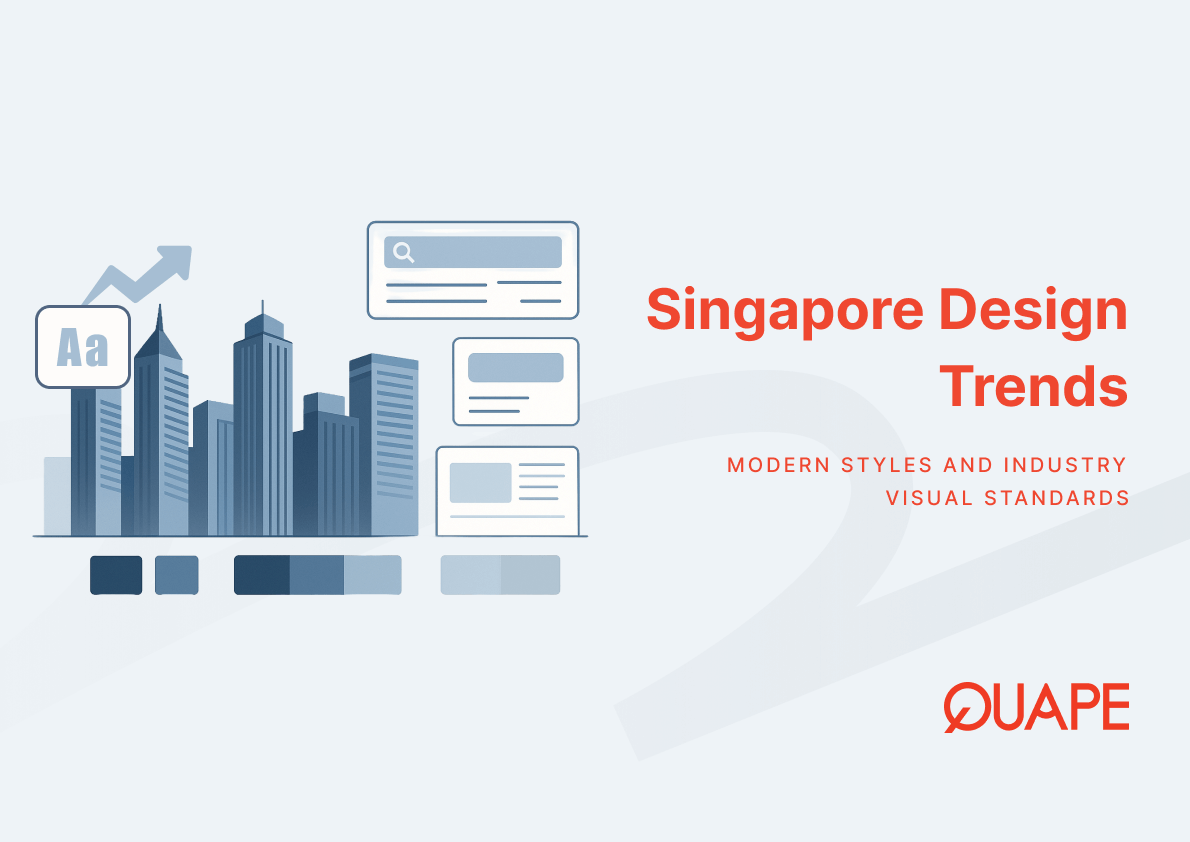
Corporate websites in Singapore operate in one of the most digitally advanced environments in the world, and that context shapes every design decision a company makes. For IT managers, CTOs, and procurement leads evaluating or rebuilding a digital presence, understanding local design benchmarks is not a branding exercise but a strategic one. Singapore’s regulatory landscape, infrastructure quality, and multicultural user base create a set of expectations that differ meaningfully from global averages. Companies that align their web design with these conditions perform better across engagement, trust, and conversion metrics. This article maps the current trends and industry benchmarks that define credible corporate web design in Singapore.
What Singapore Web Design Trends Actually Represent
Singapore web design trends are not simply aesthetic preferences. They are outputs of the country’s digital policy environment, infrastructure maturity, and user behavior patterns. The Smart Nation initiative has systematically raised expectations for digital interfaces across both public and private sectors, pushing corporate websites toward higher usability, responsiveness, and data transparency standards.
These trends reflect a convergence of regulatory pressure, competitive market dynamics, and shifting user expectations. A corporate website in Singapore is evaluated not just on how it looks but on how reliably it performs, how clearly it communicates trust, and how well it adapts to the diverse demographic it serves. Understanding these standards matters especially for businesses navigating the decisions that shape a brand-led corporate website.
Poin-Poin Utama
- Singapore’s internet penetration exceeds 90%, creating a highly demanding digital audience with elevated usability expectations.
- PDPA compliance directly shapes web design decisions, particularly around consent flows, data collection transparency, and cookie handling.
- Mobile devices account for more than half of global web traffic, making mobile-first design a baseline requirement rather than an enhancement.
- A one-second delay in page load time can reduce conversion rates by up to 7%, making performance a measurable business factor.
- Minimalist and functional design systems dominate Singapore’s corporate sector because they reduce cognitive load and support faster navigation.
- Multilingual interfaces improve accessibility across Singapore’s multicultural user base and reduce engagement drop-off.
- Trust signals such as client testimonials, regulatory badges, and transparent data policies directly influence conversion rates in regulated industries.
- AI-driven personalization is increasingly integrated into enterprise corporate websites to improve relevance and session depth.
Key Components of Singapore Web Design Trends
Minimalist and Functional Design Styles in Corporate Websites
Minimalist design has consolidated its position as the dominant visual approach in Singapore’s corporate sector, and the reasoning is functional rather than fashionable. Clean layouts reduce cognitive load, which directly supports faster decision-making by enterprise users who arrive on a website with specific intent. Functional corporate site visual design removes visual friction from the user path, allowing key messages, calls-to-action, and navigation structures to carry more weight.
This approach also performs better technically. Fewer design elements translate to lighter page weight, faster rendering, and better Core Web Vitals scores. For Singapore businesses competing on credibility, a clean and deliberate interface signals operational maturity without requiring extensive explanation.
Corporate Identity Benchmarks Across Singapore Industries
Brand consistency across digital touchpoints functions as a trust mechanism, particularly in sectors where procurement decisions involve multiple stakeholders and extended evaluation cycles. In Singapore’s financial services, legal, and technology sectors, digital brand identity systems that apply uniform typography, color logic, and visual hierarchy across all pages reduce cognitive dissonance and reinforce organizational credibility.
Enterprise benchmarks in Singapore increasingly treat visual inconsistency as a risk signal rather than a stylistic shortcoming. Companies that operate across multiple service lines or markets use structured design systems to ensure that each business unit’s web presence reads as part of a coherent whole, not as isolated or disconnected pages.
UX-Driven Interfaces for Enterprise and SME Websites
User experience design in Singapore’s corporate context is evaluated against two distinct user profiles: enterprise decision-makers who prioritize efficiency and information density, and SME clients who benefit from guided, low-friction journeys. UX design for corporate websites must bridge these needs without defaulting to one at the expense of the other.
The benchmark for usability in Singapore has been shaped significantly by the government’s own digital services, which have set a high standard for clarity, accessibility, and task completion rates. Corporate websites that adopt similar information architecture principles, particularly logical navigation hierarchies and consistent interaction patterns, report lower bounce rates and longer session durations.
According to industry analysis, 88% of online consumers are less likely to return to a website after a poor user experience, a figure that makes UX investment a retention concern, not just an acquisition one.
Performance, Speed, and Technical Efficiency Standards
Website performance is a direct revenue variable in Singapore’s digital economy. Research summarized by Deloitte indicates that a one-second delay in page load time reduces conversion rates by up to 7%. For corporate websites handling lead generation, product inquiries, or service bookings, that figure carries immediate financial implications.
Corporate website speed optimization in Singapore must account for a user base with high bandwidth access and correspondingly high expectations. Slow-loading pages that might be tolerated in lower-connectivity markets create immediate trust deficits here. Technical benchmarks include server response times under 200 milliseconds, Largest Contentful Paint below 2.5 seconds, and full mobile rendering without layout shift.
Content Structuring and Information Hierarchy Trends
How a corporate website organizes and presents information determines whether users find what they need or exit. In Singapore’s B2B and enterprise segments, information hierarchy must support multi-stage decision journeys, where a procurement lead may visit the same website multiple times across different research phases.
Effective corporate website content strategy applies structured content architecture that separates high-level positioning from detailed service specifications, case studies, and technical documentation. This layering ensures that first-time visitors receive orientation while returning visitors can move directly to deeper content without repetitive navigation.
Compliance, Accessibility, and Data Protection Standards
The Personal Data Protection Act shapes Singapore corporate web design in ways that extend well beyond a cookie banner. PDPA-compliant websites require deliberate decisions about data collection points, consent flows, data retention disclosures, and third-party integration transparency. These requirements directly influence UI patterns, particularly how forms, analytics scripts, and CRM integrations are structured.
Accessibility standards, as defined by WCAG guidelines, are increasingly applied alongside compliance requirements. Corporate web accessibility compliance supports Singapore’s multicultural and aging population by ensuring that interfaces remain usable across a broad range of devices, visual capabilities, and technical literacy levels. Companies in sectors subject to government procurement criteria are finding accessibility compliance becoming a prerequisite rather than a preference.
Practical Application for Singapore Businesses and Organizations
Aligning Web Design with Industry-Specific Expectations
Financial services companies in Singapore operate under regulatory scrutiny that extends to their digital interfaces. Clarity in service descriptions, visible licensing disclosures, and secure data handling patterns are baseline requirements. Technology sector companies, by contrast, face pressure to demonstrate innovation through their web experience itself, using interactive elements, performance metrics, and technical documentation as credibility signals.
Government digital guidelines published through IMDA establish a useful benchmark for public-sector facing organizations. These standards influence how government-adjacent companies, including legal firms, consultancies, and infrastructure providers, structure their own digital presence.
Adapting to Multilingual and Regional User Needs
Singapore’s four official languages reflect a multicultural population whose web usage patterns differ by language preference, device type, and content expectation. Multilingual corporate websites that go beyond simple translation to localize tone, imagery, and information structure perform measurably better across diverse segments.
Regional expansion further amplifies this requirement. Singapore-based companies serving clients across Southeast Asia benefit from flexible content architectures that can adapt to local regulatory contexts, language norms, and cultural expectations without requiring full website rebuilds.
Integrating Trust Signals and Credibility Elements
Trust is a design variable as much as a brand variable. In Singapore’s corporate sector, where procurement decisions often involve contracts of significant value, corporate website trust elements such as client testimonials, partner logos, industry certifications, and transparent contact information reduce friction at the evaluation stage.
These elements work because they offload verification burden from the visitor to the website itself. A company that clearly displays its regulatory certifications, client case studies, and operational transparency signals reduces the investigative effort required of a procurement lead, which shortens evaluation cycles.
Leveraging AI and Personalization in Corporate Experiences
AI-driven personalization is moving from an enterprise-only capability toward a standard expectation in Singapore’s more competitive corporate sectors. AI personalization on websites enables dynamic content delivery based on user behavior, referral source, or session history, ensuring that returning visitors and first-time arrivals receive appropriately differentiated experiences.
Behavioral targeting integrated into corporate sites supports lead qualification by surfacing relevant service content earlier in the session. This reduces dependency on sales intervention for early-stage prospects and improves the quality of leads that reach the contact stage.
How Corporate Web Design Supports Singapore Web Design Trends
Custom Design Systems Tailored to Corporate Identity
Generic templates create immediate credibility gaps in Singapore’s corporate environment, where clients evaluate web presence as a proxy for operational quality. Custom design systems that encode brand rules at the component level ensure that every page, every device, and every content update reflects the same visual and structural logic.
Scalable UI systems built around a company’s specific identity support long-term consistency without requiring full redesigns as the organization grows or adds service lines. This approach treats design as infrastructure rather than decoration.
CMS Flexibility and Content Management Efficiency
The ability to update, expand, and reorganize web content without developer dependency is a practical operational requirement, not a feature. Choosing the right CMS for corporate websites determines how quickly a marketing or communications team can respond to business changes, regulatory updates, or campaign needs.
WordPress, when properly configured with structured templates and role-based access controls, supports enterprise content workflows without the overhead of proprietary platforms. The integration of SEO tooling directly into the CMS editing environment further reduces the gap between content production and search performance.
Secure, High-Performance, and Scalable Infrastructure
Corporate website security in Singapore must account for both regulatory requirements and threat landscape realities. SSL enforcement, web application firewall configuration, regular vulnerability scanning, and secure data handling practices are not optional considerations for companies operating in regulated industries or handling customer data.
Performance and security share infrastructure dependencies. Hosting environments optimized for low latency, high availability, and geographic proximity to Singapore’s primary user base support both speed benchmarks and security posture simultaneously.
Supporting Long-Term ROI and Business Growth
A corporate website that meets current design benchmarks but cannot scale with business growth creates recurring replacement costs. Corporate web design ROI is strongest when the underlying architecture supports incremental expansion, whether that means adding service pages, integrating new tools, or extending into new markets.
Conversion optimization built into the design from the outset, including clear call-to-action placement, logical user flows, and performance-tuned landing pages, ensures that the website continues to generate measurable business value rather than simply maintaining a digital presence.
Kesimpulan
Singapore’s corporate web design environment rewards precision. The combination of a digitally sophisticated audience, active regulatory frameworks, and a competitive regional economy means that design decisions carry operational and financial consequences that extend well beyond aesthetics. Companies that align their web presence with current performance, compliance, and UX benchmarks are not simply following trends; they are building infrastructure that supports sustained business credibility and growth. For businesses ready to align with these standards, reaching out to a team with both technical and design experience is a practical starting point. Contact the Quape team at https://www.quape.com/contact-us/.
Pertanyaan yang Sering Diajukan (FAQ)
What makes Singapore’s corporate web design standards different from global norms?
Singapore’s standards are shaped by specific local factors: PDPA compliance requirements, the Smart Nation policy environment, and a highly connected user base with elevated expectations for performance and usability. These factors create design constraints and benchmarks that differ from markets with lower digital infrastructure maturity.
How does PDPA compliance affect web design decisions?
PDPA compliance requires deliberate design choices around data collection, user consent, and transparency in how personal information is stored and used. This affects the structure of forms, the implementation of analytics tools, and how cookie consent mechanisms are presented to users.
Why is mobile-first design a benchmark requirement in Singapore?
Mobile devices account for more than half of global web traffic, and Singapore’s high smartphone penetration means that a significant portion of corporate website visits originate from mobile devices. Designs that are not optimized for mobile create usability failures that directly affect engagement and conversion rates.
What is the business case for investing in website performance optimization?
Research indicates that a one-second delay in page load time can reduce conversion rates by up to 7%. For corporate websites that generate leads or facilitate service inquiries, performance gaps translate directly into revenue loss, making speed optimization a financial decision rather than a technical preference.
How should Singapore SMEs approach corporate web design benchmarks?
SMEs benefit from applying the same structural principles as enterprise companies, including clean information hierarchy, mobile responsiveness, and trust signal integration, while scaling the complexity of implementation to match their operational context and budget. A well-structured, fast, and compliant website supports credibility regardless of company size.
What role does content architecture play in corporate website performance?
Content architecture determines how effectively a website supports multi-stage decision journeys. Structured information hierarchies ensure that first-time visitors receive orientation while returning users can navigate directly to detailed content, reducing friction across the evaluation cycle.
How does multilingual support affect corporate website design in Singapore?
Multilingual interfaces go beyond translation to address differences in content expectations, reading patterns, and cultural context across Singapore’s diverse population. Websites that localize content structure and tone, not just language, perform better across segments and support regional expansion more effectively.
What should companies prioritize when evaluating a web design partner in Singapore?
Companies should evaluate a partner’s demonstrated understanding of PDPA compliance requirements, performance optimization practices, CMS configuration experience, and capacity to build scalable design systems. Technical and strategic alignment matters more than visual portfolio alone.