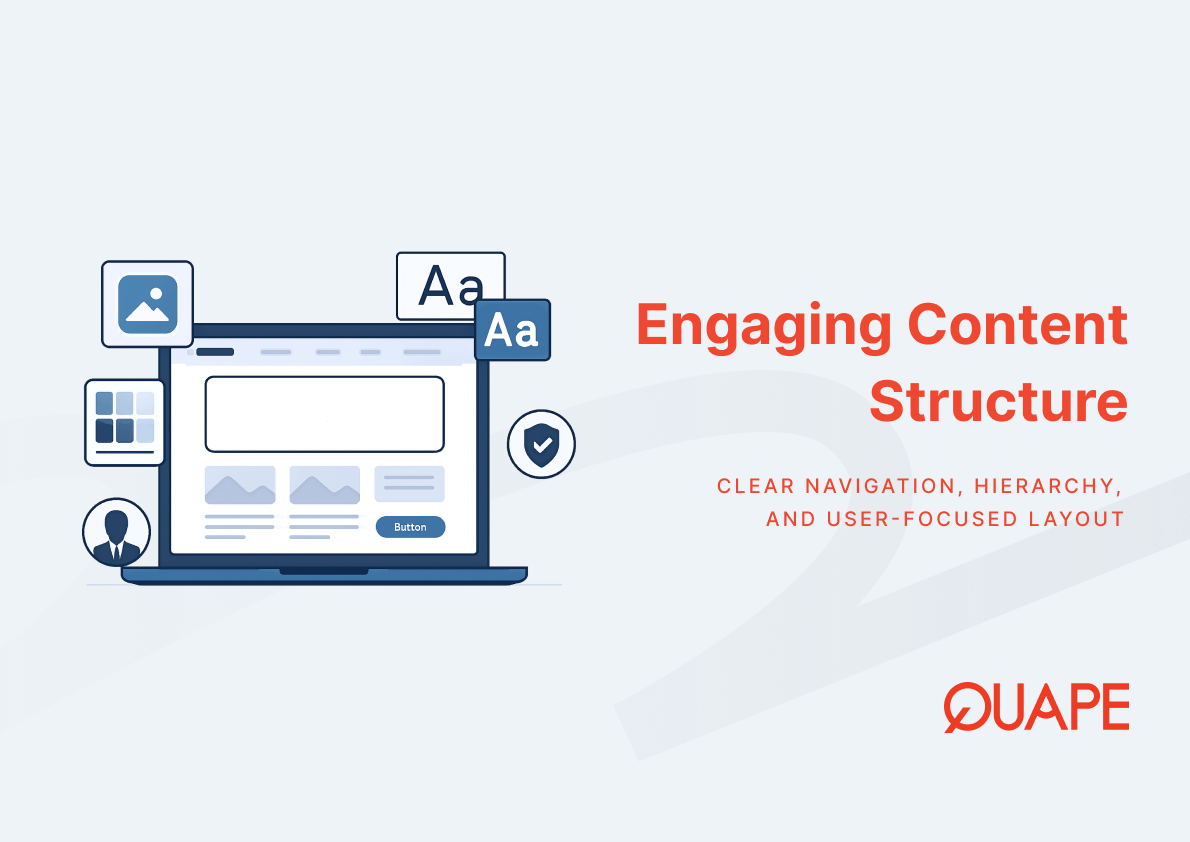
A corporate website is not simply a digital brochure. It is an operational system that processes user intent, communicates organizational capability, and guides decision-makers through structured pathways toward a business outcome. For IT managers, CTOs, and procurement leads in Singapore, how a website organizes its content determines whether technical evaluators can extract the information they need or whether they abandon the session entirely. Information architecture, content hierarchy, and modular design are not aesthetic decisions. They are structural ones with measurable consequences on engagement, discoverability, and trust. When these elements are misaligned, the commercial cost becomes visible in abandonment rates, reduced time-on-site, and weakened conversion signals. Getting the structure right from the beginning supports every other function the website is expected to perform.
Introduction to Corporate Website Content Strategy
Corporate website content strategy refers to the planned arrangement, governance, and delivery of content assets across a website to serve both user intent and organizational objectives. It connects information architecture, content modules, and the engagement funnel into a unified operational system. Without this connective tissue, individual pages function in isolation, and the website fails to accumulate topical authority or guide users toward decisions.
The strategy operates across three layers. The first is structural: how hierarchy entities are defined and how page relationships are established. The second is semantic: how content signals inform both human readers and search engines about the organization’s expertise and relevance. The third is functional: how modular components like product catalogues, booking systems, and CMS-driven editorial tools enable scalable content delivery without creating architectural debt. For Singapore enterprises navigating B2B procurement cycles and technical vendor evaluation, all three layers must work in coordination.
Những điểm chính
- Clear information architecture reduces cognitive friction across awareness, consideration, and decision funnel stages.
- Hierarchy entities define parent-child page relationships that both users and search engines use to interpret topical authority.
- Content modules mapped to business objectives enable scalable expansion without breaking site structure.
- Theo Nielsen Norman Group, users scan rather than read web pages, making visual hierarchy and structured layout critical for engagement outcomes.
- Stanford University research indicates that 75% of users form credibility judgments based on website design, which means structural weaknesses directly affect organizational trust.
- Performance and security decisions made at the architectural level influence both SEO signals and user confidence.
- Singapore-specific factors including PDPA compliance, multilingual audiences, and enterprise procurement processes impose additional structural requirements.
- A well-integrated CMS enables content governance at scale while preserving the hierarchy that supports search engine interpretation.
Information Architecture as the Foundation of Content Structure
Information architecture defines how content is categorized, labeled, and connected across a website. It determines the navigational pathways available to users and the semantic signals available to search systems. When information architecture is weak, users experience friction at every stage of their journey, and search engines encounter ambiguous page relationships that reduce indexing accuracy.
For corporate websites serving technical decision-makers, the architecture must accommodate multiple user types simultaneously. A CTO evaluating vendor capability follows a different path than a procurement manager verifying compliance documentation. The architecture must define clear pathways for each user type without creating redundancy or contradiction between content layers.
Defining Hierarchy Entities for Corporate Websites
Hierarchy entities are the primary organizational units that define content relationships on a website. In a corporate context, primary entities typically include service categories, industry verticals, and solution domains. Secondary entities include supporting content such as case studies, technical documentation, FAQs, and compliance pages. Together, these entities form a semantic map that both users and search engines use to understand the scope and authority of the organization.
Khi corporate website navigation is structured around clearly defined hierarchy entities, search engines can interpret parent-child page relationships and assign contextual weight accordingly. A services page that links to sub-pages covering specific technical capabilities signals topical coherence. This coherence supports indexing accuracy and reduces the likelihood that supporting pages are treated as isolated, low-authority content.
Topical authority accumulates when hierarchy entities are consistent, internally linked, and reinforced by supporting content. An enterprise that documents its service architecture clearly is more likely to be interpreted as an authoritative source within its domain than one whose content is scattered across unrelated categories.
Mapping Content Modules to Business Objectives
Content modules are discrete, reusable content units that can be assembled and reordered without breaking site hierarchy. In a corporate CMS environment, modules may include service descriptions, product catalogue entries, testimonials, technical specification blocks, and call-to-action components. Their value lies not just in flexibility but in their alignment with specific business objectives.
A module designed to serve the awareness stage should introduce a problem space and establish organizational relevance. A module serving the consideration stage should provide comparative detail, technical specifications, or evidence of capability. A module at the decision stage should reduce friction by providing pricing clarity, compliance assurances, or direct access to a sales pathway. When modules are mapped to these funnel stages, each content element performs a defined function within the engagement architecture.
Conversion pathways depend on this mapping. If decision-stage modules appear too early in the user journey, visitors without sufficient context will disengage. If awareness-stage content dominates pages that technically qualified users are expected to navigate, those users will find the experience inefficient and exit without completing the intended task.
Structuring the Engagement Funnel Through Content Layers
The engagement funnel describes the progression from initial awareness through active consideration to a conversion decision. For corporate websites, this funnel rarely operates linearly. B2B decision-makers return to the site multiple times across an evaluation cycle, each time seeking different content at different depths. Structuring content layers to support this non-linear behavior requires deliberate hierarchy planning.
At the awareness layer, content should address organizational problems and establish relevance without requiring deep technical knowledge. At the consideration layer, content should enable direct comparison across service attributes, technical requirements, and vendor credibility signals. The corporate website trust elements that appear at this stage, including security certifications, compliance documentation, and client references, directly influence whether a user advances toward a decision.
At the decision layer, content should reduce the cognitive effort required to commit. This means clear pricing structures, transparent service scopes, and accessible contact pathways. When these layers are structurally distinct but logically connected through internal linking and navigation, the engagement funnel operates with less friction at every stage.
Content Modules and Functional Components in Corporate Websites
CMS architecture determines how content modules are created, stored, governed, and delivered. A well-designed CMS supports structured content delivery by enforcing consistent templates, enabling version control, and preserving the hierarchy entities that define site authority. For corporate websites with large content libraries, CMS architecture is not an operational detail but a strategic infrastructure decision.
Modular web design enables organizations to expand content without architectural disruption. New service pages, regional content clusters, or compliance documentation layers can be added as discrete modules without restructuring existing hierarchy. This scalability reduces technical debt over time and supports long-term content governance without requiring repeated full-site rebuilds.
Aligning CMS Capabilities with Structured Content Delivery
WordPress CMS supports structured content delivery through its taxonomy system, custom post types, and integration with structured data plugins. When configured correctly, it enables editorial workflows that enforce content hierarchy, maintain internal linking standards, and support SEO integration at the module level.
Các best CMS for corporate websites is one that aligns with the organization’s content governance model, not simply the one with the most features. Content governance refers to the policies, roles, and workflows that determine how content is created, reviewed, published, and retired. Without governance, even a technically capable CMS will produce a fragmented content environment over time.
Editorial workflows within a CMS should map to the content hierarchy. Pages at the primary entity level, such as core service pages, should follow stricter review processes than secondary entity pages. This differentiation ensures that the most strategically significant content receives the most rigorous quality control.
Integrating Functional Modules Without Breaking Hierarchy
Functional modules such as AI chatbots, product catalogue systems, booking systems, and membership access controls extend website capability without inherently disrupting content hierarchy, provided they are integrated with structural awareness. The risk arises when functional modules are added reactively, without consideration of how they interact with existing page hierarchy and user journeys.
An AI chatbot that surfaces content from across the site relies on coherent content structure to deliver accurate responses. If the underlying content hierarchy is inconsistent, the chatbot will produce fragmented or contradictory answers, which reduces rather than enhances user confidence. Similarly, a product catalogue system that does not inherit the site’s taxonomy creates an isolated content island that neither users nor search engines can interpret within the broader organizational context.
Access control layers in membership systems introduce additional structural requirements. Content gated behind membership access must still be indexed or organized in a way that communicates its existence and relevance, even to unauthenticated users. This requires careful coordination between the CMS hierarchy, the access control system, and the metadata layer.
Performance and Security as Structural Signals
Website performance and security are not separate from content strategy. They are structural signals that affect both user experience and search engine interpretation. A page that loads slowly reduces engagement regardless of how well its content is structured. A website with security vulnerabilities introduces risk that affects both operational continuity and user trust.
Corporate website speed optimization begins at the architectural level. Decisions about image compression, server response time, caching strategy, and third-party script management all influence page load performance. These decisions must be made in coordination with content structure, not as an afterthought.
Corporate website security architecture, including web application firewalls, access control policies, and software update governance, reduces exposure to the vulnerabilities that continue to affect a significant proportion of organizations globally. Security decisions made during the architecture phase are less costly and more effective than those applied reactively after an incident. For enterprise procurement evaluators assessing vendor websites, visible indicators of security competence, including HTTPS implementation, clear privacy disclosures, and structured data governance, influence vendor credibility assessments.
Practical Application for Singapore Enterprises
Singapore enterprises operate within a specific regulatory and commercial environment that imposes additional structural requirements on corporate websites. PDPA compliance, multilingual user bases, and B2B procurement processes that involve multiple technical stakeholders require content architecture that goes beyond standard usability best practices.
The concentration of technology-oriented businesses, financial services firms, and government-linked enterprises in Singapore means that corporate websites are frequently evaluated by technically sophisticated users. Content depth, documentation clarity, and structural transparency are more important in this market than in consumer-facing contexts where emotional appeal may dominate.
Structuring Content for IT Managers and CTOs
IT managers and CTOs approach corporate websites with a specific evaluation agenda. They are looking for technical documentation layers that confirm system architecture, scalability planning, integration capabilities, and security posture. Content that addresses these concerns must be structured so that it is findable within two to three navigation steps from the homepage.
Scalability planning documentation should explain how the vendor’s systems handle growth in users, content volume, and functional complexity. System architecture transparency, including clear descriptions of hosting infrastructure, CMS configuration, and security architecture, enables technical evaluators to form independent assessments without requiring a sales conversation. This structural transparency reduces evaluation friction and accelerates procurement timelines.
Supporting Procurement and Compliance Requirements
PDPA-compliant websites must include clearly structured data handling disclosures, consent management mechanisms, and access control documentation. These requirements influence site structure by mandating dedicated content areas for privacy policies, data processing notices, and user rights information.
Procurement leads use vendor evaluation criteria that include compliance documentation, service scope clarity, and commercial transparency. When this information is buried within unstructured content or distributed across inconsistent page templates, procurement evaluations take longer and are more likely to produce negative assessments. Structuring compliance content as a discrete content cluster within the site hierarchy enables procurement leads to locate and verify this information efficiently.
Data governance policies must be reflected not only in site content but in the operational behavior of the website itself. Form handling, cookie management, and third-party data sharing practices must align with disclosed policies and be verifiable through the site’s technical configuration.
Addressing Multilingual and Regional Expansion Needs
Multilingual corporate websites in Singapore must serve audiences communicating in English, Mandarin, Malay, and Tamil, often within the same organization. Multilingual architecture requires a content hierarchy that accommodates language variants without fragmenting topical authority or creating duplicate content signals that confuse search engines.
Regional content clusters enable organizations expanding across Southeast Asia to serve market-specific content while maintaining a coherent parent site hierarchy. A Singapore entity with regional operations in Malaysia, Indonesia, or Thailand benefits from a localization strategy that adapts content at the secondary entity level while preserving the primary entity structure established in the core site. This approach supports both user relevance and search engine interpretation of regional authority.
How Corporate Web Design Supports Corporate Website Content Strategy
Translating information architecture into a functioning website requires more than design competence. It requires technical capability in CMS implementation, hierarchy configuration, SEO signal integration, performance optimization, and security architecture. Each of these disciplines must operate in coordination to produce a website that performs its strategic function across the full engagement funnel.
QUAPE’s Corporate Web Design service approaches website development by addressing these layers in sequence. Content hierarchy is defined before visual design begins. CMS architecture is configured to support content governance and structured data delivery. SEO signals are integrated at the template level, not applied retrospectively. Performance optimization is built into the hosting and deployment configuration. Security architecture is established before the site goes live, reducing exposure to vulnerabilities that affect organizations relying on post-launch remediation.
Scalable CMS implementation means the website can accommodate content expansion, functional module additions, and regional localization without requiring architectural rebuilds. Clean hierarchy entities, properly implemented from the start, preserve their structural integrity as the content library grows. This approach reduces long-term technical debt and supports the organization’s ability to respond to market changes without disproportionate investment in site restructuring.
Kết luận
A well-structured corporate website content strategy aligns information architecture, hierarchy entities, and modular content components into an engagement funnel that serves both human decision-makers and search engine systems. For Singapore enterprises, this structure must also accommodate regulatory requirements, multilingual audiences, and technically sophisticated procurement evaluators. The decisions made at the architecture level, covering hierarchy, CMS configuration, performance, and security, determine whether the website accumulates authority and converts engagement over time or remains a collection of disconnected pages that fail to perform their commercial function.
If you are planning to refine your corporate website structure or build a scalable content framework from the ground up, liên hệ với nhóm của chúng tôi tại đây.
Câu Hỏi Thường Gặp
What is corporate website content strategy?
Corporate website content strategy is the planned approach to organizing, governing, and delivering content across a website to serve user intent and business objectives. It connects information architecture, content modules, and the engagement funnel into a coordinated system. Without it, individual pages function in isolation and fail to guide users toward decisions.
How does information architecture affect engagement?
Information architecture defines how content is categorized and connected, which directly determines how easily users can find what they need. When the hierarchy is clear, users move through awareness, consideration, and decision stages with less cognitive effort. Reduced friction increases time-on-site and task completion rates.
What are hierarchy entities in a corporate website?
Hierarchy entities are the primary and secondary organizational units that define content relationships on a site. Primary entities typically include service categories and solution domains, while secondary entities include supporting content like FAQs, case studies, and compliance documentation. Together they form a semantic structure that both users and search engines use to interpret the site’s authority.
Why do content modules matter for scalability?
Content modules are reusable, discrete content units that can be added or reorganized without disrupting the existing site hierarchy. This modularity enables organizations to expand their content library, add new service areas, or introduce regional content clusters without requiring a full site rebuild. It reduces technical debt and supports long-term content governance.
How does website performance relate to content strategy?
Performance decisions, including server configuration, image optimization, and caching strategy, affect how quickly content reaches users. Slow load times increase abandonment rates regardless of content quality. Performance optimization must be integrated into the architectural planning phase, not applied as a separate afterthought.
What PDPA requirements affect corporate website structure in Singapore?
PDPA compliance requires corporate websites to include clearly structured privacy disclosures, consent management mechanisms, and data handling documentation. These requirements create structural demands, including dedicated content areas for privacy policies and user rights information. Form handling and cookie management must also align with disclosed data governance policies.
How should a corporate website serve both IT managers and procurement leads?
IT managers typically need technical documentation layers covering infrastructure, scalability, and security architecture, findable within a few navigation steps. Procurement leads need compliance documentation, service scope clarity, and commercial transparency organized into accessible content clusters. A well-structured site accommodates both user types through distinct content pathways that operate within the same hierarchy.
What is required for multilingual corporate website architecture?
Multilingual architecture requires a content hierarchy that accommodates language variants without fragmenting topical authority or creating duplicate content issues. Language variants should be implemented at the secondary entity level while preserving the primary site hierarchy. For organizations with regional operations, market-specific content clusters can serve local audiences while maintaining the coherence of the parent site structure.

- Squarespace Alternative: Bespoke UI/UX Design that Converts High-Ticket Clients - Tháng 6 17, 2026
- Wix Alternative for Enterprises: Why You Need Custom Corporate Web Design - Tháng 6 16, 2026
- Dropbox Business Alternative: Avoid High User Licensing Fees with Private Nextcloud - Tháng 6 15, 2026