Corporate websites carry a weight that marketing materials and social profiles cannot replicate. When a procurement lead, CTO, or operations manager visits your site for the first time, they are not browsing for inspiration. They are evaluating whether your organisation is credible, secure, and worth engaging. Trust signals embedded throughout your site directly influence that judgment, often within seconds. For Singapore businesses operating in competitive B2B environments, this is not a design preference. It is a commercial necessity.
Introduction to Corporate Website Trust Elements
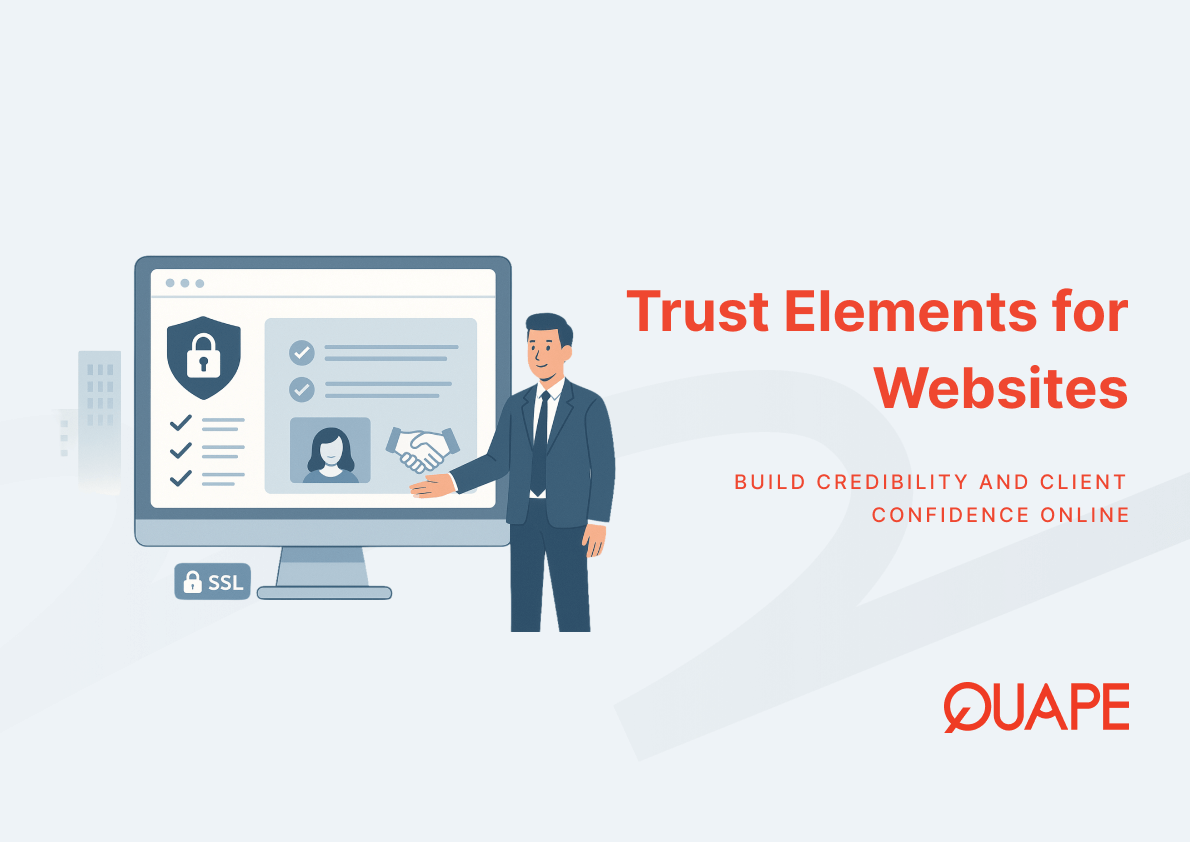
Corporate website trust elements are the structural and visual components of a site that communicate legitimacy, security, and organisational transparency to visitors. These elements include technical signals like encryption certificates, legal documentation such as privacy policies, and content-based indicators like client testimonials and leadership profiles. Each one performs a distinct function in reducing visitor uncertainty.
The concept of digital trust in corporate web design describes how individual credibility signals combine to form an overall impression of reliability. No single element builds trust in isolation. Instead, they operate as a system, where each component reinforces the others. A website with strong security implementation but no visible contact details still creates doubt. A site with compelling testimonials but no HTTPS certificate sends a conflicting message.
Những điểm chính
- SSL certificates and HTTPS protect data in transit and signal to visitors that your organisation takes security seriously.
- Privacy policies and legal transparency confirm that your business handles personal data according to documented and compliant standards.
- Visible contact information, including a physical address and direct email, validates that a real organisation operates behind the site.
- Customer testimonials and case studies provide third-party evidence of your reliability, particularly influential in B2B procurement decisions.
- Transparency elements such as leadership profiles and service disclosures reduce the ambiguity that causes visitors to disengage.
- Trust signals are interdependent. Weaknesses in one area diminish the effectiveness of the others.
- Singapore businesses must also account for PDPA compliance expectations, which influence how trust elements are perceived by local corporate buyers.
Key Components of Corporate Website Trust Elements
SSL Certificates and Security Badges as Trust Signals
SSL certificates and HTTPS implementation are now the baseline expectation for any professional website, but their role as trust signals extends beyond technical compliance. When a visitor sees HTTPS in the browser bar, they receive an immediate, browser-level confirmation that the connection between their device and the server is encrypted. According to research aggregated from SSL deployment data, 85% of internet users report feeling safer on websites with SSL certificates, linking visible encryption indicators directly to trust perception. The same data indicates that more than 317 million SSL certificates were deployed globally by 2024, reflecting how deeply this standard has embedded itself in web infrastructure.
The practical implication for corporate websites is significant. Browsers now display a “Not Secure” warning on HTTP sites, which appears before a visitor reads a single line of your content. This warning does not merely signal a technical gap. It introduces immediate doubt about whether your organisation exercises basic operational care. For businesses in sectors where procurement processes involve security assessments, such as financial services, legal firms, and enterprise technology vendors, an unencrypted website can disqualify you from consideration before a conversation begins. Proper corporate website security implementation addresses this risk through certificate management, HTTPS enforcement, and security header configuration working in combination.
It is also worth noting that SSL alone does not guarantee a secure website. Research published on arXiv found that in a study of over 3,000 global websites, more than half received failing security grades due to insufficient protection mechanisms beyond basic HTTPS. Security badges, when displayed, must reflect genuine implementation. Visitors who click on a badge and find it invalid or outdated will experience a sharper drop in trust than if no badge were present at all.
Clear Privacy Policies and Legal Transparency
A privacy policy page does more than satisfy regulatory requirements. It communicates that your organisation has thought carefully about how it handles visitor data, and that it is prepared to be accountable for those practices. In Singapore, this is directly relevant to PDPA obligations, where organisations collecting personal data through contact forms, live chat, or newsletter subscriptions must document and disclose their data handling practices. Businesses building PDPA-compliant websites embed these disclosures at the structural level, not as an afterthought.
For corporate buyers and procurement teams, the presence of a clearly written and accessible privacy policy reduces the due diligence burden during vendor evaluation. A policy that is hidden in a footer link and written in dense legal language does not serve the same trust function as one that is written plainly, easy to locate, and specific about what data is collected, how it is stored, and who has access to it. The document itself becomes a transparency signal. Corporate governance standards in Singapore enterprises increasingly include third-party website security and data compliance as part of vendor assessments, which means your privacy policy is reviewed by people who know what to look for.
Visible Contact Information and Corporate Identity
Contact information is one of the most overlooked trust elements on corporate websites, yet it functions as a fundamental legitimacy signal. The presence of a company address, direct phone number, and corporate email address confirms that a real organisation exists behind the website and that it is reachable. Its absence creates a gap that no amount of polished design can fully bridge. Visitors who cannot find a way to verify your physical presence or reach a human contact will simply leave.
This is particularly relevant for Singapore businesses targeting enterprise clients, where procurement processes often require verifiable company details before any commercial engagement proceeds. A registered business address aligned with your ACRA records, a corporate email using your own domain rather than a generic provider, and a clearly structured digital brand identity that connects your contact information to your company story all contribute to a coherent picture of legitimacy. These signals are not decorative. They answer a specific question that every serious visitor asks: is this a real organisation that will be accountable if something goes wrong?
Customer Testimonials and Social Proof
Customer testimonials operate as reputation signals in corporate website contexts because they provide third-party evidence that other organisations have engaged with you and found the experience satisfactory. In B2B environments, where purchase decisions involve multiple stakeholders and higher risk thresholds, this kind of social proof carries measurable weight. A testimonial from a named contact at a recognisable company communicates what no service description can: that the relationship was real, the work was delivered, and someone is willing to put their professional credibility behind that assessment.
The strategic placement and presentation of testimonials matters as much as their content. Testimonials buried at the bottom of a homepage or aggregated on a single reviews page carry less weight than those integrated contextually into service pages, where they appear alongside the specific capability they validate. Case studies extend this principle further by describing the problem, the approach, and the outcome in enough detail to support procurement-level evaluation. Organisations developing a corporate website content strategy that incorporates structured social proof at key decision points create a more persuasive and credible user experience than those that treat testimonials as an afterthought.
Transparency Elements in Corporate Websites
Transparency elements include company background pages, leadership profiles, service scope disclosures, and, where applicable, pricing structures. These components address a specific cognitive need in visitors: they want to understand not just what you do, but who you are and how you operate. A leadership team page with named individuals and professional backgrounds reduces the anonymity that undermines trust in faceless organisations. A company history section confirms longevity and stability.
Service disclosures that clearly describe scope, process, and deliverables reduce the ambiguity that causes potential clients to hesitate before making contact. In Singapore’s B2B market, where enterprise buyers are experienced and often risk-averse, vague service descriptions are interpreted as a lack of clarity rather than strategic positioning. Corporate site visual design that structures these transparency elements into a coherent narrative, using layout, typography, and content hierarchy, ensures that visitors can locate and process this information without friction.
Ứng dụng thực tế cho doanh nghiệp Singapore
Singapore’s enterprise procurement environment applies a higher baseline of scrutiny to corporate websites than many other markets. Procurement teams evaluating vendors frequently include IT and legal reviewers who assess not just what a company offers, but how its digital presence aligns with data governance and security expectations. For companies bidding on government-linked contracts or operating in regulated industries such as finance, healthcare, or professional services, the trust signals on your website are often reviewed as part of formal vendor qualification processes.
PDPA-compliant website architecture is a specific expectation in Singapore’s corporate environment. Businesses that demonstrate through their website structure that they understand and adhere to local data protection obligations signal a level of operational maturity that distinguishes them from competitors. This extends to how cookie consent mechanisms are implemented, how contact forms handle data submissions, and whether data breach notification procedures are documented. Understanding Singapore web design trends in this context means recognising that local corporate buyers have specific expectations shaped by regulatory familiarity and enterprise-grade procurement standards.
How Corporate Web Design Supports Corporate Website Trust Elements
Trust elements do not function independently of the design and architecture surrounding them. A security badge placed in a poorly structured footer, a testimonial buried beneath unrelated content, or a privacy policy linked from a navigation menu that visitors cannot find all fail to deliver the trust value they are supposed to carry. The design system of a website determines whether trust signals are visible, accessible, and credible.
Chuyên nghiệp corporate web design services integrate trust elements into the structural logic of the site from the beginning, rather than adding them as a compliance layer after the site is built. This means that SSL enforcement, contact visibility, legal transparency, and social proof are planned as components of the user journey, positioned where they are most likely to reduce friction and reinforce confidence. UX credibility signals emerge from the cumulative experience of navigating a well-organised site where information is where visitors expect it to be and every interaction confirms that the organisation behind it is competent and trustworthy.
Corporate website navigation best practices also contribute directly to trust, because a visitor who cannot find what they are looking for does not conclude that the information is hidden. They conclude that the organisation is disorganised. Navigation architecture that anticipates the questions that procurement leads and CTOs bring to a site, and answers them efficiently, is itself a form of credibility.
Kết luận
A trustworthy corporate website is built on clear signals that reassure visitors about security, transparency, and credibility. When these elements are properly integrated into the site’s structure, design, and content, they strengthen confidence among stakeholders, partners, and potential clients. For Singapore businesses, where procurement standards are high and digital due diligence is routine, the gap between a site that communicates trust and one that does not is measurable in commercial outcomes.
If you would like guidance on building a trustworthy and high-performing corporate website, you can reach out to the specialists at Quape here: Liên hệ bán hàng
Câu Hỏi Thường Gặp
What are corporate website trust elements? Corporate website trust elements are the structural, visual, and content-based components of a website that communicate legitimacy, security, and transparency to visitors. They include SSL certificates, privacy policies, contact information, testimonials, and company background content. Together, these elements reduce visitor uncertainty and support conversion in B2B contexts.
Why does HTTPS matter for corporate website credibility? HTTPS encrypts the connection between a visitor’s browser and the web server, protecting data in transit from interception. Beyond the technical protection it provides, HTTPS functions as a visible trust signal. Browsers now display “Not Secure” warnings on non-HTTPS sites, which can undermine credibility before a visitor reads any content.
Is SSL alone enough to make a corporate website secure and trustworthy? No. SSL certificates establish encrypted communication, but they do not address other vulnerabilities such as misconfigured security headers, insecure third-party scripts, or inadequate data handling practices. A comprehensive approach to website security addresses all of these layers, not just certificate installation.
What contact information should a corporate website display to build trust? At minimum, a corporate website should display a verified business address, a direct phone number, and a corporate email using the company’s own domain. For Singapore businesses, aligning the displayed address with ACRA registration records adds an additional layer of verifiable legitimacy.
How do customer testimonials influence B2B procurement decisions? In B2B contexts, testimonials from named contacts at recognisable organisations provide third-party validation that reduces the perceived risk of engaging a new vendor. Case studies that describe specific problems, approaches, and outcomes carry even greater weight because they give procurement teams enough detail to evaluate relevance to their own situation.
What is the role of a privacy policy in building corporate website trust? A privacy policy confirms that your organisation has documented how it collects, stores, and uses visitor data. In Singapore, this is tied to PDPA obligations. For corporate buyers, a clear and accessible privacy policy reduces the due diligence burden during vendor evaluation and signals that your organisation operates with governance standards in place.
How does website navigation affect trust on corporate websites? Poor navigation creates the impression of an disorganised or inattentive organisation. When visitors cannot locate contact information, service details, or legal documentation quickly, they interpret the friction as a credibility signal rather than a technical inconvenience. Clear, logical navigation architecture is itself a form of trust communication.
How should transparency elements be structured on a corporate website? Leadership profiles, company history, service scope descriptions, and pricing information should be structured as part of the primary content hierarchy, not hidden in secondary pages or footer links. Visitors who encounter these elements naturally during their journey receive a more credible and reassuring experience than those who have to search for them.

- Squarespace Alternative: Bespoke UI/UX Design that Converts High-Ticket Clients - Tháng 6 17, 2026
- Wix Alternative for Enterprises: Why You Need Custom Corporate Web Design - Tháng 6 16, 2026
- Dropbox Business Alternative: Avoid High User Licensing Fees with Private Nextcloud - Tháng 6 15, 2026