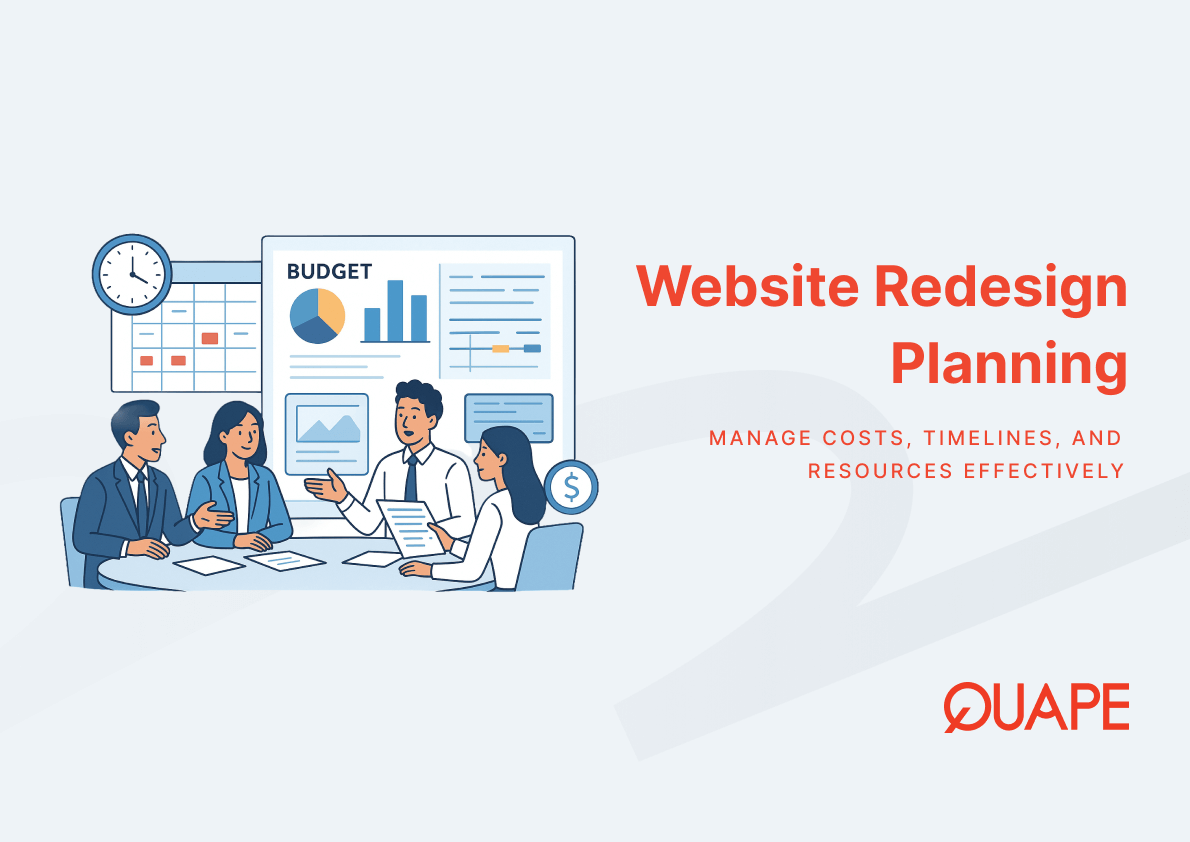
Corporate website redesign projects fail more often than most IT leaders expect, and the reasons are rarely technical. Budget overruns, missed milestones, and scope drift typically originate in planning decisions made before a single line of code is written. For IT managers, CTOs, and procurement leads in Singapore, understanding the structural causes of timeline and budget failure is the first step toward preventing them. This article breaks down the core entities that govern redesign project outcomes: how project management frameworks interact with cost estimation, how vendor selection shapes delivery risk, and how resource allocation determines whether parallel workstreams actually converge on time. If your organisation is preparing for a corporate website overhaul, this guide gives you the operational context to plan with precision rather than optimism.
What Website Redesign Timelines Actually Represent
A website redesign timeline is not simply a list of tasks arranged in sequence. It is a system of interdependencies connecting business decisions, design outputs, technical development, content production, and third-party vendor delivery. Each dependency creates potential failure points: a delayed stakeholder sign-off on UX wireframes can stall development sprints by weeks, and a procurement cycle that runs longer than expected can push launch dates by an entire quarter.
The corporate website lifecycle extends this complexity further. Unlike a greenfield build, a redesign must account for content migration, legacy system integrations, and the operational risk of transitioning a live site without disrupting existing traffic or lead flow. Treating redesign timelines as a scheduling exercise, rather than a risk management exercise, is one of the most consistent predictors of project failure.
Những điểm chính
- According to McKinsey, 45% of large IT projects run over budget, and 7% exceed cost estimates by more than 50%.
- Poor scope definition and weak stakeholder alignment are primary drivers of timeline delays and cost overruns.
- Agile frameworks improve delivery adaptability but can introduce scope fluidity that undermines budget predictability if not tightly governed.
- Bottom-up cost estimation produces more accurate budgets than top-down approaches, but requires more planning investment upfront.
- Vendor selection and procurement processes introduce timeline dependencies that are often underestimated during initial planning.
- Resource allocation bottlenecks, particularly during design approval and development handoff phases, are a leading cause of internal delays.
- Singapore-specific factors, including PDPA compliance and enterprise procurement standards, add regulatory and procedural layers to redesign timelines.
- Organisations with mature project management practices report significantly lower failure rates, according to the Project Management Institute.
Introduction to Website Redesign Timelines
The starting point for any redesign project is scope definition. Scope determines which pages are being rebuilt, which systems need integration, which content must be produced from scratch, and which stakeholders have approval authority at each phase. When scope is poorly defined at the outset, the project is effectively operating without a ceiling on cost or time.
Stakeholder alignment reinforces scope control. In corporate environments, website redesign projects typically involve IT, marketing, procurement, and sometimes legal. Each team has different priorities, different approval timelines, and different definitions of “done.” When these groups are not aligned early, the result is iterative revision cycles that compress delivery timelines and expand budgets simultaneously. The strategic foundation of a brand-led corporate website depends on this alignment being established before any design or development work begins.
Key Components of Website Redesign Timelines
Project Management Frameworks for Website Redesign
The choice of project management framework directly shapes how a redesign timeline is structured and how risk is distributed across the project. Agile methodology organises work into sprints, typically two to four weeks in length, with defined deliverables and review cycles at each interval. This structure enables faster feedback loops and reduces the risk of large-scale delivery failure because problems surface earlier.
Waterfall model execution, by contrast, sequences phases strictly: discovery, design, development, testing, launch. Each phase must complete before the next begins. This improves predictability for budget forecasting but reduces flexibility when business requirements change mid-project, which they frequently do in corporate environments. Hybrid project management combines elements of both: a fixed discovery and architecture phase followed by agile development sprints. For complex Singapore enterprise projects, this hybrid approach often balances the need for procurement-compatible planning with the delivery adaptability that modern web builds require.
Milestone tracking is critical regardless of framework. Without clearly defined milestones tied to deliverable outputs rather than calendar dates, project status reporting becomes subjective, and timeline slippage goes undetected until it is too late to recover.
Cost Estimation Models in Corporate Web Projects
Budget accuracy in website redesign depends heavily on which cost estimation model is applied and when. Bottom-up estimation builds the budget from individual task-level estimates: each design component, each development module, each integration point, and each round of testing is costed separately and aggregated. This approach is more time-intensive but produces estimates that reflect actual project complexity.
Top-down estimation starts with a target budget and distributes it across phases based on assumed proportions. It is faster and useful for initial feasibility assessments, but it consistently underestimates the cost of complex integrations and multi-stakeholder approval cycles. For corporate website redesigns involving CRM integration, PDPA-compliant data handling, or multilingual content, top-down estimation creates budget exposure that materialises during development.
Total cost of ownership (TCO) must also factor into budget frameworks. The upfront redesign cost is only part of the financial picture. Hosting infrastructure, ongoing CMS licensing, security maintenance, SEO tooling, and post-launch content production are recurring costs that should be planned alongside the initial build. Understanding corporate web design ROI requires this full cost visibility to evaluate project value accurately.
Resource Allocation and Team Structuring
Resource allocation determines whether a redesign timeline is theoretically achievable or actually achievable. A project plan that schedules design, development, and content production in parallel assumes that each team has dedicated capacity. In practice, shared resources across multiple projects create bottlenecks that compress timelines faster than any external dependency.
In-house versus outsourced team decisions affect this directly. In-house teams offer tighter communication and faster iteration cycles, but they are constrained by internal capacity. Outsourced or agency teams introduce communication overhead and handoff complexity, but they bring dedicated bandwidth and specialised skills. For most Singapore SMEs and mid-market organisations, a hybrid structure works best: internal project ownership with external execution partners.
Cross-functional teams require workload distribution planning that accounts for non-design and non-development tasks. Stakeholder review cycles, legal approval of content, and procurement sign-off on vendor contracts all consume internal capacity. Capacity planning that ignores these non-production activities consistently underestimates the true resource load of a redesign project.
Vendor Selection and Procurement Strategy
Vendor selection is one of the highest-impact timeline variables in a corporate website redesign. The RFP process, vendor evaluation, contract negotiation, and SLA finalisation can easily consume six to eight weeks before any project work begins. For organisations operating within enterprise procurement standards, this timeline is often non-negotiable.
According to the OECD, procurement inefficiencies can increase project costs by 10 to 15% due to delays and contract misalignment. This cost is frequently invisible during planning because it manifests as timeline extension rather than a direct budget line item.
Vendor evaluation criteria should extend beyond price. Technical capability, CMS expertise, integration experience, and post-launch support structure are all factors that affect total delivery risk. A vendor who is cheaper at contract signing but lacks experience with the specific CMS or integration stack can generate rework costs that exceed the initial savings.
Service-level agreements (SLA) deserve careful attention during contract negotiation. Vague SLA language around revision cycles, response times, and delivery milestones creates ambiguity that vendors interpret in their favour and clients interpret in theirs. Tight SLA definitions reduce this ambiguity and create enforceable accountability throughout the project. Understanding common corporate web design challenges helps procurement leads anticipate where SLA specificity matters most.
Timeline Risk Management and Buffer Planning
Risk mitigation in website redesign timelines operates on two levels: identifying dependencies that can cause delays and building buffer capacity that absorbs those delays without affecting the critical path. Dependency mapping is the foundational activity here. Every task that cannot begin until another task completes is a dependency, and every dependency is a potential delay point.
The critical path method identifies the longest sequence of dependent tasks in the project. Any delay on the critical path extends the overall timeline by an equivalent amount. Tasks not on the critical path have float, meaning they can slip without affecting the launch date. Understanding which workstreams are on the critical path allows project managers to concentrate risk mitigation resources where they matter most.
Contingency planning translates this analysis into reserve allocation. Best practice in corporate IT projects is to hold a contingency buffer of 15 to 20% of both timeline and budget. This buffer is not a target to consume but a mechanism to absorb unplanned complexity without triggering formal project re-scoping.
Content, UX, and Design Dependencies in Timelines
Content production is consistently underestimated as a timeline driver in corporate website redesigns. UX design for corporate websites depends on content structure: information architecture cannot be finalised without knowing what content exists, and design cannot be approved without representative content in place. When content production runs behind the design schedule, the entire development phase is affected.
The content production workflow involves more stakeholders than most project plans account for. Writers, subject matter experts, legal reviewers, brand managers, and executive approvers all interact with content before it is production-ready. Each interaction adds time. Building a realistic corporate website content strategy early in the project prevents content from becoming the last-minute bottleneck that delays launch.
Design approval cycles introduce similar delays. In corporate environments, design sign-off often requires multiple rounds of review across departments with different aesthetic preferences and brand interpretations. Defining approval authority clearly at project initiation, specifying who has final decision-making power and how many revision rounds are included, prevents cycles from extending indefinitely. A structured approach to corporate site visual design disciplines this process by anchoring decisions to brand governance criteria rather than subjective preference. The UX framework itself should similarly be treated as a governed deliverable, not an open-ended design conversation, as outlined in UX design for corporate websites.
Technical Development and CMS Considerations
CMS selection is a technical decision with direct timeline and budget consequences. A CMS that matches the development team’s expertise enables faster build cycles and reduces debugging overhead. A CMS selected primarily on feature lists or vendor preference, without considering the team’s technical familiarity, introduces a learning curve that consumes development time without producing deliverable output.
WordPress remains the dominant choice for corporate websites in Singapore due to its ecosystem maturity, plugin availability, and the broad availability of local development talent. Custom frameworks built on Laravel or similar technologies offer greater architectural flexibility but require longer development timelines and more specialised teams. Evaluating the best CMS for corporate websites against the specific project scope, team capability, and post-launch maintenance requirements produces a more defensible decision than evaluating CMS platforms in isolation.
Development sprints must account for integration planning. CRM integrations, marketing automation connections, analytics implementations, and third-party service APIs each require separate development effort, testing cycles, and often vendor coordination. Projects that treat integrations as add-ons rather than core development workstreams consistently underestimate their timeline and cost impact.
Practical Application for the Singapore Market
Singapore’s regulatory environment adds specific requirements to corporate website redesign timelines that organisations in other markets may not encounter at the same intensity. The Personal Data Protection Act (PDPA) governs how websites collect, store, and process personal data. For redesign projects involving contact forms, customer portals, membership systems, or any first-party data capture, PDPA-compliant website architecture must be planned from the start rather than retrofitted after launch.
Enterprise procurement standards in Singapore, particularly within GLCs, statutory boards, and larger private enterprises, impose structured vendor selection processes that can extend pre-project timelines significantly. Budget approval cycles, multi-level vendor evaluation, and contract review by legal counsel are standard requirements that must be built into the overall project schedule rather than treated as pre-project overhead.
Regional project timelines also reflect the talent market. Singapore’s web development workforce is competitive, and experienced teams with both technical depth and enterprise project management capability are in high demand. Organisations that begin vendor selection late in the planning process frequently find their preferred partners are unavailable for their target timeline. Awareness of Singapore web design trends and market conditions helps procurement leads initiate vendor engagement at the right point in the planning cycle.
How Corporate Web Design Supports Website Redesign Timelines and Budgets
A structured corporate web design engagement directly reduces the planning and execution risks described throughout this article. When the design agency brings established project governance, a defined discovery process, and a CMS delivery framework, the client-side burden of timeline management decreases substantially.
Quape's Corporate Web Design service is built on scalable architecture principles that reduce integration complexity and post-launch maintenance overhead. WordPress-based builds with Yoast SEO integration, structured CMS handover, and performance-optimised hosting mean that the technical stack supports ongoing content operations rather than creating new technical debt. Security, performance, and SEO optimisation are addressed as part of the delivery framework rather than treated as post-launch additions.
For Singapore organisations planning a corporate website redesign, this approach reduces the timeline risk associated with unclear technical specifications and vendor capability gaps. The project enters development with a defined architecture, a governed CMS, and a delivery team that understands both the technical and business requirements of corporate-grade website performance.
Kết luận
Managing a corporate website redesign timeline and budget is fundamentally a risk management challenge, not a scheduling exercise. The organisations that consistently deliver on time and within budget do so because they invest in scope definition, stakeholder alignment, rigorous cost estimation, and vendor selection before any design or development work begins. They build contingency into both timeline and budget, treat content production as a parallel workstream rather than a downstream activity, and select technology partners based on proven capability rather than proposal aesthetics. For Singapore organisations navigating enterprise procurement requirements and PDPA compliance alongside the technical complexity of a modern web build, structured project governance is not optional. It is the condition that makes a successful launch possible.
If you are planning a corporate website redesign and want to understand how a structured delivery approach can protect your timeline and budget, contact the Quape team to start the conversation.
Câu Hỏi Thường Gặp
How long does a corporate website redesign typically take in Singapore? The timeline varies based on project scope, but most corporate redesigns for Singapore SMEs and mid-market organisations range from three to six months from discovery to launch. Enterprise-level projects involving multiple integrations, multilingual content, and formal procurement cycles can extend to nine months or longer. Realistic timelines account for stakeholder review cycles and vendor coordination, not just development time.
What are the most common causes of corporate website redesign budget overruns? Poor scope definition at project initiation is the leading cause. When scope is not documented precisely, change requests accumulate throughout the project and are treated as inclusions rather than additions. Vendor misalignment, underestimated integration complexity, and content production delays are also frequent contributors to budget overruns.
Should Singapore companies use Agile or Waterfall for a website redesign project? Most corporate website redesigns benefit from a hybrid approach. A structured discovery and architecture phase, managed in a Waterfall sequence, establishes the scope and technical foundation. Design and development then proceed in Agile sprints, enabling iterative feedback and faster issue resolution. Pure Agile without a fixed scope baseline can weaken budget predictability in corporate environments.
How does PDPA compliance affect a corporate website redesign timeline in Singapore? PDPA compliance requirements must be addressed during the architecture and development phases, not added after launch. This includes data capture forms, cookie consent mechanisms, privacy policy structure, and data handling workflows. If PDPA is not scoped into the initial project plan, retrofitting compliance post-launch creates additional development cost and potential regulatory exposure.
What should be included in a vendor SLA for a corporate website redesign? An effective SLA should specify the number of included revision rounds at each phase, response time commitments for feedback cycles, deliverable definitions for each milestone, post-launch support scope and duration, and escalation procedures for timeline breaches. Vague SLA language is a common source of vendor-client disputes during and after project delivery.
How much budget contingency should be planned for a corporate website redesign? A contingency reserve of 15 to 20% of the total project budget is standard practice for corporate IT projects. This buffer addresses unplanned scope complexity, integration issues, and revision cycles that exceed the original estimate. The contingency should be governed, not spent freely, with approval required before it is drawn upon.
What is the biggest resource allocation mistake in corporate website redesign projects? Treating internal stakeholder time as free capacity is the most consistent mistake. Review cycles, approval sign-offs, content contributions, and legal reviews all consume internal team hours that are not accounted for in the project plan. When internal capacity is constrained by other business priorities, these activities become bottlenecks that extend the critical path and delay launch.

- Squarespace Alternative: Bespoke UI/UX Design that Converts High-Ticket Clients - Tháng 6 17, 2026
- Wix Alternative for Enterprises: Why You Need Custom Corporate Web Design - Tháng 6 16, 2026
- Dropbox Business Alternative: Avoid High User Licensing Fees with Private Nextcloud - Tháng 6 15, 2026