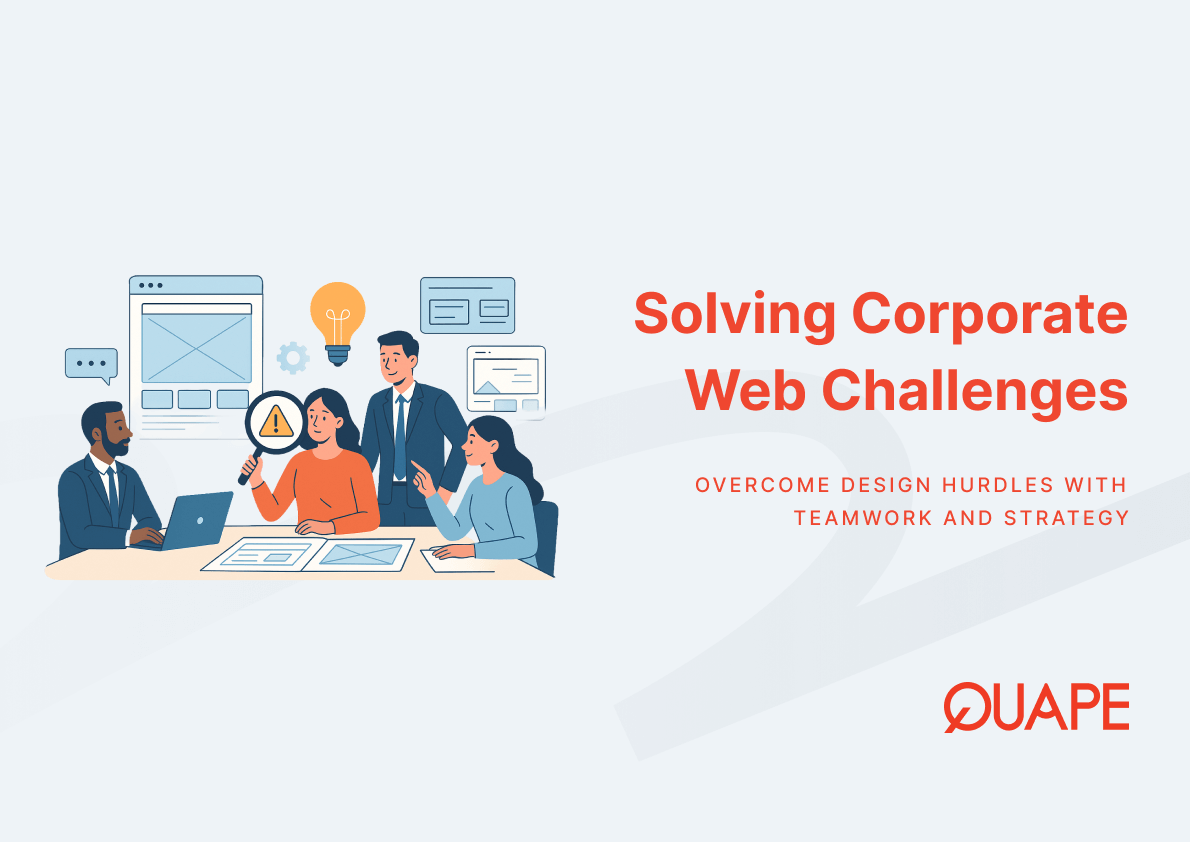
Corporate website projects rarely fail because of design talent or technology gaps. They fail because of people, processes, and priorities that pull in different directions at the same time. For IT managers, CTOs, and procurement leads in Singapore, a website redesign or launch is not a standalone creative project; it is a cross-functional initiative that touches compliance, brand governance, infrastructure, and business strategy simultaneously. When these dimensions are not coordinated, the result is delayed launches, inflated budgets, and websites that underperform from day one. Understanding where these breakdowns originate gives corporate teams the clarity to prevent them before they become costly. This article maps the most common corporate web design challenges and connects each problem to practical, governance-led solutions.
Introduction to Corporate Web Design Challenges
Corporate web design challenges refer to the structural, procedural, and organizational barriers that prevent enterprise teams from delivering websites that are functional, consistent, and strategically aligned. Unlike small business websites, corporate digital platforms must serve multiple internal stakeholders, comply with data protection regulations, integrate with existing IT infrastructure, and maintain brand consistency across departments or regional offices. For a broader foundation on what separates a brand-led corporate site from a generic online presence, the corporate website strategy framework covers the foundational principles that inform all design and development decisions at the enterprise level.
These challenges are not isolated technical problems. They emerge from the intersection of organizational complexity, tool fragmentation, and governance gaps. A corporate website project typically involves marketing, IT, legal or compliance, product management, and senior leadership, each with different success criteria and decision-making timelines. When those criteria conflict without a resolution process in place, project momentum stalls.
Những điểm chính
- Stakeholder misalignment between marketing, IT, and leadership is one of the most cited causes of corporate website project delays and budget overruns.
- Fragmented collaboration tools create handoff failures between design and development teams, leading to inconsistent outputs.
- Without version control in design workflows, teams risk deploying conflicting changes that break visual consistency or site functionality.
- Weak design governance allows departments to diverge from brand standards, creating fragmented user experiences across corporate web properties.
- Performance and security trade-offs require deliberate infrastructure decisions, not reactive fixes after launch.
- Singapore-based corporate teams must account for PDPA compliance, multilingual content requirements, and ASEAN market expectations in their web design planning.
- Structured collaboration frameworks, scalable CMS platforms, and documented governance processes significantly reduce the risk of redesign failure.
Key Components and Organizational Barriers Behind Corporate Web Design Challenges
Misalignment Between Business Stakeholders and Development Teams
Stakeholder misalignment is the single most damaging condition in corporate web design projects. Marketing teams prioritize conversion rates, visual appeal, and campaign flexibility. IT teams prioritize system stability, security, and maintainability. Leadership evaluates success through revenue impact, brand positioning, and competitive differentiation. When these three groups operate without a shared project brief or escalation process, every major design decision becomes a negotiation rather than a coordinated step forward. A well-structured corporate website content strategy can serve as the connective document that aligns all three groups around a single source of truth for what the website must achieve.
Industry research from Gartner found that 84% of marketing leaders report experiencing significant collaboration drag when working across departments, and organizations with high collaboration drag are 37% less likely to achieve their revenue goals. These figures reflect a structural problem, not a personnel one. Without clear ownership, a defined approval hierarchy, and documented scope boundaries, even technically skilled teams produce websites that fail to meet their original objectives because the objectives themselves were never fully agreed upon.
The solution is to establish a steering committee or project governance structure before any design work begins. This group should include one representative with decision-making authority from each core stakeholder group. A single project brief, signed off by all parties, should define the primary business objective, the secondary goals, the hard constraints from IT and compliance, and the escalation path when disagreements arise during execution.
Fragmented Collaboration Systems in Corporate Design Workflows
Design and development teams in enterprise environments often use separate tools that do not communicate with each other effectively. Designers may work in Figma, developers may track tasks in Jira, and content editors may manage pages through a CMS with its own access hierarchy. When these systems are not integrated into a coherent workflow, handoff failures become routine. A design component approved in Figma may be implemented differently by a developer who did not receive the final specifications, or a content update made in the CMS may override a layout that was locked at the design stage. Selecting a CMS platform built for corporate workflows reduces this friction by providing editors, designers, and developers with a shared operational environment.
Fragmented collaboration also creates accountability gaps. When a design decision is communicated verbally or through an informal channel such as email or a chat message, there is no audit trail to confirm what was agreed, who approved it, or when the change was made. Over time, these gaps accumulate into inconsistencies that are expensive to reverse after launch. Enterprise teams benefit significantly from establishing a single source of truth for design assets, content requirements, and technical specifications, maintained in a version-controlled environment that all stakeholders can access.
Lack of Version Control in Design and Development Processes
Version control is well established in software development, but it is frequently absent from design workflows in corporate web projects. When multiple designers or developers work on the same site simultaneously without a versioning system, conflicting changes become inevitable. One team may update the navigation structure while another revises the homepage layout, and without a repository that tracks these changes against each other, merging the two sets of updates produces errors that are difficult to diagnose.
The same risk applies to content management. Corporate websites often have dozens of page templates and hundreds of content blocks. If content editors can overwrite each other’s work without a revision history, a single accidental change can remove approved content, break internal links, or disrupt structured data configurations. Git-based workflows, when applied to both code and content, give teams the ability to review proposed changes, restore previous states, and trace every modification back to a specific contributor and timestamp. This discipline reduces the operational risk of corporate website management considerably.
Weak Design Governance and Brand Consistency Issues
Design governance refers to the policies, standards, and review processes that ensure a corporate website maintains visual and functional consistency over time. Without governance, different departments or regional teams may deploy pages, components, or templates independently, each making small deviations from the original design system. A subsidiary may use a different button color. A regional office may publish a page with a non-standard font. A product team may embed a third-party widget that conflicts with the site’s existing layout. These deviations are individually minor but collectively damaging to brand coherence. Establishing digital brand identity standards that are documented, accessible, and enforced through a component library prevents this drift from occurring.
A design governance framework typically includes a documented UI pattern library, approved typography and color standards, component approval workflows, and a designated design authority responsible for reviewing new page requests. For larger organizations, this framework may also define which teams have publishing rights, which require design review before deployment, and which categories of change require sign-off from legal or compliance. Strong corporate visual design standards translate brand guidelines into operational rules that every contributing team can follow without requiring a design expert in every department.
Performance and Security Trade-offs in Enterprise Websites
Enterprise websites face a structural tension between feature richness and performance. Marketing teams frequently request interactive elements, video backgrounds, dynamic content blocks, and third-party integrations, each of which adds load to the page and can reduce response speed. IT teams, meanwhile, must maintain security standards that may restrict certain plugins, limit external scripts, or require additional authentication layers that affect the user experience. Resolving this tension requires deliberate corporate website speed optimization planning that balances conversion-focused design decisions against infrastructure constraints.
Security vulnerabilities in corporate websites carry reputational and regulatory consequences that go beyond the technical impact. A compromised enterprise site can expose customer data, damage brand trust, and trigger regulatory investigations under Singapore’s PDPA framework. Corporate website security is therefore not an add-on consideration but an architectural requirement that must be integrated into the development process from the initial planning stage. This includes dependency audits, access control policies, SSL configuration, regular vulnerability scanning, and a defined incident response procedure.
Practical Application for Corporate Teams in Singapore
Singapore’s corporate digital environment introduces specific requirements that amplify standard web design challenges. Organizations operating in this market must address PDPA compliance obligations, support multilingual content for a diverse workforce and customer base, and align their digital platforms with ASEAN regional expansion goals. Each of these requirements adds a layer of governance and technical complexity that must be planned for before the design phase begins.
Aligning Corporate Web Projects With Singapore Regulatory and Market Expectations
The Personal Data Protection Act governs how Singapore-based organizations collect, use, and disclose personal data, including the data collected through website forms, analytics tools, and session tracking. Corporate websites that do not implement compliant consent mechanisms, data retention policies, and privacy notices risk enforcement action from the PDPC. PDPA-compliant website design requires input from both legal counsel and the development team during the planning phase to ensure that data flows are mapped, third-party integrations are evaluated for compliance risk, and consent management is implemented correctly at the technical level.
Beyond data protection, corporate websites in Singapore must also meet the expectations of a sophisticated B2B buyer audience that compares vendors based on professional presentation, technical credibility, and response quality. A slow, inconsistently designed, or poorly organized website signals operational immaturity to procurement leads and IT decision-makers who are evaluating vendors for long-term relationships.
Managing Multilingual Corporate Websites for Regional Operations
Organizations with operations across ASEAN frequently need their corporate websites to support multiple languages without compromising content quality, SEO structure, or user experience. A multilingual site that relies on machine translation alone, or that presents inconsistent formatting between language versions, undermines the credibility the organization is trying to build. Multilingual corporate website architecture requires a content management structure that separates language layers cleanly, supports localized metadata, and allows regional teams to update their content without affecting other language versions.
Internationalization at the technical level also involves decisions about URL structure, hreflang implementation, and the separation of locale-specific assets from shared design components. These decisions affect both search engine visibility in regional markets and the maintenance burden on the internal team responsible for keeping all language versions current and consistent.
Improving Corporate Website Navigation and Usability for Business Audiences
Corporate websites serve a specific audience: business professionals who arrive with defined objectives, limited time, and high expectations for information density. Navigation systems that work for consumer audiences often fail enterprise users because they prioritize visual impact over functional clarity. A B2B visitor looking for technical specifications, service scope, or compliance documentation needs to find that content in three clicks or fewer, without navigating through brand storytelling sections designed for general awareness. Applying UX design principles for corporate audiences means organizing information architecture around the specific task flows of IT managers, procurement leads, and senior decision-makers, rather than applying consumer-oriented navigation patterns.
Information architecture decisions at the corporate level should be informed by user journey mapping that identifies the distinct paths taken by each audience segment. A CTO evaluating infrastructure services follows a different path than a procurement manager comparing vendor pricing. Corporate website navigation best practices involve structuring primary navigation around user objectives rather than internal organizational categories, which often reflect how a company is organized internally rather than how its buyers think about their problems.
How Corporate Web Design Supports and Solves Organizational Website Challenges
Addressing these challenges requires more than selecting the right tools. It requires a development partner with the organizational fluency to translate business requirements into a structured technical brief, the governance experience to establish design systems that hold up over time, and the infrastructure capability to deliver a platform that scales as the organization grows.
A professional corporate web design engagement begins with a discovery process that maps stakeholder requirements, documents technical constraints, and defines the governance policies that will govern the site after launch. This pre-design phase is where most project failures are prevented or created. Organizations that invest in rigorous planning consistently outperform those that move directly to design and development. Understanding how corporate web design ROI is calculated helps procurement leads and CTOs make the case internally for adequate planning budgets and realistic project timelines.
Realistic website redesign timelines for enterprise projects typically span six to twelve weeks at minimum, depending on the complexity of integrations, the volume of content migration required, and the number of stakeholder approval cycles built into the process. Teams that compress these timelines to meet an arbitrary launch date consistently produce websites that require significant rework within the first year.
Quape's corporate web design service is structured to address these organizational challenges directly. From the initial consultation through CMS handover, the process integrates design governance, performance optimization, and PDPA-compliant development into a single coordinated delivery framework built for Singapore corporate teams.
Conclusion and Next Steps for Corporate Teams
The most persistent web design challenges in corporate environments are not technological. They are organizational: misaligned stakeholders, fragmented workflows, absent governance structures, and underestimated planning requirements. Addressing these challenges systematically, through structured collaboration frameworks, version-controlled design systems, documented governance policies, and scalable CMS platforms, gives corporate teams the foundation to deliver websites that perform consistently and evolve without accumulating technical debt. For Singapore-based organizations, adding PDPA compliance, multilingual architecture, and regional usability standards into this foundation creates a digital platform capable of supporting growth across the ASEAN market.
If your team is facing any of these challenges in a current or upcoming website project, contact the Quape team to discuss how a structured corporate web design engagement can reduce risk and deliver a platform built for long-term business performance.
Câu Hỏi Thường Gặp
What causes most corporate website projects to exceed their budget?
Budget overruns in corporate web projects most commonly result from unclear scope definition, late-stage stakeholder changes, and underestimated integration complexity. When project requirements are not locked before development begins, each revision round adds time and cost that was not included in the original estimate.
How does stakeholder misalignment affect a corporate website launch?
Stakeholder misalignment introduces conflicting change requests at every stage of the project, from information architecture through final content review. These conflicts delay approval cycles, force design rework, and often result in a launch-ready website being held back while internal disagreements are resolved, sometimes for months after the original delivery date.
Why is design governance important for enterprise websites?
Design governance prevents the gradual fragmentation that occurs when multiple teams contribute to a website without shared standards. Without governance, visual inconsistency accumulates across pages, brand guidelines are applied differently by different contributors, and the overall user experience degrades in ways that are expensive to audit and correct retroactively.
What is version control in the context of web design?
Version control in web design refers to the use of systems that track every change made to design files, code, and content, allowing teams to review modifications, identify conflicts, and restore previous versions when needed. Applied to both the development codebase and the design asset library, version control reduces the risk of conflicting updates being deployed to a live site simultaneously.
How does PDPA compliance affect corporate website design in Singapore?
PDPA compliance requires corporate websites to implement consent management mechanisms for data collection, publish accurate privacy notices, and ensure that third-party tools integrated into the site process personal data in ways that meet statutory obligations. These requirements influence decisions about analytics implementation, contact form design, cookie management, and the selection of hosting infrastructure.
How long does a corporate website redesign typically take?
A corporate website redesign for a medium-to-large organization typically requires six to twelve weeks from discovery to launch, provided that stakeholder alignment is established early and the approval process is defined before development begins. Projects with complex system integrations, large content migration requirements, or multiple language versions should plan for longer timelines.
What should corporate teams look for in a web design partner in Singapore?
Corporate teams should evaluate web design partners based on their experience with enterprise governance structures, their capability to deliver PDPA-compliant implementations, and their technical proficiency with scalable CMS platforms such as WordPress. A partner that provides structured discovery, documented project governance, and post-launch support reduces the organizational risk of a corporate website engagement significantly.
Can a corporate website be built to support future growth without full redevelopment?
Yes, provided the initial architecture is designed for scalability. A CMS-based corporate website built on a modular component system can be extended with new sections, language versions, integrations, and features without requiring a full rebuild. This approach depends on selecting a platform with an extensible plugin ecosystem and a development team that documents the build in a way that supports future contributors.

- Squarespace Alternative: Bespoke UI/UX Design that Converts High-Ticket Clients - Tháng 6 17, 2026
- Wix Alternative for Enterprises: Why You Need Custom Corporate Web Design - Tháng 6 16, 2026
- Dropbox Business Alternative: Avoid High User Licensing Fees with Private Nextcloud - Tháng 6 15, 2026