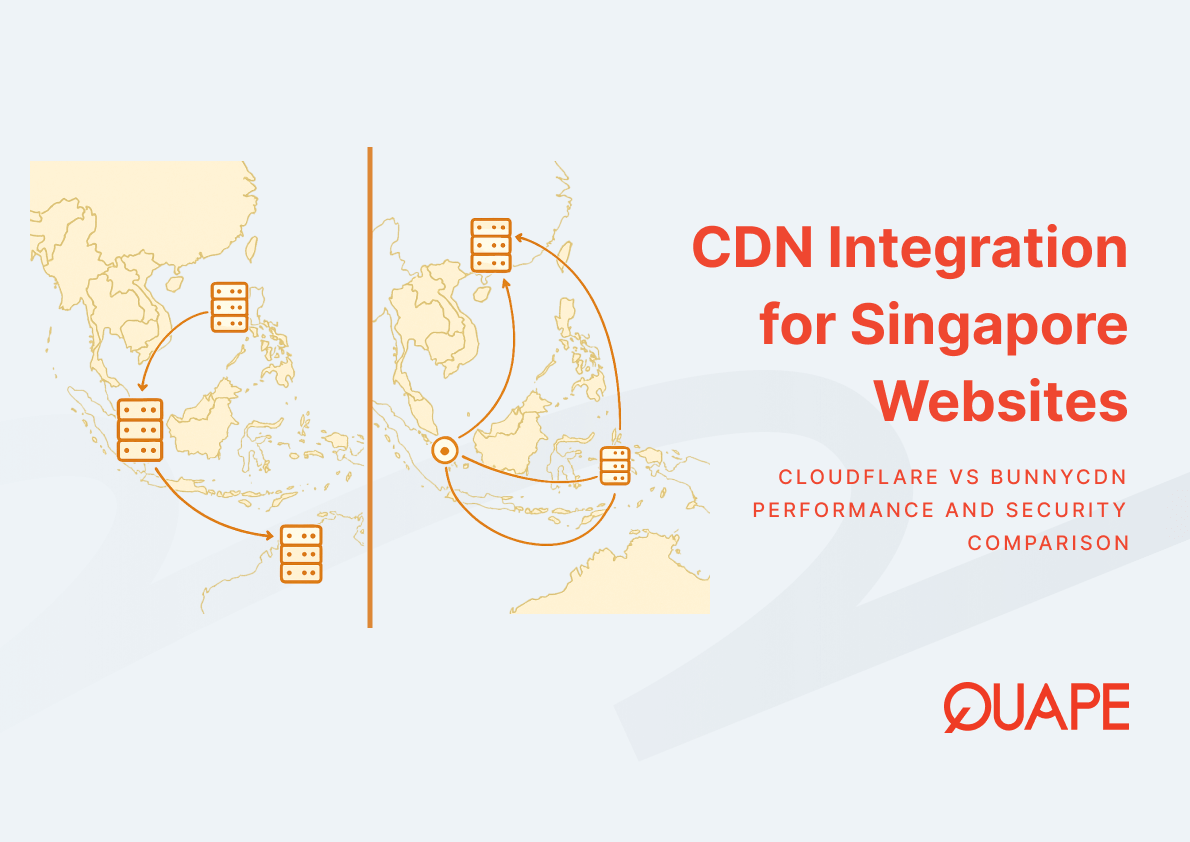
Content delivery networks influence how quickly websites reach users across geographic boundaries. For Singapore businesses, where internet adoption reaches 96%, CDN integration affects both user experience and competitive positioning. The Asia-Pacific CDN market is expected to exceed USD 63.5 billion by 2034, reflecting how regional infrastructure shapes digital service delivery. Singapore’s local cloud CDN market is projected to grow from USD 1.05 billion in 2025 to USD 2.35 billion by 2033, demonstrating sustained demand for edge-delivered content. This growth pattern suggests that businesses operating without CDN infrastructure may experience measurable disadvantages in page load performance and visitor engagement.
A content delivery network distributes website content across multiple geographic locations, storing cached copies on edge servers positioned closer to end users. When a visitor requests a page, the CDN delivers assets from the nearest edge location rather than forcing every request to travel to the origin server. This architecture reduces latency, decreases bandwidth consumption at the origin, and improves fault tolerance. For WordPress hosting environments optimized for performance, CDN integration complements server-level optimizations by addressing the geographic distance between hosting infrastructure and user populations.
Key Takeaways
- Content delivery networks reduce latency by serving cached content from edge servers positioned near end users, improving page load times for geographically distributed audiences
- Cloudflare provides integrated security features including DDoS protection and Web Application Firewall capabilities alongside content delivery functions
- BunnyCDN emphasizes cost efficiency and flexible pricing models based on actual bandwidth consumption, with edge locations spanning Asian markets
- Singapore’s broadband infrastructure performs close to advertised speeds according to IMDA measurements, creating conditions where CDN integration produces measurable performance gains
- The ASEAN cloud CDN market is projected to grow from USD 525.4 million in 2023 to USD 3.15 billion by 2032, reflecting regional demand patterns
- Edge computing drives CDN adoption by processing data closer to users, supporting real-time applications and interactive web platforms
- CDN integration requires balancing implementation costs against performance benefits, with return on investment varying based on traffic patterns and content types
- WordPress sites benefit from CDN integration through reduced origin server load, faster asset delivery, and improved handling of traffic spikes
Introduction to CDN Integration for WordPress in Singapore
Singapore’s position as a regional digital hub creates specific requirements for content delivery infrastructure. Websites hosted in Singapore data centers serve audiences across Southeast Asia, Australia, and increasingly global markets. The physical distance between hosting locations and user populations introduces latency that affects page load times, user engagement metrics, and conversion rates. CDN integration addresses this geographic challenge by distributing content across edge networks that position cached assets closer to request origins.
WordPress hosting environments generate dynamic content requiring server processing alongside static assets that benefit from caching strategies. Images, stylesheets, JavaScript files, and other static resources consume bandwidth and contribute to page weight. When these assets load from edge locations instead of origin servers, the hosting infrastructure experiences reduced load while users receive faster responses. This architectural separation allows origin servers to focus on dynamic content generation while edge networks handle static asset delivery.
The interaction between hosting infrastructure and CDN architecture determines overall site performance. High IOPS storage systems reduce the time required to generate dynamic content at the origin, while CDN edge caching minimizes the number of requests reaching the origin server. For businesses operating in Singapore, this combination supports both local and regional traffic patterns, adapting to varying network conditions across different markets.
Key Components and Concepts of CDN Integration
Understanding CDN and Edge Delivery
Edge delivery networks position content storage locations at the perimeter of internet infrastructure, reducing the physical and network distance between stored content and requesting users. When a visitor in Jakarta requests a Singapore-hosted website, edge servers in Indonesian data centers can serve cached content with lower latency than retrieving assets from the origin server. This geographic distribution transforms content delivery from a centralized model into a distributed architecture.
Content caching policies determine which assets edge servers store and for how long. Static resources such as images, CSS files, and JavaScript libraries typically cache for extended periods because they change infrequently. Dynamic content requires more nuanced caching strategies that balance freshness requirements against performance benefits. Cache headers, time-to-live settings, and cache invalidation mechanisms interact to control how edge servers manage stored content.
The relationship between server location and SEO performance extends beyond origin hosting to include edge network topology. Search engines measure page load times as part of Core Web Vitals assessments, and CDN integration directly influences these metrics. When edge servers deliver content faster than origin servers alone, user experience metrics improve, potentially affecting search visibility.
Cloudflare Overview and Features
Cloudflare operates a global network spanning more than 300 cities, positioning edge servers across major internet exchange points and carrier-neutral facilities. This extensive footprint enables content delivery from locations near most user populations. The platform integrates security functions with content delivery, combining DDoS protection, Web Application Firewall capabilities, and bot management into a unified service layer.
The security architecture processes traffic before it reaches origin infrastructure. Cloudflare’s network filters malicious requests, identifies bot traffic patterns, and blocks attack vectors at the edge. This approach protects origin servers from traffic floods and reduces the attack surface exposed to internet threats. For WordPress installations, these security protections complement hosting-level measures, creating defense layers that address different threat categories.
Cloudflare’s free tier provides basic CDN functionality and security features, making edge delivery accessible to websites at various budget levels. Paid tiers add performance optimizations, advanced security controls, and priority support. The pricing structure scales based on feature requirements rather than bandwidth consumption alone, affecting total cost calculations for high-traffic websites.
BunnyCDN Overview and Features
BunnyCDN structures its service around cost efficiency and transparent pricing models. The platform charges based on actual bandwidth consumption across different geographic regions, with Asian traffic priced separately from European or North American delivery. This regional pricing reflects underlying infrastructure costs and allows operators to predict CDN expenses based on traffic distribution patterns.
The edge network includes locations across Asia-Pacific markets, positioning servers in Singapore, Hong Kong, Sydney, Tokyo, and other regional hubs. For websites targeting Southeast Asian audiences, these edge locations reduce latency compared to CDNs with limited Asian presence. The geographic distribution aligns with local hosting strategies for Asia-focused businesses, extending performance benefits beyond origin server location.
BunnyCDN provides granular control over caching behavior, cache purging, and origin pull configurations. Operators can define custom cache rules based on URL patterns, file types, or request headers. This flexibility supports WordPress configurations with complex caching requirements, such as sites with membership systems, e-commerce functionality, or personalized content delivery.
Comparing Cloudflare and BunnyCDN for Singapore Websites
The choice between CDN providers reflects different operational priorities. Cloudflare’s integrated security features appeal to organizations concerned about DDoS attacks, bot traffic, and web application vulnerabilities. The platform’s extensive edge network and caching optimizations support global audience reach. For businesses prioritizing security alongside content delivery, Cloudflare’s unified approach reduces the need for separate security services.
BunnyCDN’s cost structure benefits websites with predictable traffic patterns and clear geographic audience distributions. The transparent bandwidth pricing allows accurate cost forecasting, particularly for sites serving primarily Asian markets where BunnyCDN’s regional edge locations provide strong coverage. Organizations with technical teams capable of managing security separately may prefer BunnyCDN’s focused content delivery approach.
Performance differences between providers depend on specific traffic patterns and user locations. Singapore-hosted websites serving local audiences experience minimal latency differences because both providers maintain Singapore edge locations. For regional traffic across Southeast Asia, BunnyCDN’s Asian edge network provides competitive performance. Global audience reach favors Cloudflare’s more extensive geographic footprint. The decision between local and global CDN strategies mirrors broader hosting architecture choices.
Practical Application for Singapore Businesses
Singapore SMEs face competitive pressure to deliver fast, reliable web experiences. As more businesses adopt CDN infrastructure, user expectations adjust to faster load times. Websites loading slowly relative to competitors risk higher bounce rates, reduced engagement, and lower conversion rates. The projected 10.8% annual growth in Singapore’s cloud CDN market through 2033 indicates increasing adoption rates among local businesses.
Implementation complexity varies based on hosting environment and technical capabilities. WordPress sites using managed hosting services often benefit from hosting providers who handle CDN integration as part of their service offering. Organizations with in-house technical teams can implement CDN services directly, maintaining control over configuration details and optimization strategies. The setup process for WordPress hosting influences how easily CDN integration occurs.
CDN effectiveness depends on content composition and traffic patterns. Sites with image-heavy content, downloadable resources, or video assets gain more pronounced benefits from edge caching than text-focused sites with minimal static assets. Traffic analysis reveals geographic distribution patterns that inform CDN selection and configuration decisions. Understanding how visitor locations relate to edge server positions helps optimize WordPress speed through hosting provider selection.
Optimizing Content Delivery for Faster Load Times
Edge delivery reduces latency through geographic proximity, but additional optimizations affect overall performance. Image optimization, file compression, and minification reduce asset sizes before CDN distribution. Smaller files transfer faster across networks regardless of server location. The combination of reduced file sizes and edge caching produces cumulative performance improvements.
Cache hit rates measure how often edge servers serve content from cache versus fetching from origin servers. Higher hit rates indicate more efficient CDN utilization. Cache warming strategies pre-populate edge servers with frequently accessed content, improving hit rates for popular assets. WordPress plugins that integrate with CDN services can automate cache warming and invalidation processes.
NVMe storage systems at origin servers reduce the time required to generate dynamic content when cache misses occur. The interaction between origin server performance and CDN caching determines baseline response times. Fast storage systems minimize delays when edge servers must retrieve updated content from origin infrastructure.
Security Considerations with CDN Integration
CDN networks function as a filtering layer between internet traffic and origin infrastructure. This positioning enables security controls that inspect and validate requests before they reach WordPress installations. SSL/TLS encryption extends across the CDN edge, ensuring secure connections from user browsers to edge servers and from edge servers to origin infrastructure.
Certificate management becomes more complex with CDN integration because both edge servers and origin servers require valid certificates. Some CDN providers offer free SSL certificates through automated certificate authorities, simplifying deployment. Organizations with existing certificate infrastructure must ensure compatibility between their certificates and CDN edge requirements. The relationship between SSL implementation and WordPress security encompasses both hosting and CDN certificate configurations.
DDoS attacks target origin servers by overwhelming them with request volume. CDN networks absorb much of this attack traffic at the edge, filtering malicious requests before they reach hosting infrastructure. The distributed nature of edge networks provides substantial capacity for absorbing traffic floods that would overwhelm single data center locations.
How QUAPE’s WordPress Hosting Supports CDN Integration
QUAPE’s WordPress hosting infrastructure uses NVMe storage and high IOPS server configurations that complement CDN architecture. Fast storage systems reduce origin server response times when generating dynamic content, establishing strong baseline performance before CDN caching occurs. The hosting environment supports multiple CDN integrations, allowing businesses to implement Cloudflare, BunnyCDN, or other providers based on their specific requirements.
Managed WordPress services include performance optimization configurations that work alongside CDN implementations. Server-level caching, PHP optimization, and database query tuning reduce the load on origin infrastructure. When combined with edge caching from CDN networks, these optimizations create multi-layered performance improvements. Organizations can explore the solution to understand how hosting and CDN strategies integrate.
The upstream provider redundancy in QUAPE’s network architecture ensures reliable connectivity between origin servers and CDN edge networks. Multiple upstream connections reduce the risk of network path failures that could interrupt content delivery. This redundancy supports consistent performance for CDN cache refresh operations and origin pulls.
Benefits for SMEs and High-Traffic Websites
Small and medium enterprises gain competitive advantages from CDN integration without requiring large infrastructure investments. Pay-as-you-grow pricing models scale CDN costs with traffic volume, avoiding large upfront commitments. This cost structure makes enterprise-grade content delivery accessible to businesses at various stages of growth.
High-traffic websites experience pronounced benefits from origin server offloading. When edge networks serve the majority of static content, origin servers handle primarily dynamic requests that require processing. This architectural separation allows hosting plans to support higher traffic volumes without requiring immediate infrastructure upgrades. The strategies for optimizing WordPress hosting for speed and uptime include CDN integration as a core component.
Geographic expansion becomes more practical with CDN infrastructure in place. Businesses can target new markets without deploying origin infrastructure in each region. Edge servers positioned in target markets provide local performance characteristics even when origin hosting remains in Singapore. This approach simplifies international growth while maintaining centralized content management.
Conclusion
CDN integration transforms how websites deliver content across geographic boundaries, particularly for Singapore businesses serving regional and global audiences. The choice between Cloudflare’s security-integrated approach and BunnyCDN’s cost-efficient model depends on specific operational requirements, traffic patterns, and technical capabilities. As Singapore’s cloud CDN market continues its projected growth trajectory, businesses adopting edge delivery infrastructure position themselves to meet evolving user expectations for fast, reliable web experiences. The interaction between hosting infrastructure and CDN architecture determines overall performance, making provider selection and configuration decisions critical for achieving measurable improvements in load times and user engagement.
For technical guidance on implementing CDN integration with optimized WordPress hosting infrastructure, contact our sales team.
Frequently Asked Questions
What technical requirements does WordPress hosting need to support CDN integration?
WordPress hosting must support custom DNS configurations or provide direct integration options with CDN services. The hosting environment should allow modifications to .htaccess files, support SSL certificates for origin connections, and provide access to caching plugin installations. Most managed WordPress hosting services include these capabilities as standard features.
How does CDN integration affect WordPress plugin performance and compatibility?
CDN integration primarily affects static asset delivery rather than plugin functionality. Some caching plugins require specific CDN configurations to avoid conflicts between server-level and edge-level caching. Security plugins that inspect request headers may need adjustments to recognize traffic coming through CDN networks. Most modern WordPress plugins handle CDN environments without requiring code modifications.
What bandwidth savings can Singapore websites expect from implementing CDN services?
Bandwidth reduction depends on the proportion of static content in the website and cache hit rates achieved at edge servers. Image-heavy sites with high cache hit rates often reduce origin bandwidth consumption by 60-80%. Text-focused sites with more dynamic content typically achieve 30-50% bandwidth reductions. The actual savings vary based on content composition and visitor access patterns.
How do CDN providers handle dynamic content that cannot be cached effectively?
Dynamic content typically bypasses CDN caching and routes directly to origin servers for generation. Some CDN providers offer edge computing capabilities that can process certain dynamic functions at edge locations, reducing round trips to origin infrastructure. WordPress installations can implement selective caching strategies that identify which dynamic content elements benefit from short-duration caching versus real-time generation.
What monitoring approaches help optimize CDN performance for WordPress sites?
Cache hit rate monitoring reveals how effectively edge servers serve content from cache versus fetching from origin. Response time measurements across different geographic locations identify performance variations and edge coverage gaps. Origin server load monitoring shows how CDN integration affects hosting infrastructure resource consumption. Many CDN providers include built-in analytics dashboards that track these metrics.
How does CDN integration interact with WordPress multisite installations?
WordPress multisite configurations can share a single CDN integration across all sites in the network or use separate CDN configurations per site. Shared CDN setups simplify management but require careful cache key configurations to prevent content mixing between sites. Separate CDN configurations provide isolation but increase management complexity. The optimal approach depends on whether sites in the network share common assets or maintain completely independent content.
What security trade-offs exist when routing traffic through CDN networks?
CDN networks introduce an additional layer in the request path, requiring trust in the CDN provider’s security practices. Traffic inspection at the edge provides security benefits but means the CDN provider can potentially access request and response data. SSL/TLS configuration must ensure encryption across both user-to-edge and edge-to-origin connections. Organizations with strict data handling requirements should verify CDN provider compliance with relevant standards.
How do CDN costs scale with traffic growth for typical Singapore SME websites?
CDN costs generally scale linearly with bandwidth consumption, though volume discounts often apply at higher traffic tiers. A small business website consuming 100 GB monthly might pay USD 5-15 for CDN services, while sites consuming 1 TB monthly typically pay USD 40-80 depending on geographic distribution. Singapore-focused traffic often costs less than global delivery due to concentrated edge infrastructure in the region.