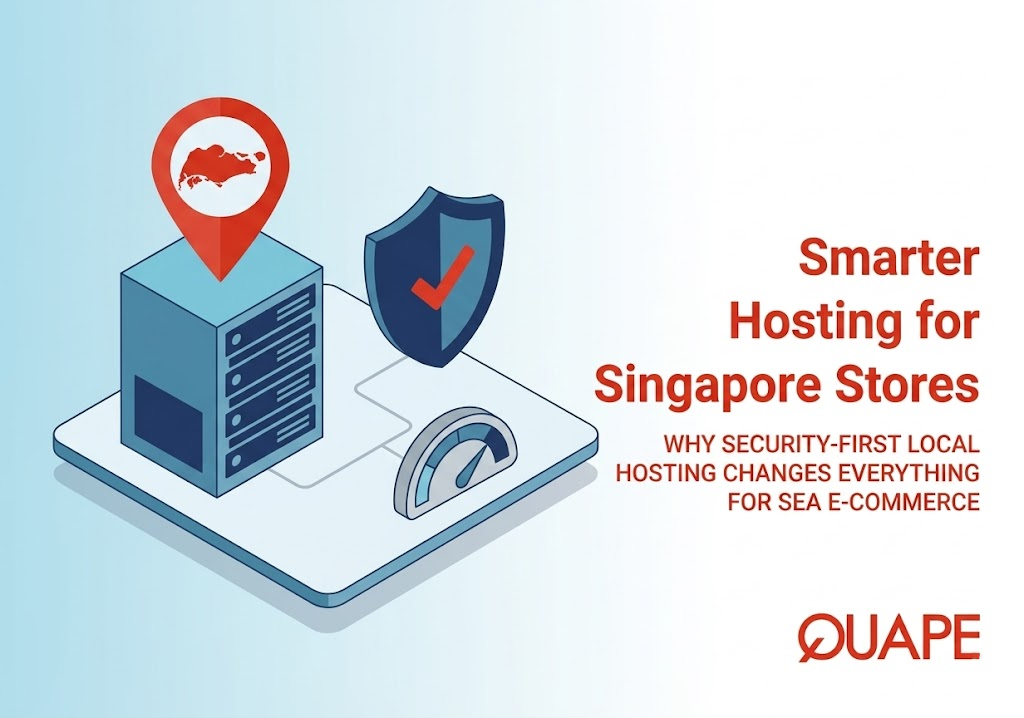
If you run an online store in Singapore or Southeast Asia and your hosting provider treats security as an afterthought, the consequences land directly on your revenue. HostGator remains one of the most recognised names in shared hosting globally, but recognition does not equal reliability for e-commerce operations where every checkout, every transaction, and every customer record depends on consistent protection. For SME owners and e-commerce managers evaluating alternatives, the core question is not which provider is cheapest, it is which provider treats your store’s security as a managed responsibility rather than something you handle yourself. This article compares HostGator and Quape specifically for Singapore and SEA-based WooCommerce stores where proactive security updates, local infrastructure, and accessible support represent non-negotiable operational requirements.
Why Security Update Delays Are a Bigger Risk for E-Commerce Stores Than Downtime
Most store owners fear downtime. A few hours offline is visible, measurable, and easy to report. A security breach is different. It often starts quietly, through an unpatched plugin or an exploited application vulnerability, and the damage compounds before anyone notices.
According to Verizon’s 2024 Data Breach Investigations Report, vulnerability exploitation as an initial breach method increased by 180% year over year. Attackers are not waiting for defenders to catch up. They scan for known vulnerabilities at scale, and unpatched WooCommerce plugins or exposed WordPress endpoints become targets within days of a public disclosure.
For an SME without a dedicated security team, this creates a structural problem. Your hosting provider’s security model determines how fast threats are identified and blocked, regardless of whether you personally have the time or expertise to manage patches.
Why Singapore and SEA Store Owners Are Reconsidering Large International Hosts
The frustration that drives most searches for a HostGator alternative in Singapore is not a single dramatic failure. It builds gradually, through slow page loads on checkout pages, through support tickets routed to offshore teams unfamiliar with local payment gateways, and through security incidents that surface weeks after the underlying vulnerability was first exploited.
Large international hosts serve millions of customers across diverse markets. That scale creates efficiencies for the provider, but it also creates distance between what your store needs and what standard support tiers actually deliver. For businesses whose customers are primarily in Singapore, Malaysia, Indonesia, or the Philippines, hosting routed through US-based data centres introduces latency that is felt at exactly the wrong moments, during search, browsing, and checkout.
What HostGator Still Does Well for Small Business Websites
HostGator has earned its position in the market for specific reasons. Its cPanel interface is among the most widely documented hosting environments available, which means a large pool of developers and freelancers already know how to navigate it. Entry-level plans are priced competitively, and the brand recognition provides a degree of reassurance for first-time website owners who prioritise familiarity over specialisation.
For businesses running informational websites, portfolio pages, or simple brochure-style sites without payment processing, HostGator’s global infrastructure and low-cost shared hosting plans represent a reasonable choice. The brand’s longevity also means its ecosystem of tutorials, community support, and third-party integrations is mature and well-documented.
Where HostGator Works Best for Non-Critical or Brochure-Style Websites
If your website does not collect payment data, does not process orders, and does not depend on fast regional load times to convert visitors, HostGator’s standard shared hosting plans offer a functional and affordable entry point. A small business in Singapore using a simple contact-form site or a static product catalogue with no checkout function has meaningfully different security and performance requirements than a growing WooCommerce store with live inventory and customer accounts.
The comparison in this article is specific: it applies to stores where security update management, server resource isolation, infrastructure location, and local technical support directly influence store performance and customer trust.
The Hidden Security Gaps That Frustrate E-Commerce Businesses on Large Shared Hosting Platforms
Shared hosting is not inherently insecure. The problem is how shared hosting is managed at scale. When hundreds of websites share a single server without resource isolation controls, a security incident on one site can create exposure pathways for others. This is commonly called the “bad neighbour effect,” and it is a known structural limitation of densely populated shared hosting environments.
For WooCommerce stores, this matters more than it does for informational sites. A store processes database queries continuously, stores customer session data, and handles payment gateway callbacks. Any degradation in server environment stability, whether from resource contention or a neighbouring site’s malware infection, disrupts these operations directly.
Remote code execution vulnerabilities in WordPress e-commerce plugins continue to emerge, and some allow unauthenticated attackers to compromise entire server environments when left unpatched. Reactive security models, where fixes are applied only after incidents are reported, leave stores exposed during exactly the window when automated exploit tools are most active.
Why Reactive Security Creates Operational Risk for Online Stores
Verizon’s 2025 DBIR analysis found that the median remediation time for exploited edge-device vulnerabilities reached 32 days. For an e-commerce store, 32 days of exposure is not a theoretical risk window. It is a period during which customer credentials, payment records, and order data remain vulnerable to exfiltration.
A Web Application Firewall provides a critical first layer of defence by filtering malicious HTTP traffic before it reaches application logic. However, WAF effectiveness depends on continuous rule maintenance and security assessment. A statically configured WAF left without updates loses effectiveness over time as attack techniques evolve, which is why routine security assessments are as important as the WAF itself.
How Overseas Infrastructure Can Slow Down Customer Experience in Singapore
Physical distance between a user and a server directly affects how long each page request takes to complete. According to MassiveGRID’s infrastructure analysis, typical network round-trip latency from Singapore to nearby Southeast Asian countries sits between 5 and 30 ms, while connections routed through US West Coast servers regularly exceed 170 to 200 ms.
For an e-commerce store, that difference is felt on every product page load, every cart update, and every checkout step. Checkout abandonment is already one of the highest-friction points in the purchase funnel, and latency compounds that friction. Customers on mobile connections in Jakarta, Kuala Lumpur, or Manila are particularly sensitive to response time because mobile networks already introduce variability that server latency amplifies.
Why Quape Positions Itself Differently for Security-Conscious E-Commerce Businesses
Quape is a Singapore-based hosting provider that structures its services around managed security and local infrastructure, specifically for SMEs in Singapore and Southeast Asia. Rather than competing on price at scale, Quape limits shared server density to a maximum of 20 users per server, a deliberate constraint that preserves resource availability for each site and reduces cross-contamination risk between accounts.
The Quape business hosting plans include built-in WAF protection, Let’s Encrypt SSL certificates, multi-homed bandwidth, and a DirectAdmin control panel. Free WordPress migration is included for standard sites, which removes one of the most common barriers to switching providers.
Built-In WAF and Routine Security Assessments Instead of Reactive Fixes
Quape’s security model is proactive rather than reactive. Every hosting plan includes WAF protection that filters malicious traffic before it reaches the application layer, and routine security assessments are conducted to maintain the effectiveness of those defences over time. This addresses the structural gap that research consistently identifies: WAF deployment alone is insufficient without ongoing rule maintenance and environmental monitoring.
For a WooCommerce store running on shared hosting, this means threats are evaluated and filtered at the infrastructure level rather than relying entirely on plugin-level defences that the store owner must manage independently.
Why Server Density Matters for WooCommerce Stability
WooCommerce is a database-intensive application. Each page load involving a product catalogue, customer session, or order query generates multiple database interactions. On a densely populated shared server, resource contention during traffic peaks causes these queries to queue, producing slow page renders and checkout delays that directly affect conversion rates.
Quape caps its shared servers at 20 users. This is not a marketing claim about performance, it is an architectural decision about resource availability. Fewer accounts per server means each site retains access to consistent CPU, memory, and I/O capacity even when neighbouring sites experience traffic spikes.
The Local Infrastructure Advantage for Singapore and SEA Buyers
Quape’s servers are housed in a Tier 3 Singapore Data Centre certified to TIA 942 Rated 3 standards. Singapore’s role as a submarine cable landing hub in Asia-Pacific enables low-latency regional connectivity across Southeast Asia, with round-trip times to major SEA markets that US-hosted infrastructure cannot match.
For a store whose customers are primarily in Singapore, Malaysia, Indonesia, or Thailand, this infrastructure advantage translates into faster product page rendering, more responsive checkout flows, and reduced abandonment at the payment step. The latency gap between Singapore-hosted and US-hosted infrastructure for regional audiences can reach 100 to 200 ms per request, a difference that accumulates meaningfully across a full browsing and purchase session.
Comparing HostGator vs Quape for the Factors That Actually Affect Store Revenue
| Factor | HostGator | Quape |
|---|---|---|
| Security model | Reactive, customer-managed patching | Proactive WAF and routine security assessments |
| Server density | High-density shared hosting | Capped at 20 users per server |
| Data centre location | US-based | Tier 3 Singapore (TIA 942 Rated 3) |
| SSL certificate | Varies by plan | Free on all plans |
| WordPress migration | Not always included | Free for standard WordPress sites |
| Local support | International support queues | Singapore-based team |
| Pricing (entry) | Competitive globally | From SGD 11/month |
Security Update Management and Threat Prevention
HostGator’s shared hosting environment places the responsibility for WordPress and plugin updates largely on the store owner. For an SME without a developer on retainer, this creates recurring vulnerability windows between when a patch is released and when it is actually applied. Quape’s built-in WAF and regular security assessments reduce dependence on perfect update hygiene by filtering known exploit patterns at the server level.
Free SSL is included on all Quape plans, which ensures that the encrypted connection between customers and the store is established from day one without billing complications or plan-level restrictions.
Server Environment and Shared Hosting Reliability
HostGator does not publicly publish its shared server user density figures. Industry criticism of large-scale shared hosting providers consistently points to resource contention as a performance bottleneck, particularly during high-traffic events. Quape’s 20-user cap per server is a stated policy, not an estimate, and it directly supports the consistent database performance that WooCommerce requires.
Support Experience During Website Emergencies
When something breaks on a live store, the value of local support becomes immediately clear. HostGator’s global support structure routes queries through standardised ticketing systems that are designed for efficiency at volume rather than fast resolution for complex technical escalations. Quape’s Singapore-based team handles migrations, DNS configurations, and technical issues with direct access rather than scripted first-level responses.
Infrastructure Location and E-Commerce Conversion Performance
Hosting infrastructure located in Singapore reduces latency to Southeast Asian markets by approximately 100 to 200 ms compared to hosting in the US or Europe. For mobile commerce users in the region, this difference is reflected in Time to First Byte and overall page render speed, both of which influence how likely a visitor is to complete a purchase rather than abandon a slow-loading checkout page.
When It Makes Sense to Stay With HostGator and When It’s Time to Switch
Not every website requires the level of security management and local infrastructure that Quape provides. Understanding which category your site falls into prevents unnecessary migration effort and cost.
Businesses That May Still Be Fine Using HostGator
A low-traffic blog, a freelancer’s portfolio site, or a simple informational page for a local business with no payment processing has security and performance requirements that HostGator’s standard plans handle adequately. The brand’s cPanel ecosystem and global documentation resources also make it a practical choice for developers who manage many sites across different markets and need a familiar, well-supported interface.
If your primary audience is based outside Southeast Asia, HostGator’s US-based infrastructure may also deliver acceptable latency for your specific user geography.
Businesses That Benefit More From Quape’s Local Security-Focused Approach
WooCommerce stores with active transactions, customer accounts, and payment data require a hosting environment that treats security as a managed infrastructure service rather than a user responsibility. Singapore SMEs selling to regional customers, businesses running membership portals, and stores integrating with local payment gateways like 2C2P benefit directly from Quape’s server location, WAF coverage, and capped server density.
Businesses considering a custom-built store, rather than a pre-built theme, benefit from combining Quape’s hosting infrastructure with a purpose-built e-commerce web design approach that avoids the plugin bloat and performance drag that pre-packaged themes introduce.
Migrating an E-Commerce Store Without Breaking SEO, Orders, or Customer Trust
Migration anxiety is one of the primary reasons store owners stay with a suboptimal hosting provider longer than they should. The concerns are legitimate: DNS propagation errors can cause checkout failures, SSL misconfigurations can trigger browser security warnings, and improperly handled redirects can erode search rankings built over months.
Quape includes free migration for WordPress sites and email accounts as a standard part of its hosting plans. This removes the cost barrier that often deters SMEs from switching, and it means the migration is handled by a team familiar with the hosting environment the site is moving into. For larger or custom migrations involving complex system configurations or extensive mailboxes, a small additional fee applies.
Why Local Technical Support Matters During Store Migration
DNS propagation and SSL provisioning during a migration involve time-sensitive steps where a support team’s response speed directly affects store downtime. A Singapore-based support team operating in the same time zone as the store owner removes the latency of routing escalations through international support queues during a period when fast resolution is critical.
Choosing a Hosting Provider That Matches the Risk Profile of Your Store
Hosting selection for an e-commerce store is a risk management decision as much as a cost decision. The cheapest plan that leaves your store dependent on manual patching, densely shared server resources, and US-based infrastructure creates hidden costs that appear in cart abandonment rates, security incidents, and support delays rather than on a monthly invoice.
For Singapore and SEA-based WooCommerce store owners who need proactive security management, consistent server performance, and local technical support, the gap between large international hosts and a locally focused provider is meaningful and measurable. If your store is outgrowing what your current host’s security model can reliably support, reviewing Quape’s business hosting plans gives you a clear benchmark for what managed security hosting looks like at the SME price point.
FAQ
Is HostGator suitable for a Singapore-based e-commerce store?
HostGator can support a basic WooCommerce setup, but its US-based infrastructure introduces latency for Singapore and SEA customers that affects page load times and checkout responsiveness. For stores where regional performance and proactive security management matter, a locally hosted alternative is worth evaluating.
What does a built-in WAF actually do for my online store?
A Web Application Firewall inspects incoming HTTP traffic and blocks requests that match known malicious patterns, such as SQL injection attempts or cross-site scripting payloads. It functions as a protective layer between the public internet and your store’s application, reducing the volume of threats that reach your code and database.
Why does server density matter for WooCommerce performance?
WooCommerce generates continuous database queries for product pages, cart sessions, and order processing. On a densely populated shared server, these queries compete for CPU and memory with other sites, causing slowdowns during traffic peaks. A capped server environment with fewer co-hosted sites preserves consistent resource availability for database-heavy operations.
When does it actually make more sense to stay with HostGator?
If you run a low-traffic informational site, a portfolio page, or a brochure site without payment processing, HostGator’s entry-level plans offer adequate performance and a familiar cPanel environment at a competitive price. The case for switching to a security-focused local host becomes stronger when your site processes transactions, holds customer data, or serves a primarily Singapore and SEA-based audience.
Is free SSL really significant, or is it a minor feature difference?
SSL is a baseline requirement for any site handling customer data or payment information. When SSL provisioning is included as standard rather than as a paid add-on, it removes a billing complexity that sometimes leads to certificate lapses on lower-tier plans. A lapsed SSL certificate triggers browser security warnings that immediately erode customer trust at the point of checkout.
How long does migrating from HostGator to Quape typically take?
According to a verified Google review, one customer’s migration to Quape was completed within two days, with longstanding issues resolved within hours of the transfer. Standard WordPress site migrations are included free of charge, though complex or large-scale migrations involving custom systems may involve a small additional fee.
Does hosting location in Singapore directly improve my Google rankings?
Server location influences page speed and regional latency, both of which contribute to Core Web Vitals metrics that Google uses as ranking signals. Hosting in Singapore does not guarantee ranking improvements, but reducing latency for regional users improves the performance signals that search engines measure, which supports rather than directly creates ranking gains.