If your business serves customers in Indonesia, Malaysia, or Vietnam and your site is hosted on DreamHost, there is a structural problem that no amount of optimization can fix: your server is in the United States. DreamHost is a capable platform with a long industry track record, but its infrastructure is built for a North American audience, and that geographic reality translates directly into higher latency, slower load times, and reduced conversion potential for Southeast Asian visitors. This article compares DreamHost and Quape specifically for the use case of businesses whose audience, operations, or both are based in the region. If your site traffic is predominantly Southeast Asian, server proximity becomes the single most consequential hosting decision you can make.
DreamHost and Quape: What Each Platform Brings to This Comparison
DreamHost has operated since 1997 and built a strong reputation on affordable shared and managed WordPress hosting for the US market. It offers clean plan structures, an in-house control panel, unlimited bandwidth on most plans, and a 97-day money-back guarantee that reflects genuine confidence in its product. For bloggers, personal projects, and US-facing small businesses, it is a reasonable and cost-effective choice. Its longevity in the market also means a mature knowledge base and a wide community of users who have solved common problems before you encounter them.
Quape approaches this comparison from a different starting point. It is a Singapore-based managed WordPress hosting provider with infrastructure anchored in a Tier 3 certified data center, positioned specifically to serve SMEs operating in or targeting Southeast Asia. Where DreamHost optimises for breadth and accessibility, Quape focuses on regional performance, technical depth, and managed support. The comparison is not about which provider is universally better. It is about which platform is better suited for a business whose customers are in Jakarta, Kuala Lumpur, or Ho Chi Minh City.
Key Takeaways
- DreamHost’s infrastructure is US-only. Every request from Southeast Asia travels through trans-Pacific submarine cables, adding 150 to 200 ms of round-trip latency before a single byte loads.
- Quape operates from a Singapore Tier 3 data center, reducing intra-Asia round-trip times to roughly 20 to 50 ms for Indonesia, Malaysia, and Vietnam.
- Cloudflare CDN is included on all Quape plans, further reducing load times for static assets across ASEAN edge nodes.
- DreamHost provides limited live chat support with no phone access on base plans. Quape offers 24/7 DevOps engineering support.
- DreamHost prices in USD, which introduces currency exposure for Southeast Asian businesses budgeting in IDR, MYR, or VND. Quape prices transparently in SGD annually.
- Quape provides free migration within 1 to 3 business days. DreamHost’s migration support is largely self-service.
- Singapore-based hosting carries PDPA-aligned data residency, relevant for Malaysian and Indonesian businesses navigating cross-border data compliance obligations.
- DreamHost remains a strong choice for US-facing websites, personal blogs, and low-traffic projects where US server proximity is either irrelevant or advantageous.
Why Southeast Asian Businesses Struggle with US-Based Hosting Infrastructure
Latency is not a vague performance concept. It is a measurable physical constraint governed by signal propagation speed and network routing complexity. When a visitor in Surabaya opens your website, their browser sends a request that must travel thousands of kilometres to a US data center, receive a response, and return. That journey introduces delay at every hop.
How distance from US servers impacts load time and conversion rates in Indonesia, Malaysia, and Vietnam
Average latency from Southeast Asia to the US West Coast ranges between 150 and 200 ms, compared to 20 to 50 ms for intra-Asia connections, according to network performance research from Cisco ThousandEyes. That difference compounds across every page element: HTML, CSS, JavaScript, images, and database queries all wait in sequence. The result is a noticeably slower experience for regional users even when on fast local broadband connections.
The commercial impact is documented. Research from Akamai indicates that a 100 ms delay in page load time can reduce conversion rates by up to 7%. For an e-commerce site, a lead generation form, or a booking page, that is not a theoretical risk. It is a measurable revenue drag operating in the background every day.
The hidden cost of “affordable” hosting when your audience is in Southeast Asia
Entry-level shared hosting at a low monthly price can look attractive on a spreadsheet. But when the server is positioned 15,000 km from your users, the real cost shows up in bounce rate, lower Google Search rankings driven by poor Core Web Vitals scores, and user drop-off before checkout or enquiry completion. Google has documented that 53% of mobile users abandon a site that takes more than 3 seconds to load. In markets like Indonesia and Vietnam where mobile internet is dominant, that threshold is unforgiving.
The economics of “cheap and distant” hosting often shift when factoring in the lost traffic and conversions that slow performance quietly erodes over time.
What DreamHost Does Well, and Why It’s Popular Globally
Strong brand reputation and long-term presence in the hosting industry
DreamHost’s nearly three-decade operating history is not trivial. It has survived multiple cycles of industry consolidation and built a reputation for fair pricing and honest communication. It is one of a small number of hosts officially recommended on WordPress.org, which reflects genuine technical credibility rather than just marketing spend.
Competitive pricing for US-based customers and simple plan structures
For a business operating in the United States, DreamHost’s pricing is genuinely competitive. Its shared plans start low, its managed WordPress product (DreamPress) is well-regarded for performance within the US, and its plan structure avoids the excessive upselling common in budget hosting. If your audience is North American, these are real advantages.
Beginner-friendly experience for small websites and blogs
DreamHost invests in usability. Its custom control panel is clean, WordPress installation is streamlined, and the knowledge base covers most common issues comprehensively. For a solo founder or small team without technical resources, that accessibility has genuine value, particularly for low-stakes projects where performance targets are modest.
Where DreamHost Creates Friction for Southeast Asian Businesses
US-only infrastructure and its impact on regional latency
DreamHost operates data centers in the United States. There is no regional presence in Southeast Asia, no Singapore point of presence, and no option to select an APAC server location. All traffic from Indonesia, Malaysia, and Vietnam transits through submarine cable systems connecting the Asia-Pacific region to the US West Coast. Those cable systems introduce routing overhead that cannot be mitigated by configuration changes or caching layers alone, because origin server location governs dynamic content response time regardless of what CDN sits in front of it.
Limited real-time support for time zones in Indonesia, Malaysia, and Vietnam
DreamHost’s support model relies primarily on tickets and live chat, with phone support unavailable on base plans. For businesses in GMT+7 or GMT+8 time zones, a support ticket raised during local business hours may not receive a substantive response until the following day. For managed WordPress customers, downtime during a product launch or high-traffic period is not an inconvenience. It is a direct business loss. Support availability that does not align with your operating hours creates operational risk that compound over time.
Self-service migration and operational overhead for non-technical teams
DreamHost’s migration tooling is self-service. The platform provides a WordPress migration plugin and documentation, but the process of transferring databases, resolving plugin conflicts, updating DNS, and verifying post-migration performance falls largely on the site owner or their developer. For lean teams without in-house engineering capacity, that overhead is real. Errors during migration can cause extended downtime, and the cost of a botched migration often exceeds any savings from a lower monthly plan price.
Pricing in USD and the problem of long-term cost predictability
DreamHost bills in US dollars. For businesses in Indonesia, Malaysia, or Vietnam, this introduces currency exchange exposure that compounds over a multi-year hosting relationship. When promotional pricing expires and renewal rates apply at prevailing USD exchange rates, the effective local-currency cost can shift significantly. That unpredictability is a real friction point for finance teams building annual technology budgets.
What Actually Matters When Choosing a DreamHost Alternative in Southeast Asia
Proximity of data centers to end users
Server location is the foundational variable in regional hosting performance. CDN layers, caching plugins, and image optimisation tools all improve performance at the margins, but they cannot substitute for a low-latency connection between the origin server and the end user. For businesses targeting Indonesia, Malaysia, or Vietnam, a hosting provider with infrastructure in Singapore eliminates the primary latency bottleneck at the source rather than patching around it.
Built-in CDN and network routing efficiency across ASEAN
CDNs reduce latency by caching static content at edge nodes geographically closer to users. This improves the delivery of images, stylesheets, and JavaScript, but dynamic content, such as database-driven page generation, still depends on the origin server’s response time. A CDN without a nearby origin server handles the easy part of performance. An origin server in Singapore, combined with CDN edge delivery, handles both.
Technical support depth vs generic hosting support
Generic hosting support typically handles account-level issues: password resets, billing queries, and basic control panel guidance. DevOps-level managed support handles server configuration, plugin conflicts, performance degradation, and security incidents. The distinction matters when something breaks at 2 AM before a major campaign launch. Support that understands your server environment at a technical level resolves problems faster and prevents them more reliably than tiered ticket queues reaching first-line agents.
Data residency and compliance considerations (PDPA, cross-border data)
Data localisation requirements are increasingly relevant across Southeast Asia. Singapore’s Personal Data Protection Act governs how organisations transfer personal data across borders and requires comparable protection standards at the destination. For Malaysian and Indonesian businesses handling customer data, hosting in a Singapore data center that operates under PDPA-aligned governance provides a clearer compliance basis than transferring data to US infrastructure under a different regulatory regime. The Personal Data Protection Commission Singapore provides the regulatory framework that underpins these residency decisions.
Why Singapore-Based Hosting Changes Performance for Indonesia, Malaysia, and Vietnam
Singapore as a network hub for Southeast Asia traffic routing
Singapore’s position as a regional data infrastructure hub is structural, not incidental. The country hosts a disproportionate share of Southeast Asia’s data center capacity, sits at the convergence of major submarine cable systems, and operates significant internet exchange points that reduce hops between ASEAN networks. The World Economic Forum has documented Singapore’s role as a key interconnection point for the region’s internet traffic. Hosting in Singapore means your site benefits from that backbone rather than routing around it.
Real-world latency improvements compared to US hosting
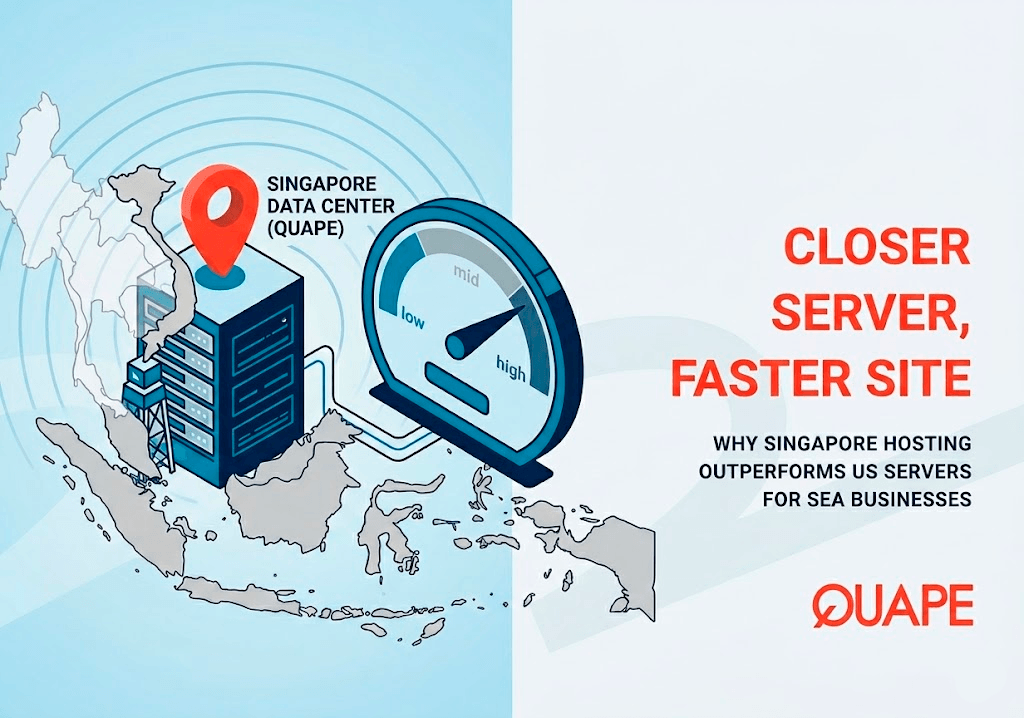
The latency gap between US-hosted and Singapore-hosted infrastructure is not marginal for Southeast Asian users. A round-trip time of 20 to 50 ms from Indonesia, Malaysia, or Vietnam to Singapore versus 150 to 200 ms to the US West Coast represents a 3x to 8x improvement in base connection speed before any application-level optimisation. That difference is perceptible to users and measurable in page speed scores, Core Web Vitals, and ultimately in search ranking and conversion performance.
How Quape Solves the Gaps Left by DreamHost (For Southeast Asian Use Cases)
Singapore Tier 3 data centers for low-latency regional access
Quape’s infrastructure is housed in TIA 942-certified Tier 3 data centers in Singapore. Tier 3 certification indicates redundant power and cooling systems with 99.982% availability targets, meaning single points of failure do not take the facility offline. For business-critical WordPress sites, that infrastructure resilience is the foundation everything else builds on. Proximity to ASEAN internet exchange points reduces round-trip times to Indonesia, Malaysia, and Vietnam to the low tens of milliseconds.
Cloudflare CDN integration for faster multi-country delivery
All Quape plans include Cloudflare CDN. Cloudflare’s edge network covers major population centers across Southeast Asia, including Jakarta, Kuala Lumpur, and Ho Chi Minh City. Static assets, cached page responses, and media files are served from the nearest edge node to each user rather than traversing back to the origin server for every request. Combined with a Singapore origin, this architecture handles both the dynamic and static dimensions of page performance.
24/7 DevOps support for businesses without in-house engineers
Quape provides 24/7 engineering support from a DevOps-capable team, not a first-line support queue. That matters most when something goes wrong at an inconvenient time, which is when hosting incidents tend to occur. For SME owners and startup teams that do not have engineers on call, having access to technical support that can diagnose and resolve server-level problems at any hour is a meaningful operational safeguard, not a premium luxury.
NVMe storage and High IOPS for performance-sensitive WordPress sites
All Quape WordPress hosting plans use NVMe storage. NVMe drives connect directly to the CPU via PCIe rather than through the SATA interface used by conventional SSDs, which reduces storage latency significantly. For WordPress sites with active databases, plugin-heavy configurations, or WooCommerce catalogs, faster storage reduces the time each PHP process spends waiting for database reads and writes. The practical outcome is faster Time to First Byte even before CDN caching activates.
Transparent SGD pricing and predictable cost structure
Quape publishes its plans clearly in Singapore dollars: WP Essential at SGD 25/month (SGD 300 annually), Professional at SGD 50/month (SGD 600 annually), and Enterprise at SGD 100/month (SGD 1,200 annually). There are no introductory rates that spike at renewal. For Southeast Asian businesses that budget in regional currencies, SGD pricing provides a stable reference point that reduces the foreign exchange unpredictability associated with USD-denominated hosting subscriptions.
Free migration with minimal downtime for growing businesses
Quape handles migrations as a managed service, completing them within 1 to 3 business days with urgent options available for time-sensitive transitions. The migration process includes a plugin audit, security review, and pre-launch checklist conducted by the technical team rather than the site owner. For businesses moving from DreamHost, this removes the operational risk of a self-managed migration and reduces the likelihood of downtime or data integrity issues during the transition.
DreamHost vs Quape: What Actually Matters for Your Use Case
| Criteria | DreamHost | Quape |
| Data center location | US only | Singapore (Tier 3) |
| Latency to SEA (avg) | 150–200 ms | 20–50 ms |
| CDN included | Via Cloudflare add-on (some plans) | Cloudflare CDN on all plans |
| Storage type | SSD (entry plans) | NVMe High IOPS (all plans) |
| Support model | Chat and tickets, no phone on base plans | 24/7 DevOps engineering support |
| Migration support | Self-service plugin | Free managed migration 1–3 business days |
| Billing currency | USD | SGD (transparent annual pricing) |
| Data residency | US infrastructure | Singapore, PDPA-aligned |
| Best fit | US-facing sites, personal blogs | SEA-targeting SMEs and startups |
If your customers are in Southeast Asia, which platform delivers better speed?
On raw server proximity alone, Quape delivers a structural performance advantage for Indonesia, Malaysia, and Vietnam audiences. The Singapore data center eliminates the trans-Pacific routing that US-hosted infrastructure cannot avoid. When Cloudflare CDN layers on top of that low-latency origin, both dynamic and static content reach regional users faster. For any business where Core Web Vitals scores influence organic search rankings, or where page speed directly precedes a purchase or enquiry decision, that difference compounds into business outcomes over time.
For lean teams: support accessibility and operational burden
DreamHost’s self-service model works well for technically confident site owners who are comfortable diagnosing WordPress issues independently. For founders and SME operators whose primary role is not managing hosting infrastructure, the model shifts operational burden onto people who are least equipped to carry it efficiently. Quape’s managed approach, combined with 24/7 DevOps access, reduces the time and expertise required to keep a site running reliably, which has a real cost value for lean teams.
For scaling WordPress sites: performance under traffic growth
High IOPS NVMe storage combined with server-level WordPress optimisation means Quape’s infrastructure handles traffic spikes without the I/O bottlenecks that conventional SSD storage can introduce. For sites experiencing growth in Indonesia or Vietnam, where mobile internet adoption continues to accelerate, infrastructure that maintains performance under load is more important than headline storage capacity figures.
For finance teams: pricing transparency and currency stability
DreamHost’s introductory pricing model is a well-known pattern across budget hosting providers. First-year rates are low; renewal rates are substantially higher. For a finance team building a 2 to 3 year technology cost forecast, that variability adds planning friction. Quape’s annual SGD pricing removes that ambiguity. What you see is what you pay at renewal.
When DreamHost Still Makes Sense (and When It Doesn’t)
Ideal use cases for DreamHost
- Personal blogs, portfolio sites, or creative projects with no audience location sensitivity
- US-based businesses with a North American customer base where DreamHost’s infrastructure is well-positioned
- Developers comfortable with self-service migration and control panel management who prioritise plan flexibility
- Low-traffic informational sites where speed differences between server locations have minimal measurable impact
When a Southeast Asia-focused alternative becomes necessary
- Your site traffic data shows a majority of sessions from Indonesia, Malaysia, Vietnam, or broader ASEAN
- You are running WooCommerce, a booking system, or a lead generation funnel where conversion rate is directly tied to load speed
- Your team lacks in-house engineers and needs managed support that operates in your time zone
- You are handling personal data subject to PDPA or cross-border data transfer considerations
- You need predictable annual billing in a currency closely pegged to regional business costs
Choosing the Right WordPress Hosting for Southeast Asia Operations
What to look for in a managed WordPress hosting provider in ASEAN
The decision framework for ASEAN-focused WordPress hosting should prioritise five variables in this order: server location relative to your primary audience, CDN coverage across the specific countries you serve, support availability during your local business hours, storage technology’s impact on database-heavy WordPress configurations, and pricing structure’s compatibility with your budget planning cycle. A provider offering managed services from Singapore-based WordPress hosting infrastructure addresses all five for businesses targeting Indonesia, Malaysia, and Vietnam, where the combination of proximity, regional CDN edge coverage, and PDPA-aligned data residency creates a coherent operational foundation rather than a patchwork of workarounds.
Uptime guarantees and SLA commitments matter, but they are table stakes. What differentiates providers at the operational level is what happens when something goes wrong: who responds, how fast, and with what level of technical authority. For SMEs without in-house DevOps capacity, that question deserves more weight in the selection process than monthly plan price comparisons.
Conclusion
DreamHost is a credible, well-established hosting provider with a strong track record for US-facing websites. That track record does not transfer to Southeast Asia, where the physics of network routing, the economics of latency-driven conversion loss, and the operational demands of regional compliance create a different set of requirements. For SME owners, startup founders, and web managers whose audience sits in Indonesia, Malaysia, or Vietnam, the case for hosting on infrastructure that is geographically close to those users is structural, not a matter of preference. Quape’s Singapore Tier 3 data center, Cloudflare CDN inclusion, NVMe storage, managed DevOps support, and transparent SGD pricing are not marketing differentiators in isolation. They are a coherent answer to the specific gaps that US-based hosting creates for regionally focused Southeast Asian businesses.
Ready to reduce latency and improve site performance for your Southeast Asian audience? Explore Quape’s Singapore-based managed WordPress hosting plans and migrate your site with confidence.
Frequently Asked Questions
Will switching from DreamHost to a Singapore host actually make a noticeable difference for my visitors in Indonesia or Malaysia?
For visitors in Indonesia, Malaysia, or Vietnam, the latency difference between a US data center and a Singapore data center is typically between 100 and 150 ms per round trip. That improvement is perceptible on page loads and measurable in Core Web Vitals scores. Sites with database-driven content, such as WooCommerce stores or booking platforms, benefit most because dynamic content generation depends directly on origin server response time rather than CDN caching alone.
Does DreamHost offer any CDN or edge delivery for Southeast Asian users?
DreamHost does offer Cloudflare integration on some plans, but it functions as a passthrough CDN with the origin server remaining in the US. CDN edge nodes cache static assets closer to regional users, but dynamic content such as page HTML generated by WordPress still returns to the US origin for each request. Quape includes Cloudflare CDN on all plans with a Singapore origin, which means both static and dynamic content benefit from the shorter regional network path.
Is DreamHost still a better choice if I only occasionally serve Southeast Asian customers?
Yes, if your primary audience is in the US or Europe and Southeast Asian traffic represents a small and non-conversion-critical fraction of your sessions, DreamHost’s infrastructure is well-matched to your core use case. The latency disadvantage for SEA visitors is real but only becomes commercially significant when that audience is the primary one you are trying to convert. For mixed-audience sites, a CDN layer on US hosting can partially close the gap for static content delivery.
How does PDPA compliance affect my choice of hosting provider?
Singapore’s Personal Data Protection Act governs how organisations collect, use, and transfer personal data, including requirements for comparable protection standards when data crosses borders. For Malaysian and Indonesian businesses handling customer data on their websites, hosting in a Singapore data center that operates under PDPA-aligned governance simplifies the compliance basis compared to storing data on US infrastructure under a different regulatory framework. This is particularly relevant for businesses running e-commerce, lead generation, or CRM-integrated WordPress sites that process personally identifiable information.
How long does migration from DreamHost to Quape take, and will my site go offline?
Quape’s managed migration typically completes within 1 to 3 business days, with urgent options available for time-sensitive transitions. The process includes a plugin audit and pre-launch checklist conducted by the technical team. DNS propagation after migration introduces a brief transition window during which some visitors may still reach the old server, but properly staged migrations keep downtime to a minimum and usually avoid any observable outage for end users.
What happens if my WordPress site outgrows the hosting plan I start with?
Quape’s managed WordPress plans scale from WP Essential for single sites up to WP Enterprise for multi-site configurations with monthly content updates included. For sites that grow beyond standard WordPress hosting requirements, VPS hosting provides additional CPU, RAM, and storage capacity without requiring a platform change. The upgrade path stays within the same provider relationship and support structure, which reduces migration overhead as your site scales.
Is the price difference between DreamHost and Quape significant for a small business?
DreamHost’s promotional entry pricing is lower than Quape’s base plan, but the comparison changes when accounting for renewal rates, the managed services included in Quape’s plans, and the operational cost of handling issues that would require paid developer time under a self-service model. Quape’s WP Essential plan at SGD 25/month includes daily backups, monthly security updates, free migration, and 24/7 DevOps access. For small businesses without in-house technical staff, those inclusions offset a meaningful portion of the price difference.