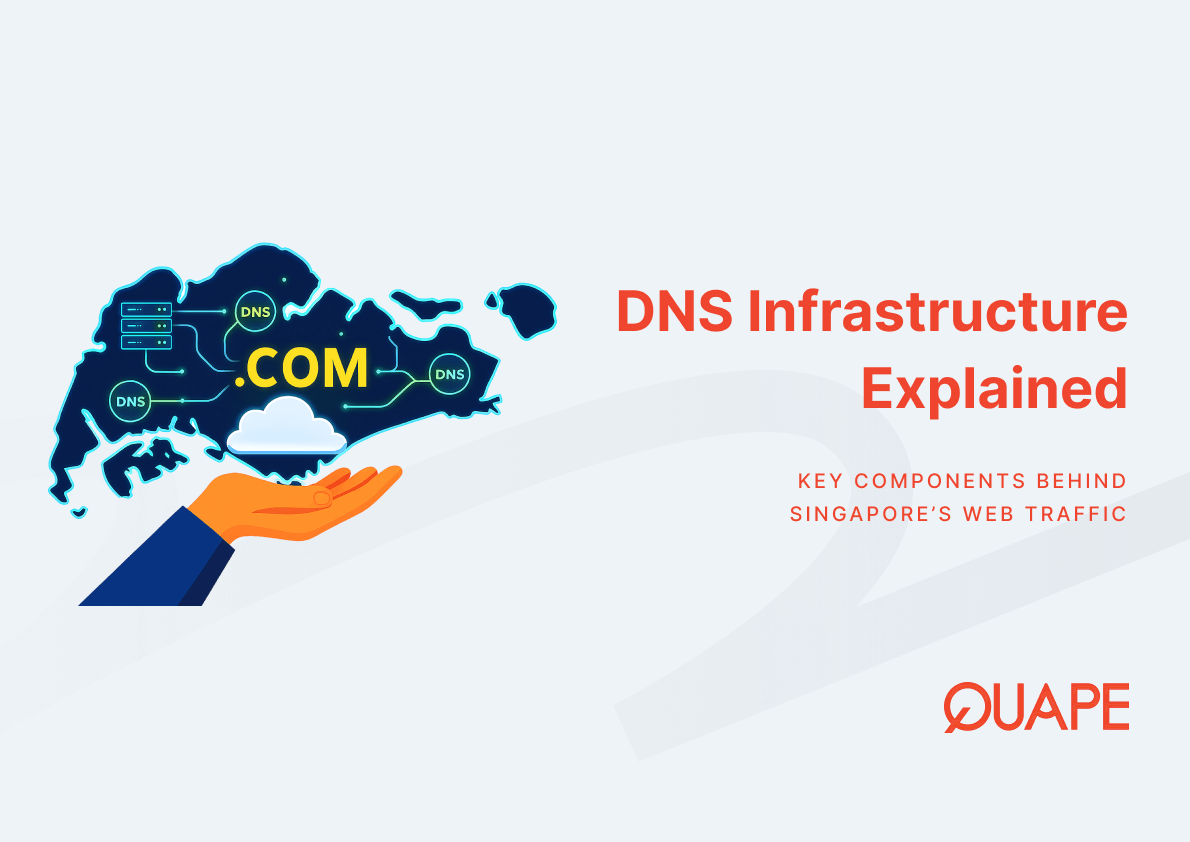
Singapore’s DNS infrastructure serves as the operational backbone for over 94% of the nation’s internet users, enabling domain name resolution with latency characteristics that support regional business operations and cross-border digital services. The Domain Name System translates human-readable domain names into IP addresses, and Singapore’s architecture combines national registry oversight, local resolver diversity, and security protocols that position the city-state as a regional hub for internet infrastructure. For IT managers and CTOs operating in Southeast Asia, understanding how DNS components interact with network performance, security posture, and application availability directly influences infrastructure planning decisions and operational resilience.
DNS infrastructure in Singapore operates through a layered ecosystem where the Singapore Network Information Centre (SGNIC) manages the .sg country code top-level domain (ccTLD), local caching resolvers improve query performance, and security protocols like DNSSEC validate response integrity. This infrastructure enables businesses to serve applications with reduced latency to regional users, supports compliance with data sovereignty considerations, and integrates with Singapore’s strategic position as a regional hosting hub where peering arrangements and network density optimize cross-border connectivity. The interaction between domain registration, DNS zone delegation, and resolver architecture determines how reliably and quickly end users can access digital services hosted in or routed through Singapore.
The Domain Name System functions as a distributed hierarchical database where authoritative name servers publish DNS records for specific domains, and recursive resolvers query this hierarchy on behalf of client applications. In Singapore’s context, DNS infrastructure encompasses root server instances, SGNIC’s authoritative servers for the .sg namespace, ISP-operated recursive resolvers, and enterprise DNS caching layers that reduce external query dependencies. This architecture supports the resolution of both local .sg domains and international domain names, with performance characteristics shaped by resolver placement, caching behavior, and routing efficiency across Singapore’s internet exchange points.
Key Takeaways
- Singapore’s DNS infrastructure achieves an internet resilience score of 81 out of 100, with infrastructure coverage reaching 95 out of 100, reflecting mature deployment of DNS assets and connectivity resources
- SGNIC operates Singapore’s ccTLD registry and introduced DNSSEC capability for .sg domains, providing cryptographic validation to protect against DNS spoofing and cache poisoning attacks
- Over 50% of DNS queries in Singapore originate from local providers, indicating substantial use of in-country recursive resolvers that reduce cross-border lookup latency
- 69% of the top 1,000 websites can be reached through local servers or caches in Singapore, improving DNS resolution performance for regionally hosted content
- DNSSEC validation scores approximately 68% across Singapore’s web traffic, demonstrating adoption of secure DNS practices among resolver operators and domain owners
- Selecting appropriate domain extensions during registration establishes the foundation for DNS zone delegation and influences resolver query patterns
Key Components and Concepts of DNS Infrastructure in Singapore
DNS infrastructure in Singapore comprises multiple interacting components that determine how domain queries are processed, validated, and optimized for regional traffic. Understanding these components allows businesses to make informed decisions about domain strategy, hosting placement, and network architecture that align with Singapore’s infrastructure capabilities.
Role of SGNIC and Singapore’s ccTLD DNS Ecosystem
SGNIC functions as the national registry for the .sg domain space, managing the authoritative name servers that publish DNS records for all registered .sg and .com.sg domains. This registry-registrar separation model ensures that domain registration services are provided by accredited registrars while SGNIC maintains the authoritative DNS infrastructure and zone files. The registry operates redundant authoritative name servers distributed across multiple network locations, enabling continued resolution of .sg domains even during localized network disruptions or infrastructure failures.
SGNIC’s introduction of DNSSEC capability for .sg domains establishes a chain of trust where DNS responses can be cryptographically verified, reducing the risk that malicious actors can redirect users to fraudulent sites through DNS cache poisoning. Domain owners can opt into DNSSEC signing, which adds digital signatures to their DNS records that recursive resolvers can validate against SGNIC’s published trust anchors. This validation process depends on both the domain’s authoritative servers supporting DNSSEC and the resolver infrastructure performing validation, creating a security relationship that extends from the registry through the resolver to the end user.
The authoritative DNS servers for .sg domains respond to queries from recursive resolvers worldwide, but performance characteristics improve when resolvers are positioned within Singapore or the broader Asia-Pacific region due to reduced network round-trip time. SGNIC’s infrastructure supports high query volumes and implements distributed server architecture to maintain availability during traffic spikes or attack scenarios. This resilience directly benefits businesses operating under .sg domains by ensuring that DNS resolution remains functional even when individual network paths experience degradation.
Local DNS Resolvers and Caching Behavior in Singapore
Local caching resolvers operated by ISPs and enterprises in Singapore handle over half of DNS queries, reducing dependency on international DNS services and improving resolution latency for end users. These recursive resolvers query authoritative name servers on behalf of client devices, cache the responses according to time-to-live (TTL) values, and serve subsequent identical queries from cache without re-querying upstream servers. The caching behavior directly influences how quickly DNS changes propagate to users and affects the resilience of DNS resolution when authoritative servers experience temporary unavailability.
Enterprise DNS caching deployments within Singapore organizations enable further optimization by keeping frequently accessed DNS records within corporate networks, reducing external query volume and improving application performance. When an application initiates a connection to a domain name, the local resolver checks its cache before issuing a recursive query, and the cache hit rate depends on TTL settings, query patterns, and cache size. Organizations operating high-transaction applications benefit from local caching because repeated DNS lookups for the same domain return instantly from cache, eliminating the variable latency introduced by external resolver queries.
The diversity of resolver usage in Singapore, with significant portions of traffic handled by local ISPs rather than concentrated in a small number of public DNS services, distributes query load across multiple infrastructure providers and reduces single points of failure. This resolver diversity interacts with network performance characteristics by ensuring that no single resolver outage disrupts DNS resolution for a majority of users. However, it also creates variability in DNSSEC validation adoption, as each resolver operator independently implements security features and validation policies.
Latency Optimization Through Regional DNS Architecture
DNS latency optimization in Singapore benefits from the concentration of internet exchange points, subsea cable landing stations, and regional content delivery networks that position DNS infrastructure close to end users. Anycast DNS deployment allows multiple geographically distributed servers to share the same IP address, with network routing automatically directing queries to the nearest server based on BGP routing metrics. This architecture reduces DNS query latency by ensuring that recursive resolvers in Singapore query authoritative servers within the region rather than routing queries to distant continents.
The performance advantage of regional DNS architecture becomes particularly significant for businesses serving users across Southeast Asia, where Singapore’s central position and extensive peering relationships enable efficient routing to neighboring countries. DNS queries that remain within the region typically complete in single-digit milliseconds, while queries routed intercontinentally may experience 100-200ms latency that accumulates across multiple DNS lookups during application initialization. Applications that perform frequent DNS lookups or operate with short TTL values amplify the impact of resolver latency on overall user experience.
Singapore’s position as a regional peering hub creates natural advantages for DNS resolution because direct network connections between ISPs and hosting providers reduce the number of autonomous system (AS) hops required for DNS queries. This reduced hop count improves both latency and reliability, as each additional network segment introduces potential failure points and variable congestion. Organizations hosting VPS infrastructure in Singapore benefit from this regional DNS efficiency because application servers can resolve domain names with minimal latency, supporting responsive application behavior and efficient service-to-service communication.
DNS Security Considerations in the Singapore Region
Regional DNS security in Singapore addresses threats including DNS spoofing, cache poisoning, DDoS attacks targeting DNS infrastructure, and unauthorized DNS data manipulation. DNSSEC provides cryptographic validation of DNS responses, ensuring that resolvers can detect if responses have been altered or injected by attackers positioned between authoritative servers and resolvers. The security protocol operates through a hierarchical chain of trust where each level of the DNS hierarchy signs the records for the level below, allowing resolvers to verify authenticity by checking signatures against published keys.
DNSSEC adoption requires coordination between domain owners who must sign their zones, authoritative server operators who must serve signed records, and resolver operators who must perform validation. Singapore’s reported DNSSEC validation score of approximately 68% reflects partial adoption where a majority but not all resolvers actively validate signatures, and where domain owners selectively enable signing. This partial deployment creates a tiered security environment where DNSSEC-enabled domains and validating resolvers achieve stronger protection, while domains or resolvers without DNSSEC support remain vulnerable to traditional DNS attacks.
DDoS mitigation for DNS infrastructure involves multiple strategies including over-provisioned bandwidth capacity, distributed server architectures that absorb attack traffic across many endpoints, and filtering techniques that distinguish legitimate queries from attack traffic. Singapore’s DNS infrastructure benefits from the region’s high-capacity network connections and the presence of DDoS mitigation services operated by major ISPs and cloud providers. These protections interact with cybersecurity best practices by establishing baseline resilience for DNS resolution that organizations can extend through secondary DNS providers, monitoring for anomalous query patterns, and maintaining cached DNS records within application infrastructure.
Query integrity mechanisms beyond DNSSEC include DNS over HTTPS (DoH) and DNS over TLS (DoT), which encrypt DNS queries between clients and resolvers to prevent eavesdropping and manipulation by intermediate network devices. These protocols address privacy concerns by preventing ISPs and network operators from observing which domains users query, but adoption remains uneven across client devices and resolver services. The regulatory environment in Singapore supports DNS security improvements while balancing operational needs for network visibility, creating a context where security-conscious organizations can deploy encrypted DNS protocols without regulatory barriers.
Practical DNS Implications for Businesses Operating in Singapore
Businesses deploying digital services in Singapore must consider how DNS infrastructure choices affect application availability, user experience, and operational resilience. Enterprise IT architecture decisions regarding domain structure, DNS hosting, and resolver selection directly influence how reliably applications can be accessed by regional users and how gracefully services degrade during infrastructure disruptions.
SMEs establishing digital presence in Singapore benefit from selecting .sg or .com.sg domains because local domain extensions signal regional focus to users and may improve local search visibility. The DNS infrastructure supporting these domains operates with redundancy and performance characteristics optimized for the Asia-Pacific region, ensuring that domain resolution succeeds even when international network paths experience congestion. Organizations serving primarily regional audiences should evaluate whether their domain’s authoritative DNS servers are positioned within Asia, as distant server placement introduces latency that accumulates across DNS lookups and affects initial connection establishment times.
Application availability depends on DNS infrastructure through multiple dependencies: applications cannot receive traffic if DNS queries fail to resolve domain names, connection pooling fails when DNS lookups introduce excessive latency, and load balancing systems require functional DNS to distribute traffic across multiple backend servers. Organizations operating high-traffic web applications should implement DNS monitoring that tracks query success rates, resolution latency, and cache behavior to detect degradation before it impacts end users. Secondary DNS providers offer redundancy by serving DNS records from independent infrastructure, ensuring that a failure affecting the primary DNS provider does not render domains unresolvable.
Cross-border traffic patterns interact with DNS infrastructure when applications serve users across multiple countries in Southeast Asia. DNS resolution latency for users in neighboring countries depends on whether authoritative DNS servers are positioned within the region or require queries to route to other continents. Organizations can optimize cross-border DNS performance by using DNS providers with regional points of presence, configuring appropriate TTL values that balance caching benefits against the need for rapid DNS record updates, and implementing geographic DNS routing that directs users to the nearest application server based on resolver location.
How Domain Registration Enables Effective DNS Infrastructure in Singapore
Domain registration establishes the foundational relationship between domain ownership and DNS zone delegation, enabling organizations to control the authoritative DNS records that determine how traffic reaches their services. When registering a domain through an accredited registrar, organizations specify which authoritative name servers will publish DNS records for that domain, creating a delegation from the registry to those servers. This delegation process determines where recursive resolvers query for the domain’s DNS information and establishes the primary point of control for managing DNS records.
TLD selection during registration influences DNS infrastructure characteristics because different TLDs operate with varying security requirements, operational practices, and regional optimizations. The .sg and .com.sg TLDs require local presence or administrative contacts, limiting registration to organizations with Singapore connections and reducing domain squatting. These restrictions create a higher-trust DNS environment because the registry verifies registrant eligibility before allowing domain activation, and the smaller namespace makes detecting and reporting malicious domains more feasible than in unrestricted global TLDs.
Registrar DNS services typically provide basic authoritative DNS hosting as part of domain registration, offering a convenient but often limited DNS management platform. Organizations with complex DNS requirements, including multiple record types, geographic routing, or advanced security features, may choose to delegate DNS hosting to specialized DNS providers while maintaining domain registration with their preferred registrar. This separation allows flexible DNS infrastructure management while preserving registrar relationships for domain renewal, transfer lock settings, and ownership details.
DNS zone delegation configuration occurs through registrar interfaces where organizations specify the authoritative name servers for their domains. These name server records propagate to the TLD’s zone file, and recursive resolvers query these designated servers when resolving the domain. Proper delegation requires configuring at least two authoritative name servers for redundancy, ensuring that these servers are reachable from the internet, and maintaining consistent DNS records across all authoritative servers. Misconfigurations in delegation settings cause complete DNS resolution failure for the affected domain, making correct initial setup and ongoing validation essential for operational continuity.
Conclusion and Next Steps for Optimizing DNS Infrastructure
DNS infrastructure in Singapore operates through coordinated interactions between SGNIC’s registry functions, local resolver networks, security protocols, and regional network architecture that collectively enable efficient, resilient domain name resolution for businesses and internet users. Organizations planning infrastructure deployments should evaluate DNS considerations alongside hosting location, network connectivity, and security requirements because DNS performance and reliability directly affect application availability and user experience. Strategic DNS decisions include selecting appropriate domain extensions that signal regional focus, configuring authoritative DNS with redundancy and regional presence, and implementing security measures that protect against DNS-based attacks while maintaining resolution performance.
The relationship between domain registration, DNS infrastructure, and application hosting creates dependencies that require coordinated management across multiple service providers and technical domains. Organizations benefit from periodically reviewing their DNS configuration to ensure that record accuracy, TTL settings, security features, and monitoring coverage align with current business requirements and infrastructure scale.
If you need guidance on aligning DNS infrastructure with your business or technical requirements, you can reach out to us.
Frequently Asked Questions
What is the role of SGNIC in Singapore’s DNS infrastructure?
SGNIC operates as the national registry for .sg domains, managing authoritative name servers that publish DNS records for all Singapore ccTLD domains. The organization maintains DNS infrastructure security and introduced DNSSEC capability to enable cryptographic validation of DNS responses, protecting against spoofing and cache poisoning attacks.
How does DNS latency affect application performance in Singapore?
DNS latency accumulates across multiple lookups during application initialization and directly impacts time to first byte for web applications. Local resolver infrastructure in Singapore reduces latency by serving queries within the region rather than routing to distant continents, particularly benefiting applications with short TTL values or frequent DNS lookups.
What is DNSSEC and why does it matter for Singapore domains?
DNSSEC adds cryptographic signatures to DNS records, allowing recursive resolvers to validate that responses have not been altered by attackers. Singapore’s adoption of DNSSEC at the registry level for .sg domains enables domain owners to opt into this security layer, creating authenticated DNS responses that protect users from being redirected to malicious sites.
Should businesses use .sg domains or international TLDs?
.sg domains signal regional focus and benefit from SGNIC’s infrastructure optimized for Asia-Pacific routing, while international TLDs like .com offer global recognition. Organizations primarily serving Singapore and Southeast Asian markets benefit from .sg or .com.sg domains, while businesses with global audiences may prioritize .com for universal recognition.
How do local DNS resolvers improve performance in Singapore?
Local resolvers cache DNS responses within Singapore networks, eliminating repeated queries to authoritative servers and reducing resolution latency to single-digit milliseconds for cached records. Over 50% of Singapore’s DNS queries use local resolvers, distributing load across ISP infrastructure and reducing dependency on international DNS services.
What DNS redundancy should organizations implement?
Organizations should configure at least two authoritative name servers for domains, preferably operated by different providers or in different network locations. Secondary DNS providers offer additional redundancy by serving DNS records from independent infrastructure, ensuring domains remain resolvable if the primary DNS provider experiences outages.
How does DNS infrastructure interact with VPS hosting performance?
VPS instances require functional DNS to receive traffic, and DNS resolution latency affects initial connection establishment times. Hosting VPS infrastructure in Singapore positions servers close to regional DNS resolvers and end users, reducing cumulative latency from DNS lookup through application response.
What DNS security measures should Singapore businesses implement?
Businesses should enable DNSSEC for their domains to protect against DNS spoofing, implement monitoring to detect anomalous query patterns or resolution failures, configure appropriate TTL values that balance caching benefits against update urgency, and consider secondary DNS providers for redundancy. Organizations handling sensitive data may deploy DNS over HTTPS or DNS over TLS to encrypt queries between clients and resolvers.

- Business Email Hosting vs G-Suite / Microsoft 365 - December 29, 2025
- Shared Hosting vs Dedicated Hosting for Email - December 29, 2025
- SMTP vs POP3 vs IMAP: Which Protocol Fits Your Business Workflow - December 28, 2025