Domain privacy protection has become a compliance requirement, not a convenience feature. When you register a domain, your contact details are published in a public WHOIS database unless explicitly masked. This exposure creates measurable security and regulatory risks. Organizations operating in Singapore face dual compliance obligations: Singapore’s Personal Data Protection Act (PDPA) governs how registrant data is collected and used locally, while the European Union’s General Data Protection Regulation (GDPR) applies when EU data subjects are involved. Understanding how domain privacy services interact with these frameworks determines whether your organization meets baseline data protection standards or inadvertently violates them.
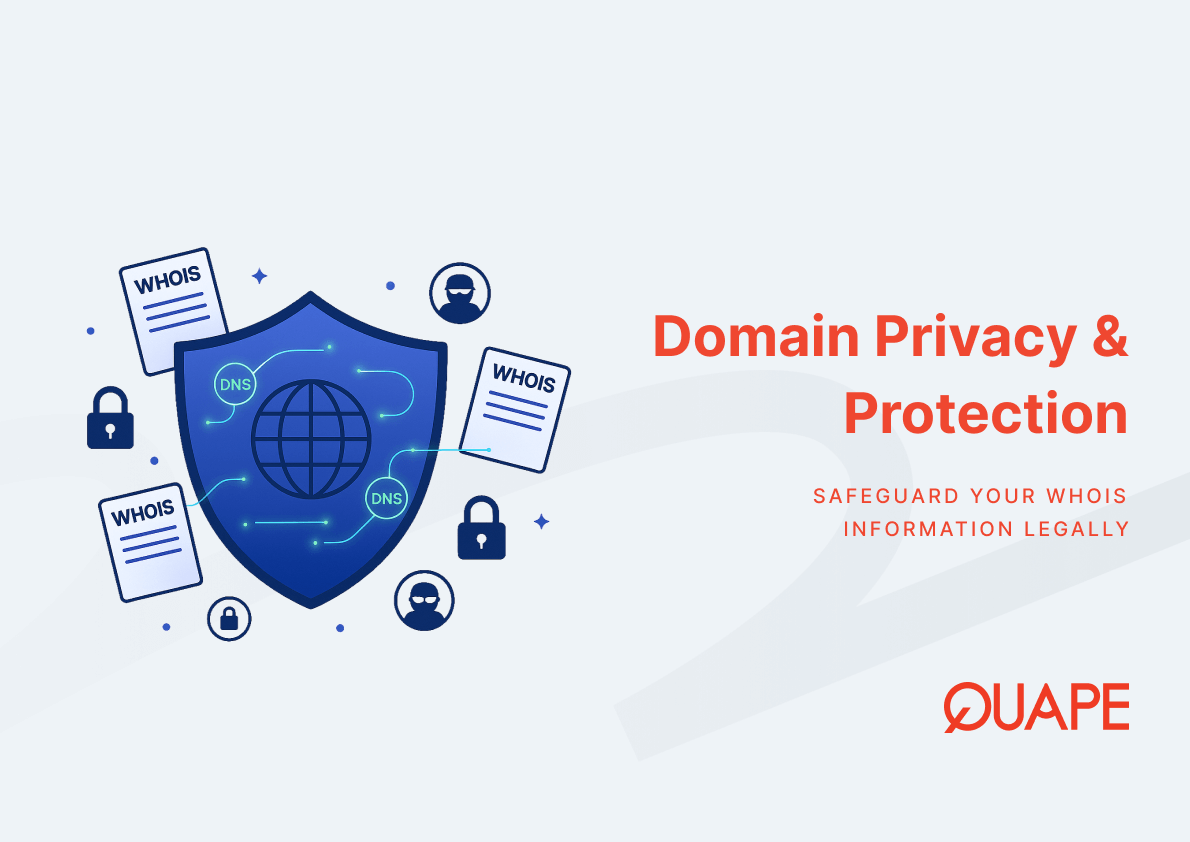
Domain privacy protection refers to technical and administrative measures that prevent public disclosure of registrant contact information in WHOIS databases. WHOIS databases were originally designed to publish registrant details publicly to support network troubleshooting and accountability, not privacy. Over time, this design exposed individuals and organizations to spam, phishing, identity scraping, and social engineering attacks. Domain privacy services mask registrant data by replacing it with proxy contact details provided by the registrar or a third-party service. However, the legal ownership and administrative control of the domain remain with the original registrant, distinguishing privacy services from proxy registration models where ownership is legally transferred.
Key Takeaways
- WHOIS databases expose registrant contact information by default, creating attack vectors for spam, phishing, and identity theft.
- GDPR and Singapore PDPA classify registrant contact details as personal data when they identify natural persons, triggering strict handling obligations.
- Domain privacy services mask WHOIS data but do not alter domain ownership or control, unlike proxy registration which legally substitutes ownership.
- Singapore’s PDPA emphasizes organizational accountability and consent, while GDPR prioritizes individual rights and cross-border data protection.
- ICANN policies governing WHOIS data publication conflict with global data protection laws, forcing registrars to implement redaction and tiered access systems.
- Over 90% of individual registrant WHOIS records were redacted or anonymized after GDPR enforcement in 2018, fundamentally altering global domain transparency.
- Compliance failures related to domain data exposure can trigger penalties up to 10% of annual turnover under Singapore PDPA or €20 million under GDPR.
- Choosing the right domain name includes evaluating how registrar privacy policies align with your data protection obligations.
Introduction to Domain Privacy Protection
Domain privacy protection mediates the tension between transparency and data security in the domain registration lifecycle. Every domain registration creates a record in a WHOIS database containing registrant identity information: full name, email address, phone number, and physical address. These records are accessible to anyone via public WHOIS lookup tools. Before data protection regulations gained enforcement power, this system functioned as an open directory. Network administrators used WHOIS data to troubleshoot connectivity issues and identify domain ownership during disputes. However, spammers, marketers, and threat actors also used WHOIS data to harvest contact details at scale.
The introduction of GDPR in 2018 disrupted this model. GDPR classifies domain registrant information as personal data when it identifies a natural person, meaning registrars and registries that publish unmasked WHOIS records without lawful basis violate European data protection law. ICANN formally acknowledged that global data protection laws conflict with legacy WHOIS data publication requirements, triggering policy changes across the domain industry. Registrars began redacting or anonymizing WHOIS records for individual registrants by default. Organizations managing infrastructure across Singapore and other jurisdictions must understand how domain privacy services interact with VPS hosting deployments, where exposed registrant data can become an entry point for reconnaissance and targeted attacks.
Domain privacy protection does not eliminate WHOIS records. Instead, it replaces registrant contact details with anonymized proxy information provided by the registrar or a designated privacy service. When someone performs a WHOIS lookup on a privacy-protected domain, they see the privacy service’s contact details instead of the registrant’s personal information. Legitimate inquiries, such as abuse reports or legal notices, are forwarded to the actual registrant through the privacy service’s contact system. This mechanism preserves the accountability function of WHOIS while reducing exposure to malicious data harvesting.
Key Components & Concepts of Domain Privacy Protection
WHOIS Masking and Registrant Data Exposure
WHOIS masking replaces publicly visible registrant contact data with substitute information that conceals the domain owner’s identity. The WHOIS protocol operates as a query-response system maintained by domain registries and registrars. When a domain is registered, the registrar submits contact data to the registry, which stores it in the WHOIS database. Without masking, this data becomes visible to anyone performing a WHOIS query. ICANN policies historically required registrars to ensure WHOIS accuracy and completeness, creating a compliance obligation to publish verified contact details.
WHOIS masking services interrupt this publication flow. When a registrant enables WHOIS masking, the registrar substitutes the registrant’s personal details with proxy contact information before submitting data to the registry. The proxy contact typically includes a generic email address managed by the privacy service, a forwarding phone number, and a privacy service’s business address. This substitution occurs at the registrar level, meaning the registry never receives the registrant’s actual contact details. Importantly, the registrant retains full administrative control over the domain. DNS settings, renewal management, and transfer authorizations remain under the registrant’s direct control through the registrar’s management interface.
Registrant data exposure carries measurable operational risks. Spam and phishing campaigns routinely scrape WHOIS databases to harvest email addresses and phone numbers. Social engineering attacks leverage exposed registrant details to impersonate domain owners during support interactions or account recovery attempts. Identity theft becomes feasible when attackers correlate WHOIS data with other publicly available information, constructing detailed profiles of target individuals. Organizations using exposed WHOIS data for domains associated with production infrastructure inadvertently provide reconnaissance information to threat actors mapping attack surfaces.
Proxy Registration vs True Domain Privacy Services
Proxy registration and domain privacy services both conceal registrant identity, but they operate through fundamentally different legal and operational mechanisms. Proxy registration transfers legal ownership of the domain to a proxy entity, which acts as the domain’s registrant of record. The original purchaser receives beneficial use rights through a contractual agreement with the proxy service, but the proxy entity holds the domain registration in its own name. This structure means the proxy service appears as the legal owner in WHOIS records, registry databases, and any legal proceedings involving the domain.
True domain privacy services do not transfer ownership. The original registrant remains the legal owner and registrant of record, but their contact details are masked in public WHOIS queries. The privacy service provides substitute contact information that forwards communications to the registrant while keeping their identity private. This distinction matters during domain disputes, transfers, or legal actions. With proxy registration, the proxy entity must formally participate in any legal or administrative proceedings involving the domain, adding procedural complexity. With privacy services, the registrant remains the direct party to all domain-related matters.
Administrative contact roles further differentiate these models. In proxy registration, the proxy entity typically controls administrative functions unless contractual terms specify otherwise. Domain transfers, DNS changes, and renewal decisions may require action by the proxy service rather than direct registrant control. Privacy services maintain registrant control over administrative functions. The registrant logs into their registrar account and manages DNS settings, renewals, and transfers directly, with only the publicly visible contact data being masked. This operational difference influences how quickly an organization can respond to DNS configuration needs or security incidents requiring immediate domain management action.
Registrar roles also vary between these models. Some registrars offer both proxy and privacy services, while others provide only privacy masking. Organizations evaluating domain registration options must verify which model a registrar implements and whether the service terms align with operational requirements. For businesses requiring rapid DNS changes or frequent domain transfers, true privacy services preserve operational flexibility better than proxy registration models.
Data Privacy Regulations Affecting Domains (GDPR & PDPA)
GDPR establishes strict obligations for processing personal data of individuals in the European Union, and domain registrant information falls within its scope when it identifies natural persons. GDPR classifies personal data broadly, including names, email addresses, phone numbers, and IP-linked identifiers. When a registrar collects, stores, or publishes registrant contact details for domains owned by EU data subjects, GDPR applies regardless of where the registrar operates. This extraterritorial reach means Singapore-based registrars processing EU registrant data must implement GDPR-compliant handling practices.
Singapore’s PDPA governs how organizations collect, use, and disclose personal data within Singapore. PDPA applies to organizations that collect, use, or disclose personal data in Singapore, including online identifiers and contact details submitted during domain registration. Unlike GDPR, PDPA emphasizes organizational accountability and consent-based processing. Organizations must notify individuals about data collection purposes, obtain consent before using personal data for secondary purposes, and implement reasonable security measures to protect collected data. When a Singapore-based organization registers domains using employee or customer contact details, PDPA obligations attach to that data handling activity.
Lawful processing requirements differ between GDPR and PDPA but converge on key principles. GDPR requires a legal basis for processing personal data, such as consent, contractual necessity, or legitimate interests balanced against individual rights. Publishing registrant data in WHOIS without consent or another valid legal basis constitutes unlawful processing under GDPR. PDPA requires consent or another legitimate purpose recognized under Singapore law. Both frameworks prohibit excessive data collection, meaning registrars cannot demand more personal information than necessary to fulfill domain registration requirements.
Consent obligations operate differently under each framework. GDPR treats consent as one legal basis among several, and consent must be freely given, specific, informed, and unambiguous. Registrants must actively opt in to data publication rather than being opted in by default. PDPA also requires informed consent but allows deemed consent in certain business contexts where data use is reasonable given the relationship. For domain registration, explicit consent remains the safer compliance approach under both frameworks, particularly for organizations handling cross-border registrations.
ICANN Compliance and Registrar Responsibilities
ICANN governs the global domain name system through policy frameworks and contracts with accredited registrars. The Registrar Accreditation Agreement (RAA) establishes obligations for registrars participating in the domain registration ecosystem. Historically, RAA provisions required registrars to collect accurate registrant contact data and make it publicly accessible via WHOIS. These obligations supported network transparency and accountability but conflicted with emerging data protection laws.
Data accuracy obligations under the RAA require registrars to verify registrant contact information and ensure WHOIS records reflect current data. Registrars must implement processes to detect and correct inaccurate WHOIS data, including email verification during registration and periodic data accuracy reminders. However, GDPR and similar regulations complicate these requirements. Registrars cannot publish unmasked personal data to enable public verification without violating data protection laws. ICANN responded by introducing temporary specifications and consensus policies that allow registrars to redact personal data from public WHOIS while maintaining non-public repositories for legitimate access requests.
Accredited registrars must balance these competing obligations. They collect full registrant contact data to satisfy RAA accuracy requirements but publish redacted or masked versions in public WHOIS to comply with data protection laws. Access to unredacted WHOIS data now operates through tiered systems where law enforcement, intellectual property holders, and security researchers can request access through formal channels. This operational shift increases complexity for registrars, who must implement access request systems, validate requester credentials, and document disclosure decisions for regulatory audits.
Singapore-Specific Considerations for Domain Privacy
Singapore’s domain ecosystem reflects both local regulatory requirements and integration with global domain infrastructure. The .sg registry (SGNIC) administers Singapore’s country-code top-level domain and enforces local presence requirements for certain domain types. Organizations registering .sg domains must meet eligibility criteria tied to Singapore residency or corporate registration. Individual registrants must hold Singapore citizenship or permanent residency. Corporate registrants must maintain a valid Singapore entity registration with the Accounting and Corporate Regulatory Authority (ACRA). These requirements ensure .sg domains reflect genuine connections to Singapore rather than speculative registrations.
Corporate versus individual registrants face different privacy considerations under Singapore’s domain framework. Corporate registrants typically publish organizational contact details rather than personal information, reducing PDPA exposure since organizational data falls outside PDPA scope in many contexts. Individual registrants using personal contact details trigger full PDPA obligations. When a Singaporean registers a .sg domain using their NRIC-linked personal details, the registrar must handle that data according to PDPA consent, notification, and security requirements. Mixing personal and corporate identity in domain registrations creates compliance ambiguity that organizations should avoid by consistently using corporate contact details for business domains.
SG PDPA vs GDPR: Key Differences for IT & Compliance Teams
PDPC Singapore enforces PDPA through guidance, investigations, and financial penalties. The enforcement model emphasizes organizational accountability, meaning organizations must demonstrate proactive compliance measures rather than merely reacting to complaints. PDPA’s accountability principle requires organizations to designate data protection officers, implement data protection policies, and conduct impact assessments for high-risk processing activities. These obligations apply to registrars and organizations using registrant data for business purposes.
EU data subjects enjoy specific rights under GDPR that exceed PDPA protections in certain areas. GDPR grants individuals rights to access their personal data, request corrections, demand erasure (the “right to be forgotten”), restrict processing, and object to automated decision-making. PDPA provides access and correction rights but does not include explicit erasure or objection rights equivalent to GDPR. This difference affects how registrars handle data subject requests from EU versus Singapore registrants. An EU data subject can demand a registrar delete their contact details and cancel domain privacy services, while a Singapore data subject’s deletion request may be refused if the registrar has legitimate business or legal reasons to retain the data.
Cross-border data transfer rules diverge significantly. GDPR restricts transfers of personal data outside the EU unless the destination country provides adequate protection or the data exporter implements safeguards like Standard Contractual Clauses. Singapore is not recognized as an adequate jurisdiction under GDPR, meaning transfers from EU registrars to Singapore-based registrars require contractual protections. PDPA regulates overseas transfers by requiring organizations to ensure transferred data receives comparable protection in the destination jurisdiction. For organizations managing domains across Singapore and EU markets, these rules create compliance obligations at the registrar selection and data flow design stages.
WHOIS Visibility Rules for .sg vs Global TLDs
.sg domains operate under SGNIC policies that differ from WHOIS visibility rules governing generic top-level domains (gTLDs) like .com, .net, and .org. SGNIC redacts personal contact details for individual .sg registrants by default, publishing only the domain name, creation date, and registrar information. Corporate .sg registrants may have organizational contact details published depending on the data provided during registration. This policy aligns with PDPA principles by limiting exposure of personal data while maintaining transparency around domain ownership for corporate entities.
gTLDs follow ICANN policies that evolved significantly after GDPR enforcement. Before 2018, gTLD WHOIS records displayed full registrant contact details for most domains. Post-GDPR, registrars began redacting personal data for individual registrants while maintaining some visibility for organizational registrants. Registry disclosure policies vary by TLD operator. Some registries implement blanket redaction for all registrant types, while others differentiate between individual and organizational registrants. Organizations registering domains across multiple TLDs must understand that WHOIS visibility varies not only by domain extension but also by the registry operator’s interpretation of applicable data protection laws.
This variability creates operational challenges for IT teams managing multi-domain portfolios. A domain registered under a .com extension may expose different contact details compared to the same organization’s .sg domain, depending on registrar and registry policies. DNS management and VPS security practices must account for this inconsistency, particularly when domain contact details influence access control or security incident response procedures.
Operational & Security Implications of Domain Privacy
Attack surface reduction directly benefits from domain privacy protection. When threat actors conduct reconnaissance against target organizations, WHOIS data provides valuable intelligence about infrastructure ownership, contact points, and operational relationships. Exposed registrant email addresses become targets for spear-phishing campaigns designed to compromise domain management credentials. Phone numbers enable voice phishing attacks where attackers impersonate technical support to extract account access details. Physical addresses facilitate social engineering by allowing attackers to impersonate the organization in communications with registrars or hosting providers.
Spam prevention improves when domain privacy masks contact details. Bulk email harvesters scrape WHOIS databases continuously, feeding collected addresses into spam distribution networks. Organizations using unmasked registrant email addresses receive measurably higher volumes of unsolicited commercial email compared to privacy-protected domains. This spam volume creates operational costs: mail server resources consumed filtering unwanted messages, user productivity lost managing inbox clutter, and security risks when sophisticated phishing attempts blend with legitimate spam.
Social engineering risks escalate when attackers combine WHOIS data with other publicly available information. An attacker who harvests a registrant’s name, phone number, and company affiliation from WHOIS can construct convincing pretexts for phone-based social engineering attacks. For example, calling a registrar’s support line and claiming to be the domain owner becomes more credible when the attacker possesses accurate registrant details. Domain transfers, DNS changes, and account recovery procedures become vulnerable to social engineering when authentication relies partly on knowledge of registrant information published in WHOIS.
DNS abuse often originates from actors who use WHOIS data to identify targets for domain hijacking attempts. Domains registered with weak account security or inactive email addresses become attractive targets. Attackers use WHOIS data to identify domains with registrant email addresses hosted on compromised email platforms, then exploit those email accounts to initiate unauthorized domain transfers. Organizations managing critical domains must implement domain privacy as one layer in a defense-in-depth strategy that includes strong account authentication, transfer locks, and monitoring for unauthorized WHOIS changes.
How Domain Registration Choices Impact Privacy & Compliance
Domain registration providers vary significantly in their privacy and compliance capabilities. Some registrars implement comprehensive privacy protection by default, automatically masking registrant data for all new registrations unless the customer opts out. Other registrars treat privacy as an add-on service with additional fees, requiring customers to explicitly enable protection. These policy differences directly influence an organization’s compliance posture. A registrar that publishes unmasked contact details by default forces the organization to remember to enable privacy protection for each domain, creating opportunities for human error and compliance gaps.
DNS management capabilities intersect with privacy considerations when organizations use separate DNS hosting services. Some organizations register domains with one provider but manage DNS records through a specialized DNS hosting platform like Cloudflare or Amazon Route 53. This separation requires careful coordination to ensure privacy settings at the registrar level do not conflict with DNS security policies. For example, if a registrar publishes the organization’s primary DNS contact in WHOIS but the DNS hosting service uses different contact details for security notifications, incident response becomes fragmented.
Registrar tooling influences how effectively organizations maintain privacy across domain portfolios. Registrars offering bulk management interfaces allow privacy settings to be applied consistently across hundreds or thousands of domains. Registrars lacking bulk management force administrators to configure privacy settings individually per domain, increasing operational burden and error rates. Organizations should evaluate registrar APIs and management tools during provider selection to ensure privacy policies can be enforced systematically rather than manually.
Renewal governance affects long-term privacy maintenance. Domain privacy services typically renew annually alongside domain registrations, but some registrars separate privacy renewal from domain renewal, creating scenarios where a domain remains registered but privacy protection expires. Organizations must implement renewal monitoring processes that track both domain expiration dates and privacy service renewal dates to prevent unintentional exposure of registrant data when privacy protection lapses.
How QUAPE Domain Registration Supports Domain Privacy Protection
QUAPE’s domain registration service implements transparent privacy practices aligned with Singapore PDPA and international data protection standards. All domain registrations include DNS control through QUAPE’s management interface, allowing customers to configure DNS records without exposing registrant contact details through third-party DNS hosting services. Transparent pricing eliminates the common industry practice of offering artificially low introductory rates followed by substantially higher renewal fees, ensuring privacy protection costs remain predictable across multi-year domain portfolios.
Compliance-aware registrars like QUAPE recognize that domain privacy protection serves as a baseline control in broader data protection strategies. Organizations managing domains for production workloads need registrars that understand how domain management integrates with infrastructure security and compliance requirements. QUAPE’s focus on the Asia-Pacific market means its domain services account for regional regulatory variations, including Singapore PDPA obligations and cross-border considerations for organizations operating across multiple APAC jurisdictions.
DNS control combined with privacy protection allows organizations to implement consistent security policies across their domain portfolio. Customers can enable DNSSEC, configure CAA records for certificate authority authorization, and implement SPF, DKIM, and DMARC records for email authentication without requiring public disclosure of technical contact details. This integration reduces the operational friction that often accompanies domain privacy services offered as afterthoughts to core registration functionality.
Conclusion
Domain privacy protection bridges the gap between legacy WHOIS transparency requirements and modern data protection obligations imposed by GDPR, Singapore PDPA, and similar regulatory frameworks. Organizations cannot treat domain privacy as an optional feature when registrant contact data qualifies as personal information under applicable law. The shift from open WHOIS publication to redacted or masked records reflects a permanent change in how domain systems balance accountability with privacy. IT managers and compliance teams must evaluate domain registration providers based on their privacy implementation models, PDPA and GDPR alignment, and operational integration with DNS management and infrastructure security practices. Selecting registrars that embed privacy protection into standard registration workflows reduces compliance risk and operational overhead compared to providers treating privacy as an add-on requiring manual activation per domain.
Organizations seeking domain registration that supports privacy protection and compliance readiness can contact QUAPE’s sales team to discuss requirements and implementation options.
Frequently Asked Questions
What is the difference between domain privacy and proxy registration?
Domain privacy masks your contact details in WHOIS records but keeps you as the legal owner of the domain. Proxy registration transfers legal ownership to a proxy entity, which then holds the domain on your behalf through a contractual agreement. Privacy services give you direct control over DNS and domain management, while proxy services may require the proxy entity to participate in transfers or disputes.
Does Singapore PDPA require domain privacy for business domains?
PDPA requires organizations to protect personal data, but organizational contact details for corporate domains typically fall outside PDPA’s scope. If you register business domains using personal contact information (such as an employee’s personal email or phone number), PDPA obligations apply. Using corporate email addresses and company details reduces personal data exposure and simplifies compliance.
Can law enforcement still access registrant information if I use domain privacy?
Yes. Domain privacy masks public WHOIS data but does not prevent legitimate access by law enforcement or authorities with proper legal justification. Registrars maintain complete registrant records internally and respond to valid legal requests through established channels. Privacy protection prevents public scraping and spam, not lawful investigations.
Do all domain registrars offer privacy protection by default?
No. Privacy implementation varies by registrar. Some enable privacy protection automatically for all new registrations, while others treat it as an optional add-on service with additional fees. Organizations should verify a registrar’s default privacy settings during provider evaluation to avoid unintentional exposure of registrant data.
How does domain privacy affect DNS management and hosting?
Domain privacy does not restrict your ability to manage DNS records or hosting configurations. You retain full administrative control over your domain through your registrar account. Only the publicly visible WHOIS contact details are masked. DNS changes, hosting provider updates, and email configuration remain under your direct control regardless of privacy settings.
What happens to domain privacy if I transfer my domain to a different registrar?
Privacy protection typically does not transfer automatically between registrars. When you initiate a domain transfer, you must enable privacy protection with the new registrar separately. During the transfer process, WHOIS records may temporarily display unmasked data depending on registry and registrar policies. Plan domain transfers carefully to minimize exposure windows.
Can I use domain privacy for .sg domains registered through QUAPE?
Yes. While SGNIC already redacts personal details for individual .sg registrants by default, QUAPE can implement additional privacy measures for organizational domains or gTLDs where registry policies allow fuller WHOIS publication. Privacy options depend on the specific TLD and your registrant type (individual versus corporate).
Does domain privacy protection comply with both GDPR and Singapore PDPA simultaneously?
Yes. Properly implemented domain privacy aligns with both frameworks because it reduces unnecessary disclosure of personal data, a core principle shared by GDPR and PDPA. Privacy protection helps organizations meet GDPR requirements when handling EU data subjects and PDPA obligations when processing personal data in Singapore, though each framework has additional requirements beyond WHOIS masking that organizations must also address.

- Business Email Hosting vs G-Suite / Microsoft 365 - December 29, 2025
- Shared Hosting vs Dedicated Hosting for Email - December 29, 2025
- SMTP vs POP3 vs IMAP: Which Protocol Fits Your Business Workflow - December 28, 2025