Many businesses discover too late that moving their website to a new server does not transfer their domain name, and changing registrars does not relocate their web files. This confusion stems from a fundamental misunderstanding of how domain ownership and web hosting operate on separate control planes within the internet’s governance structure. Domain registrars manage registry-level authority over domain names, while hosting providers control server infrastructure where website files and applications run. Understanding this separation prevents costly mistakes, reduces operational risk, and ensures your organization maintains uninterrupted control over its most critical digital assets. For businesses in Singapore managing .sg or .com.sg domains, this distinction becomes even more important due to local registry requirements and compliance obligations.
What Domain Transfer and Hosting Transfer Actually Mean
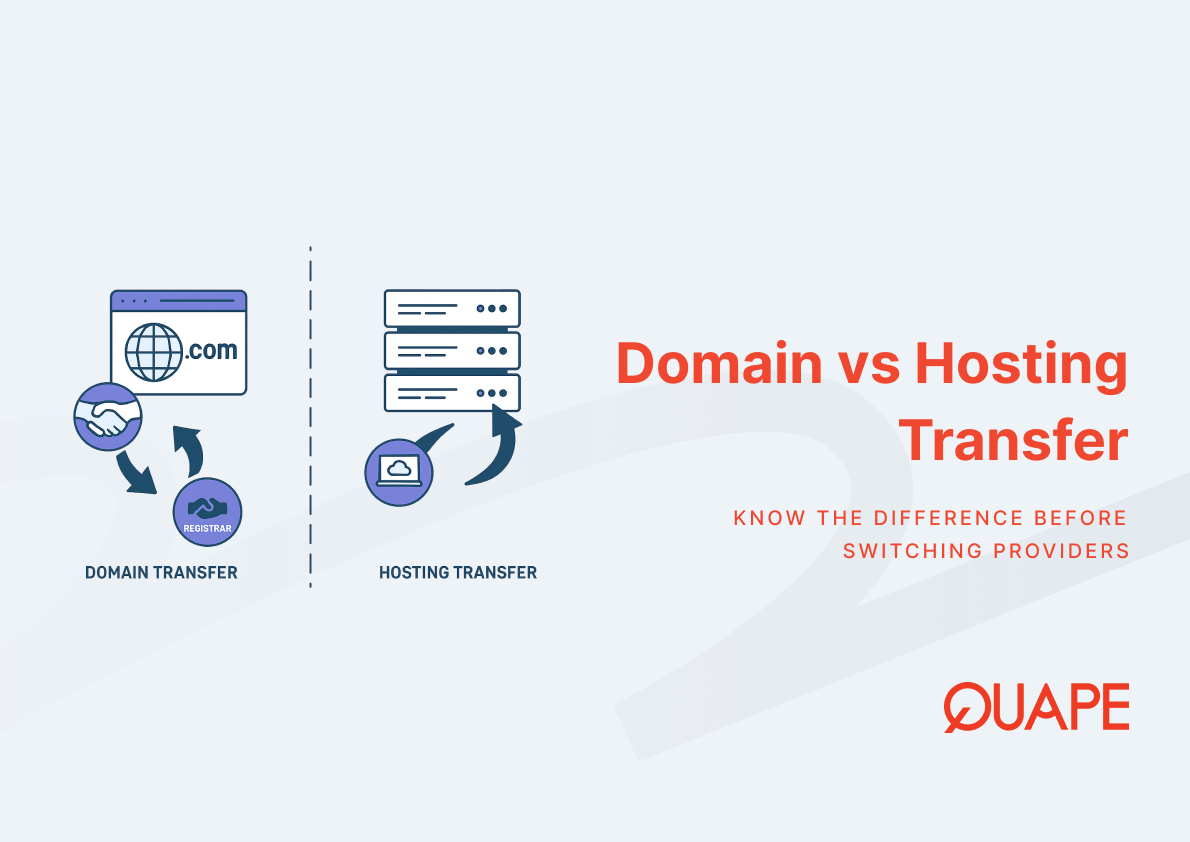
A domain transfer moves your domain name from one accredited registrar to another, changing who manages your domain’s registry records, renewal cycles, and ownership verification. According to ICANN, domain name transfers are governed at the registry level and require authorization codes (EPP/AuthInfo) issued by the registrar, not the hosting provider. This process does not affect where your website files are stored or which servers deliver your content to visitors. A hosting transfer, by contrast, moves your website files, databases, and application stack from one server environment to another without changing who controls your domain name at the registry level. These two operations exist independently because they serve different functions within the internet’s layered architecture.
Key Takeaways:
- Domain registrars control ownership records, renewal dates, and transfer authorization at the registry level, while hosting providers manage servers, file systems, and application environments.
- Transferring your domain to a new registrar does not move your website files; transferring your hosting does not change domain ownership or registrar control.
- DNS nameservers act as the delegation point that connects your domain to your hosting infrastructure without transferring ownership in either direction.
- Over 60% of organizations use different vendors for domain registration and hosting to reduce dependency and operational risk, according to Gartner.
- Web hosting providers have no legal authority to change domain ownership or registrar records unless they are also accredited registrars, as confirmed by ICANN.
- Misconfiguring DNS during infrastructure migrations is one of the top causes of unintended service downtime, based on data from ENISA.
- Selecting the right domain registration strategy establishes the foundation for long-term infrastructure flexibility and governance clarity.
Key Components and Authority Layers Behind Domain and Hosting
The internet’s governance hierarchy separates domain management from hosting infrastructure through distinct layers of authority. ICANN coordinates the global domain name system by accrediting registrars and overseeing registries, which maintain authoritative databases for each top-level domain. Domain registries store the official records that map domain names to their designated nameservers, while registrars act as intermediaries between domain owners and registries. Hosting infrastructure operates independently from this registry system, consisting of web servers, storage systems, and application environments that deliver content to end users. This separation ensures that domain ownership remains stable even when hosting providers change, and that website migrations do not inadvertently alter registry-level control. The distinction between these layers prevents vendor lock-in and supports infrastructure portability across different service providers.
What a Domain Registrar Controls (Registrar-Level Authority)
Domain registrars manage the legal and administrative relationship between domain owners and domain registries. They control WHOIS records that identify the registrant, administrative contact, and technical contact for each domain name. Registrars issue EPP authorization codes, which serve as secure tokens required to initiate transfers between registrars. They also manage the domain renewal lifecycle, including expiration dates, grace periods, and redemption windows that determine when a domain can be recovered after expiration. Transfer lock status, controlled at the registrar level, prevents unauthorized domain transfers by requiring explicit unlocking before any transfer request can proceed. These registrar functions operate entirely separately from hosting provider controls, which means changing your web host does not affect your registrar’s authority over your domain. Organizations that consolidate domain registration services with a trusted registrar gain clearer visibility into renewal schedules and transfer procedures.
What a Hosting Provider Controls (Server & Application Layer)
Hosting providers manage the physical and virtual infrastructure that stores website files and delivers content to visitors. They control web server software, file system access, and the application stack that runs your website’s code and processes user requests. IP address allocation falls under hosting provider authority, determining which network endpoints receive traffic directed to your domain. Resource allocation, including CPU, memory, storage, and bandwidth, defines how your website performs under varying traffic loads. These hosting controls exist independently from domain registrar authority, meaning that hosting providers cannot modify domain ownership records, transfer domains to different registrars, or change domain expiration dates unless they also function as accredited registrars. Businesses evaluating VPS hosting versus shared hosting should recognize that hosting performance and scalability decisions do not influence domain-level control or registry relationships.
DNS Delegation: The Separation Point Between Registrar and Hosting
DNS nameservers create the connection between domain registrar authority and hosting provider infrastructure without transferring ownership in either direction. Domain registries store authoritative nameserver records that delegate DNS resolution responsibility to specific name servers, which may be managed by your hosting provider, a third-party DNS service, or your registrar. DNS zone files, controlled by these delegated nameservers, contain A records that map your domain to specific IP addresses and MX records that direct email traffic to designated mail servers. This delegation model allows you to point your domain at any hosting infrastructure by updating nameserver records, without initiating a registrar transfer or changing domain ownership. The distinction between delegation and ownership prevents confusion during infrastructure changes: updating nameservers redirects traffic to new servers, while domain transfers move registry-level control between registrars. Organizations optimizing VPS network performance and latency benefit from understanding how DNS delegation affects traffic routing independently from domain ownership.
Common Misconceptions When Transferring Domains or Hosting
Many organizations incorrectly assume that purchasing hosting from a new provider automatically transfers their domain to that provider’s registrar. This misconception leads to situations where businesses believe their domain is managed by their hosting company, only to discover during a crisis that their domain remains with a separate registrar they no longer remember. Another frequent misunderstanding involves website downtime expectations: teams assume that transferring a domain between registrars will interrupt website availability, when in fact DNS continuity maintains service throughout the transfer process if properly managed. Email service dependency creates additional confusion, as organizations often believe email accounts are tied to their domain registrar, when email services actually depend on hosting infrastructure and DNS MX records rather than registrar identity. DNS propagation timelines also generate misconceptions: while DNS changes typically propagate within minutes to 48 hours, domain transfers between registrars follow completely separate timelines governed by registry policies and authorization procedures.
Why Domain Transfer Does Not Move Your Website
The registry transfer process changes which registrar manages your domain’s official records without relocating website files or altering server configurations. Domain transfers require authorization codes issued by your current registrar and acceptance by your new registrar, but these steps occur entirely at the registry level without touching hosting infrastructure. Hosting independence ensures your website continues running on the same servers throughout the domain transfer, since nameserver records remain unchanged unless you explicitly modify them. DNS continuity maintains uninterrupted service because the authoritative nameservers that resolve your domain to specific IP addresses keep functioning regardless of which registrar holds your domain. Organizations must separately plan website migration if they intend to move hosting infrastructure, recognizing that domain registrar changes and hosting provider changes require distinct procedures with different technical requirements and risk profiles.
Why Hosting Migration Does Not Change Domain Ownership
Registrar separation from hosting infrastructure means that moving your website to a new server environment does not affect who controls your domain at the registry level. Domain lock status, managed exclusively by your registrar, prevents unauthorized transfers regardless of hosting changes. Transfer authorization procedures require registrar-issued EPP codes that hosting providers cannot generate or access unless they also function as accredited registrars for your domain. This separation protects domain ownership from being inadvertently affected by routine hosting decisions, ensuring that upgrading servers, changing hosting vendors, or implementing VPS hosting solutions does not create unexpected changes to domain registration records, renewal dates, or transfer eligibility.
Practical Implications for Businesses in Singapore
Singapore’s .sg domain registry maintains specific requirements that separate domain registration authority from hosting infrastructure decisions. SGNIC and IMDA enforce local presence rules requiring .sg and .com.sg domain registrants to meet eligibility criteria based on Singapore citizenship, residency, or business registration status. These regulatory requirements operate at the registrar level, meaning hosting provider selection does not affect compliance with local domain registration policies. Procurement compliance frameworks in Singapore increasingly recognize domains as legal digital assets requiring governance separate from IT infrastructure procurement. Vendor separation best practices recommend maintaining domain registration with a distinct registrar rather than bundling everything with a single provider, reducing dependency risk and improving disaster recovery capabilities across critical digital infrastructure components.
Operational Risks for SMEs and Enterprises
Vendor lock-in emerges when organizations bundle domain registration, DNS management, and hosting services with a single provider without understanding the difficulty of untangling these services later. Compliance risk increases when IT teams cannot quickly verify domain ownership, transfer eligibility, or renewal status because administrative access remains with former employees or external agencies. Renewal mismanagement occurs frequently when businesses assume their hosting provider manages domain renewals, leading to expired domains and complete loss of online presence when registrar renewal notices go unmonitored. Downtime exposure during infrastructure changes intensifies when teams lack clear visibility into the separation between registrar authority and hosting control, resulting in misconfigured DNS settings that break website availability or email delivery. Businesses implementing VPS hosting compliance standards should establish parallel processes for domain lifecycle management to ensure registry-level controls receive appropriate governance attention.
How Proper Domain Registration Management Supports Infrastructure Scalability
Domain lifecycle management establishes predictable renewal schedules, transfer procedures, and ownership verification processes that remain stable even as hosting infrastructure evolves. Infrastructure portability improves when domain control exists separately from hosting vendor relationships, allowing organizations to migrate servers, upgrade hosting tiers, or switch providers without triggering domain-level complications. Vendor neutrality at the domain registration layer prevents hosting decisions from being constrained by domain transfer complexity, enabling teams to select optimal infrastructure based on performance, cost, and feature requirements rather than domain portability concerns. Long-term cost control benefits from separating domain registration from hosting bundled offerings, as transparent registrar pricing typically provides better visibility into renewal costs compared to promotional hosting packages that include “free” domain registration. Organizations evaluating fully managed versus self-managed VPS hosting should ensure their domain registration strategy supports infrastructure flexibility regardless of hosting management model.
Why Clear Separation Between Registrar and Hosting Matters Long-Term
IT governance frameworks increasingly recognize domain names as strategic assets requiring dedicated management processes distinct from hosting infrastructure administration. Procurement strategy benefits from treating domain registration as a separate vendor relationship with its own evaluation criteria, contract terms, and performance metrics. Disaster recovery planning depends on understanding that domain control and hosting redundancy require independent backup procedures, since losing access to your registrar account creates entirely different recovery challenges than server failures. Infrastructure resilience improves when domain registration remains stable across hosting migrations, server upgrades, and infrastructure modernization initiatives. Organizations implementing VPS backup and disaster recovery planning should ensure their domain management processes align with their infrastructure continuity requirements, recognizing that registry-level authority and server-level operations demand coordinated but separate governance approaches.
Conclusion & Next Steps for Secure Domain Control
Understanding the separation between domain registrar authority and hosting provider infrastructure enables organizations to make informed decisions about vendor relationships, infrastructure portability, and long-term digital asset management. Domain ownership clarity ensures your business maintains uninterrupted control over its online identity regardless of hosting changes, while registrar trust establishes the foundation for reliable renewal management and secure transfer procedures. Infrastructure flexibility improves when domain registration decisions prioritize portability and vendor neutrality rather than short-term bundled pricing. Businesses seeking to establish robust domain governance should evaluate their current registrar relationships, verify administrative access to domain management tools, and implement processes that treat domain registration as a strategic asset requiring dedicated attention. For organizations ready to strengthen their domain management foundation, contact our sales team to discuss how proper domain registration services support your infrastructure strategy.
Frequently Asked Questions
Can I transfer my domain and hosting to the same provider at once?
Yes, you can coordinate both transfers simultaneously, but they remain separate technical processes requiring different procedures. Domain transfer requires authorization codes from your current registrar and follows registry-specific timelines, while hosting migration involves moving files and configuring servers according to your new provider’s infrastructure. Managing both transitions in parallel demands careful coordination of DNS settings to maintain service continuity throughout both processes.
Will my website go offline during a domain registrar transfer?
No, your website remains accessible during domain registrar transfers if DNS nameserver records stay configured correctly. The transfer process changes registry-level ownership records without affecting the nameservers that route traffic to your hosting infrastructure. Downtime only occurs if you modify DNS settings incorrectly or if your current registrar suspends services before the transfer completes.
Do I need to update DNS records when switching hosting providers?
Yes, hosting migrations typically require updating DNS A records to point to your new server’s IP address, though the specific changes depend on your DNS management approach. If you continue using your previous hosting provider’s nameservers after migration, you must update records through their control panel. Organizations using third-party DNS services or their registrar’s nameservers have more flexibility to manage DNS changes independently from hosting provider transitions.
Can my hosting provider prevent me from transferring my domain?
No, hosting providers cannot block domain transfers unless they also serve as your domain registrar with legitimate reasons like outstanding payment disputes or security holds. Domain transfer authority belongs exclusively to the registrar of record, not to hosting companies. If your hosting provider claims control over your domain transfer, verify whether they are also your registrar or if your domain is registered through a separate registrar account.
What happens to my email when I transfer my domain registrar?
Your email service continues functioning unchanged during domain registrar transfers, since email delivery depends on MX records in your DNS configuration rather than registrar identity. As long as DNS nameservers remain stable and MX records continue pointing to your email server, messages flow normally throughout the transfer process. Email disruption only occurs if DNS management changes coincide with the registrar transfer without proper planning.
Should Singapore businesses use separate vendors for domain and hosting?
Many Singapore organizations benefit from vendor separation strategies that improve governance over .sg and .com.sg domains while maintaining flexibility for hosting infrastructure changes. Separating registrar and hosting relationships reduces dependency risk, simplifies compliance with SGNIC requirements, and supports disaster recovery planning by ensuring domain control persists independently from hosting service interruptions. However, some businesses prefer integrated management through a single trusted provider that offers both registrar and hosting services with clear administrative separation.
How long does domain registrar transfer typically take?
Domain transfers between registrars generally complete within five to seven days, though timelines vary based on registry policies and registrar processing speeds. The current registrar must approve the transfer or allow an automatic approval period to expire, while the gaining registrar validates authorization codes and confirms transfer requests. These timelines operate independently from DNS propagation delays, which affect how quickly nameserver changes take effect across the global DNS infrastructure.
Can I manage DNS separately from both my registrar and hosting provider?
Yes, third-party DNS services allow you to manage nameservers and zone records independently from both your domain registrar and hosting provider. This separation improves DNS reliability, enables advanced traffic management features, and simplifies infrastructure changes by decoupling DNS configuration from vendor relationships. Organizations implementing this approach point their domain’s nameservers at the third-party DNS service through their registrar’s control panel, then manage all DNS records through the DNS provider’s interface.

- Business Email Hosting vs G-Suite / Microsoft 365 - December 29, 2025
- Shared Hosting vs Dedicated Hosting for Email - December 29, 2025
- SMTP vs POP3 vs IMAP: Which Protocol Fits Your Business Workflow - December 28, 2025