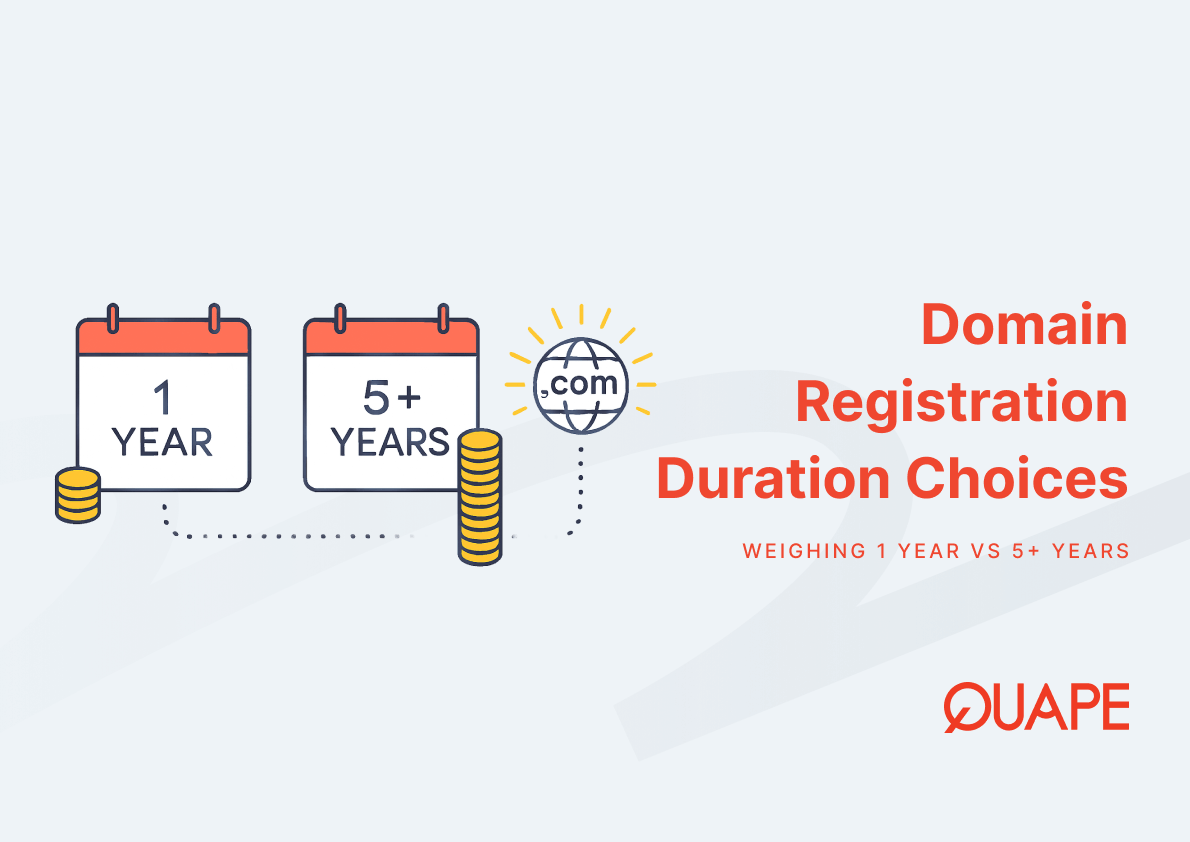
Domain registration period is a strategic decision that affects operational risk, cost predictability, and administrative overhead for IT teams. While search engines do not use registration length as a ranking factor, the choice between 1-year, multi-year, or long-term registration periods influences renewal management workflows, budget planning, and the likelihood of accidental domain expiration. Businesses that treat domains as critical digital assets align registration terms with broader IT governance frameworks, balancing flexibility against continuity risk. Understanding how registration duration interacts with renewal automation, cost amortization, and brand protection helps decision-makers select the term length that matches their operational maturity and risk tolerance.
Domain registration period refers to the length of time a domain name remains actively registered to an owner before requiring renewal. Registrars offer terms ranging from 1 to 10 years, with the registration duration determining when the domain enters its expiration lifecycle. The period selected does not alter DNS functionality, hosting performance, or search engine treatment, but it directly affects administrative frequency, cost exposure, and the probability of service interruption due to missed renewals.
Key Takeaways
- Search engines do not treat long domain registration periods as a direct ranking factor; domain age matters, but prepaid years do not.
- Short registration terms (1 year) increase renewal frequency, which raises the probability of administrative errors or forgotten renewals leading to domain expiration.
- Multi-year registration (2–5 years) reduces operational overhead and stabilizes cost exposure, but requires higher upfront commitment.
- Long-term registration (5–10 years) offers maximum renewal predictability and brand protection, though it locks pricing and limits flexibility.
- Most domain hijacking incidents and website outages stem from expired or forgotten renewals, not active cyberattacks.
- Over 360 million domain names are registered globally, with an average registration term of 1.83 years, indicating widespread short-term renewal behavior.
- Automated renewal failures account for a significant portion of SME website outages, particularly when payment methods expire or procurement cycles delay approvals.
- Domains function as intangible digital assets and should be managed with the same rigor as IP licenses, software subscriptions, or infrastructure contracts.
Introduction to Domain Registration Period
Domain registration period determines how long a domain remains active under a registrant’s control before entering the expiration process defined by ICANN lifecycle policies. The registration term selected at purchase or renewal does not influence DNS resolution, hosting availability, or technical performance, but it governs the frequency at which renewal actions must occur. Shorter terms require more frequent renewals, which increases the number of administrative touchpoints and introduces more opportunities for process failure. Longer terms reduce renewal frequency, lowering operational overhead but increasing upfront financial commitment.
The domain lifecycle includes registration, active use, expiration, grace period, redemption, and eventual deletion if not renewed. Each phase is governed by registrar policies and ICANN standards, with expiration triggering a cascade of events that can result in service interruption, email downtime, or permanent loss of the domain. Registration period interacts with renewal management systems by determining when these critical transitions occur. Organizations that select longer registration terms extend the interval between renewal cycles, which reduces the probability of missed deadlines but does not eliminate the need for proactive lifecycle governance.
Renewal cycles align with IT planning cycles differently depending on registration term length. Annual renewals require coordination with procurement, finance, and IT operations every 12 months, creating administrative overhead that scales with the number of domains managed. Multi-year terms reduce this frequency, allowing IT teams to batch renewals or align domain lifecycle management with other infrastructure contracts. However, longer terms require upfront budget allocation and may complicate cost recovery if business priorities shift. The relationship between registration period and renewal cycles is operational, not technical, but it directly affects how reliably domains remain active over time.
Registrar policies govern minimum and maximum registration terms, renewal processes, and transfer eligibility. Most registrars allow VPS hosting customers to bundle domain registration with hosting contracts, but the registration term remains independent of hosting duration. Some registrars enforce automatic renewal by default, while others require manual opt-in. The interaction between registrar policies and registration period determines how much control an organization has over renewal timing, cost predictability, and the ability to transfer domains without service interruption.
Key Components & Concepts of Domain Registration Period
Domain duration entity refers to the selected length of time a domain remains registered before requiring renewal action. This entity interacts with registrar systems, billing schedules, and IT asset management frameworks to determine when renewal processes must occur. Domain duration does not alter technical functionality, but it defines the frequency and timing of administrative interventions required to maintain ownership continuity. Organizations that select longer durations reduce the number of renewal events, which lowers the probability of process failure but increases the upfront cost commitment.
Registration term length describes the specific period chosen at the time of domain purchase or renewal, typically ranging from 1 to 10 years. This length is set by registrar policies and cannot be changed without processing a renewal or extension transaction. Registration term length interacts with procurement cycles by determining when budget approvals, payment processing, and vendor communication must occur. Shorter terms align with annual budgeting but require more frequent administrative action. Longer terms reduce frequency but require multi-year financial planning and may introduce rigidity if business needs change.
Renewal windows define the period during which a domain can be renewed before entering expiration. Most registrars allow renewals at any time before expiration, but some enforce advance renewal deadlines or limit the maximum extension period. Renewal windows interact with automated renewal systems by determining when payment processing must occur and when manual intervention is required if automation fails. Organizations that rely on automated renewals must ensure payment methods remain valid throughout the renewal window, as expired credit cards or failed billing triggers can result in missed renewals.
Expiry risk represents the probability that a domain will not be renewed in time, resulting in service interruption or permanent loss. This risk increases with shorter registration terms because more frequent renewals create more opportunities for administrative errors, payment failures, or process delays. Expiry risk interacts with IT governance frameworks by requiring oversight mechanisms, renewal tracking systems, and escalation protocols to ensure continuity. Organizations that treat domains as critical infrastructure implement multi-layered safeguards, including automated renewals, calendar reminders, and vendor alerting, to mitigate expiry risk across all registration terms.
Short-Term Registration (1 Year): Flexibility vs Administrative Overhead
Annual renewal offers maximum flexibility for organizations that require frequent reassessment of domain portfolios, budget adjustments, or vendor changes. The 1-year registration term aligns with standard fiscal planning cycles, making it easier to justify expenditures during annual budget reviews. This alignment simplifies cost approval processes but increases the frequency of renewal transactions, which creates more administrative touchpoints and raises the probability of process failure. Organizations that manage large domain portfolios must coordinate multiple renewals annually, which can strain IT resources if renewal workflows are not fully automated.
Procurement approval cycles interact with annual renewals by requiring budget authorization, vendor evaluation, and payment processing every 12 months. In organizations with centralized procurement, this frequency can introduce delays if approval workflows coincide with fiscal year-end or budget freezes. Annual renewals that fall during procurement blackout periods risk expiration if approval cannot be obtained in time. This operational dependency makes short-term registration less suitable for organizations with rigid procurement cycles or limited administrative capacity.
Renewal management risk escalates with annual registration because more frequent renewals increase the likelihood of administrative errors, such as forgotten renewal dates, expired payment methods, or unmonitored email alerts. Automated renewal systems reduce this risk, but they depend on accurate billing information and uninterrupted payment processing. Organizations that rely on manual renewal processes face higher risk with annual terms because each renewal cycle introduces another opportunity for oversight failure. This risk compounds in environments where domain management responsibilities are distributed across multiple teams or where IT documentation is incomplete.
Domain expiration occurs when renewal actions are not completed before the end of the registration term, triggering a cascade of events that begin with service interruption and can end with permanent domain loss. The shorter the registration term, the more frequently expiration risk materializes. Annual registration requires vigilance 12 times per decade, while 10-year registration requires vigilance only once. However, annual registration also offers an escape valve for organizations that need to exit vendor relationships, discontinue services, or reallocate budgets without being locked into long-term commitments.
Mid-Term Registration (2–3 Years): Balancing Cost Control and Stability
Cost amortization becomes more favorable with mid-term registration because upfront costs are spread across multiple years, reducing the annual effective cost per domain. Registrars often offer discounts for multi-year purchases, which lowers total cost compared to sequential annual renewals. This cost structure benefits organizations that prioritize budget predictability and want to lock in pricing before registrar fee increases take effect. Mid-term registration reduces the frequency of price renegotiation, which simplifies financial planning but requires confidence that the domain will remain strategically relevant throughout the term.
Budget predictability improves with 2- to 3-year registration terms because IT teams can forecast domain costs with greater certainty and reduce the frequency of budget justification exercises. Multi-year registration eliminates the need for annual procurement approvals, which accelerates renewal workflows and reduces administrative burden. However, this predictability depends on stable registrar pricing and assumes that business priorities will not shift significantly during the registration period. Organizations that operate in volatile markets or undergo frequent restructuring may find mid-term registration less suitable because it introduces rigidity.
IT asset planning frameworks treat domains as long-term digital assets that require lifecycle management similar to software licenses, hardware warranties, and SaaS subscriptions. Mid-term registration aligns with typical IT asset planning horizons, which span 2 to 3 years and coincide with infrastructure refresh cycles. This alignment allows IT teams to synchronize domain renewals with broader asset management activities, reducing the cognitive load of tracking disparate renewal schedules. Organizations that integrate domain registration into IT asset management systems benefit from centralized oversight, automated renewal tracking, and consolidated vendor management.
Long-Term Registration (5–10 Years): Strategic Control & Risk Reduction
Long-term digital asset ownership secures domain control for extended periods, reducing the frequency of renewal actions to once per decade or less. This approach minimizes administrative overhead and eliminates the risk of expiration due to missed annual or biennial renewals. Long-term registration is particularly valuable for organizations that treat domains as foundational brand assets, where loss of control would result in significant operational disruption, reputational damage, or financial loss. By committing to extended registration periods, organizations signal their intent to maintain long-term digital presence and reduce the probability of domain hijacking through renewal lapses.
Brand protection strengthens with long-term registration because extended ownership periods reduce the window during which competitors, cybersquatters, or bad actors can acquire expired domains. Domains that lapse into expiration enter public auction or deletion cycles, where they become available for registration by third parties. Long-term registration prevents this exposure by ensuring the domain remains continuously under the original owner’s control. This protection is especially critical for high-value domains, core brand identifiers, and domains that host customer-facing services or email infrastructure.
Registrar lock-in considerations arise with long-term registration because extended terms reduce the flexibility to change vendors, renegotiate pricing, or respond to service quality degradation. Organizations that commit to 5- or 10-year terms must trust that the registrar will maintain acceptable service standards, pricing transparency, and technical reliability throughout the registration period. Domain transfer processes can mitigate lock-in, but transfers require administrative effort and may introduce service interruption if not executed carefully. Organizations should evaluate registrar reputation, financial stability, and transfer policies before committing to long-term registration.
SEO, Trust & Brand Signals Associated With Registration Length
SEO trust signals are often misunderstood in the context of domain registration period. Google has publicly stated that domain registration length does not function as a ranking factor in search algorithms. Search engines evaluate content quality, user engagement, technical performance, and backlink profiles, not the number of years prepaid on a domain registration. The myth that longer registration periods improve rankings persists because correlation is often mistaken for causation: established websites with strong SEO performance are more likely to register domains for longer periods, but the registration length itself does not confer ranking advantages.
Domain age perception differs from registration length in that search engines do consider the historical presence of a domain, including when it was first indexed, how consistently it has been active, and whether it has maintained stable ownership. A domain registered for 10 years upfront does not receive the same treatment as a domain that has existed for 10 years with continuous content publication and user engagement. Domain age accumulates over time through active use, not through advance payment of registration fees. Organizations that prioritize SEO should focus on content strategy, technical optimization, and user experience rather than registration term length.
Search engine risk mitigation relates to domain registration only insofar as expired domains can lose search rankings if they experience prolonged downtime or if they are acquired by bad actors who repurpose them for spam or malicious content. Avoiding expiration protects accumulated SEO value by ensuring continuous availability, but this protection is equally achievable through reliable renewal management regardless of registration term length. Organizations that depend on organic search traffic should implement renewal safeguards, but they should not expect registration length to directly influence rankings.
Brand credibility in the eyes of users or business partners is sometimes associated with long-term domain registration because it signals stability, commitment, and forward planning. However, this signal is indirect and not universally recognized. Most users do not check WHOIS records to verify registration length, and most business partners evaluate credibility based on operational performance, not domain lifecycle management. Organizations that seek to project long-term stability should focus on transparent communication, consistent service delivery, and strong customer relationships rather than relying on registration term length as a credibility signal.
Cost Amortization & Financial Planning for Domain Registration
Cost amortization improves with longer registration terms because the total cost is distributed across multiple years, reducing the annual effective expense per domain. Registrars frequently offer volume discounts or multi-year pricing incentives that lower total cost compared to sequential annual renewals. This cost structure benefits organizations that manage large domain portfolios and want to reduce both per-domain costs and the frequency of financial transactions. However, cost amortization requires upfront budget allocation, which may be challenging for organizations with constrained cash flow or annual budgeting limitations.
Long-term pricing stability protects against registrar fee increases by locking in current pricing for the duration of the registration term. Registrars periodically adjust renewal pricing in response to ICANN fee changes, market conditions, or business strategy shifts. Organizations that register domains for multiple years avoid exposure to these increases until the next renewal cycle. This stability is particularly valuable in markets where domain pricing is volatile or where registrar consolidation has led to aggressive pricing changes. However, pricing stability also means organizations cannot benefit from future price reductions or competitive offers until the registration term expires.
Renewal fee exposure increases with shorter registration terms because each renewal cycle introduces an opportunity for registrars to adjust pricing. Organizations that renew annually face pricing uncertainty every 12 months, which complicates long-term financial planning and can result in unexpected budget overruns if registrars implement steep increases. Multi-year registration reduces this exposure by extending the interval between pricing adjustments, but it also requires confidence that the locked-in price represents good value over the term. Organizations should compare registrar pricing models, evaluate historical fee trends, and assess the risk of pricing volatility when selecting registration terms.
Procurement forecasting becomes more reliable with longer registration terms because IT teams can predict domain costs with greater accuracy and reduce the frequency of budget justification exercises. Organizations that integrate domain costs into multi-year IT budgets benefit from reduced administrative overhead and more stable cost projections. However, longer terms require coordination with finance teams to ensure upfront expenditures are approved and that domain costs are tracked as prepaid assets or deferred expenses. Organizations with mature IT asset management practices often find that VPS hosting pricing models and domain registration terms can be aligned to simplify cost forecasting across infrastructure components.
Operational Risk & Renewal Management for IT Teams
Renewal automation reduces the probability of domain expiration by eliminating manual renewal processes and ensuring that renewals occur automatically before the registration term ends. Most registrars offer automated renewal as an opt-in or default feature, which processes renewal payments without requiring manual intervention. However, automation depends on accurate billing information, valid payment methods, and uninterrupted payment processing. Organizations that rely on automation must monitor renewal confirmations, track payment method expiration dates, and maintain backup renewal mechanisms to ensure continuity if automation fails.
Administrative errors represent a significant source of domain expiration risk, particularly in organizations where domain management responsibilities are distributed across multiple teams or where documentation is incomplete. Common errors include forgetting renewal dates, failing to update contact information, allowing payment methods to expire, or misconfiguring automated renewal settings. These errors occur more frequently with annual registration because each renewal cycle introduces another opportunity for process failure. Organizations that standardize renewal workflows, centralize domain management, and implement redundant safeguards reduce administrative error risk regardless of registration term length.
Ownership continuity depends on reliable renewal processes and clear governance over domain lifecycle management. Organizations that experience personnel turnover, departmental restructuring, or vendor changes face heightened risk of domain loss if renewal responsibilities are not clearly assigned and documented. Long-term registration extends the interval between renewal actions, which reduces the probability that ownership transitions will coincide with renewal cycles. However, ownership continuity also requires proactive succession planning, where domain credentials, renewal schedules, and vendor contacts are maintained in centralized repositories accessible to authorized personnel.
Vendor governance frameworks ensure that domain registrars meet service level expectations, maintain transparent pricing, and provide reliable renewal infrastructure. Organizations that treat domains as critical IT assets should evaluate registrar performance, financial stability, and customer support quality before committing to long-term registration. Registrar failures, including business closures, service outages, or unresponsive support, can jeopardize domain continuity if transfers cannot be executed quickly. Organizations should maintain relationships with multiple registrars, document transfer procedures, and test transfer processes periodically to ensure they can migrate domains if vendor performance degrades. For broader operational risk planning, IT teams often align domain renewal governance with VPS backup and disaster recovery planning frameworks to ensure business continuity across infrastructure components.
Practical Considerations for Singapore-Based Businesses
Singapore domain policies govern the registration, transfer, and renewal of .sg and .com.sg domains through the Singapore Network Information Centre (SGNIC), which enforces eligibility requirements, documentation standards, and renewal procedures specific to Singapore-based entities. Organizations that register .sg domains must provide proof of local presence, such as NRIC, FIN, or UEN documentation, which adds a compliance layer to domain management. These policies interact with registration term length by determining how frequently documentation must be reviewed or updated during renewal cycles. Multi-year registration reduces the frequency of compliance reviews but requires upfront documentation accuracy.
.sg and .com.sg governance requires that registrants maintain valid local contact information and comply with SGNIC policies throughout the registration term. Non-compliance can result in domain suspension or cancellation, particularly if contact information becomes outdated or if ownership changes are not properly documented. Organizations that select longer registration terms should implement periodic reviews of SGNIC compliance status to ensure that documentation remains current and that any changes in business structure, ownership, or contact details are reflected in domain records. This governance requirement applies regardless of registration term length but becomes more critical with multi-year terms because longer intervals increase the probability of organizational changes.
Corporate compliance frameworks in Singapore often require that digital assets, including domains, be managed in accordance with data protection, cybersecurity, and business continuity standards. Organizations subject to regulatory oversight, such as financial institutions, healthcare providers, or government contractors, may need to demonstrate that domain lifecycle management aligns with broader compliance obligations. Long-term domain registration can support compliance by reducing the frequency of renewal transactions, simplifying audit trails, and ensuring that critical domains remain under continuous organizational control.
Local brand trust strengthens when organizations use .sg or .com.sg domains because these extensions signal local presence, regulatory compliance, and commitment to the Singapore market. Customers, partners, and government entities often perceive .sg domains as more trustworthy than generic TLDs because the eligibility requirements create a higher barrier to registration and reduce the prevalence of cybersquatting or fraudulent sites. Organizations that prioritize local brand credibility should consider whether registration term length aligns with their long-term market presence and whether multi-year registration reinforces their commitment to stable operations in Singapore.
How QUAPE Domain Registration Supports Long-Term Domain Control
Domain registration service at QUAPE is designed to support organizations that treat domains as strategic digital assets requiring reliable lifecycle management, transparent pricing, and proactive renewal safeguards. QUAPE offers registration terms ranging from 1 to 10 years, allowing customers to select the term length that aligns with their operational maturity, risk tolerance, and financial planning horizons. The registration process integrates with IT asset management workflows, enabling organizations to track renewal schedules, monitor expiration dates, and synchronize domain lifecycle management with broader infrastructure planning.
Transparent renewal pricing eliminates the risk of unexpected fee increases or hidden costs that can complicate budget forecasting and procurement approvals. QUAPE maintains consistent pricing across renewal cycles and provides advance notice of any fee adjustments, allowing customers to make informed decisions about registration term length and vendor relationships. This transparency supports cost amortization strategies by ensuring that multi-year registration costs remain predictable and that organizations can compare pricing models across different term lengths without encountering bait-and-switch tactics.
Automated renewal management at QUAPE reduces the probability of domain expiration by processing renewals automatically before the registration term ends, provided that billing information remains current and payment processing succeeds. Customers receive renewal confirmations, expiration alerts, and payment failure notifications to ensure that automated processes are functioning correctly and that manual intervention can occur if needed. This automation integrates with calendar systems, ticketing platforms, and email workflows to provide multiple layers of renewal oversight.
Multi-year registration support enables organizations to secure domains for extended periods, reducing administrative overhead and locking in pricing stability. QUAPE customers who select domain registration terms of 5 or 10 years benefit from fewer renewal cycles, lower effective annual costs, and reduced exposure to registrar fee volatility. This support extends to .sg and .com.sg domains, where QUAPE manages SGNIC compliance requirements and ensures that documentation remains current throughout the registration term.
Conclusion & CTA
Selecting the appropriate domain registration period requires balancing operational risk, cost predictability, and administrative capacity against organizational priorities and IT governance maturity. Short-term registration offers flexibility but increases renewal frequency and expiry risk. Long-term registration reduces operational overhead and locks in pricing but requires upfront commitment and limits vendor flexibility. Organizations that align registration term length with broader IT asset management strategies, implement reliable renewal safeguards, and treat domains as critical infrastructure achieve greater continuity and reduce the probability of service interruption due to preventable expiration events.
If you need guidance on selecting the right domain registration term for your organization or want to explore how multi-year registration can support your IT governance framework, contact our sales team to discuss your requirements.
Frequently Asked Questions
Does registering a domain for 10 years improve SEO rankings?
No, search engines do not use domain registration length as a ranking factor. Google has confirmed that prepaid registration years do not influence search rankings. SEO performance depends on content quality, user engagement, and technical optimization, not on how many years are paid in advance.
What happens if I forget to renew my domain?
If a domain is not renewed before expiration, it enters a grace period during which renewal is still possible, often with late fees. After the grace period, the domain enters redemption status, where recovery is more expensive and time-consuming. If not recovered, the domain is eventually deleted and becomes available for public registration.
Can I change my domain registration term after purchase?
You cannot retroactively change an existing registration term, but you can extend the term by processing a renewal transaction before the current term expires. Most registrars allow you to add additional years at any time, up to the maximum registration limit of 10 years.
Is multi-year domain registration more cost-effective?
Multi-year registration often provides cost savings through volume discounts and protects against future price increases by locking in current pricing. The total cost is typically lower than sequential annual renewals, and the reduced administrative overhead adds value beyond direct cost savings.
Do .sg domains have different registration term requirements?
.sg and .com.sg domains follow the same registration term options as generic TLDs, allowing terms from 1 to 10 years. However, these domains require compliance with SGNIC eligibility requirements and local documentation standards throughout the registration period.
Should startups register domains for longer periods?
Startups should evaluate cash flow constraints, business stability, and strategic planning horizons before committing to long-term registration. If the domain is core to brand identity and cash flow permits, multi-year registration reduces operational risk and signals long-term commitment. If business direction is uncertain, annual registration offers more flexibility.
How does automated renewal work with multi-year registration?
Automated renewal processes the next registration term automatically when the current term approaches expiration, regardless of whether the current term is 1 year or 10 years. Organizations that select long-term registration still need to ensure payment methods remain valid, but renewal frequency is reduced.
Can I transfer a domain to another registrar before the registration term ends?
Yes, domains can be transferred to another registrar at any time, regardless of remaining registration term. The remaining time typically transfers with the domain, and most registrars add one additional year during the transfer process. Transfer procedures vary by registrar and TLD.

- Business Email Hosting vs G-Suite / Microsoft 365 - December 29, 2025
- Shared Hosting vs Dedicated Hosting for Email - December 29, 2025
- SMTP vs POP3 vs IMAP: Which Protocol Fits Your Business Workflow - December 28, 2025