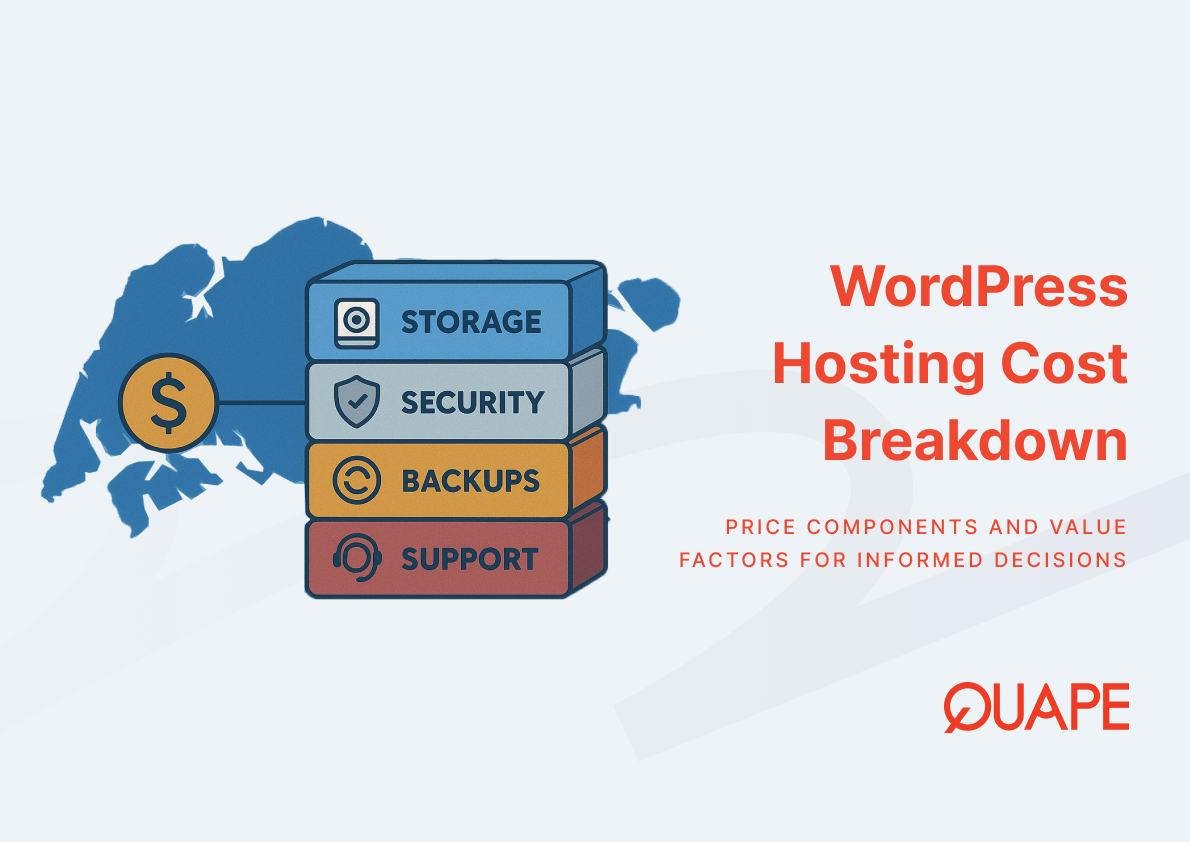
WordPress hosting costs in Singapore range from SGD 60 annually for basic shared plans to SGD 1,200 or more for enterprise-managed services, but pricing alone rarely tells the full story. The real cost drivers include storage technology, security automation, backup frequency, support scope, and infrastructure certification, all of which influence total cost of ownership and business risk. With WordPress powering roughly 43% of all websites, procurement teams must evaluate hosting investments against operational risk, performance impact, and regulatory requirements rather than sticker price. This guide breaks down the components that determine what you should actually pay for WordPress hosting, explains how each element contributes to value, and offers practical benchmarks for Singapore businesses making informed hosting decisions.
WordPress hosting cost breakdown describes the line-item and structural factors that together determine the total expense of running a WordPress site on a hosting platform. Unlike commodity hosting where price per gigabyte drives decisions, WordPress hosting pricing reflects a bundle of interdependent services: compute and storage resources, security patching workflows, backup systems, expert support, and data center compliance. Understanding how these components interact, and which ones materially reduce business risk or improve revenue outcomes, enables IT managers and procurement leads to distinguish between low-cost plans that shift operational burden onto internal teams and higher-cost managed services that absorb security, performance, and availability responsibilities. The following sections examine each cost component, explain trade-offs, and provide context for typical Singapore pricing.
Key Takeaways
- Managed WordPress hosting typically costs SGD 300 to SGD 1,200 annually in Singapore, with pricing reflecting automation of security updates, daily backups, and expert support rather than raw storage capacity alone.
- NVMe storage delivers substantially higher throughput and IOPS than legacy SATA interfaces, materially improving database query performance and page-load speed for WordPress sites handling dynamic content or e-commerce transactions.
- Security vulnerability disclosures in the WordPress ecosystem numbered over 5,200 in 2023, making automated patching and monitoring a recurring cost driver that managed plans absorb and unmanaged plans shift to internal teams.
- Annual billing models reduce effective monthly cost by 10–20% compared to month-to-month contracts, locking in predictable budgets and reducing administrative overhead for multi-year hosting commitments.
- Singapore businesses benefit from local data center hosting that reduces network latency to regional customers, simplifies PDPA compliance workflows, and aligns with IMDA advisory guidelines for cloud service resilience issued in early 2025.
Introduction to WordPress Hosting Cost Breakdown
When evaluating WordPress hosting plans in Singapore, procurement teams and IT managers often focus on advertised monthly or annual fees without fully accounting for hidden operational costs, performance trade-offs, and risk exposure. The true cost of WordPress hosting extends beyond the invoice line item to include internal labor for security patching, downtime impact on revenue, and performance penalties that degrade conversion rates or search rankings. A comprehensive cost breakdown therefore considers not only direct hosting fees but also the value delivered by managed services, infrastructure quality, and contractual guarantees that reduce total cost of ownership over the lifecycle of a WordPress deployment.
Hosting pricing models vary significantly across shared, managed, VPS, and enterprise tiers, each reflecting different allocations of responsibility between the hosting provider and the customer. Shared hosting plans, which can start as low as SGD 60 annually, place the burden of plugin updates, security monitoring, and performance tuning squarely on the site owner or internal IT team. Managed WordPress hosting plans, typically priced from SGD 300 to SGD 1,200 annually in the Singapore market, absorb these operational tasks and bundle them with automated backups, security patching, and expert support. Understanding these structural differences enables businesses to assess whether a lower upfront price genuinely delivers value or simply defers costs and risks to internal teams. For SMEs with limited IT resources and enterprises with high-traffic or revenue-critical sites, the premium paid for managed services often proves cost-efficient when measured against the alternative of staffing, tooling, and downtime exposure.
Service tiers within managed hosting further segment pricing based on storage capacity, number of sites supported, backup frequency, and inclusion of value-added services such as content updates or migration assistance. Billing cycles also influence cost efficiency: annual contracts typically discount the effective monthly rate by 10–20% compared to month-to-month arrangements, locking in predictable budgets and reducing administrative churn for multi-year commitments. Performance features such as NVMe storage, high IOPS capacity, and data center redundancy introduce incremental cost but deliver measurable improvements in page-load speed, database responsiveness, and uptime reliability. For Singapore businesses serving local and regional markets, hosting in certified Singapore data centers reduces network latency, simplifies regulatory compliance, and aligns with government advisory guidelines on cloud service resilience.
Key Components of WordPress Hosting Pricing
Hosting Plan Types and Their Cost Structures
The distinction between managed and unmanaged hosting fundamentally shapes cost structure and operational responsibility. Unmanaged or shared hosting plans, often priced at SGD 5 to SGD 10 monthly, provide server resources and basic control panel access but leave WordPress installation, plugin management, security updates, and troubleshooting to the site owner. This model minimizes direct hosting expense but increases indirect costs: internal teams must monitor security advisories, apply patches, configure backups, and respond to performance issues. When businesses lack dedicated IT staff or WordPress expertise, these tasks consume time, introduce delay in patching critical vulnerabilities, and increase the likelihood of downtime or security incidents that carry real business costs.
Managed WordPress hosting inverts this model by bundling operational responsibilities into the service tier. Providers handle WordPress core updates, plugin and theme patching, daily automated backups, security monitoring, and expert troubleshooting as part of the monthly or annual fee. Pricing reflects the labor, automation infrastructure, and support capacity required to maintain these services at scale. Entry-level managed plans in Singapore typically start around SGD 300 annually for single-site hosting with 15–20 GB NVMe storage, monthly security updates, and daily backups. Mid-tier plans priced at SGD 600 annually expand storage to 50 GB, support two websites, and maintain the same security and backup cadence. Enterprise tiers at SGD 1,200 annually or higher include larger storage allocations, multi-site support, and value-added services such as monthly content updates or priority migration assistance.
Service features beyond storage and site count also drive cost differentiation. Support levels vary from email-based ticketing in lower tiers to phone and chat support in premium plans, reflecting the cost of staffing expert teams capable of diagnosing WordPress-specific issues. Scalability provisions, such as the ability to upgrade seamlessly to VPS or dedicated resources as traffic grows, add contractual flexibility and reduce future migration complexity. For procurement teams budgeting hosting investments, these structural differences mean that comparing price per gigabyte or price per site without accounting for operational workload transfer produces misleading cost-benefit conclusions.
Performance Features That Influence Cost
Storage technology represents one of the most material cost and performance factors in modern WordPress hosting. NVMe storage, which leverages the PCIe interface rather than legacy SATA or SAS protocols, delivers substantially higher throughput, lower latency, and orders of magnitude greater IOPS than SATA-based SSDs. For WordPress sites, which rely heavily on database queries to generate dynamic pages, high IOPS capacity directly improves query response time and reduces page-load duration. The cost premium for NVMe-equipped hosting plans, typically an incremental SGD 50 to SGD 150 annually, translates into measurable improvements in WordPress speed that affect both user experience and search engine rankings.
Bandwidth allocation and data transfer limits influence cost for high-traffic sites or those serving media-heavy content. Most managed WordPress plans in Singapore include generous or unmetered bandwidth within the service tier, recognizing that bandwidth costs have declined and that predictable pricing models reduce customer friction. However, very high-traffic scenarios, such as e-commerce promotions or viral content campaigns, may trigger overage fees or require migration to VPS tiers with dedicated bandwidth guarantees. Uptime SLA commitments, which formalize the provider’s contractual obligation to maintain service availability, also correlate with price: plans offering 99.9% or higher SLA typically cost more because they require redundant infrastructure, monitoring systems, and incident response protocols.
Data center infrastructure quality, including Tier certification under ANSI/TIA-942 standards, influences hosting cost by reflecting investment in redundant power, cooling, network connectivity, and physical security. Higher Tier facilities, which maintain dual or N+1 redundancy for critical systems, incur greater capital and operational expense that providers pass through in hosting fees. For Singapore businesses with high availability requirements or regulatory scrutiny, hosting in certified facilities justifies the incremental cost by reducing downtime risk and demonstrating compliance with industry-standard infrastructure practices.
Security and Maintenance Cost Factors
Security and maintenance represent significant recurring costs in WordPress hosting, driven by the frequency and volume of vulnerability disclosures in the WordPress ecosystem. Security researchers identified over 5,200 vulnerabilities in 2023, and independent trackers reported nearly 5,948 new entries in vulnerability databases during the same period. These figures underscore that plugin and theme maintenance is not a one-time task but a continuous operational burden requiring monitoring, testing, and rapid deployment of patches. Managed hosting plans absorb this workload by automating security updates, scanning for known vulnerabilities, and deploying patches on a regular cadence, typically monthly for routine updates and ad-hoc for critical zero-day disclosures.
Backup frequency and retention policies also influence cost structure. Daily automated backups, which most managed plans include, require storage capacity for multiple restore points and infrastructure to execute backup jobs without performance impact. One-click restore functionality, which simplifies recovery from security incidents or failed updates, adds user interface development and testing overhead. For businesses handling transactional data or customer information, backup reliability and retention duration directly influence business continuity planning and regulatory compliance, making backup services a security checklist priority worth budgeting for.
SSL certificate provisioning and renewal, though increasingly commoditized, still represents a line-item cost in some hosting plans. Managed providers typically bundle free SSL certificates via Let’s Encrypt or similar services, automating renewal and configuration. The inclusion of SSL in WordPress hosting eliminates manual certificate management and ensures consistent encryption for visitor traffic, supporting both security posture and search engine requirements. The cost of these services, when internalized by the provider, reflects automation tooling and support capacity rather than certificate expense alone.
Billing Models and Long-Term Cost Efficiency
Annual billing models offer immediate cost savings compared to month-to-month contracts, typically reducing effective monthly cost by 10–20%. This discount reflects the provider’s reduced churn risk, lower payment processing overhead, and improved cash flow predictability. For procurement teams managing multi-year hosting budgets, annual commitments also lock in pricing and protect against mid-contract rate increases, simplifying financial forecasting. However, annual billing introduces switching costs: businesses dissatisfied with service quality or requiring rapid scaling must wait for contract renewal or negotiate early termination, reducing flexibility.
Value-added services bundled into higher-tier plans, such as monthly content updates, priority migration assistance, or dedicated account management, increase upfront cost but reduce total cost of ownership when these services would otherwise require vendor procurement or internal labor. For example, enterprise plans priced at SGD 1,200 annually that include one content update per month effectively offset the cost of hiring freelance developers or dedicating staff time to routine WordPress maintenance tasks. Evaluating these services requires understanding internal labor costs and opportunity costs: the time IT teams spend managing WordPress updates is time not available for strategic projects or infrastructure improvements.
Contract terms, including renewal pricing, upgrade paths, and termination clauses, influence long-term cost efficiency. Transparent pricing models that guarantee renewal rates for multi-year commitments reduce budget uncertainty, while flexible upgrade paths allow businesses to scale hosting resources without data migration or service interruption. For Singapore SMEs and enterprises planning multi-year WordPress deployments, these contractual details merit careful review during procurement to avoid cost surprises or lock-in scenarios that limit future flexibility.
Practical Pricing Considerations for Singapore Businesses
Singapore businesses face unique cost considerations when selecting WordPress hosting, driven by regulatory requirements, local market dynamics, and customer expectations for performance and data residency. Hosting sites in Singapore data centers reduces network latency to local and regional customers, improving page-load speed and user experience. This latency reduction translates into measurable business outcomes: faster sites increase conversion rates, reduce bounce rates, and improve search engine rankings, particularly for mobile users on variable network connections. The cost premium for local hosting, typically SGD 50 to SGD 200 annually compared to distant offshore options, often proves cost-efficient when measured against revenue impact and customer satisfaction.
Regulatory compliance considerations also favor local hosting for Singapore businesses handling customer data or operating in regulated sectors. The Personal Data Protection Act requires businesses to implement reasonable security safeguards, and hosting in certified Singapore facilities simplifies compliance workflows by ensuring data residency within familiar jurisdictional frameworks. In early 2025, IMDA issued advisory guidelines for cloud services and data centers that emphasize resilience and security, signaling government focus on infrastructure standards. For procurement teams in public sector or finance, healthcare, and professional services sectors, hosting providers that meet these guidelines reduce audit burden and demonstrate alignment with regulatory expectations.
Multi-site hosting scenarios, common for businesses managing corporate sites, regional microsites, or client portfolios, introduce additional cost considerations. Managed plans that support multiple WordPress installations on a single account reduce per-site cost compared to provisioning separate hosting contracts for each site. Mid-tier plans priced at SGD 600 annually that support two sites, or enterprise plans at SGD 1,200 annually supporting three sites, deliver per-site costs of SGD 300 and SGD 400 respectively, representing meaningful economies of scale. However, these plans typically share storage, bandwidth, and compute resources across all sites, requiring businesses to assess whether aggregate traffic and storage needs fit within plan limits or whether isolated VPS or dedicated hosting better serves high-traffic multi-site deployments.
Local billing and support also influence total cost of ownership for Singapore businesses. Providers that invoice in SGD, accept local payment methods, and maintain Singapore-based support teams reduce currency exchange risk, payment processing friction, and timezone misalignment that complicates incident response. These operational conveniences, though difficult to quantify in direct cost terms, reduce administrative overhead and improve incident resolution speed when business-critical hosting issues arise.
How WordPress Hosting Plans from Quape Support Cost Efficiency
Quape’s managed WordPress hosting plans structure pricing to balance upfront cost with operational risk transfer, targeting Singapore SMEs, developers, and enterprises that require predictable performance and security without dedicating internal resources to WordPress maintenance. The WP Essential plan at SGD 300 annually provides 15 GB NVMe storage, monthly security updates, daily automated backups, and single-site hosting, delivering entry-level managed services at a cost point accessible to small businesses and individual developers. This pricing reflects automation of security patching and backup workflows that would otherwise require manual intervention, monitoring tools, and IT labor.
The WP Professional plan at SGD 600 annually expands storage to 50 GB, supports two WordPress sites, and maintains the same security update and backup cadence, offering per-site economies for businesses managing multiple properties. This tier suits agencies managing client sites or businesses operating corporate and product microsites on a single hosting account. The WP Enterprise plan at SGD 1,200 annually further increases storage to 100 GB, supports three sites, and adds monthly content updates, absorbing routine WordPress maintenance tasks such as plugin updates, minor fixes, or content edits that would otherwise require freelance developer contracts or internal staff time.
All three tiers deploy NVMe storage to ensure high IOPS capacity for database-intensive WordPress workloads, reflecting the cost premium for modern storage technology balanced against performance benefits that improve page-load speed and user experience. Daily backups across all tiers provide one-click restore capability, reducing recovery time objective and simplifying disaster recovery workflows. Monthly security updates, rather than continuous real-time patching, establish a predictable maintenance cadence that balances security responsiveness with stability and testing requirements.
Storage and site limits within each tier encourage businesses to right-size hosting investments against actual resource needs rather than over-provisioning for hypothetical future growth. Businesses that outgrow storage or site limits can upgrade to higher tiers or migrate to VPS hosting plans that provide dedicated CPU, RAM, and storage for high-traffic or resource-intensive WordPress deployments. This upgrade path reduces switching costs and avoids data migration complexity when scaling hosting infrastructure.
Conclusion & CTA
WordPress hosting cost breakdown reveals that price transparency requires understanding the operational responsibilities, performance characteristics, and risk mitigation bundled into each service tier rather than comparing headline monthly fees alone. For Singapore businesses, the choice between low-cost shared hosting and managed WordPress plans reflects a strategic decision about where to allocate resources: internal IT labor managing security, backups, and performance tuning, or vendor-provided automation that absorbs these tasks at a predictable annual cost. NVMe storage, daily backups, automated security updates, and local data center hosting introduce incremental cost but deliver measurable improvements in speed, reliability, and compliance that reduce total cost of ownership over multi-year deployments. Procurement teams evaluating WordPress hosting investments should assess pricing against business risk exposure, revenue impact from downtime or poor performance, and internal labor costs rather than storage capacity or site count alone.
Ready to evaluate managed WordPress hosting that balances cost efficiency with operational risk reduction? Contact our sales team to discuss hosting plans tailored to your business requirements, traffic profile, and compliance needs.
Frequently Asked Questions
What factors drive WordPress hosting costs beyond storage and bandwidth?
Security automation, backup frequency, support scope, and data center certification drive significant cost differences between hosting plans. Managed services absorb operational tasks such as plugin updates, vulnerability patching, and daily backups, reducing internal labor requirements. Infrastructure quality, including NVMe storage and Tier-certified facilities, introduces capital expense that providers pass through in pricing but delivers measurable performance and uptime improvements.
How do annual billing models reduce total cost of ownership for WordPress hosting?
Annual contracts typically discount effective monthly cost by 10–20% compared to month-to-month billing, reflecting reduced churn risk and payment processing overhead for providers. Annual commitments also lock in pricing for the contract term, protecting against mid-contract rate increases and simplifying multi-year budget forecasting. However, annual billing reduces flexibility to switch providers or scale resources mid-term without financial penalty.
Why does NVMe storage cost more than SATA-based hosting, and is the premium justified?
NVMe storage leverages PCIe interfaces to deliver substantially higher throughput and IOPS than SATA-based SSDs, improving database query performance and page-load speed for WordPress sites. The cost premium, typically SGD 50 to SGD 150 annually, reflects both hardware expense and the performance benefit that affects user experience, conversion rates, and search rankings. For business sites where page speed materially influences revenue, NVMe storage justifies the incremental cost.
What hidden costs do low-cost shared hosting plans introduce for businesses?
Shared hosting plans shift security patching, backup management, performance tuning, and troubleshooting responsibilities to site owners, requiring internal IT labor or freelance developer contracts. Downtime risk increases because shared environments lack redundancy and monitoring guarantees, introducing revenue loss and customer dissatisfaction costs. Performance penalties from shared resource contention degrade page-load speed, affecting conversion rates and search rankings in ways that offset initial cost savings.
How does hosting in Singapore data centers affect total cost of ownership?
Local hosting reduces network latency to Singapore and regional customers, improving page-load speed and user experience. It simplifies PDPA compliance by ensuring data residency within familiar jurisdictional frameworks and aligns with IMDA advisory guidelines on cloud service resilience. The cost premium for Singapore hosting, typically SGD 50 to SGD 200 annually, often proves cost-efficient when measured against revenue impact from performance improvements and reduced compliance audit burden.
What value do managed hosting plans deliver beyond server resources?
Managed plans absorb operational responsibilities including security updates, plugin patching, daily backups, performance monitoring, and expert troubleshooting. This workload transfer reduces internal IT labor requirements, lowers downtime risk, and accelerates incident response through provider support teams. For SMEs without dedicated WordPress expertise or enterprises prioritizing high availability, managed services deliver value by converting unpredictable operational costs into predictable annual fees.
How should procurement teams evaluate multi-site WordPress hosting costs?
Multi-site plans reduce per-site cost by sharing resources across installations on a single account, delivering economies of scale for businesses managing multiple properties. However, shared storage, bandwidth, and compute resources require assessment of aggregate traffic and storage needs to ensure plan limits accommodate all sites. High-traffic multi-site deployments may require VPS or dedicated hosting to isolate resources and prevent one site from affecting others.
What role does backup frequency play in WordPress hosting cost structure?
Daily automated backups require storage capacity for multiple restore points and infrastructure to execute backup jobs without performance impact. Providers bundle backup services into managed plans, reflecting the cost of automation tooling, storage overhead, and one-click restore interfaces. For businesses handling transactional data or customer information, backup reliability directly influences business continuity and regulatory compliance, justifying the premium over plans with weekly or manual backup schedules.

- Business Email Hosting vs G-Suite / Microsoft 365 - December 29, 2025
- Shared Hosting vs Dedicated Hosting for Email - December 29, 2025
- SMTP vs POP3 vs IMAP: Which Protocol Fits Your Business Workflow - December 28, 2025