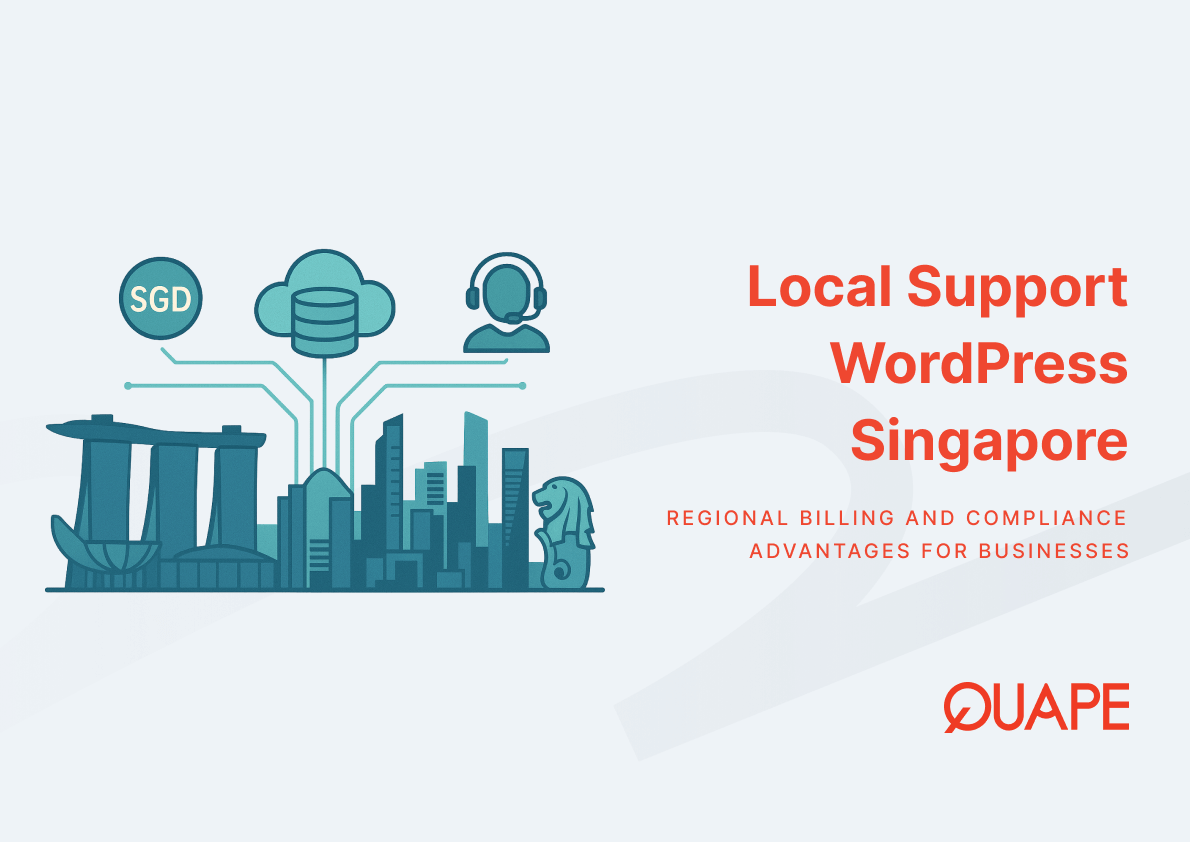
For organisations running WordPress sites in Singapore, the choice of hosting provider extends well beyond server speed and uptime promises. Local billing in SGD and regional support availability reduce operational friction, simplify procurement workflows, and materially improve incident response times when technical issues arise. These advantages become especially significant for SMEs, CTOs, and procurement leads managing budgets under GST compliance requirements, coordinating with finance teams who prefer predictable local-currency invoices, and ensuring service-level agreements align with Singapore business hours. When hosting infrastructure, billing systems, and technical support teams operate within the same regulatory and timezone context as the businesses they serve, the result is faster problem resolution, lower administrative overhead, and stronger alignment between service delivery and local compliance obligations.
What Local Support Means for WordPress Hosting in Singapore
Local support for WordPress hosting refers to technical assistance, account management, and billing services delivered by teams operating in Singapore or the broader Asia-Pacific region, typically during Singapore business hours. This model contrasts with offshore support centres in distant timezones where language barriers, cultural misalignment, or delayed escalation paths can extend Mean Time To Repair (MTTR) during critical outages. For WordPress sites serving regional audiences or handling personal data subject to Singapore’s Personal Data Protection Act (PDPA), local hosting and support infrastructure enables faster troubleshooting, clearer communication with procurement and legal teams, and simplified audit trails when demonstrating compliance with data residency requirements.
Local support also encompasses the practical reality that Singapore-based technical teams understand regional infrastructure nuances, such as how submarine cable routes affect latency to neighbouring markets or how IMDA’s Digital Connectivity Blueprint influences bandwidth availability and redundancy planning. These teams can advise on architectural decisions that reflect Singapore’s position as one of the world’s most densely interconnected internet hubs, where multiple submarine cables and landing stations materially reduce round-trip latency to regional markets when servers are located locally.
Key Takeaways
- Billing in SGD eliminates foreign-exchange conversion fees and simplifies GST reconciliation for Singapore finance and procurement teams.
- Regional support operating in Singapore business hours reduces incident response latency and escalation friction compared to offshore 24/7 centres in distant timezones.
- Local technical teams understand Singapore’s regulatory environment, including PDPA obligations and data residency requirements, which streamlines compliance audits.
- Singapore’s submarine cable infrastructure and IMDA connectivity investments reduce latency to regional markets and improve redundancy for locally hosted WordPress sites.
- IMF research documents that invoicing currency choice affects trade relationships and operational risk exposure, making SGD billing strategically relevant for domestic buyers.
- Industry studies show enterprise downtime costs can reach tens to hundreds of thousands of USD per hour, justifying investment in faster local incident response.
- MAS payment statistics and evolving governance structures indicate that local-currency billing rails and B2B payment systems in Singapore are operationally mature and continue to improve.
- Local hosting combined with local support simplifies contractual dataflow controls and makes PDPA compliance audits more straightforward for legal and procurement teams.
Key Components of Local Support for WordPress Hosting in Singapore
Importance of Billing in Local Currency (SGD) for Businesses
Invoicing and recurring hosting charges in SGD reduce operational currency risk and administrative friction for Singapore organisations. When hosting providers bill in foreign currencies such as USD or EUR, finance teams must account for foreign-exchange conversion fees, potential exposure to currency fluctuations, and more complex bookkeeping during GST reconciliation and annual audits. The Monetary Authority of Singapore (MAS) publishes semi-annual retail payment statistics that document the maturity and volume of e-payments in Singapore, demonstrating that local payment rails are operationally significant for business transactions and B2B invoicing.
Recent IMF research on patterns of invoicing currency in global trade shows how currency choice affects trade relationships and risk exposure at both macro and micro levels. While USD dominance persists globally, regional currency usage trends matter for local invoicing strategies because they determine whether domestic buyers bear FX risk or whether suppliers absorb it. For Singapore SMEs and public entities managing budgets under predictable local-currency constraints, SGD billing means invoices match revenue streams and cost forecasts without introducing volatile exchange-rate assumptions into quarterly planning cycles.
MAS is actively developing and centralising national payments governance through collaboration with the Association of Banks in Singapore, reflecting an increasingly resilient and evolving domestic payments infrastructure used for business and B2B payments. This institutional change, reported by Reuters in early 2025, signals that invoicing in SGD and settling through local payment schemes will become easier and more reliable over time, which strengthens the business case for locally billed managed WordPress hosting aimed at Singapore enterprises.
Regional Support Availability and Response Efficiency
Regional support teams operating during Singapore business hours deliver faster on-hours response and culturally aligned communications compared to offshore centres in distant timezones. When a WordPress site experiences a plugin conflict, database corruption, or sudden traffic spike during Singapore working hours, local support engineers can escalate issues to senior technical staff without waiting for overnight handoffs or navigating timezone gaps that delay resolution. This operational reality materially reduces Mean Time To Repair (MTTR), which becomes critical when enterprise downtime costs can run from tens of thousands to hundreds of thousands of USD per hour according to industry surveys and analyses referencing Gartner and Ponemon Institute studies.
Service-level agreements tied to Singapore business hours also simplify procurement workflows. IT managers and CTOs can negotiate response-time commitments that align with their own operational schedules, avoiding the ambiguity of 24/7 global coverage promises where “immediate response” may mean a ticket acknowledgment from a different hemisphere rather than live troubleshooting by engineers familiar with regional infrastructure. For organisations running business-critical WordPress instances that serve regional audiences, understanding how common hosting problems manifest and are resolved becomes easier when support teams operate in the same timezone and can reference regional connectivity patterns during diagnostics.
The trade-off between local support and truly global 24/7 offshore coverage depends on operational requirements. For most Singapore businesses operating primarily during local working hours, a responsive local team delivers better outcomes than distributed global support with longer escalation paths. However, organisations with genuine 24/7 operational needs may still require hybrid models that combine local daytime expertise with overnight offshore coverage.
Local Expertise in WordPress Troubleshooting and Site Optimization
WordPress performance tuning and troubleshooting benefit from local technical teams who understand regional infrastructure constraints and opportunities. Singapore’s position as a densely interconnected internet hub, documented by TeleGeography’s 2025 submarine cable dataset, means that servers hosted locally enjoy lower latency to neighbouring markets and benefit from multiple redundant cable routes. Local WordPress experts can advise on architectural decisions such as content delivery network (CDN) configuration, database replication strategies, and upstream provider diversity that reflect this regional connectivity landscape.
Site migration projects also proceed more smoothly when technical teams operate in the same timezone as the client’s IT staff. Coordination of DNS cutover, testing of database replication, and validation of plugin compatibility all require real-time communication during business hours. When migration timelines compress due to business urgency, local teams can schedule urgent migrations within hours rather than waiting for offshore teams to begin their working day. This responsiveness becomes especially valuable for organisations managing WordPress multisite installations or complex multi-tier architectures where downtime windows must be tightly controlled.
Performance optimization for WordPress sites serving Singapore and regional audiences requires familiarity with how IMDA’s Digital Connectivity Blueprint influences bandwidth availability and how submarine cable investments affect latency profiles to key markets. Singapore aims to facilitate a tenfold domestic bandwidth increase and catalyse multi-billion-SGD submarine-cable investment to strengthen regional connectivity, which means that hosting WordPress sites in Singapore data centers positions applications to benefit from these infrastructure improvements as they materialise over the next several years.
Data Residency and Compliance Benefits for Singapore Businesses
Singapore’s Personal Data Protection Act (PDPA) sets baseline legal obligations for organisations handling personal data and requires organisations to safeguard personal data collected in Singapore. While the PDPA permits cross-border data transfers under certain conditions, organisations must establish adequate safeguards and maintain clear documentation of dataflows for audit purposes. Hosting WordPress instances in Singapore data centers simplifies compliance audits because procurement and legal teams can demonstrate that personal data remains within Singapore’s regulatory jurisdiction without navigating complex cross-border transfer agreements or explaining foreign legal frameworks to auditors.
Data sovereignty concerns also influence procurement decisions for public sector entities and enterprises handling sensitive customer information. When WordPress sites store user login credentials, customer contact details, or e-commerce transaction records, the physical location of database servers and backup storage becomes relevant to contractual obligations and risk assessments. Local hosting combined with local support creates simpler contractual dataflow controls because service agreements can specify Singapore-based infrastructure and escalation procedures that align with PDPA obligations without introducing ambiguity about where data processing occurs or which legal jurisdictions govern incident response.
Cybersecurity incident response also benefits from local hosting and support alignment. When a security event requires forensic investigation, coordination with local law enforcement, or rapid containment measures, having technical teams and infrastructure within Singapore’s regulatory framework reduces procedural friction and accelerates decision-making. For organisations evaluating whether local or global hosting better serves their operational needs, data residency obligations and incident response logistics often tip the balance toward local providers who can demonstrate clear compliance pathways and responsive coordination during security events.
Practical Application for Singapore Businesses
For SMEs managing limited IT budgets, local billing in SGD and responsive regional support reduce administrative overhead and improve budget predictability. Finance teams appreciate invoices that match revenue currency and avoid FX volatility, while IT managers value support engineers who understand regional infrastructure and can troubleshoot during Singapore business hours without timezone delays. These operational efficiencies accumulate over annual hosting contracts and become especially visible during critical incidents when fast escalation paths materially reduce downtime costs.
Enterprise CTOs and procurement leads evaluating managed WordPress hosting providers should assess not only technical specifications such as NVMe storage and high IOPS performance but also service delivery alignment with business operations. Providers who offer SGD pricing, maintain Singapore-based technical teams, and host infrastructure in local TIA 942 data centers deliver operational advantages that extend beyond simple server performance metrics. When service-level agreements, billing cycles, and support availability all align with Singapore business hours and regulatory expectations, the result is smoother procurement workflows, clearer compliance documentation, and faster incident resolution.
Organisations handling personal data subject to PDPA obligations should prioritise hosting providers who can articulate clear data residency policies and demonstrate technical safeguards that simplify compliance audits. Local hosting infrastructure combined with local technical support creates a coherent operational model where dataflows, incident response procedures, and contractual obligations all operate within Singapore’s regulatory framework. This alignment reduces legal risk and makes audit preparation more straightforward compared to hybrid models where some infrastructure components reside offshore and cross-border transfer documentation becomes necessary.
How WordPress Hosting by Quape Supports Local Billing and Regional Support
Quape’s managed WordPress hosting plans deliver SGD pricing, Singapore-based technical support, and infrastructure hosted in secured TIA 942 data centers located within Singapore. All plans include automated daily backups, monthly security updates, and high-performance NVMe drives that ensure fast loading times for WordPress sites serving regional audiences. The WordPress Toolkit management platform enables one-click plugin updates and simplified site administration without requiring login to individual WordPress dashboards, which reduces routine maintenance overhead for IT teams managing multiple sites.
Billing in SGD eliminates foreign-exchange conversion fees and simplifies GST reconciliation for Singapore finance teams. Technical support operates during Singapore business hours with engineers who understand regional infrastructure nuances and can coordinate urgent migrations within hours when business requirements compress migration timelines. For organisations requiring higher storage capacity or content update services, enterprise-tier plans include 100 GB NVMe disk allocation and one content update monthly, which supports growing WordPress multisite deployments and complex site architectures.
Quape maintains at least three upstream providers to ensure site accessibility from various locations around the world, which leverages Singapore’s position as a densely interconnected internet hub with multiple submarine cable routes. This upstream diversity reduces concentration risk and improves redundancy compared to hosting providers relying on only one or two upstream connections. For organisations exploring tailored managed WordPress hosting that aligns with local billing preferences and regional support expectations, Quape’s plans combine technical infrastructure with operational service delivery designed specifically for Singapore businesses.
Strategic Considerations for Local WordPress Hosting
Choosing WordPress hosting that combines local billing, regional support, and Singapore data center infrastructure delivers operational advantages that accumulate over long-term hosting contracts. For SMEs and enterprises managing WordPress sites that serve regional audiences or handle personal data subject to PDPA obligations, these advantages translate into lower administrative friction, faster incident response, and clearer compliance pathways. As Singapore continues to strengthen its position as a regional connectivity hub through IMDA infrastructure investments and MAS payment system evolution, the business case for locally hosted and locally supported WordPress instances will only strengthen. Organisations evaluating hosting providers should assess not only technical performance metrics but also service delivery alignment with their operational context, regulatory obligations, and budgeting processes.
To explore tailored support options that align with your organisation’s requirements for local billing and regional technical expertise, feel free to contact our team.
Frequently Asked Questions
Why does billing in SGD matter for Singapore businesses using WordPress hosting?
Billing in SGD eliminates foreign-exchange conversion fees and simplifies GST reconciliation during annual audits. Finance teams can match hosting expenses directly to local revenue streams without introducing currency volatility into quarterly budget forecasts. This predictability becomes especially valuable for SMEs and public entities managing budgets under fixed local-currency constraints.
How does regional support improve incident response compared to global 24/7 support?
Regional support teams operating during Singapore business hours can escalate issues to senior technical staff immediately without waiting for timezone handoffs. This reduces Mean Time To Repair (MTTR) during critical incidents when enterprise downtime costs can reach tens to hundreds of thousands of USD per hour. Cultural alignment and familiarity with regional infrastructure also improve diagnostic efficiency and communication clarity during troubleshooting.
What are the compliance benefits of hosting WordPress sites in Singapore data centers?
Hosting in Singapore data centers simplifies PDPA compliance audits because legal and procurement teams can demonstrate that personal data remains within Singapore’s regulatory jurisdiction. This eliminates the need for complex cross-border transfer agreements and makes contractual dataflow controls more straightforward. Local hosting also streamlines cybersecurity incident response when coordination with local authorities becomes necessary.
Can local support handle urgent WordPress migrations within tight timelines?
Yes, local support teams operating in the same timezone as client IT staff can coordinate urgent migrations within hours rather than waiting for offshore teams to begin their working day. Real-time communication during DNS cutover, database replication testing, and plugin compatibility validation becomes possible when both parties operate during Singapore business hours, which compresses migration timelines significantly.
How does Singapore’s submarine cable infrastructure affect WordPress site performance?
Singapore is one of the world’s most densely interconnected internet hubs with multiple submarine cables and landing stations. This infrastructure materially reduces round-trip latency to regional markets when servers are located in Singapore. WordPress sites serving audiences in Southeast Asia, Australia, or other Asia-Pacific regions benefit from faster page load times and lower network latency compared to hosting in distant geographic locations.
What should CTOs prioritise when evaluating managed WordPress hosting providers?
CTOs should assess service delivery alignment beyond technical specifications such as NVMe storage and high IOPS performance. Key factors include SGD pricing availability, regional support operating hours, data residency policies that simplify PDPA compliance, and upstream provider diversity that ensures redundancy. Service-level agreements should align with business hours and escalation procedures should reflect local operational context.
How do local payment systems in Singapore support business hosting transactions?
MAS publishes semi-annual retail payment statistics demonstrating the maturity and volume of e-payments in Singapore. The central bank’s active development of payment governance through collaboration with the Association of Banks indicates that local payment rails are operationally significant and continue to improve. This institutional infrastructure makes SGD billing and B2B invoicing reliable for recurring hosting services.
Are there any trade-offs between local support and truly global 24/7 coverage?
For organisations operating primarily during Singapore business hours, local support delivers better outcomes through faster escalation and culturally aligned communication. However, businesses with genuine 24/7 operational requirements may need hybrid models combining local daytime expertise with overnight offshore coverage. The trade-off depends on whether operational needs justify the complexity of managing distributed global support teams versus accepting slightly delayed response during off-hours.

- Business Email Hosting vs G-Suite / Microsoft 365 - December 29, 2025
- Shared Hosting vs Dedicated Hosting for Email - December 29, 2025
- SMTP vs POP3 vs IMAP: Which Protocol Fits Your Business Workflow - December 28, 2025