Hosting
Multi-Homed Bandwidth: Why It Matters for Email Delivery Speed
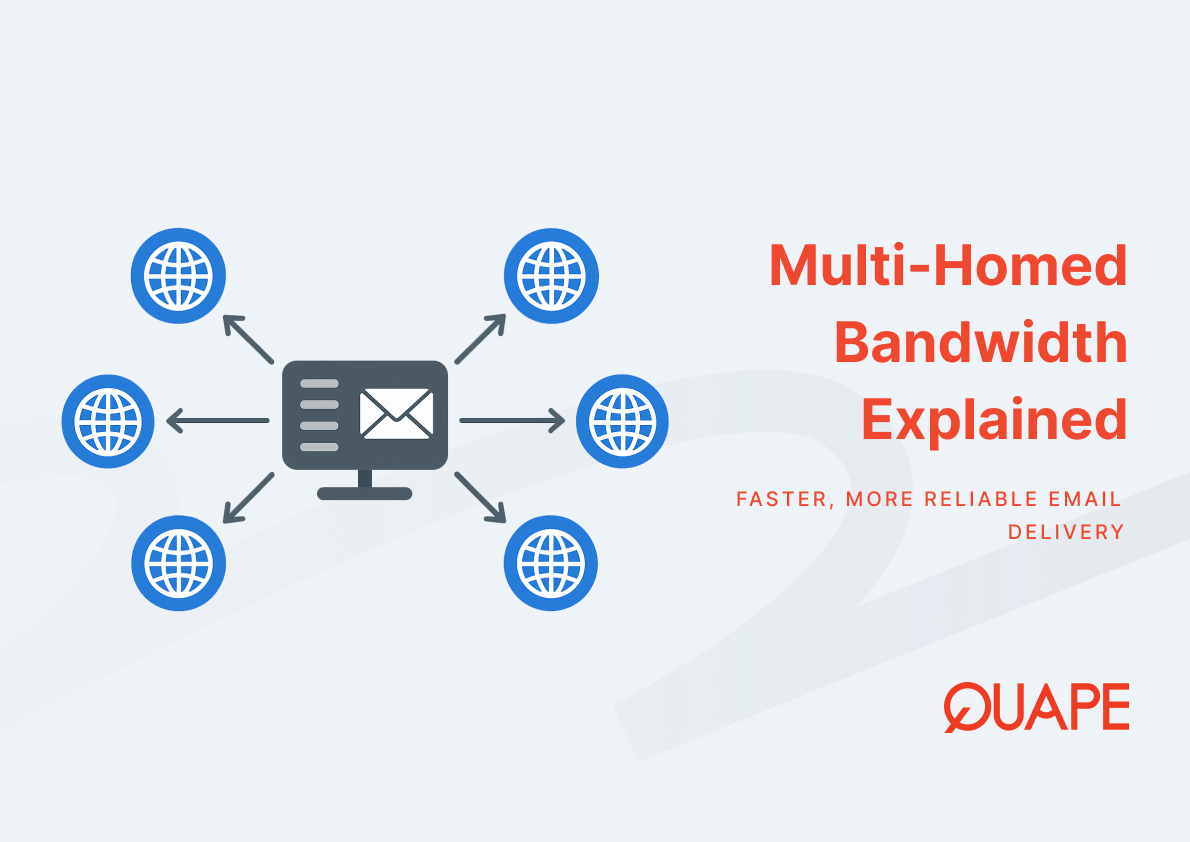
When email delivery slows or fails, business operations stall. Multi-homed bandwidth addresses this vulnerability by connecting email infrastructure to multiple upstream network providers simultaneously, creating redundant pathways that maintain delivery speed even when individual links degrade or fail. For organizations in Singapore that depend on reliable email communications, particularly in finance, healthcare, and e-commerce, understanding how multi-homed routing mechanisms interact with delivery performance becomes essential for operational continuity. This article examines the technical relationships between network redundancy, latency optimization, and email throughput, providing IT decision-makers with the context needed to evaluate infrastructure choices that directly affect business communication reliability.
Multi-homed bandwidth refers to network architecture where a single system maintains active connections to two or more distinct internet service providers or upstream networks. Unlike single-provider configurations that create bottlenecks and single points of failure, multi-homed setups enable traffic to flow through whichever path offers optimal performance characteristics at any given moment. This architectural approach supports business email hosting services in Singapore by providing the infrastructure foundation that email servers require to maintain consistent delivery speeds across varying network conditions.
Key Takeaways
- Multi-homed bandwidth connects email infrastructure to multiple upstream providers, eliminating single-path dependency that causes delivery delays during outages or congestion
- Intelligent route selection across diverse network paths can improve round-trip latency by up to 25% and throughput by up to 20% compared to single-ISP connections
- Border Gateway Protocol (BGP) enables automatic failover when primary links fail, but latency optimization requires active path monitoring beyond basic BGP implementations
- Email delivery performance depends on both redundancy mechanisms and the ability to dynamically select routes with lower latency to specific recipient mail servers
- Singapore’s position as a regional connectivity hub benefits from multi-homed infrastructure that leverages diverse submarine cable systems and peering relationships
- Organizations evaluating email hosting solutions should assess whether providers implement active path optimization rather than passive failover-only configurations
- Multi-homing introduces routing complexity and BGP policy management requirements that hosted solutions absorb, reducing operational burden for customer IT teams
Introduction to Multi-Homed Email Speed
Email delivery speed encompasses multiple performance dimensions that multi-homed bandwidth directly influences. Network redundancy provides the foundation by ensuring alternative paths remain available when primary routes experience degradation, but redundancy alone does not guarantee optimal performance. Latency, measured as the time required for data packets to travel between sending and receiving mail servers, affects how quickly email messages traverse the internet infrastructure. Singapore IT infrastructure benefits from geographic positioning between major Asia-Pacific markets, yet even well-positioned data centers experience performance variations when relying on single upstream connections that may route traffic through suboptimal paths during peak congestion periods.
Multi-homed configurations address these limitations by enabling email servers to select among multiple available routes based on current performance characteristics. When one ISP experiences elevated latency to specific destination networks, traffic can shift to an alternate provider whose peering relationships offer more direct paths. This dynamic routing capability transforms redundancy from a passive failover mechanism into an active performance optimization tool. For businesses that operate across regional markets or maintain global customer communications, the ability to minimize latency through intelligent path selection directly impacts user experience and operational efficiency.
The interaction between multi-homed bandwidth and email delivery extends beyond simple uptime metrics. Email throughput, which measures the volume of messages processed per unit of time, depends on consistent network performance that prevents retransmission delays caused by packet loss or timeout events. Singapore-based organizations that handle time-sensitive communications benefit when their email infrastructure can maintain stable connections through whichever upstream provider offers the most reliable path at any moment, rather than accepting whatever performance their single ISP delivers during network stress events.
Key Components of Multi-Homed Email Speed
Multi-Homed Routing & Latency
Redundant network paths create opportunities for latency reduction when routing protocols can evaluate and select optimal routes dynamically. Research demonstrates that multihoming with intelligent route control can improve round-trip time performance by approximately 25% compared to single-ISP configurations, with throughput gains reaching 20% in measured environments. These improvements occur because email servers connected to multiple providers can avoid congested or circuitous paths that single-homed systems must accept. Route optimization depends on monitoring mechanisms that assess current performance metrics across available paths and direct traffic accordingly, transforming passive redundancy into active performance management.
Border Gateway Protocol manages inter-network routing decisions in multi-homed environments, but BGP prioritizes reachability and policy compliance over latency minimization. This design characteristic means basic multi-homed setups achieve redundancy without automatically optimizing for speed. Effective latency reduction requires additional intelligence layers that continuously measure path performance and override default BGP route selection when alternate paths offer measurably better characteristics. Packet loss mitigation follows similar principles, where diverse paths reduce the probability that all routes simultaneously experience degradation that would trigger retransmissions and delivery delays.
The relationship between route optimization and email delivery becomes particularly relevant when mail servers communicate across international boundaries or through complex peering arrangements. Email messages between Singapore and European recipients might traverse Pacific routes through one provider while traveling westward through Middle Eastern networks via another. Multi-homed infrastructure enables email systems to test and compare these path options, selecting whichever demonstrates lower latency and more stable performance characteristics at the moment of transmission.
Network Redundancy Strategies
Failover systems represent the most basic form of network redundancy, activating backup connections only when primary links fail completely. While failover prevents total outages, it offers limited performance benefits during partial degradation scenarios where primary paths remain functional but deliver suboptimal performance. Multiple upstream providers enable more sophisticated redundancy approaches that treat all connections as active resources rather than primary/backup pairs. Load balancing distributes traffic across available paths based on capacity, utilization, or performance metrics, ensuring that no single link becomes saturated while others remain underutilized.
High availability configurations combine redundancy mechanisms with monitoring systems that detect performance degradation before complete failures occur. This proactive approach allows email infrastructure to shift traffic away from degrading paths while they remain technically operational, avoiding the performance penalties that users experience during the transition period between full function and complete failure. For organizations operating email systems that handle transactional messages, order confirmations, or authentication codes, the difference between reactive failover and proactive load balancing directly affects whether time-sensitive messages arrive within acceptable delivery windows.
The effectiveness of network redundancy strategies depends on the diversity of upstream provider relationships and routing policies. When multiple ISPs maintain similar peering arrangements and route traffic through overlapping infrastructure, redundancy provides limited protection against regional outages or shared infrastructure failures. True resilience requires upstream providers with diverse network architectures, distinct peering relationships, and geographically separated infrastructure that minimizes common failure modes across supposedly independent paths.
Measuring Email Delivery Performance
Email throughput quantifies the volume of messages that infrastructure can process and transmit within specific timeframes. Server response time measures how quickly email systems acknowledge incoming connections and begin processing messages. Delivery success rate tracks the percentage of transmission attempts that complete without errors, timeouts, or rejections. Monitoring tools collect these metrics continuously, providing the visibility required to assess whether multi-homed bandwidth configurations deliver their theoretical performance advantages in production environments.
Performance measurement becomes complex in multi-homed environments because different destination networks may demonstrate varying characteristics across available paths. An email server might achieve excellent throughput to recipients using one major mail provider while experiencing elevated latency to another provider whose networks peer more favorably with a different upstream ISP. Comprehensive monitoring must evaluate performance across representative destination samples rather than relying on aggregate metrics that obscure path-specific variations.
The relationship between measurement and optimization creates feedback loops where performance data informs routing decisions. Systems that collect real-time latency measurements to specific destination networks can preferentially route traffic through whichever upstream provider currently offers optimal characteristics for each recipient domain. This granular approach to path selection maximizes the performance benefits available from multi-homed configurations, though it requires monitoring infrastructure and routing logic beyond what basic BGP implementations provide.
Practical Application for Singapore Businesses
SMEs operating in Singapore face competitive pressures that make email reliability non-negotiable. IT managers and CTOs evaluating infrastructure options must balance cost constraints against the business impact of email disruptions or persistent delivery delays. Procurement leads responsible for vendor selection increasingly recognize that advertised uptime percentages tell incomplete stories when user experience depends on performance characteristics that basic availability metrics ignore. Business email hosting decisions should account for how underlying network architecture affects the latency-sensitive operations that modern organizations depend upon for customer communications, internal coordination, and transactional workflows.
Financial services firms processing time-sensitive market data and trade confirmations cannot afford email delays that might cause missed opportunities or compliance violations. Healthcare organizations transmitting appointment reminders, lab results, or care coordination messages face operational and patient satisfaction consequences when communications arrive late or fail entirely. E-commerce businesses sending order confirmations, shipping notifications, and customer service responses recognize that delivery speed directly affects perceived responsiveness and customer trust. These use cases share common requirements for email infrastructure that maintains consistent performance rather than merely avoiding complete failures.
The concentration of submarine cable landing stations and internet exchange points in Singapore creates advantageous conditions for multi-homed email infrastructure. Organizations whose providers maintain connections to multiple tier-one networks and regional carriers benefit from Singapore’s position as a connectivity crossroads, though these advantages materialize only when hosting providers implement architectures that actively leverage diverse path options. IT decision-makers should evaluate whether prospective email hosting services deploy multi-homed bandwidth configurations and whether those configurations include intelligence layers that optimize path selection beyond passive redundancy.
How Email Hosting Solutions Support Multi-Homed Bandwidth
QUAPE business hosting implements multi-homed bandwidth architecture that connects email infrastructure to multiple upstream network providers simultaneously. This configuration ensures that email delivery remains operational and maintains performance even when individual ISP links experience degradation or outages. The email hosting platform operates from TIA-942 Singapore data center facilities that provide the physical infrastructure foundations required for reliable multi-provider connectivity, including diverse fiber entry points and carrier-neutral interconnection capabilities that enable direct connections to multiple networks without dependency on any single provider’s infrastructure.
High-speed connectivity in multi-homed environments depends on both the capacity of individual links and the intelligence systems that determine how traffic distributes across available paths. Email servers benefit when hosting providers implement active monitoring that assesses current performance to destination networks and routes messages through whichever upstream provider offers optimal characteristics at transmission time. This operational approach transforms redundant connections from backup resources into continuously utilized performance optimization tools. Secure email delivery integrates with multi-homed bandwidth configurations through encrypted transmission protocols that function transparently across whichever network path the routing system selects, ensuring that security mechanisms do not degrade when traffic shifts between providers.
Organizations seeking to explore QUAPE’s email hosting solution gain access to infrastructure that absorbs the complexity of BGP management, route optimization, and multi-provider relationship management. Customer email systems benefit from multi-homed performance characteristics without requiring internal teams to develop the specialized networking expertise that these configurations demand. The hosting platform handles provider coordination, policy management, and performance monitoring while delivering email throughput and delivery reliability improvements to customers who simply require communications infrastructure that consistently performs under varying network conditions.
Conclusion
Multi-homed bandwidth represents infrastructure architecture rather than feature marketing, delivering measurable improvements in email delivery speed and reliability through redundant network paths that enable both failover protection and active performance optimization. Singapore businesses operating email communications that affect customer experience, operational coordination, or transactional workflows should evaluate whether their hosting providers implement multi-homed configurations with intelligent route selection rather than accepting single-provider limitations that create unnecessary performance constraints and vulnerability to degradation events.
Organizations ready to assess how multi-homed email infrastructure supports their operational requirements can reach out to our team for technical consultation on hosting configurations matched to specific business communication needs.
Frequently Asked Questions
What distinguishes multi-homed bandwidth from having a backup internet connection?
Multi-homed bandwidth actively uses multiple upstream connections simultaneously rather than keeping backup links idle until primary connections fail. This architectural difference enables performance optimization through path selection and load distribution, not just redundancy. Backup connections provide failover protection but offer no performance benefits until primary links completely fail, whereas multi-homing can improve latency and throughput during normal operations.
How does multi-homing affect email delivery to recipients using different mail providers?
Multi-homed infrastructure can route messages through whichever upstream provider offers optimal paths to each recipient’s mail server network. Gmail recipients might receive faster delivery through one ISP while Outlook users benefit from routing through another provider with better peering to Microsoft’s networks. This destination-aware routing capability maximizes the performance advantages available from diverse network connections.
Do small businesses need multi-homed email infrastructure?
Small businesses benefit from multi-homed infrastructure’s reliability and performance improvements regardless of organization size. Email disruptions affect customer communications and operational coordination equally whether a company has five employees or five hundred. The relevant question concerns whether businesses can justify managing multi-homed complexity internally or whether hosted solutions that include multi-homing in their architecture offer more practical approaches.
What monitoring capabilities should organizations expect from multi-homed email hosting?
Effective multi-homed hosting should include continuous performance monitoring across all upstream connections, automatic traffic shifting when degradation occurs, and visibility into which paths currently handle email traffic. Providers should track delivery success rates, latency measurements, and throughput metrics that demonstrate whether multi-homing delivers practical performance benefits rather than theoretical redundancy.
How does Border Gateway Protocol relate to email delivery speed?
BGP manages routing decisions between networks in multi-homed environments but prioritizes reachability over performance optimization. Email delivery speed improvements require intelligence layers beyond basic BGP that actively measure latency and throughput across available paths. BGP provides the foundation for multi-homing by enabling connections to multiple providers, but performance benefits depend on additional systems that use BGP’s flexibility to select optimal routes.
Can multi-homed bandwidth prevent all email delivery delays?
Multi-homed bandwidth addresses network path issues but cannot eliminate delays caused by recipient server problems, spam filtering processing, or message queue congestion. It provides optimized routing and redundancy for network transmission but represents one component of overall email delivery infrastructure. Organizations should expect multi-homing to minimize network-related delays while recognizing that end-to-end delivery involves multiple systems beyond network connectivity.
What happens during BGP routing table updates in multi-homed environments?
BGP continuously adjusts routing tables to reflect network changes, and these updates can temporarily affect path selection during convergence periods. Well-designed multi-homed systems maintain stable email delivery during routing updates by preserving established connections and avoiding unnecessary path changes. The impact on email delivery depends on how hosting providers configure BGP policies and whether they implement mechanisms that prioritize connection stability during routing transitions.
Why does Singapore’s geographic position matter for multi-homed email infrastructure?
Singapore serves as a regional connectivity hub with multiple submarine cable systems and extensive peering relationships between networks. Multi-homed infrastructure in Singapore can leverage this diversity to access varied paths toward Asia-Pacific, European, and American destinations. Geographic positioning enhances multi-homing benefits when providers maintain connections to carriers with different regional route preferences and peering arrangements.