Development
Toptal Alternative: Reliable IT Manpower Outsourcing for Singapore Startups
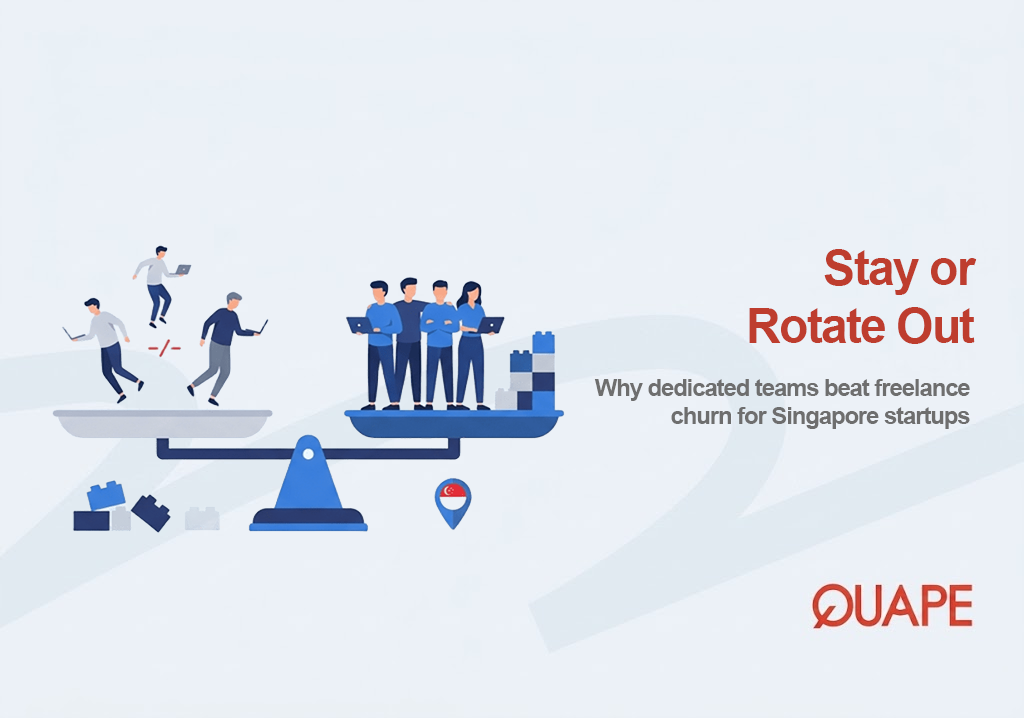
For a Singapore startup that needs more engineering capacity but cannot justify a string of permanent hires, the choice is rarely about which platform has the best developers. It is about which engagement model survives contact with a multi-month product roadmap. Toptal is a strong fit when you need a vetted specialist to close a narrow gap for a defined period, and many fast-moving teams use it exactly that way. The friction starts when a short engagement quietly becomes an ongoing one, because a freelance marketplace bills by the hour, leaves day-to-day management on your plate, and cannot promise that the developer who learned your codebase will still be there next quarter. This comparison is for founders weighing that trade-off, and it makes the case that a dedicated contract team with transparent SGD pricing and local accountability is the better choice when the work is continuous rather than one-off.
Why Singapore Startups Start Looking Beyond Toptal
Toptal earned its reputation by solving a real problem: finding a genuinely capable freelancer quickly, without sifting through a hundred applicants. For a discrete piece of work with a clear start and end, that model is hard to beat. The difficulty surfaces when a startup’s actual need is not a single skill gap but sustained development velocity across many months. Software delivery is already where early-stage companies struggle most, and research on startups has identified weak software engineering practices as a contributor to elevated startup failure risk. When the resourcing model adds coordination overhead on top of that, the problem compounds rather than resolves.
The Challenge of Scaling Product Development Without Expanding Permanent Headcount
Permanent hiring in Singapore is expensive in ways that go well beyond the offer letter. Mid-level software engineers commonly earn SGD 72,000 to 108,000 a year before any employer overhead, and senior engineers frequently command SGD 108,000 to 144,000 or more. Cost is only half the constraint. Sourcing, interviewing, negotiation, and notice periods mean hiring a developer in Singapore often takes two to four months before any productive work begins. A seed-stage team with a roadmap to ship cannot easily absorb a permanent salary line or a quarter-long hiring delay, which is exactly why flexible access to engineering capacity has become so attractive.
When a Freelance Marketplace Solves the Wrong Problem
A freelance marketplace optimises for talent access and matching speed, and it does that well. What it does not absorb is the work that surrounds the developer: project planning, task allocation, knowledge management, and accountability for delivery all stay with you. That division is comfortable for a short, well-scoped task. It becomes visible and costly during longer engagements, where continuity and coordination start to matter more than how fast the initial match arrived. When the real need is ownership of delivery rather than a vetted stranger to supervise, the marketplace is solving the wrong problem.
What Toptal Does Well for Fast-Growing Technology Companies
Before building the case for an alternative, it is worth being precise about where Toptal genuinely excels, because for the right scenario it remains the stronger option.
Access to Experienced Developers Across Multiple Technology Stacks
Toptal’s screening is rigorous, and the result is reliable access to experienced React developers, Node.js engineers, mobile specialists, and other senior contributors without a long search. That access matters more every year. Global demand for technical talent continues to outpace supply, with persistent shortages across software engineering and AI roles. In a market where the right specialist is scarce, a platform that produces one in a week or two has real value.
Flexibility for Short-Term Projects and Narrow Skill Gaps
The marketplace model is built for impermanence, and that is a feature when the work is impermanent. A three-month build, a single product sprint, or a narrow integration handled by one expert maps cleanly onto hourly, part-time, or project-based engagement. You bring the person in, the work completes, and the arrangement ends without residual obligation.
Why Toptal Appeals to Companies That Already Have Strong Internal Engineering Management
Toptal supplies talent, not delivery ownership, so it works best for companies that already have engineering managers, product leads, and clear processes in place. If you have the internal leadership to direct a developer day to day, that flexibility is an advantage rather than a gap. The model assumes a strong management layer already exists on your side.
Where Toptal Can Create Operational Friction for Singapore Startups
The same characteristics that make Toptal excellent for short specialist work create friction when a Singapore startup needs continuous capacity over many months.
Understanding the Impact of Premium Hourly Pricing Over Multi-Month Engagements
Toptal operates on a blended hourly rate, where the single number a client sees folds in the freelancer’s pay and an undisclosed platform markup that independent breakdowns place as high as fifty percent. For one specialist on a short engagement, that premium is a fair trade for speed and vetting. Over a multi-month engagement, the arithmetic changes. For context, Singapore contractor developer rates commonly sit at SGD 80 to 160 an hour, and a marked-up hourly model running continuously turns a convenient rate into one of a startup’s largest recurring expenses.
Deposits, Platform Fees, and the Hidden Cost of Long-Term Hiring
Layered on top of the hourly rate sit a refundable deposit and a recurring monthly subscription. For a single short engagement these are minor. Multiplied across a longer arrangement or several developers, they add a fixed cost that scales in the wrong direction for a startup managing runway. The structure was designed for short, flexible hiring, not for sustained capacity.
The Management Burden Does Not Disappear After the Developer Is Matched
Matching a developer is where Toptal’s responsibility largely ends and yours begins. Sprint planning, task allocation, code review coordination, and delivery accountability remain with your team. For a founder already stretched across product, fundraising, and operations, absorbing the project management of an outsourced developer is precisely the overhead that outsourcing was meant to remove.
Cross-Border Compliance, Tax, and Employment Considerations for Singapore Businesses
Compliance is the least visible cost and often the most consequential. Singapore organisations that transfer personal data overseas must ensure the receiving party provides a standard of protection comparable to the PDPA’s requirements. A distributed roster of international freelancers can introduce governance responsibilities that many founders overlook while focused on talent and rates. The marketplace leaves employment, tax, and data-protection considerations for the client to navigate, and for a business handling customer data, that is not a trivial line item.
The Difference Between Renting Talent and Building Delivery Capacity
The clearest way to frame the comparison is this: a marketplace rents you talent, while a managed outsourcing partner builds you delivery capacity. The distinction matters most after the first month.
Why Continuity Matters More Than Initial Talent Quality
Initial talent quality gets all the attention, but continuity is what protects a roadmap. Research on software maintenance shows that developer turnover creates knowledge loss and raises maintenance costs unless knowledge transfer is actively managed. The developer who understands your architecture, your business rules, and the reasoning behind past decisions is worth far more in month six than an equally skilled stranger would be. A model built on rotation cannot guarantee that person stays.
How Developer Turnover Impacts Product Velocity and Technical Debt
When a developer leaves, undocumented knowledge about architecture and implementation tends to leave with them. Academic research consistently identifies engineer turnover as a source of project delays and increased development costs, and the risk concentrates when critical project knowledge sits with a small number of people. The result is slower feature delivery and accumulating technical debt, which is the opposite of what a startup chasing product-market fit can afford.
Why Quape Is Better Aligned With Singapore Startups That Need Ongoing Development Support
Quape approaches the same problem from the opposite direction. Instead of renting a freelancer at a marked-up hourly rate, a Singapore startup engages a dedicated contract team or an individual developer through Quape’s IT manpower and development team outsourcing, with the surrounding delivery responsibility included rather than left behind.
Transparent SGD-Based Engagements Without Deposits or Subscription Layers
Pricing is quoted transparently in SGD, without a refundable deposit or a recurring platform subscription stacked on top. For a founder forecasting runway, that predictability is the point. A fixed, knowable monthly cost is far easier to plan against than an hourly meter plus platform fees that expand as the engagement lengthens.
Dedicated Contract Teams Designed for Long-Term Product Ownership
The engagement is structured for retention and continuity, so the people who learn your codebase stay with it rather than rotating out at the end of a match. Whether you need a full dedicated team for a complex build or a single developer on specific tasks, the arrangement is designed around long-term product ownership instead of a one-off placement.
Local Accountability, Time Zone Alignment, and Compliance Support
Working with a Singapore-based partner means accountability in your own jurisdiction and time zone. The PDPA requires organisations to implement reasonable security arrangements to protect personal data, and engaging developers on a clear contract basis with a local partner keeps that responsibility close rather than scattered across borders. Quape handles the employment, tax, and compliance complexity directly, which removes a category of risk that a global marketplace leaves with you.
Reducing the Overhead Associated With Full-Time Developer Hiring
The full cost of a permanent hire is far larger than salary. Employer CPF contributions can add up to 17% on top of salary for citizens and permanent residents, and recruitment agency fees for a mid-level developer can reach SGD 10,000 to 20,000 per hire. A contract model absorbs the equipment, office space, employee benefits, and recruitment overhead that an in-house hire would otherwise carry, converting a heavy fixed commitment into scalable capacity.
Toptal vs Quape: The Factors That Actually Matter After the First Month
| Factor | Toptal | Quape |
|---|---|---|
| Pricing model | Blended hourly rate with embedded markup | Transparent fixed SGD engagement |
| Upfront and recurring fees | Refundable deposit plus monthly subscription | No deposit or subscription layer |
| Delivery responsibility | Client manages day to day | Managed delivery included |
| Continuity | Match ends, developer rotates out | Dedicated team built for retention |
| Compliance handling | Client navigates cross-border obligations | Local partner handles compliance directly |
| Best fit | Short, specialist, well-defined project | Ongoing, multi-month development capacity |
Cost Predictability Versus Expanding Hourly Spend
A fixed engagement lets a founder forecast development cost with confidence, while an hourly model rewards speed but punishes duration. The longer the work runs, the more a predictable monthly figure outperforms a meter that never stops.
Freelancer Management Versus Managed Delivery Responsibility
With a marketplace, project ownership and coordination stay with you. With a managed partner, delivery governance and team coordination are part of the service. That difference decides how much of your week is spent building product versus supervising it.
Short-Term Flexibility Versus Long-Term Team Continuity
Marketplace flexibility is genuinely valuable for short bursts, but turnover contributes to productivity reductions and higher defect risk when project knowledge sits with a few people. For anything resembling a product lifecycle, team stability beats interchangeability.
Global Marketplace Model Versus Local Singapore Partnership
The PDPA was designed partly to strengthen Singapore’s position as a trusted business hub by regulating how personal data flows between organisations. A local partnership aligns naturally with that intent, where a dispersed cross-border roster can quietly add governance burden.
Which Option Fits Your Startup Stage?
A seed-stage team building an MVP usually needs sustained capacity and continuity more than a single specialist, which favours a dedicated team. A Series A company with established engineering management and a narrow, time-boxed gap may be exactly the case where a marketplace specialist fits best. Stage and engagement shape, not brand, should drive the decision.
When Toptal Is the Better Choice and When Quape Is the Smarter Alternative
Choose Toptal If You Need a Highly Specialized Individual Contributor for a Defined Project
If your need is one senior specialist for a clearly scoped, short-term project, and you already have the internal management to direct them, Toptal’s speed and vetting are hard to beat. This is the scenario the marketplace was built for, and it remains the right call there.
Choose Quape If You Need Predictable Development Capacity Without Growing Internal Headcount
If you need ongoing development capacity without adding permanent payroll, a dedicated contract team gives you scalable engineering output at a predictable cost. This suits startups that want to ship continuously without committing to full-time hires.
Choose Quape If You Want Long-Term Continuity, Local Accountability, and Managed Delivery
If continuity, delivery ownership, and PDPA-aligned local accountability matter to your product, a managed Singapore partner is the smarter alternative. The team stays, the delivery is owned, and the compliance sits in your jurisdiction.
Building a Sustainable Engineering Team Without the Cost of Traditional Hiring
Evaluate the Development Capacity You Need Before Hiring
Before choosing a model, map the work honestly. A defined, one-off task points toward a specialist. A roadmap of continuous milestones points toward a dedicated team, because that is where continuity and managed delivery pay for themselves.
Request a Free Consultation to Scope Your Dedicated Development Team
For founders whose roadmap is ongoing rather than one-off, the predictable cost and continuity of a managed contract team usually win after the first month. If that describes your stage, you can discuss your team requirements with a local outsourcing partner and scope the capacity your product actually needs.
For a Singapore or Southeast Asian startup choosing between renting talent and building delivery capacity, the decision comes down to duration and ownership. Toptal is the right tool for a short, specialist, well-managed task. For continuous development over many months, where cost predictability, team continuity, and local compliance accountability determine whether a roadmap ships on time, a dedicated contract team is the better aligned choice.
Frequently Asked Questions
Is Quape a direct replacement for Toptal?
Not exactly, because they solve different problems. Toptal matches you with a vetted freelancer for a defined task, while Quape provides a dedicated contract team or developer with managed delivery and local accountability. Quape is the better fit when you need ongoing capacity rather than a one-off specialist.
When is Toptal genuinely the better choice?
When you need a single highly specialised contributor for a short, clearly scoped project and you already have strong internal engineering management to direct them. In that scenario, Toptal’s fast matching and rigorous vetting are difficult to match, and a full team would be more than the task requires.
Why does developer continuity matter so much for startups?
Because undocumented knowledge about your architecture and decisions tends to leave when a developer does. Research consistently links engineer turnover to delays, higher costs, and lost knowledge, so retaining the people who understand your codebase protects both velocity and product quality over time.
How does pricing differ between the two models?
Toptal uses a blended hourly rate with an embedded markup, plus a deposit and monthly subscription, which suits short engagements but scales uncomfortably over months. Quape quotes transparent SGD engagements without those added layers, giving founders a predictable cost to plan runway against.
What compliance advantage does a local partner provide?
Singapore’s PDPA places obligations on organisations around protecting personal data and ensuring comparable protection during overseas transfers. Engaging a Singapore-based partner keeps employment, tax, and data-protection responsibility within your jurisdiction rather than spread across international contractors.
Does outsourcing suit seed-stage startups, or only larger companies?
It often suits early-stage startups most, because it provides access to engineering capacity without the cost and delay of permanent hiring. With hiring in Singapore frequently taking two to four months and carrying significant overhead, a contract team lets a small company scale output while protecting runway.