Online stores running WooCommerce face escalating security challenges as attackers exploit web application vulnerabilities, target payment infrastructure, and increasingly compromise backup systems. WordPress powers roughly 43% of all websites, which creates a vast attack surface where even low-prevalence vulnerabilities affect many stores. For Singapore-based merchants and regional operators, hosting security directly influences regulatory compliance, customer trust, and business continuity. The architecture decisions you make about SSL implementation, payment gateway integration, firewall configuration, backup resilience, and access control define your store’s ability to protect cardholder data and recover from ransomware incidents. Understanding how hosting capabilities interact with WooCommerce’s security requirements enables you to build defenses that align with PCI DSS obligations, PDPA enforcement patterns, and the threat landscape documented in recent breach investigations.
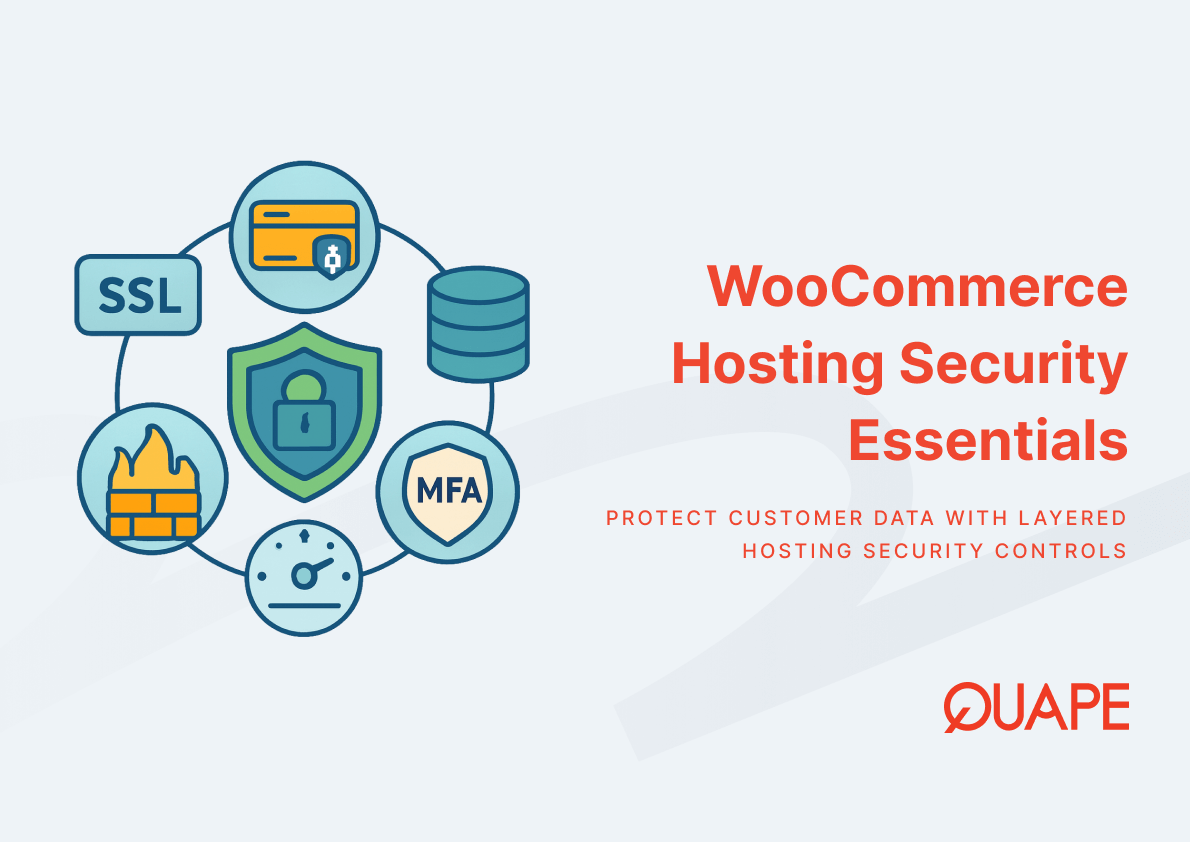
WooCommerce hosting security encompasses the technical and operational controls that protect e-commerce data, authenticate users, prevent unauthorized access, and maintain transaction integrity across the hosting infrastructure. This includes SSL/TLS encryption for data in transit, WAF and malware scanning to block web application attacks, backup systems designed to resist ransomware, and authentication mechanisms that reduce credential compromise. Security operates as a layered system where hosting providers implement server-level defenses while merchants configure application controls and payment architectures that minimize stored cardholder data.
Key Takeaways
- Basic web application attacks, system intrusions, and social engineering together account for approximately 79% of breaches in recent data-breach investigations, which means WAF deployment, strong authentication, and patching cadence are foundational controls.
- SSL certificates establish encrypted HTTPS connections that protect customer data in transit and satisfy baseline PCI DSS requirements, but encryption alone does not prevent application-layer attacks or server compromise.
- Tokenization and hosted payment flows keep cardholder data off merchant servers, which reduces PCI scope and decreases the risk exposure from stored payment information.
- Immutable and offline backups materially lower business continuity risk after ransomware incidents, as attackers increasingly target accessible backup systems to force ransom payments.
- Singapore’s Personal Data Protection Act enforces reasonable security arrangements, and PDPC enforcement actions against e-commerce platforms demonstrate that poor hosting practices create regulatory and financial exposure.
- Role-based access control and multi-factor authentication reduce the likelihood of credential-based intrusions, which remain a primary entry vector in social engineering and brute-force campaigns.
- Managed WordPress hosting services that include automated security updates, plugin monitoring, and threat remediation shift operational burden from merchants to hosting providers and reduce the window of exposure to known vulnerabilities.
Introduction to WooCommerce Hosting Security
WooCommerce hosting security addresses the protection requirements unique to online stores that process customer payments, store personal data, and maintain transaction histories. Unlike content-focused WordPress sites, WooCommerce deployments introduce payment gateway integrations, customer account databases, and regulatory obligations tied to financial data handling. Threat prevention in this context requires coordination between hosting infrastructure controls and application-level configurations, since vulnerabilities in either layer can compromise the entire e-commerce operation.
The dominant breach patterns observed in the Verizon Data Breach Investigations Report 2024 show that web applications remain a primary target, with system intrusions and social engineering completing the top three attack methods. These patterns affect WooCommerce stores directly because the platform’s open plugin ecosystem and customizable architecture create multiple entry points where outdated extensions, weak credentials, or misconfigured settings enable unauthorized access. Fast and secure WordPress hosting strategies must account for these realities by combining server hardening with application monitoring and incident response capabilities.
Singapore hosting compliance adds a regional dimension to security planning. The Personal Data Protection Commission has issued financial penalties to e-commerce enablers that failed to implement reasonable security arrangements, including a S$74,400 fine in August 2023. These enforcement actions signal that regulators expect merchants and hosting providers to maintain technical safeguards proportionate to the sensitivity of personal data collected during transactions. For merchants operating in Singapore or serving customers in the region, hosting decisions about data center location, access controls, and contractual data handling responsibilities directly influence compliance posture and legal exposure.
Data protection in WooCommerce environments extends beyond preventing breaches to ensuring business continuity after incidents. Ransomware operators increasingly target backup systems to eliminate recovery options and force ransom payments. The UK National Cyber Security Centre publishes guidance on ransomware-resistant backups that emphasizes offline storage, immutability features, access restrictions, and tested restore procedures. These principles apply equally to hosted WooCommerce stores, where backup architecture determines whether a merchant can restore operations after a destructive attack or must rebuild from scratch.
Key Components of WooCommerce Hosting Security
SSL Certificates and Secure Encryption
SSL certificates enable HTTPS connections that encrypt data transmitted between customer browsers and WooCommerce servers, which protects payment details, login credentials, and personal information from interception during transit. The Payment Card Industry Data Security Standard requires encryption for cardholder data transmission over public networks, making SSL implementation on WordPress hosting a baseline compliance requirement for any store processing card payments. Modern TLS protocols also provide authentication mechanisms that verify server identity, which prevents man-in-the-middle attacks where attackers impersonate legitimate sites to harvest customer credentials.
Customer data protection depends on SSL/TLS configuration quality as much as certificate presence. Weak cipher suites, outdated protocol versions, or improper certificate validation can undermine encryption effectiveness and create vulnerabilities that sophisticated attackers exploit. Hosting providers that automatically provision and renew SSL certificates through services like Let’s Encrypt reduce configuration errors and eliminate the operational burden of manual certificate management. However, merchants must still verify that hosting configurations enforce HTTPS for all store pages, redirect HTTP requests appropriately, and maintain certificate validity without interruption.
PCI-DSS compliance frameworks treat encryption as one control among many required to protect cardholder environments. While SSL secures data in transit, PCI standards also mandate encryption for stored data, network segmentation, access logging, and vulnerability management. This means SSL certificates satisfy only a portion of PCI requirements, and merchants must coordinate encryption implementation with other hosting and application security controls to achieve full compliance. Understanding that SSL addresses transmission security but not application vulnerabilities or server compromise helps merchants prioritize complementary defenses like web application firewalls and intrusion detection systems.
Payment Gateway Security and Transaction Integrity
Payment gateways act as intermediaries that authorize and process transactions between WooCommerce stores and financial institutions, which removes the need for merchants to directly handle raw cardholder data on their servers. Secure transaction processing relies on tokenization, where gateways replace sensitive payment details with non-sensitive tokens that merchants store for reference without retaining actual card numbers or CVV codes. This architectural approach reduces the merchant’s PCI scope because cardholder data never resides in the WooCommerce database, which eliminates many storage security requirements and decreases the impact of database compromises.
Tokenization interacts with payment gateway APIs to maintain transaction functionality while minimizing data exposure. When customers submit payment information through a hosted payment page or embedded gateway interface, the gateway captures and encrypts card details before sending a token back to the WooCommerce server. Subsequent refunds or recurring charges use the token to reference the stored payment method without requiring merchants to access the underlying card data. This separation ensures that even if attackers compromise the WooCommerce application or hosting environment, they cannot extract usable payment information from the merchant’s systems.
Fraud prevention mechanisms built into payment gateways provide additional transaction integrity safeguards that reduce chargebacks and protect merchants from financial losses. Gateway services typically include address verification, CVV matching, velocity checks, and risk scoring algorithms that flag suspicious transaction patterns before authorization. The CyberSource Global eCommerce Payments and Fraud Report 2024 identifies card and digital-wallet channels as the highest perceived fraud risk by merchants, which underscores the importance of integrating gateway fraud tools with WooCommerce checkout flows. Effective fraud prevention requires merchants to configure threshold rules, review flagged transactions, and balance security controls against checkout friction that might drive legitimate customers away.
Firewalls, Malware Detection, and Attack Mitigation
Firewalls operate at the network and application layers to filter incoming traffic, block malicious requests, and prevent unauthorized access to WooCommerce hosting infrastructure. Web application firewalls specifically analyze HTTP/HTTPS traffic patterns to identify and block attacks that target application vulnerabilities, including SQL injection attempts, cross-site scripting payloads, and authentication bypass techniques documented in the OWASP Top 10. Deploying WAF rules tailored to WordPress and WooCommerce attack signatures reduces exposure to automated exploit campaigns that scan for known plugin vulnerabilities across the internet.
Brute-force attacks attempt to guess admin credentials by submitting thousands of username and password combinations against the WordPress login page. Rate limiting and IP-based blocking features in hosting firewalls mitigate these attacks by restricting login attempt frequency and temporarily banning IP addresses that exhibit suspicious behavior. WordPress hosting security checklists typically emphasize combining firewall rules with strong password policies and multi-factor authentication, since layered defenses perform better than any single control when attackers adapt techniques to evade detection.
Malware scanning complements firewall protection by detecting malicious code that has already penetrated defenses and established persistence within the hosting environment. Regular file integrity monitoring compares current WordPress core files, theme templates, and plugin scripts against known-good versions to identify unauthorized modifications that indicate compromise. When malware scanning identifies infected files, automated or manual remediation processes quarantine affected code and restore clean versions to eliminate backdoors before attackers can escalate privileges or exfiltrate data. DDoS protection services add another mitigation layer by absorbing volumetric attacks that attempt to overwhelm server resources and render WooCommerce stores inaccessible to legitimate customers.
Data Backup, Restore, and Business Continuity
Backup solutions preserve copies of WooCommerce databases, uploaded files, configuration settings, and site content at regular intervals, which enables recovery after data loss incidents caused by hardware failures, software bugs, or malicious attacks. Daily backup schedules capture recent changes with minimal data loss windows, while retention policies determine how many historical backup versions remain available for restoration. The effectiveness of backup strategies for WordPress shared hosting depends on storage location, access controls, and restore testing procedures that validate recovery capabilities before incidents occur.
Disaster recovery planning must account for ransomware scenarios where attackers encrypt production systems and also target accessible backups to eliminate recovery options. The UK National Cyber Security Centre’s ransomware-resistant backup guidance recommends storing backup copies offline or in immutable storage that prevents deletion or modification even by authenticated administrators. Implementing these controls requires hosting providers to offer backup architectures that physically or logically separate backup systems from production environments, which increases resilience against credential compromise and lateral movement attacks that propagate from infected web servers to backup infrastructure.
Data restore procedures translate backup systems into operational recovery when incidents occur. Merchants should periodically test restore operations in staging environments to verify backup integrity, measure recovery time objectives, and train staff on restoration workflows. Uptime assurance depends not only on backup existence but on the ability to execute recovery under pressure when production systems are unavailable. Business continuity planning integrates backup capabilities with incident response procedures, communication protocols, and failover arrangements that maintain customer access and transaction processing during outages.
User Access Control and Authentication
Role-based access control limits administrative privileges within WooCommerce by assigning users to predefined roles that grant only the permissions necessary for their responsibilities. Separating shop managers, inventory administrators, and content editors into distinct roles reduces the impact of credential compromise, since attackers who obtain low-privilege credentials cannot immediately access sensitive settings or customer data. Admin security improves when hosting platforms enforce the principle of least privilege across both WordPress application roles and server-level access, which prevents unauthorized configuration changes that could disable security controls or introduce vulnerabilities.
Multi-factor authentication requires users to present two or more verification factors during login, which significantly reduces the success rate of credential-based attacks even when attackers obtain valid passwords through phishing or data breaches. Implementing MFA for all administrative accounts protects against both brute-force attacks and social engineering campaigns where attackers trick users into revealing passwords. Credential management practices that encourage unique passwords, regular rotation, and secure storage in password managers further strengthen authentication defenses by eliminating password reuse vulnerabilities that allow attackers to leverage credentials stolen from third-party breaches.
Authentication mechanisms interact with hosting firewall rules and monitoring systems to create layered defenses against unauthorized access. Failed login alerts notify administrators of potential intrusion attempts, while session management controls terminate idle connections and prevent session hijacking attacks. Hosting providers that integrate authentication logs with security information and event management systems enable centralized monitoring of access patterns, which helps detect compromised accounts through anomalous login locations, timing, or privilege escalation activities.
Practical Security Considerations for WooCommerce Stores in Singapore
PDPA compliance obligations require Singapore-based merchants to implement reasonable security arrangements that protect personal data collected during e-commerce transactions. The Personal Data Protection Commission’s enforcement actions demonstrate that regulators assess security posture holistically, examining technical controls, operational procedures, and vendor relationships to determine whether organizations met their protection obligations. For WooCommerce merchants, this means hosting provider selection, data handling agreements, and security configuration decisions create compliance implications that extend beyond immediate technical functionality.
Singapore cybersecurity regulations and industry guidance provide frameworks for interpreting reasonable security standards in the e-commerce context. While PDPA does not prescribe specific technologies, enforcement precedents indicate that regulators expect encryption for data in transit, access controls for administrative functions, regular security updates, and incident response capabilities appropriate to the scale and sensitivity of operations. Merchants operating WordPress hosting from Singapore data centers gain both latency advantages for regional customers and clearer compliance postures when data residency and local infrastructure support regulatory reporting and audit requirements.
Local data centers offer operational benefits beyond compliance considerations. Proximity between hosting infrastructure and customer populations reduces page load times, which influences both user experience and search engine ranking algorithms that factor site speed into visibility calculations. Security benefits emerge from reduced network path complexity and lower exposure to international routing vulnerabilities, though merchants must still implement comprehensive security controls regardless of hosting location since attackers operate globally and exploit vulnerabilities wherever they exist.
SME eCommerce security planning requires balancing comprehensive protection against resource constraints typical of small and medium enterprises. Limited security expertise and operational capacity mean SMEs benefit particularly from managed hosting services that assume responsibility for patching, monitoring, and incident response rather than expecting merchants to maintain security controls independently. Understanding the threat landscape, regulatory expectations, and available hosting capabilities enables SME merchants to make informed security investments that protect their businesses without diverting excessive resources from core e-commerce operations.
How WordPress Hosting Supports WooCommerce Security
Managed WordPress hosting services integrate security controls directly into hosting infrastructure, which reduces the security configuration burden on merchants and improves baseline protection across all hosted stores. Hosting providers that specialize in WordPress environments maintain expertise in platform-specific vulnerabilities, attack patterns, and hardening techniques that generalist hosting services may overlook. This specialization enables proactive security updates, optimized server configurations, and faster threat remediation when new vulnerabilities emerge in WordPress core or popular plugins.
Secured environments provided by WordPress hosting typically include hardened operating systems, isolated hosting accounts, and server configurations that disable unnecessary services and enforce least-privilege principles at the system level. These infrastructure controls complement application-level security by limiting attack surface and preventing lateral movement between customer accounts when one site experiences compromise. Hosting in TIA 942 compliant data centers adds physical security controls, environmental monitoring, and infrastructure redundancy that support overall security posture and business continuity objectives.
Hosting updates delivered through managed services ensure that WordPress core, PHP runtime, and server software receive security patches promptly after release. The window between vulnerability disclosure and patch application represents critical exposure time when attackers actively exploit known weaknesses. Automated update management reduces this window and eliminates the risk that merchants delay patching due to operational priorities or technical complexity. Plugin monitoring extends update management to the broader ecosystem by tracking installed extensions for security advisories and initiating updates or notifications when vulnerabilities affect merchant installations.
Threat remediation capabilities distinguish managed WordPress hosting from basic shared hosting where merchants assume full responsibility for security response. When malware detection identifies compromised files or suspicious activity, managed hosting providers can quarantine affected sites, analyze attack vectors, clean infected code, and restore clean backups without requiring merchant intervention. This response capability provides value particularly during incidents that occur outside business hours or when merchants lack technical expertise to diagnose and remediate sophisticated attacks independently.
QUAPE’s Singapore WordPress hosting delivers these security capabilities through managed plans that include monthly security updates, daily backups, and professional support for security issues. Understanding WooCommerce hosting requirements helps merchants evaluate whether standard managed WordPress services provide sufficient protection or whether custom architectures with enhanced security controls better serve specific risk profiles and compliance obligations. For stores handling high transaction volumes or sensitive customer data, consulting with hosting providers about security architecture options enables tailored solutions that align technical capabilities with business requirements.
Conclusion
WooCommerce hosting security requires coordinated implementation of encryption, payment architecture, access controls, backup resilience, and threat monitoring to protect customer data and maintain business continuity against escalating cyber threats. The interaction between hosting infrastructure capabilities and application security configurations determines overall protection effectiveness, with managed hosting services offering significant operational advantages for merchants who lack dedicated security resources. Singapore merchants must additionally consider PDPA compliance implications and regional infrastructure benefits when selecting hosting providers and architecting security controls. Developing a comprehensive security strategy that addresses both immediate technical requirements and long-term business resilience positions WooCommerce stores to handle current threats while adapting to evolving attack techniques and regulatory expectations.
Contact our sales team to discuss how QUAPE’s managed WordPress hosting can support your WooCommerce security requirements with local Singapore infrastructure and enterprise-grade protection.
Frequently Asked Questions
What makes WooCommerce security different from regular WordPress security?
WooCommerce introduces payment processing, customer databases, and financial data handling that create additional security requirements beyond content-focused WordPress sites. PCI DSS compliance obligations apply to stores processing card payments, and regulatory frameworks like Singapore’s PDPA impose specific data protection standards for personal information collected during transactions. The extended attack surface from payment gateway integrations and customer account systems requires layered security controls that address both WordPress vulnerabilities and e-commerce-specific threats.
How does hosting location affect WooCommerce security and compliance?
Hosting location influences data residency for regulatory compliance, network latency for customer experience, and jurisdictional issues for legal enforcement and incident response. Singapore-based hosting clarifies PDPA compliance posture by keeping data within local jurisdiction and simplifies coordination with regional authorities during security incidents. Physical proximity between servers and customers also reduces page load times and limits exposure to international routing vulnerabilities, though comprehensive security controls remain necessary regardless of hosting location.
What backup strategy protects WooCommerce stores from ransomware?
Effective ransomware protection requires immutable or offline backups that attackers cannot delete or encrypt even after compromising production systems. Automated daily backups should be stored separately from the hosting environment with access controls that prevent credential-based deletion. Regular restore testing validates backup integrity and recovery procedures, while retention policies maintain multiple historical versions to ensure clean backups exist from before initial compromise. Combining secure backup architecture with monitoring for unauthorized access attempts provides defense in depth against ransomware scenarios.
Do I need a separate security plugin if my hosting includes security features?
The necessity of additional security plugins depends on the comprehensiveness of hosting-provided controls and your specific risk profile. Managed WordPress hosting that includes WAF, malware scanning, automated updates, and threat remediation may provide sufficient protection for standard WooCommerce deployments. However, stores with custom security requirements, specialized compliance obligations, or enhanced monitoring needs may benefit from supplementary plugins that offer granular control, advanced logging, or integration with security information and event management systems. Evaluating your hosting provider’s security capabilities against your requirements helps determine whether additional tools add value or create redundant complexity.
How does tokenization reduce PCI compliance scope for WooCommerce merchants?
Tokenization keeps cardholder data on payment gateway servers rather than merchant systems by replacing sensitive payment details with non-sensitive tokens immediately after customer submission. Since the WooCommerce database stores only tokens and never retains actual card numbers or CVV codes, merchants avoid many PCI DSS requirements related to encryption of stored data, access controls for cardholder environments, and vulnerability management for systems handling payment information. This architectural approach significantly reduces compliance complexity and cost while maintaining full transaction functionality through gateway APIs that process payments using stored tokens.
What authentication controls best protect WooCommerce admin access?
Multi-factor authentication provides the strongest protection by requiring two or more verification factors during login, which prevents unauthorized access even when attackers obtain valid passwords. Combining MFA with role-based access control limits administrative privileges to necessary functions and reduces the impact of credential compromise. Strong password policies, regular credential rotation, failed login monitoring, and IP-based access restrictions create layered defenses that address multiple attack vectors from brute-force attempts to social engineering campaigns targeting administrative users.
How quickly should security updates be applied to WooCommerce installations?
Security updates should be applied as rapidly as testing and operational procedures allow, ideally within days of release for critical vulnerabilities. Managed WordPress hosting services typically automate this process by testing updates in staging environments before deploying to production, which accelerates implementation while reducing compatibility risks. The window between vulnerability disclosure and patch application represents critical exposure time when attackers actively exploit known weaknesses, so minimizing this window through automated or prioritized manual updating significantly reduces breach risk.
What role does managed WordPress hosting play in incident response?
Managed WordPress hosting providers assume primary responsibility for detecting, analyzing, and remediating security incidents affecting hosted stores. This includes malware scanning and cleanup, suspicious activity investigation, backup restoration after compromise, and coordination with merchants during recovery processes. Professional incident response capabilities particularly benefit merchants who lack dedicated security staff or technical expertise to diagnose sophisticated attacks, and response services available 24/7 reduce downtime and data loss by enabling immediate action when incidents occur outside business hours.

- Business Email Hosting vs G-Suite / Microsoft 365 - December 29, 2025
- Shared Hosting vs Dedicated Hosting for Email - December 29, 2025
- SMTP vs POP3 vs IMAP: Which Protocol Fits Your Business Workflow - December 28, 2025