Hosting
AWS Alternative for SMEs: Predictable Private Cloud Pricing Without Hidden Fees
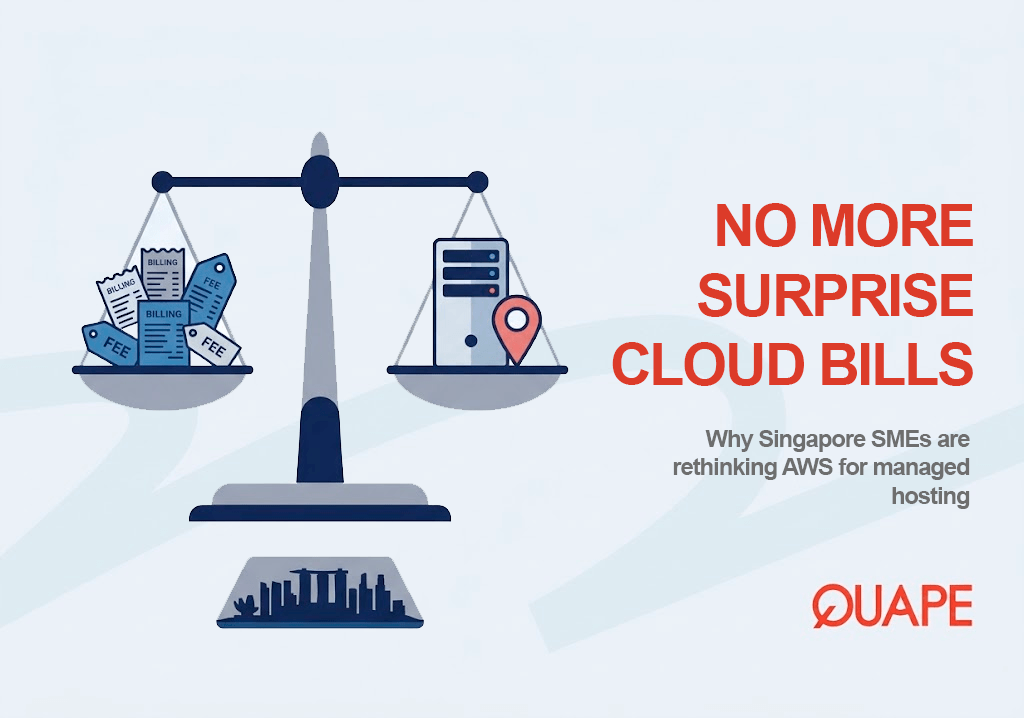
For Singapore SMEs running web applications, internal tools, or business workloads, Amazon Web Services offers genuine infrastructure scale but introduces a level of billing complexity and operational overhead that most organisations at this size are not equipped to manage. The gap between what AWS costs on paper and what it costs in practice, once egress fees, support tiers, and DevOps resourcing are included, is rarely closed without dedicated cloud expertise. This comparison is specifically for decision-makers who have outgrown shared hosting, need more control than a consumer-grade plan offers, and are now weighing whether hyperscale cloud is actually the right fit for their workload and their team. For Singapore and Southeast Asia SMEs in compliance-sensitive sectors such as finance, healthcare, legal, and retail, there is a meaningful alternative: a managed, fixed-price private cloud environment with Singapore data residency built in, not bolted on.
Amazon Web Services is the dominant force in global cloud infrastructure, and that dominance is earned. Its ecosystem depth, global reach, and service breadth give enterprises the tools to build almost anything at any scale. But scale is the operative word. AWS is optimised for organisations with the technical resources to navigate it. For a Singapore SME with 10 to 200 employees and no dedicated DevOps team, the platform’s strengths can quickly become friction points. Quape enters this comparison not as a feature-for-feature cloud replacement, but as a simpler, more predictable infrastructure model built specifically for the operational realities of regional SMEs.
Key takeaways
- AWS billing spans over 200 service dimensions. Egress fees, API call charges, and support tier costs consistently cause SME cloud bills to exceed initial estimates.
- According to Flexera’s annual cloud report, organisations waste an estimated 28 to 32% of cloud spend due to overprovisioning, idle resources, and poor cost visibility.
- AWS’s free support tier is limited to community forums. Meaningful technical assistance starts at approximately $100 per month, separate from infrastructure costs.
- Multi-region architecture is AWS’s default. Locking data to Singapore for PDPA compliance requires deliberate configuration that many SMEs skip or miss.
- Quape provides fixed monthly pricing with no usage-based variables, so finance teams can budget accurately without a cloud cost management tool.
- 24/7 DevOps engineering support is included in Quape’s plans, covering infrastructure management directly rather than routing through documentation or tiered queues.
- Quape’s Singapore TIA-942 data center provides PDPA-aligned data residency by default, with no additional configuration required.
- For SMEs that have outgrown shared hosting but do not need the full complexity of hyperscale cloud, a managed VPS or dedicated server model offers a more practical fit.
Why “AWS Alternative Singapore” Is a Growing Search Among SMEs
The public cloud services market exceeded $500 billion annually and continues to grow at double digits, which has dramatically increased the number of services, pricing structures, and compliance obligations that organisations must navigate. For large enterprises with dedicated cloud architects and FinOps teams, that complexity is manageable. For Singapore SMEs, it often is not.
Three specific pressures are driving regional SMEs to reconsider AWS. The first is billing unpredictability: cloud costs that expand month-over-month without corresponding growth in business output. The second is operational burden: the hidden cost of the DevOps expertise required to configure and maintain a cloud environment correctly. The third is regulatory alignment: as data localisation and compliance obligations increase across Southeast Asia, the multi-region default of hyperscale cloud creates configuration risk that smaller teams are not positioned to audit consistently. According to IDC, data localisation and regulatory compliance rank among the top three concerns for enterprises adopting cloud infrastructure in Southeast Asia, and that pressure is even more acute for SMEs without dedicated compliance personnel.
What AWS Gets Right for Growing Digital Businesses
Before building a case for an alternative, it is worth being direct about what AWS does well, because it genuinely does some things at a level no regional provider can match.
Breadth of services and ecosystem depth
AWS spans IaaS, PaaS, and a vast ecosystem of managed services covering compute, databases, machine learning, security tooling, content delivery, and more. For organisations building complex, multi-service architectures, that breadth eliminates the need for third-party integrations and enables tight, native service coordination. The AWS Marketplace further extends this with thousands of pre-configured software solutions deployable in minutes.
On-demand scaling and global infrastructure reach
Auto scaling on AWS allows workloads to expand and contract in response to real-time demand, without pre-provisioning capacity. For businesses with highly variable traffic, seasonal spikes, or rapid growth trajectories, this elasticity removes infrastructure as a constraint. AWS also operates across 30-plus geographic regions, which matters for businesses that serve customers across multiple countries and require low-latency access points in each market. As noted by NIST, cloud computing’s on-demand self-service and rapid elasticity are genuine technical advantages that enable dynamic resource allocation without provider intervention.
Where AWS Starts to Break Down for Singapore SMEs
Billing complexity and the reality of unpredictable costs
AWS pricing operates across compute, storage, network transfer, API requests, and dozens of ancillary services, each with its own rate card. Pay-as-you-go pricing sounds efficient until you realise that costs scale not only with compute usage but with network egress, storage operations, data transfer between availability zones, and the volume of API calls made by your application. Small architectural changes, such as adding a caching layer or enabling cross-region replication, can produce significant monthly cost increases that were not part of the original budget. Flexera’s research found that organisations waste an estimated 28 to 32% of their cloud spend due to overprovisioning and idle resources, a problem that compounds when there is no dedicated person monitoring it.
Hidden operational costs: DevOps, support, and time
Running AWS correctly requires cloud architecture knowledge that most SMEs do not have in-house. Configuring IAM policies, setting up VPCs, managing security groups, and optimising resource allocation all require ongoing DevOps expertise. The OECD notes that SMEs often lack dedicated IT and cybersecurity personnel, which increases their reliance on managed services or external expertise. When that expertise is not available internally, businesses either hire it at significant cost, contract it out, or leave the infrastructure partially misconfigured. AWS’s own support tiers reflect this: the free Developer plan offers email support with response times measured in hours, while the Business plan, which includes 24/7 phone and chat access, starts at $100 per month or a percentage of monthly usage, whichever is higher.
Data residency risks without explicit configuration
AWS defaults to distributing data across its global infrastructure. For a Singapore company subject to the Personal Data Protection Act, that default creates compliance risk unless the team actively configures region-locking, audits data flows, and ensures that cross-border transfers meet the PDPC’s requirements. The Personal Data Protection Commission requires organisations to implement safeguards for cross-border data transfers, including contractual protections and transfer impact assessments. For a small operations team without a dedicated privacy officer, that is a meaningful compliance burden that rarely gets the attention it requires.
Performance variability in shared cloud environments
AWS runs on a virtualised shared cloud model. Multi-tenant architecture means that physical server resources are distributed among multiple customers, and resource contention introduces performance variability that is difficult to predict or control. The noisy neighbour effect, where one tenant’s high-resource workload degrades performance for others on the same physical host, is a known characteristic of public cloud environments. For workloads that require consistent response times, such as customer-facing APIs, healthcare platforms, or transactional e-commerce applications, that variability creates reliability risk that is hard to quantify in advance.
The Shift Toward Predictable Private Cloud for SMEs
The appeal of a managed private cloud model for SMEs is not about getting more features than AWS. It is about getting the right infrastructure at a level of complexity that the organisation can actually operate. Fixed-price managed hosting aligns infrastructure cost with business planning cycles. It removes the need for a cloud cost management layer. And it shifts infrastructure responsibility to a provider whose service model is built around managing the environment, not billing for every interaction with it.
Why predictability matters more than infinite scalability
Most Singapore SMEs do not experience the kind of traffic volatility that makes auto-scaling essential. A legal firm’s document management platform, a healthcare clinic’s patient portal, or a retail brand’s e-commerce store typically operates within a foreseeable resource envelope. For these workloads, capacity planning against a fixed server specification is more practical than dynamic elasticity, because it removes a variable from the cost model without removing capability from the application.
How Quape Reframes Cloud Infrastructure for SMEs
Fixed monthly pricing without usage surprises
Quape’s VPS and dedicated server plans are priced as fixed monthly commitments. A plan at SGD 55 per month costs SGD 55 per month, regardless of bandwidth consumed within the included allocation, API calls made, or storage operations performed. For finance teams building annual IT budgets, that predictability removes a significant source of forecast risk that public cloud billing routinely introduces.
Built-in DevOps support instead of paid support tiers
Rather than charging separately for access to engineers, Quape includes 24/7 DevOps engineering support as part of the managed infrastructure service. The engineers manage the environment directly, which means they are not pointing customers to documentation or routing them through automated troubleshooting flows. For SMEs without internal cloud expertise, this changes the operational model: the infrastructure management function is outsourced to the provider, not left to the customer to figure out.
Fully managed infrastructure without cloud architecture overhead
Quape’s environment is fully managed, which means customers do not need to configure networking, security policies, or resource allocation independently. The complexity that AWS requires customers to handle, including VPC configuration, IAM roles, and region selection, is handled at the infrastructure level. SMEs without a dedicated in-house IT team can operate at the same infrastructure quality without needing to build internal cloud architecture capability first.
Singapore-based data residency by default (PDPA-aligned)
Quape’s infrastructure is housed in a Singapore TIA-942 data center. Data residency in Singapore is not a configuration option; it is the default state of every plan. For businesses in finance, healthcare, legal, or retail that handle personal data subject to the PDPA, that default eliminates the need for cross-border transfer impact assessments and removes the compliance risk that comes from multi-region cloud defaults. The Uptime Institute defines TIA-942 facilities as providing 99.982% availability with redundant capacity components, which means the Singapore data residency commitment does not come at the cost of reliability.
More predictable performance through capped server density
Quape operates on a capped server density model, which limits the number of virtual machines sharing each physical host. This directly addresses the noisy neighbour problem inherent in public cloud multi-tenant environments. For workloads requiring consistent response times, the resource allocation model provides more stable performance than a shared cloud environment where contention is an uncontrolled variable.
VPS vs Dedicated Servers: Choosing the Right AWS Alternative Architecture
For SMEs moving away from AWS, the choice between a virtual private server and a dedicated server depends primarily on workload size, recovery time requirements, and budget.
When VPS is the right fit for SME workloads
A managed VPS in Singapore suits most SME workloads: web applications, internal tools, growing e-commerce platforms, APIs, and development environments. Quape’s VPS plans run on NVMe SSD storage with KVM or XCP-NG virtualisation, starting from SGD 28 per month for the SG-Lite plan (2 vCPU, 4 GB RAM, 50 GB NVMe SSD) through to the SG-Ultra at SGD 220 per month (16 vCPU, 32 GB RAM, 600 GB NVMe SSD, 10 TB bandwidth at 1 Gbps). The virtualised architecture also enables faster recovery: in the event of a VPS failure, restoration typically takes 5 to 10 minutes, compared to several hours for dedicated hardware replacement.
When dedicated servers make more sense
For compute-intensive workloads, large databases, multi-tenant SaaS platforms, or applications with strict isolation requirements, a dedicated server in Singapore provides bare-metal performance with no resource sharing at the hardware level. Quape’s dedicated server range starts at SGD 200 per month for the BYOS-Intel configuration and scales to the DS-Pro Gold at SGD 850 per month, featuring dual Intel Xeon Gold processors, 512 GB DDR4 ECC RAM, and 500 Mbps shared bandwidth. All servers run on enterprise-grade hardware with dual PSU and are housed in Quape’s TIA-942 Singapore facility.
AWS vs Quape: A Practical Comparison Based on Real SME Constraints
| Dimension | AWS | Quape |
| Pricing model | Usage-based across 200+ service dimensions; egress, API, and support costs variable | Fixed monthly plans from SGD 28; no usage variables within plan allocation |
| Support | Free tier: forums only. Business support from ~$100/mo extra | 24/7 DevOps engineering support included in all plans |
| Required expertise | Cloud architect skills needed for correct configuration | Fully managed; no in-house DevOps required |
| Data residency | Multi-region default; Singapore lock-in requires explicit configuration | Singapore TIA-942 data center by default; PDPA-aligned |
| Performance model | Virtualised shared cloud; noisy neighbour risk | Capped server density; more consistent resource allocation |
| Recovery time | Varies by architecture and region failover configuration | VPS restoration in 5 to 10 minutes; dedicated server setup within 2 working days |
Cost predictability vs usage-based billing
The core financial trade-off is between flexibility and predictability. AWS’s pay-as-you-go model is efficient when usage is optimised by someone with the skills to do so. For SMEs without that expertise, it introduces ongoing cost variability that complicates budgeting. Quape’s fixed pricing removes that variable entirely, at the cost of elastic scalability beyond the plan tier.
Required in-house expertise vs managed simplicity
AWS shifts infrastructure responsibility to the customer. Quape holds it. For organisations with strong internal DevOps capability, AWS’s control is an advantage. For organisations without it, that control is a burden that manifests as misconfiguration risk, security gaps, and unoptimised resource spend.
Global flexibility vs local compliance simplicity
AWS’s global infrastructure supports multi-region deployment, which benefits businesses serving customers across multiple geographies. For a Singapore SME serving predominantly local or regional customers, that global reach adds architectural complexity without meaningful performance benefit, while introducing the data residency configuration requirements the PDPA demands.
Elastic scaling vs stable performance guarantees
Auto-scaling on AWS is genuinely useful for workloads with unpredictable or highly variable demand. For most SME workloads, where traffic patterns are relatively stable and growth is incremental, the ability to scale a VPS plan tier provides sufficient headroom without introducing the monitoring and automation overhead that elastic scaling requires to function correctly.
Who Should Choose AWS, and Who Should Not
When AWS still makes sense
AWS remains the right choice for organisations building for genuine hyperscale, deploying machine learning pipelines, running multi-region SaaS products, or operating workloads that require the full depth of AWS’s managed service ecosystem. If the team includes cloud architects and the workload genuinely demands elastic compute, AWS’s infrastructure is difficult to match at that level.
When an SME should consider a simpler alternative
If your organisation is running a web application, e-commerce store, internal business platform, or API backend, does not have a dedicated DevOps engineer, is budgeting against a predictable monthly IT cost, and needs Singapore data residency without manual configuration, then hyperscale cloud is solving a problem you do not have while charging you for infrastructure you cannot fully operate.
A More Practical Cloud Model for Singapore SMEs
AWS is the right infrastructure for the right organisation, but right-sizing that decision matters. For Singapore SMEs in finance, healthcare, legal, or retail that handle personal data, run consistent workloads, and need managed infrastructure support without building an internal cloud team, the trade-offs of hyperscale cloud rarely justify the complexity and cost variability it introduces. A fixed-price, fully managed, Singapore-based environment addresses the actual constraints these organisations face. For SMEs that prioritise predictable costs, local compliance, and hands-on infrastructure support without building an internal DevOps team, the more practical next step is to explore Quape’s VPS hosting plans, with dedicated server options available for higher-performance workloads.
Frequently asked questions
Can Quape VPS handle the same workloads as an AWS EC2 instance?
For most SME workloads including web applications, APIs, e-commerce platforms, and internal tools, yes. Quape’s VPS plans run on NVMe SSD with KVM virtualisation and EPYC processors, and internal benchmarks show strong performance relative to comparably priced public cloud compute. For workloads requiring auto-scaling across multiple regions or deep integration with managed AWS services like RDS, Lambda, or SageMaker, AWS remains the more capable environment.
Is Quape automatically PDPA compliant?
Quape’s infrastructure is housed in a Singapore TIA-942 data center, which means data residency in Singapore is the default state of every plan, with no additional configuration needed to meet that specific requirement. However, PDPA compliance is a broader obligation that also covers how your organisation collects, uses, and manages personal data at the application level. Infrastructure residency is a necessary condition, not a sufficient one on its own.
When does it actually make sense to stay on AWS?
AWS is genuinely the better choice for organisations running machine learning workloads, multi-region SaaS products, or architectures that depend on the breadth of AWS’s managed service ecosystem. If you have in-house cloud architecture capability and your workloads require elastic compute at scale, AWS’s infrastructure depth is difficult to replace. A managed VPS or dedicated server model is better suited for stable, predictable workloads where that ecosystem depth is not needed.
What happens if my workload grows beyond a VPS plan?
Quape offers a range of VPS tiers from SGD 28 to SGD 220 per month, covering 2 to 16 vCPU and 4 to 32 GB RAM. If workloads exceed VPS capacity, the dedicated server range provides bare-metal performance starting from SGD 200 per month. Both product tiers are managed by Quape’s DevOps team, so migration between tiers does not require the customer to rebuild the infrastructure independently.
Does Quape include backup and monitoring in VPS plans?
Yes. Quape’s VPS plans include daily backup and security monitoring as standard, alongside 24/7 DevOps engineering support. This contrasts with AWS, where backup configuration, monitoring setup, and support access each involve separate services and associated costs.
How does the noisy neighbour effect impact SME workloads on AWS?
In a public cloud multi-tenant environment, multiple customers share physical server resources, and a high-resource workload from one tenant can reduce available performance for others on the same host. For workloads requiring consistent response times, such as patient portals, transactional e-commerce platforms, or financial applications, this variability introduces reliability risk that is difficult to predict or contractually guarantee. Quape’s capped server density model limits the number of virtual machines per physical host, which reduces contention and improves performance consistency.
Can I migrate my existing AWS workload to Quape?
Yes. Quape’s DevOps engineering team supports migration from existing cloud or hosting environments. Since Quape VPS supports a wide range of Linux distributions including Ubuntu, AlmaLinux, and Debian, as well as Windows, most workloads currently running on AWS EC2 can be migrated without significant re-architecture. Contacting Quape’s team directly is the recommended starting point for a migration scoping conversation.